Part Two: Project Two: Exercise One: Detail and Tone

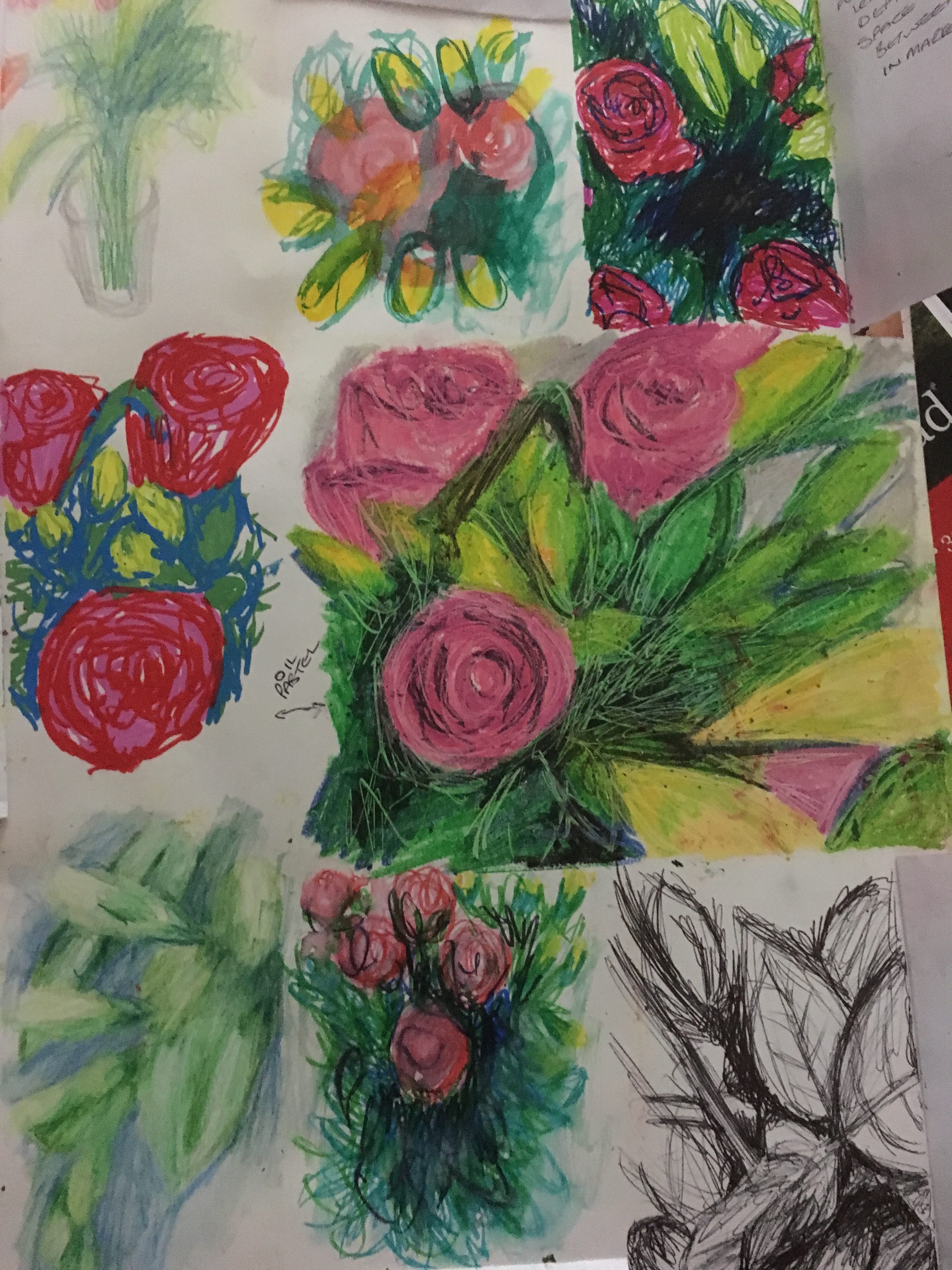
To begin this exercise, I decided to look closely at a bunch of flowers and use several different media to interpret the differing tonal ranges within them in my sketchbook. I decided not to be too precious about the marks I made, but to just try and recreate the flowers roughly as I wanted to investigate them more than draw them.

Observation of bunch of flowers in different mediums

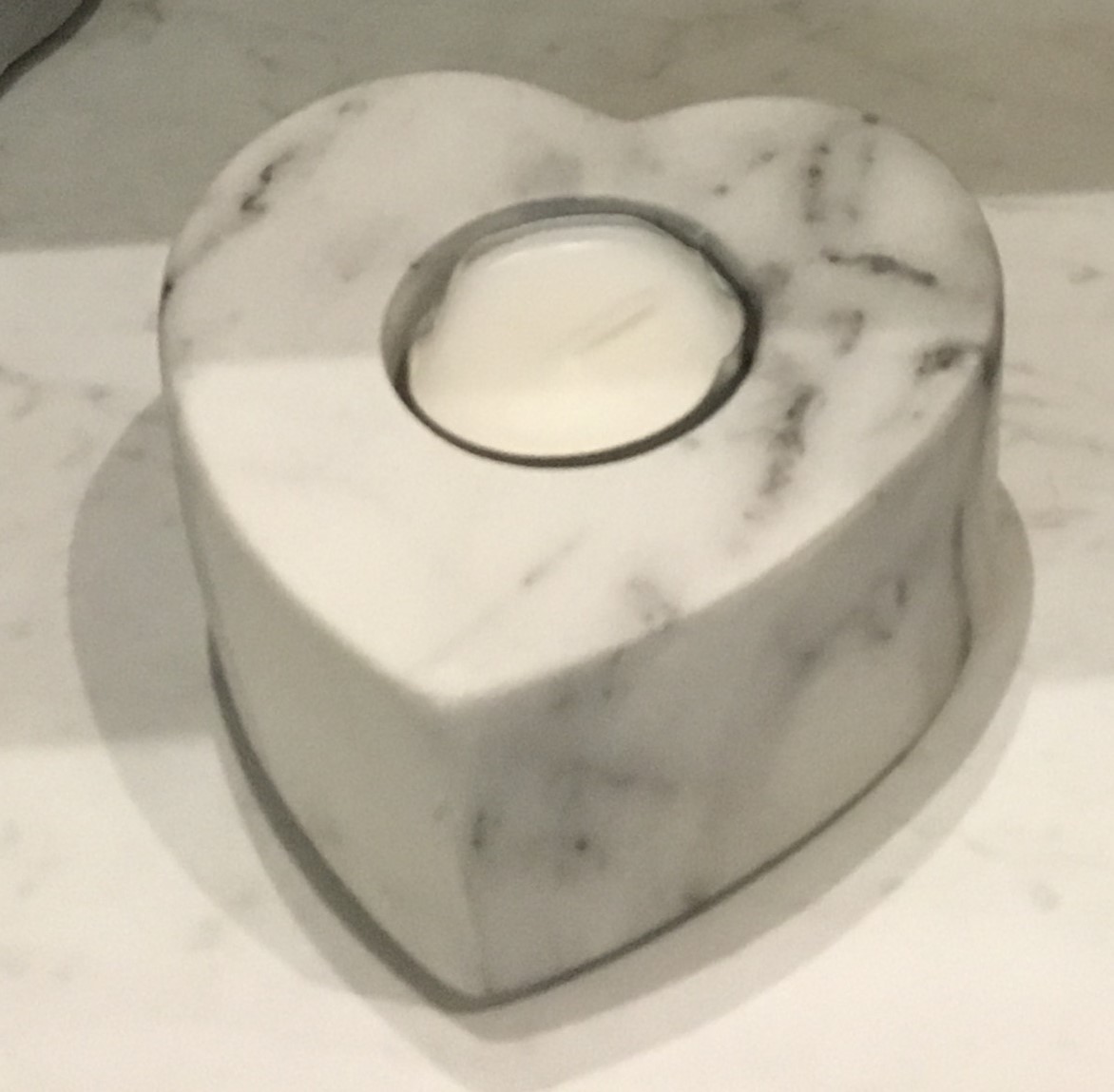
Whilst I was aware I was meant to be focusing on natural objects, I was drawn to the different areas of tone and differing areas of shadows overlapping each other due to several different lighting angles and also the marbling detail to the object.

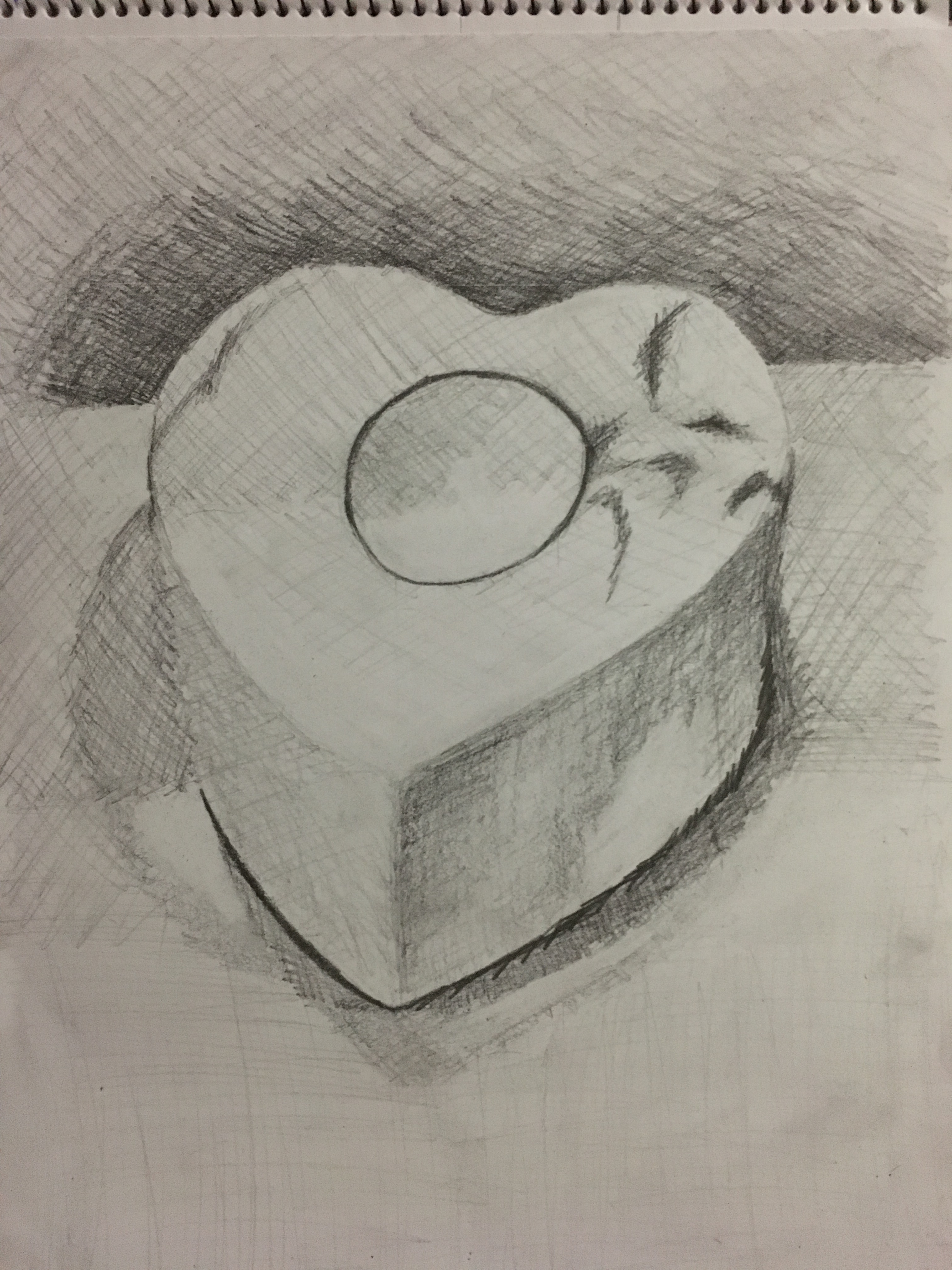
I created the piece very gradually and stayed rather delicate throughout, allowing patience and delicacy where I wouldn’t normally. After my tutor’s comments regarding my issues with perspective, I realised I needed to work on it somewhat. Whilst I do not think I have recreated the perspective completely accurately here, I am rather pleased with the overall shape as I do think there is a good depth to the shape. I began by putting in the darkest areas of tone with a 4B pencil (behind the object in the divide between the wall and shelf and also at the base of the object) and then gradually got lighter and lighter, moving my way gradually through the grades of pencils until I finally filled in the lightest areas of tone (the front top left of the holder and the shelf it is sitting on. I then used the putty rubber to work in some finer, lightest details to the object and the surface it sat on.

Reflection

I am glad I began the exercise by being experimental in my sketchbook. I think doing so allowed me to get the initial burst of energy out of my system, leaving me somewhat contented and able to relax into a more delicate piece.

I really enjoyed working from darkest to lightest and found it really did help to screw my eyes up to see the darkest areas. I found it quite foreign to begin with the darkest areas at first, but then began to rather enjoy it. As I said above, I think my perspective may have been off slightly, but overall I think I have improved slightly in this area. I also feel this will increase as the course progresses, but hopefully it is a step in the right direction. Having taken a step back since finishing the piece, I think I have overused the rubber somewhat too. I considered going back and adding the detail back in, but decided to leave it be and put it down to being a learning curve for future reference.

Part Two: Research Point: Today’s Artists’ use of Positive and Negative Space

What are Positive and Negative Space?

All pieces of art consist of positive and negative space. ‘Positive’ space is the area of a piece which contains understandable visual information; a person’s features, a flower’s petals, leaves and stem, and so on. ‘Negative’ space is the area of a piece which contains no understandable visual information, such as a background and is a very important tool in the construction of all pieces of art. The balance between positive and negative space is meant to be rather equal and complementary to one another.

Whilst artists may work in different ways (such as expressionism, cubism or surrealism), positive and negative space is always there. When you first think about creating a piece, you are presented with a blank page with no visual information at all. This is completely negative space and creates no visual stimuli whatsoever. If you were to draw the outline of a circle, the outline would become the positive space, with negative space both around and inside it. By adding tone by drawing or painting to the inside of the circle, you would be creating more positive space in the piece and changing the ball into a sphere or a hole, if coloured in completely and depending on the styles used. If detail was added to the outside of the circle, this would then become the positive space, leaving a hole inside the circle in the remaining negative space.

Artists, whether in drawing, painting or sculpting, have used positive and negative space throughout the history of time, a few examples of which are shown below.

Comparison of Works

I came across a few artists whose work really caught my eye, (as shown below) and compared their styles. The results of my findings are as shown below:

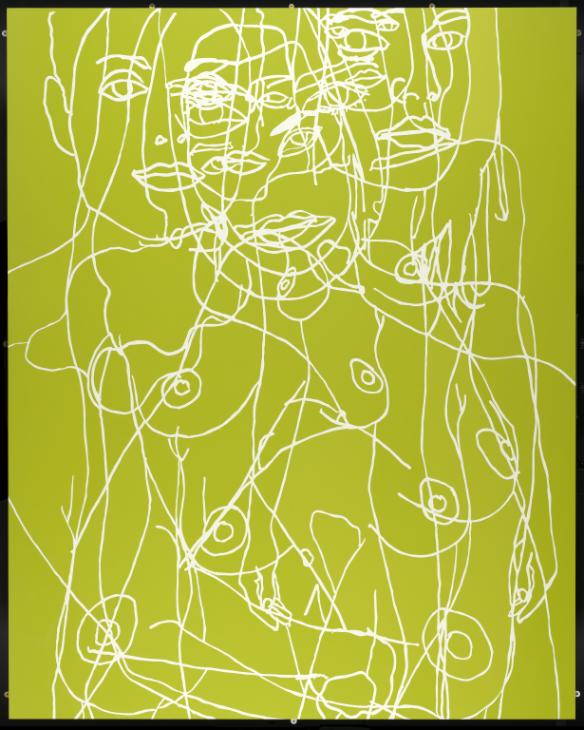
Fig. 1. Caulfield, P Pitcher (1981-1982) Fig. 2. Hume, G Waterpainting (1999) Fig. 3. Durrant, J Watercolour (2013) Fig. 4. Bar, N Pointed Sense (unknown)
Patrick Caulfield was a British artist who was renowned for his bold colours and simplified images.  His work has often been linked with the Pop Art movement, but he was not happy about this as he viewed his work as more formal in nature. Gary Hume is a British artist who is associated with the Young British Artists (‘YBA’) generation.  He works with only a small selection of colours and simplifies the visual information within his pieces.  Hume has made comment about how his pieces are all religious. Jessica Durrant is an American artist who specialises in the fashion, beauty and lifestyle genres and illustration.  She also uses positive and negative space regularly within her work.  Whilst I cannot find any religious connotations in her work, Durrant uses a very strong focus on the female form and in empowering women. Noma Bar is an Israeli graphic designer and illustrator who works with simplified images without excess visual information to avoid distraction and the strong use of positive and negative space.  Whilst I cannot see any references to religion in the pieces per se, I know Bar follows the Jewish religion, so I believe his upbringing in this religion will have some form of impact in his work, even if indirectly.
This piece appears somewhat differently to the rest.  Instead of using the negative space to imply an alternative image, this artist appears to use the negative space as part of the positive image by carefully placing certain shapes in precise locations so as to help the viewer’s brain create an imagined outline and thus the complete object.  This piece is fascinating in a completely different way to the others, but I think it very clever in its own unique way.  This piece was created using screen print on paper. This piece appears to be the silhouette of a woman (or several women, perhaps) who are moving either towards the ‘lens’ or away from it.  The piece is monochrome in colours and simply consists of what appears to be a background of green and a white continual line drawing of the woman / women layered on top of each other in white.  The piece was created using household paint on an aluminium panel, as is the artist’s preferred method. This piece appears to be the side view of a woman’s face in the negative space.  It appears as though the positive space in the piece is the watercoloured part as it is the only section with visual information, but yet is the background of the image.  I think it rather fascinating as I find myself constantly questioning which part of the piece is the positive and which the negative!  The piece was created with watercolours, but I also wonder whether the artist used masking fluid to ensure there was no bleeding of the colour. This piece appears to be computer-generated, having a green negative background and the positive foreground silhouette of a moving dog who is exiting through the right-hand side of the piece.  When looking again, what originally appeared to me as a negative background can actually be interpreted as a positive foreground of the silhouette of the front end of a moving dog entering the piece from the left-hand side.  This piece is fascinating to me as I am constantly pulled between the two silhouettes as to which is the ‘real’ animal.  Perhaps it is actually a pack of dogs / wolves etc caught mid-prowl?
The colour in this piece makes me consider that the contents of the pitcher must be hot or at least warm – perhaps coffee? The overall colouring of the piece is warm in nature, so perhaps it is actually misleading and the pitcher is actually filled with cold juice? In this piece, I can see the woman / women moving around the piece.  The movement appears chaotic and frantic to me due to the many overlapping lines. This piece reminds me of cold, running water and wonder if perhaps she is in the shower washing away her tribulations of the day? In this piece, I can hear a dog barking, imagine being able to stroke its fur and tail.  I imagine a very strong, confident dog.  The simplicity works rather well in the sense that a dog’s life is rather simple; he eats, drinks, sleeps… There are no worries for the average dog about working, paying bills etc.
This piece differs from the rest in the way it uses the negative space, allowing the mind to complete the outline of the pitcher, whereas the rest show the outline completely and do not require the viewer’s mind to fill the blanks.  Similar to Bar’s piece, the colours and shapes are made of solid blocks of colour. This piece is similar to Durrant’s piece as it seems to focus on women, showing an appreciation for their form, as well as only using two colours.  This piece is similar to Bar’s piece in the sense it has several perspectives instead of one single one. Again, this piece is similar to Hume’s piece as it focuses on women and also the contrast between the white of the page and the blue paint. Similar to Hume’s piece, this has more than one perspective; showing the front end and then the back end of a dog.  This piece differs from Durrant’s piece as it has only flat, solid colours, similar to that of Hume’s and Caulfield’s pieces.
I find the white space in this piece to be the main point of emphasis, but also rather confusing and frustrating as I cannot see the need for it to be there.  The background is a completely different colour, so this cut out space appears to be solid.  If trying to imagine holding the pitcher up, I can only imagine hitting something such as a solid piece of plastic or ceramic etc, which I find really frustrating.  I really just want to colour the section in to match the rest of the background.  Perhaps this was done by the artist on purpose to create such frustration? The points of emphasis in this piece are the lines used and the eyes, lips breasts of the woman / women. For me, the strongest point of emphasis to this piece is the divide between the positive and negative space; between the white space and the coloured space.  There are strong, dark features to the face in the eyes / brow and lips. The black in this piece is much bolder than the green, which is rather mellow, so is the main point of emphasis to this piece.
Due to the bold, solid shapes used in this piece, I cannot see any expressive marks here at all. This piece is full of expressive qualities in respect of the constant flow of lines and the mass of faces. The running colour and the hair in this piece provide quite a nice amount of expressive quality. Due to the solid shapes in this piece, there is not much in the way of expression, which appears only available in the quiffs of the fur.
Whilst I find the colours in this piece somewhat soothing to my eye, I am also increasingly frustrated due to the handle. I find this piece rather chaotic and frustrating and too much visual information for my liking. This piece makes me feel inspired and empowered as a woman.  However, I also feel somewhat sad; perhaps this is because I question what the character in the piece may have endured and what the ‘tears’ may represent. This piece also makes me feel emboldened as I cant help but feel as a member of the pack would; needed, on a mission, determined to continue their current mission, perhaps to find prey.
This piece is very successful in the fact it is able to request the viewer’s brain to fill the blanks due to the perfect placement of the shapes used.  As stated above, however, I do not like the space inside the handle and find it rather disappointing and frustrating. I think the successes of this piece are the contrast between the green and the white and the movement.  As stated above, I do not enjoy this piece as much as some of the others as the eye is pulled in too many directions all at once and I find it rather confusing and chaotic. I really like the outline and separation of the two sections in this piece, as well as the contrast between the two.  However, I think the several spots of paint on the face of the woman let the piece down somewhat.  I think it would be better if it had been created without this inclusion. This piece offers a strong double-meaning within it and also the movement.  However, I think the face is too large for the rest of the body.
For this piece, I would use markers and collage on coloured paper. If I were to recreate this piece, I would use masking fluid with watercolours acrylic or ink creating an overlay before removing the masking fluid. For this piece, I would use ink over masking fluid.  Whilst I know this piece was created with watercolours, I would be interested to see what results could be achieved using the same method but with inks. For this, I would use a black marker on a muted coloured page.

Experimentation

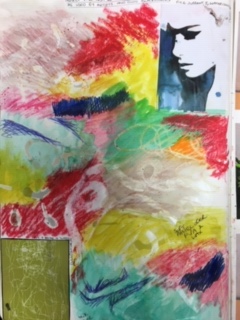
I decided to experiment in my sketchbook in different media with the concept of positive and negative space.

Experimentation with Positive and Negative Space

I first tried to use PVA glue and the wax of a candle to create the ‘negative’ space when layering over the different media.  I was rather disappointed with the PVA glue as it did not provide as much resistance as I thought it would.  If anything, it reminded me of the trail a snail would leave; rather shimmery in appearance.  It was interesting, however, as it seemed like a hidden message within the piece which only became visible when looked at in a certain way – this started to remind me of my research into Redon’s Two Trees and the fact that the average viewer would generally glance at the piece quickly and then move on without giving enough time to actually see the hidden message.  I think I may potentially use this again moving forward; perhaps to show a hidden message, or maybe to add a sort of pearlized shimmer to certain objects.  The candle wax, however, provided a fantastic amount of colour separation and a clear negative space, however, the grease in it seemed to ruin the page on the other side of my sketchbook in places and due to the fact it reset rather quickly with cooling, I think I could only really use this method on rather thick material or material I do not wish to use the other side of and only for places I wish there to be expressive marks made as the lack of control is to temperamental to try and use for a specific shape or object.

I then came across something called masking fluid, which I had never heard of before.  I decided to experiment with it by drawing around my hand on the page over the different mediums and then adding a wash of diluted ink over the top before removing the masking fluid to reveal the surface underneath.

Reflection

I think I have found a real appreciation for the positive and negative space within artwork and how important a role both play in all pieces. I’ve realised there is a delicate balance between the two and getting them both right can lead to phenomenal results.

I was actually really pleased with how easily the masking fluid was removed and how crisp the lines were underneath in my experiment.  This is definitely something I really want to use again in my future pieces and perhaps also my final piece for this part of the course.

NB: Citation for images used in my sketchbook can be found by clicking here.

List of Illustrations

Fig. 1. Caulfield, P (1981-1982) Pitcher [Screenprint on paper] At: https://www.tate.org.uk/art/artworks/caulfield-pitcher-p78308 (Accessed on 13 March 2019)

Fig. 2. Hume, G (1999) Water Painting [Household pain on aluminium panel] At: https://www.tate.org.uk/art/artworks/hume-water-painting-t07618 (Accessed on 19 March 2019)

Fig. 3.  Durrant, Jessica (2013) Watercolour [Watercolour paints] At: https://plus.google.com/photos/116570597784626887840/albums/5927011673564805793/5927011675196366658?pid=5927011675196366658&oid=116570597784626887840 (Accessed on 19 March 2019)

Fig. 4. Bar, N (unknown) Pointed Sense [Computer-generated] At: https://www.dutchuncle.co.uk/noma-bar-selected-images (Accessed on 20 March 2019)

Bibliography

Fussell, M (unknown) ‘Positive and Negative Space’ In The Virtual Instructor.com [online] At: https://thevirtualinstructor.com/positive-and-negative-space.html (accessed on 11 March 2019)

Tate (unknown) ‘Gary Hume born 1962’ In Tate.org [online] At: https://www.tate.org.uk/art/artists/gary-hume-2403 (Accessed on 11 March 2019)

Jessica Durrant (unknown) ‘’[online] At: http://jessicadurrant.com/about (Accessed on 12 March 2019)

Dutch Uncle (unknown) ‘’[online] At: https://www.dutchuncle.co.uk/noma-bar-selected-images (Accessed on 11 March 2019)

Wikipedia (2019) ‘’ [online] At: https://en.wikipedia.org/wiki/Noma_Bar (Accessed on 12 March 2019)

Tate (unknown) ‘’ [online] At: https://www.tate.org.uk/art/artworks/caulfield-pitcher-p78308 (Accessed on 13 March 2019)

Wikipedia (2019) ‘’ [online] At: https://en.wikipedia.org/wiki/Patrick_Caulfield (Accessed on 12 March 2019)

Wikipedia (2019) ‘’ [online] At: https://en.wikipedia.org/wiki/Gary_Hume (Accessed on 11 March 2019)

Part Two: Research Point: Still Life Genre

Still life, or nature morte in French, refers to where artists have created a piece of work where the subject matter is inanimate, whether it be man-made objects or organic objects and things which used to be alive.  Common items used for still life pieces include flowers, fruit and other household objects such as chairs, however, other items such as skulls and dead animals are also used to add a sinister touch to the work.

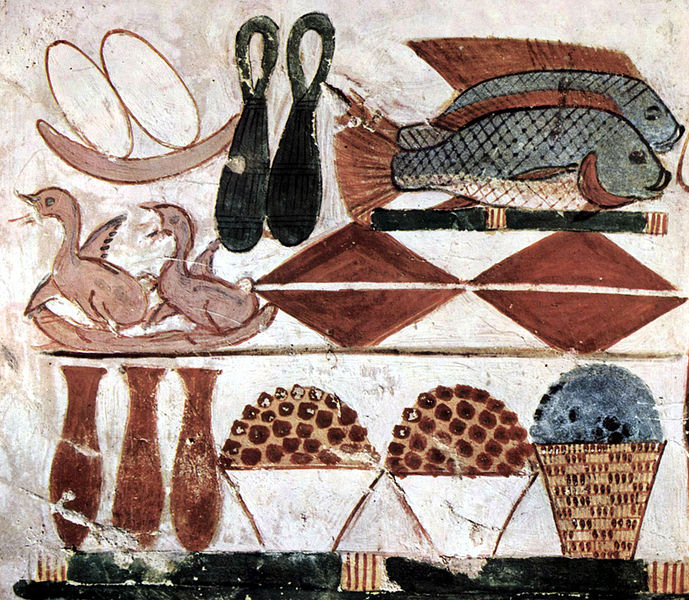
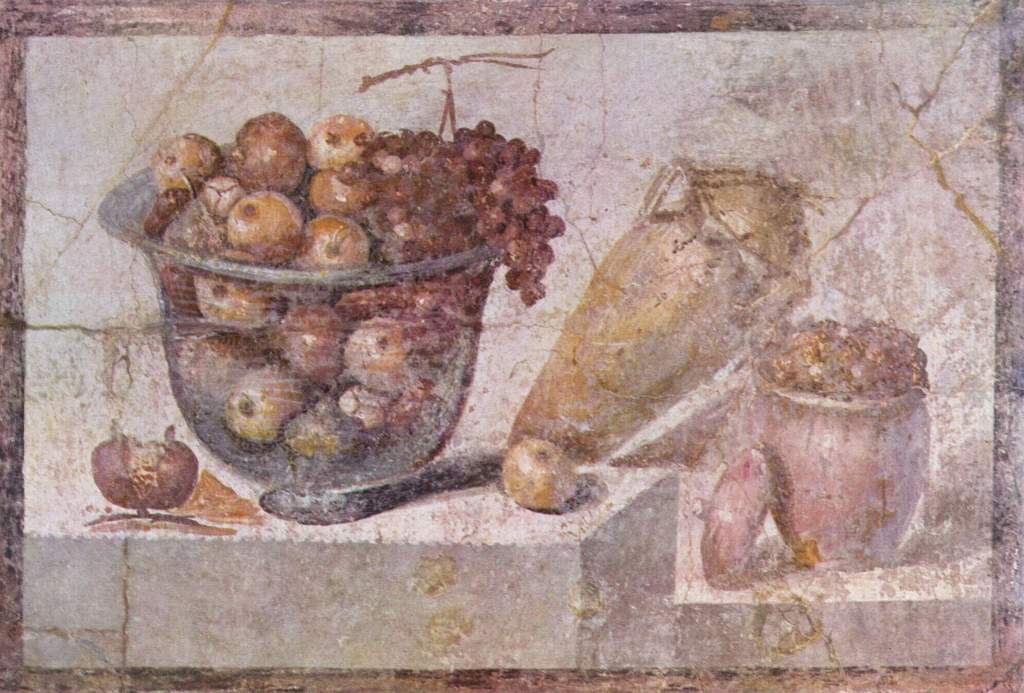
Still life has been used throughout history and notably by the Ancient Egyptians in the 15th Century BCE, who would paint food and meat at burial sites as an offering to the gods. The Greeks and Romans created still life pieces in mosaics and frescoes (a painting done in watercolours onto wet plaster so the colours become embedded during the drying process).

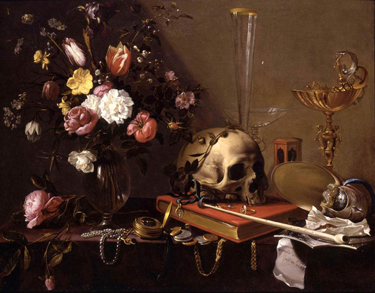
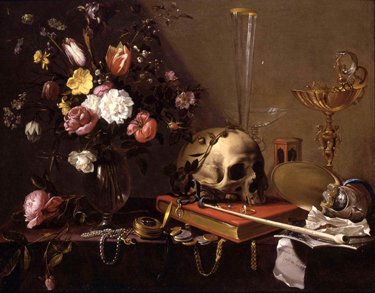
During the Renaissance (14th to 17th Century), flowers became a well-used item for still life pieces as artists were becoming more and more interested in recreating realistic imagery in their work as well as the use of colours. In the Middle Ages (around 1500AD to 1600AD), still life was used by artists for religious purposes as both symbols and as decoration around the border of manuscripts. The 17th Century also saw rise of the Dutch Golden Age and the interest in flowers develop with the creation of ‘vanitas’ works, which would focus on reminding the viewer of their own mortality and the fleetingness of time.

Fig. 3. Van Ultrecht, A Vanitas Still Life with a Bouquet and a Skull (1642)

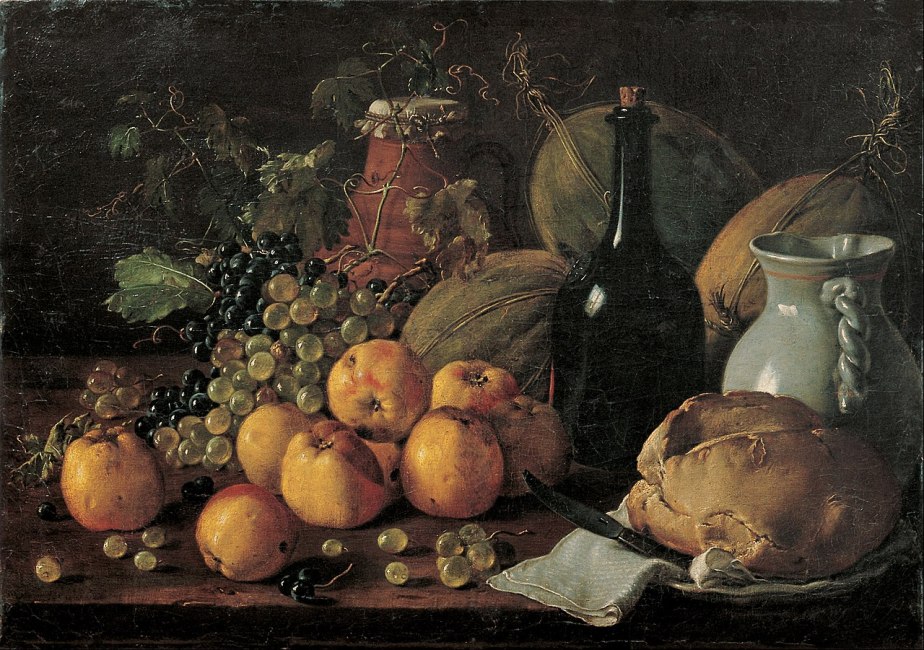
The 18th Century saw a rise in notable French artists whose focus in regard to still life was similar to that of vanitas works, but which would focus on the wealth and bounty of the aristocracy and would leave out the moral messages found within the vanitas pieces. Still life was seen as a lesser importance than religious and mythical depictions.

Fig. 4. Meléndez, L Still Life with Apples, Grapes, Melon, Bread, Jug and Bottle (circa 1771)

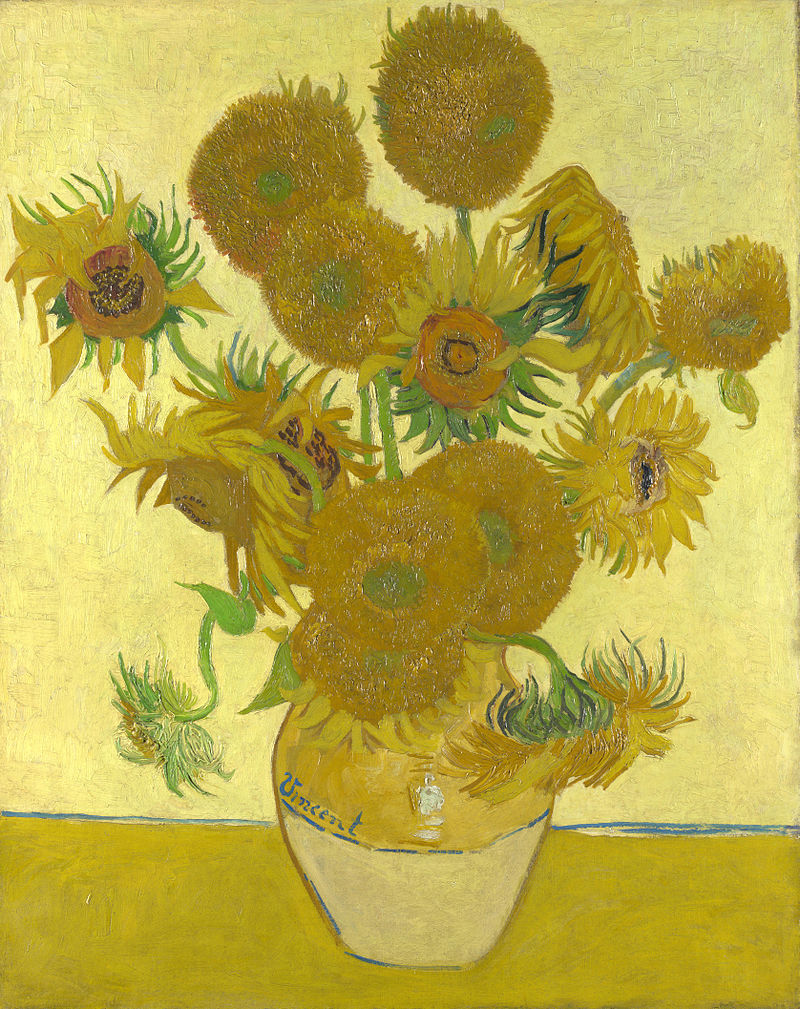
The 19th century brought about the Impressionists and Post-Impressionists who were more interested in experimenting with the vibrancy and exaggeration of colours and methods of applying paint as the invention of cameras had reduced the call for realistic painted pieces.

Fig. 5. Van Gogh, V Sunflowers or Vase with 15 Sunflowers (1888)

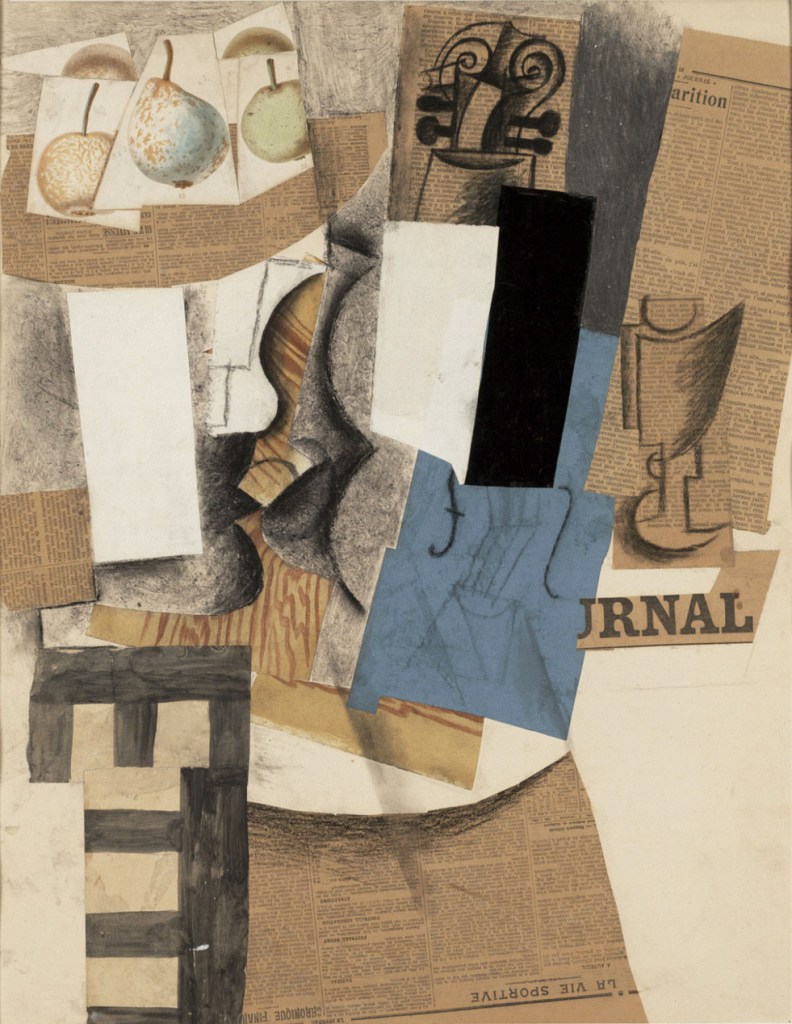
Fauvism (the emphasis of bold colours over realistic values) and Cubism (the deconstruction of objects into geometric and abstract shapes) was developed in the 20th Century.

Fig. 6. Picasso, P Compotier avec Fruits, Violon et Verre (Bowl with Fruit, Violin and Wineglass) (1913)

The 21st Century has seen the rise of many interpretations of still life pieces, with artists using such things as computer rendering and sculpture to show their personalities within their work.

Fig. 7. Tran, G A Completely Synthetic, Computer-Generated Still Life (2006)

Experimentation with Works Throughout History

I decided to compare a few of the pieces I found above from different times in history to their predecessors and successors, as well as two of the artists my tutor suggested in my feedback for Part One.  My findings are as shown below:

Pre-Twentieth Century

Fig. 3. Van Ulrecht, Vanitas Still Life with a Bouquet and a Skull (1642) Fig. 5. Van Gogh, V Sunflowers (1888) Fig. 8. Cezanne, P Curtain, Jug and Fruit Bowl (1893)
Flemish artist (from Antwerp).  Work created in Belgium.  Piece created when a new type of still life was emerging. Dutch artist during the Post-Impressionism stage. French artist.  Piece created in France during the Post-Impressionism era.  Cezanne’s work was later seen as the bridge between Impressionism and Cubism.
Piece consists of a vase of flowers, a human skull, gold and silver coins, several vases, a book and a pocket-watch. Piece consists of numerous sunflowers during various stages of their lives in a vase. Piece consists of a jug, curtain, a piece of material, fruit and a bowl.
The term ‘vanitas’ translates to ‘empty’.  These pieces were used by Christians to show how earthly goods are pointless and meaningless as we all will face our mortality regardless of our wealth or stature. There does not appear to be any religious significance to this piece that I can find, however, it is well known that van Gogh was raised in a very religious household. This piece does not appear to have any religious connotations; however, it does show fruit and a jug, which could be found within pieces depicting religious offerings to gods or even in pieces such as those depicting The Last Supper.
This piece causes me to smell the sweetness of the flowers, whilst also the stench of death.  I hear the clock ticking and the coins jangling, reminding us of our greed, indulgence and gluttony, as well as our eventual fates, whether as a direct or indirect result of our greed. Whilst initially I sense the freshness and happiness of the bright and colourful flowers, I am then filled with a sort of confusion I imagine the sweet taste of the apples, feel the weight and coldness of the jug and bowl, as well as the softness of the cloth.
Created with oil paints on canvas.  To replicate this piece in drawing, I would use markers for their bold but controlled colours and lines or pencil crayons for their delicacy. Created with oil paints on canvas.  To replicate this piece in drawing, I would use oil pastels for their bold colours and expressive mark-making qualities. Created with oil paints on canvas.  To replicate this piece in drawing, I would use oil pastels for their bold but expressive colours or pencil crayons for their delicacy.
The successes in this piece are that it is realistic, has a strong message to portray and has strong contrast in tonal values.   There is actually nothing in this piece I would change or improve as I think it is almost too realistic. I really like the stages of life depicted in the sunflowers, however, I am not a huge fan of the colour yellow, so this piece does not appeal to me as much as others.  I think the perspective of the vase is slightly off, sliding slightly too far down to the right of the piece and the blue is rather contrasting in comparison to the rest of the colours used in the piece.  Perhaps this was intentional, but it does take away some of the realism of the piece. The depth of the fruit and jug in this piece are fantastic and something I will try to replicate and consider going forward.  I think the perspective of the drawer and the table are slightly off.  However, this could be intentional – the table does appear old, so maybe parts of it do not stand as they would have when first created due to the wear and tear of time.
The perspective of this piece appears to be at eye level, looking forward at the banquet in front of me. This piece seems to use the Rule of Thirds, most notably in the divide between the table and the wall being the bottom horizontal line and the vase and tallest flowers being placed centrally within the composition. The perspective of this piece appears to be at eye level.  If looking at the piece with the Rule of Thirds in mind, the front of the table is along the lower horizontal line, the body of the objects in the centre of the piece and the tops of the jugs along the upper horizontal line.  The blue fabric is located in the left-most column.

Twentieth Century Onwards

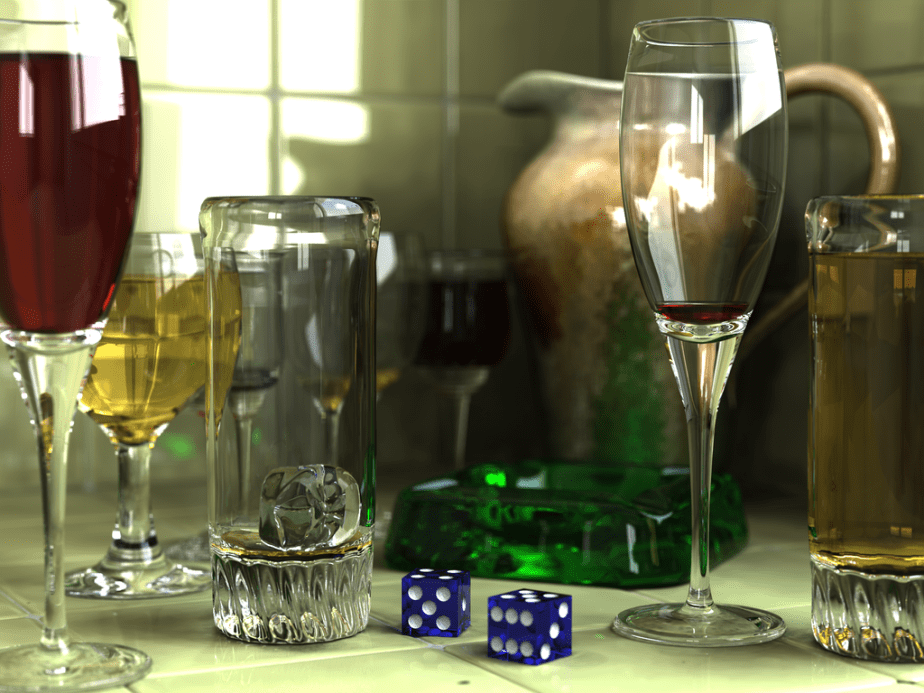
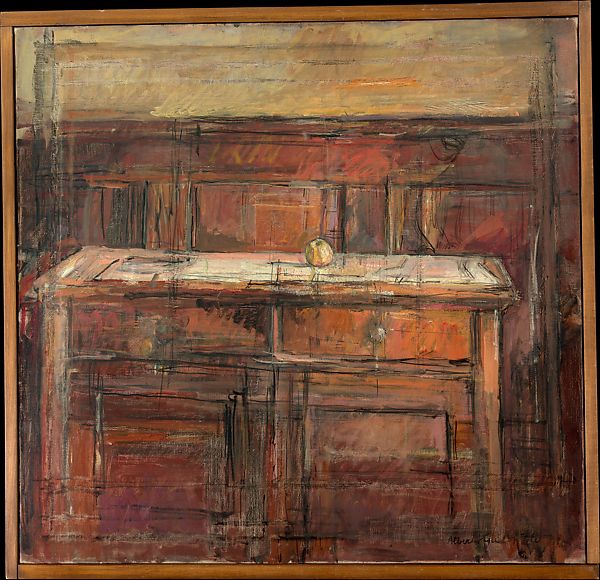
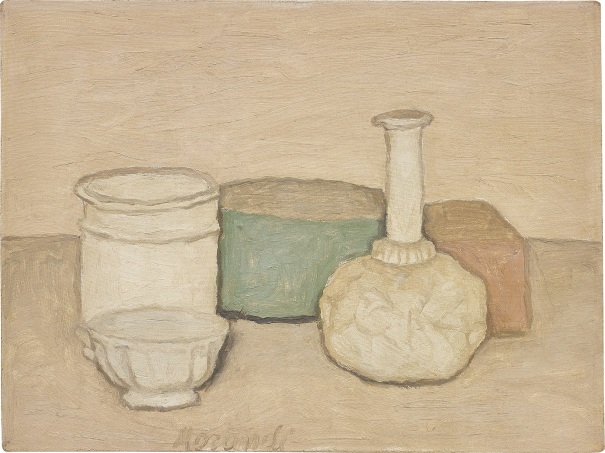
Fig. 9. Giocometti, A Still Life with an Apple (1937) Fig. 10. Morandi, G Natura Morta (1952) Fig.  7. Tran, G Glasses (2006)
Alberto Giocometti was a Swiss artist who was heavily influenced by Cubism and Realism.  He enjoyed debating philosophical questions relating to the human condition and phenomenon. Morandi, who was of Italian descent, was heavily influenced by the works of Paul Cezanne. Gilles Tran is a contemporary French artist who specialises in rendered art.
This piece consists of a single, almost insignificant apple sitting on a desk in what appears to be a study or an educational setting perhaps and was created with oil paint on a canvas.  This piece consists of simple blocks of colour and objects.  This piece was created with oil paint on a canvas. This piece consists of several different types of glass objects, such as drinking glasses and two dice.  This piece has been generated completely via a computer, using POV-Ray.
From this piece, I see a lot of darkness, moodiness and expressive marks.  I find the piece surprising as the focus appears to be on the apple, but it is also rather insubstantial within the piece.  I think the apple may represent the humbleness and delicate beauty of nature which is not always bold and intense enough to be deemed ‘beautiful’ instantly, whereas the desk (which could potentially have been made using the wood from the same tree which grew the apple) is bold, majestic and grand, indicating the greed and manmade ‘beauty’ which can usually be appreciated much sooner than that of simple, humble fruit. I find this piece to be calm and peaceful, having been created with a muted palette.  I like the simplicity of the objects and their gentle colouring.  I have struggled to find anything within this piece which represents any symbolisation, but feel the muted colours could perhaps represent a calm within the painter himself.  Perhaps he has tried to view the world as a child would; purely basic shapes and colours, leaving the intricacies and finer details of the objects / life for others to be concerned with. This piece firstly fills me with thirst due to all of the drinks!  Secondly, I am filled with amazement that this is actually a computer-generated image.  It is so realistic and well created, however, I do not think there is much expression in the piece except, perhaps, for the brightly coloured dice which stand out in the piece. Again, I cannot find any hidden symbology within this piece, but can only conclude the artist was very interested in recreating real life, almost as though considering himself a supreme being in his own right.
The perspective of this piece appears somewhat different to that of the other pieces, which seem to rest at the same level as the object, whereas this piece seems to focus on the objects from a distance.  However, it is somewhat similar as it does contain fruit. 
The piece also appears to contain something natural and something which is manmade.
Again, this piece appears to be created from a little distance from the objects, but still at the same sort of level as the objects.  These objects are all manmade and the artist has opted for a very muted palette as opposed to previously seen bold and intense colours and detail. Again, this piece appears to contain only manmade objects and focuses on bold, intense colours, but does have a few muted colours as well.  The perspective of the piece is once again rather close up and at the same level as the objects.
On first viewing this piece, my eye was drawn to the middle to the apple, then the desk as a whole and then to the drawer to the right as these all appear to have the most visual information and lighting. In this piece, my eye was naturally drawn to the middle of the piece and then up the neck of the bottle as this seemed to be where the information is mainly held and none of the colours really battle for the viewer’s attention. For this piece, my eye was instantly drawn to the bold, bright colouring of the dice, then to the green of the glass stem and then just around the rest of the piece generally.  Whilst there is what appears to be a glass of red wine in the piece, the red is not an intense shade and does not really battle for your attention in comparison to the blue and the green.
For this piece, I think the apple appears very fresh and ripe, whereas the wood of the desk appears to be old and almost an antique, which does counter the thought that maybe it could be from the same tree as the apple. The body of the bottle within this piece seems to remind me of crinkled paper and not so much of a bottle, even though it is clear as to what it is meant to be. The objects in this piece were almost too realistic.  I imagine a party taking place and, similar to a vanitas painting, the dice may represent the gamble with our lives we take when drinking in abundance and enjoying the intoxication of life’s frivolities.
The successes to this piece as the age of the wood and the depth created with the paint.  The placement of the apple, whilst almost insignificant, is done very well and intensifies the depth to the desk.  However, I feel the cupboard door has been overworked and is rather close to spoiling the piece. I think the successes of this piece are the muted colours and the depth created even with the lack of other details.  I do think the outline to the objects does let the piece down slightly as they are somewhat less realistic as a result and there is an apparent lack of shadow to the objects, which is somewhat strange I feel. I think the realism of this piece is fantastic, as are the shadows and reflected colours and light, however, due to it being so realistic, I do not think there is much personality to the piece or a fingerprint of the artists so to speak.
If I were to recreate this piece, I think I would use oil pastels due to the expressive nature of the marks made, as well as the boldness of the colours used. For this piece, I would use soft pastels or pencil crayons to recreate it due to their soft and calm nature, not to mention the ability to create a muted palette best of all the mediums I have experimented with so far, but also for their ability to create the finer lines for the outlines of the objects. Again, I would be tempted to use pencil crayons for this piece due to their ability for fine detail, but would also be tempted to use markers as they are also able to produce finer lines, but also would add the boldness of colour that the pencil crayons would lack.

Other Works Compared

List of Illustrations

Fig. 1. Maler der Grabkammer des Menna, Ackerschreiber des Königs, Szene Opfergaben (circa 1422-1411 BCE) [Mural] At: https://commons.wikimedia.org/wiki/File:Maler_der_Grabkammer_des_Menna_009.jpg (Accessed on 13 March 2019)

Fig. 2. Glass bowl of fruit and vases (around 70AD) [Roman wall painting in Pompeii] At: https://en.wikipedia.org/wiki/Still_life#/media/File:Pompejanischer_Maler_um_70_001.jpg (Accessed on 12 March 2019)

Fig. 3. Van Ultrecht, A (1642) Vanitas Still Life with a Bouquet and a Skull [Oil on canvas] At: https://www.timetrips.co.uk/still_life_history.htm and http://omeka.wustl.edu/omeka/exhibits/show/flowerstilllifes/17thand18thcenturies/vanitasstilllifewithflowersand (Accessed on 12 March 2019)

Fig. 4. Meléndez, L (circa 1771) Still Life with Apples, Grapes, Melons, Bread, Jug and Bottle [Oil on canvas] At: https://upload.wikimedia.org/wikipedia/commons/c/c1/Luis_Mel%C3%A9ndez_-_Still_Life_with_Apples%2C_Grapes%2C_Melons%2C_Bread%2C_Jug_and_Bottle_-_Google_Art_Project.jpg and https://commons.wikimedia.org/wiki/File:Luis_Mel%C3%A9ndez_-_Still_Life_with_Apples,_Grapes,_Melons,_Bread,_Jug_and_Bottle_-_Google_Art_Project.jpg  (Accessed on 14 March 2019)

Fig. 5. Van Gogh, V (1888) Sunflowers or Vase with Fifteen Sunflowers [Oil on canvas] At: https://en.wikipedia.org/wiki/Still_life and https://en.wikipedia.org/wiki/Sunflowers_(Van_Gogh_series) (Accessed on 12 March 2019)

Fig. 6. Picasso, P (1912) Compotier avec Fruits violon et verre [charcoal, chalk, watercolour, oil paint and course charcoal on papers and cardboard] At: https://en.wikipedia.org/wiki/Still_life#/media/File:Compotier_avec_fruits,_violon_et_verre.jpg and https://en.wikipedia.org/wiki/File:Compotier_avec_fruits,_violon_et_verre.jpg (Accessed on 12 March 2019)

Fig. 7. Tran, G (2006) A completely synthetic, computer generated still life [computer-generated] At: https://en.wikipedia.org/wiki/Still_life (Accessed on 12 March 2019)

Fig. 8. Cezanne, P (1893) Curtain, Jug and Fruit Bowl [Oil on Canvas] At: https://en.m.wikipedia.org/wiki/Rideau,_Cruchon_et_Compotier (Accessed on 12 March 2019)

Fig. 9. Giocometti, A (1937) Still Life with an Apple [Oil on canvas] At:
https://www.metmuseum.org/art/collection/search/492699 (Accessed on 13 March 2019)

Fig. 10.Morandi, G (1952) Natura Morta [Oil on canvas] At: https://www.metmuseum.org/art/collection/search/492699 (Accessed on 13 March 2019)

Bibliography

ArtNet (2018) ‘Phillips London’ [online] At:
http://www.artnet.com/artists/giorgio-morandi/natura-morta-X9x6QkJasHNGMKkespganw2 (Accessed on 13 March 2019)

My Modern Met (2018) ‘How Artists Have Kept Still Life Painting Alive Over Thousands of Years’ [online] At: https://mymodernmet.com/what-is-still-life-painting-definition/ (Accessed on 11 March 2019)

Omeka (Unknown) ‘WUSTL Digital Gateway Image Collections& Exhibitions: Vanitas Still Life with Flowers and Skull’ [online] At:
http://omeka.wustl.edu/omeka/exhibits/show/flowerstilllifes/17thand18thcenturies/vanitasstilllifewithflowersand (Accessed 13 March 2019)

Tate (unknown) ‘Giorgio Morandi’ [online] At:
https://www.tate.org.uk/art/artists/giorgio-morandi-1660 (Accessed on 13 March 2019)

Tate (unknown) ‘Still Life’ [online] At: https://www.tate.org.uk/art/art-terms/s/still-life (Accessed on 11 March 2019)

The Met (2019) ‘Still Life with an Apple, 1937’ [online] At:
https://www.metmuseum.org/art/collection/search/492699 (Accessed on 14 March 2019)

Time Trips (unknown) ‘Still Life: A History’ [online] At: https://www.timetrips.co.uk/still_life_history.htm (Accessed on 11 March 2019)

Wikipedia (2019) ‘Alberto Giacometti’ [online] At:
https://en.m.wikipedia.org/wiki/Alberto_Giacometti (Accessed on 13 March 2019)

Wikipedia (2018) ‘Adriaen van Utrecht’ [online] At:
https://en.m.wikipedia.org/wiki/Adriaen_van_Utrecht (Accessed on 13 March 2019)

Wikipedia (2019) ‘Gilles Tran’ [online] At:
https://en.m.wikipedia.org/wiki/Gilles_Tran (Accessed on 13 March 2019)

Wikipedia (2019) ‘Paul Cezanne’ [online] At:
https://en.m.wikipedia.org/wiki/Paul_C%C3%A9zanne (Accessed on 13 March 2019)

Wikipedia (2019) ‘Rideau, Cruchon et Compotier’ [online] At:https://en.m.wikipedia.org/wiki/Rideau,_Cruchon_et_Compotier (Accessed on 13 March 2019)

Wikipedia (2019) ‘Still Life’ [online] At: https://en.wikipedia.org/wiki/Still_life (Accessed on 11 March 2019)

Wikipedia (2019) ‘Sunflowers (Van Gogh Series)’ [online] At:
https://en.m.wikipedia.org/wiki/Sunflowers_(Van_Gogh_series) (Accessed on 12 March 2019)

Wikipedia (2019) ‘Vanitas’ [online] At: https://en.m.wikipedia.org/wiki/Vanitas (Accessed on 13 March 2019)

Wikipedia (2019) ‘Vincent van Gogh’ [online] At:
https://en.m.wikipedia.org/wiki/Vincent_van_Gogh (Accessed on 12 March 2019)

Part Two: Project One: Composition Research

Reason for Research

Composition is mentioned within this part of the course, so I decided to do a little research of my own to enrich the actual Research Point for this project, which requires me to look at and compare approaches of traditional and contemporary artists in their still life pieces so I would have a better understanding of what I should be questioning.

Findings

Composition is the arrangement of objects and their placement on the canvas in such a manner as to be both aesthetically pleasing to the artist, but also the viewer.  Composition has been a key part of all artwork throughout history, whether to increase the sense of balance in the piece or to work against it and, although our course manual advises there are no specific rules to follow, I found that some artists do, indeed,  follow some basic instruction or attempt to challenge the ‘rules’ others may generally follow, the ideas of which I will explain below:

Rules of Composition

There are several rules artists have followed throughout history to improve their responsiveness to the viewer.  Some of these rules (notably ones I wish to look into further in the future) are:

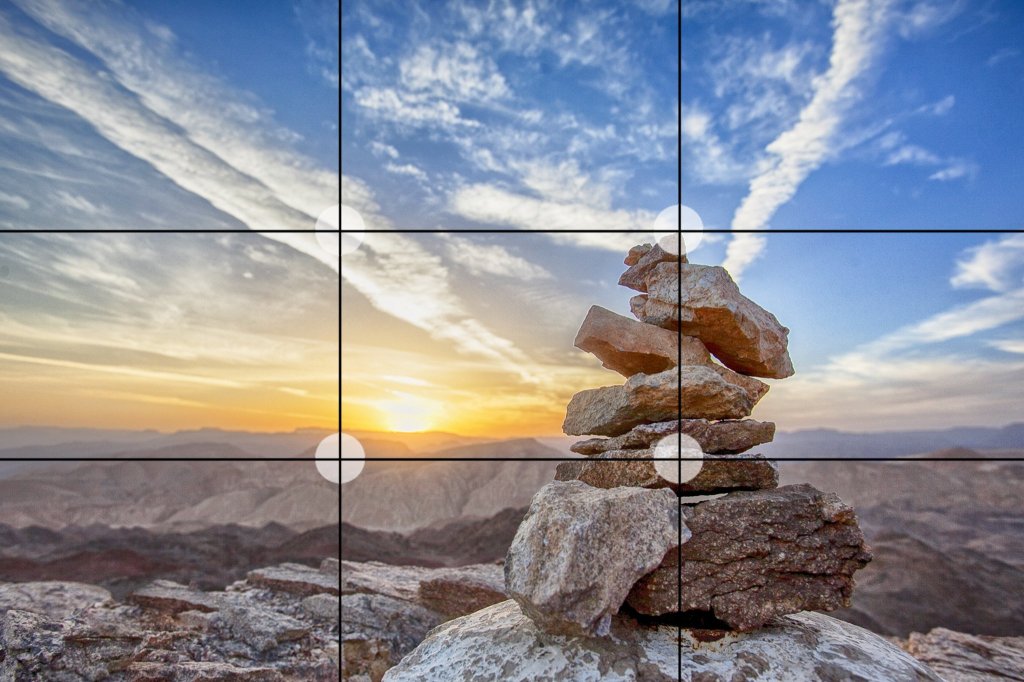
Rule of Thirds

Fig. 1.  Rule of Thirds (unknown)

This rule means dividing the page into nine equal squares / rectangles.  Images are then placed on or close to vertical and horizontal lines as these are meant to be the most aesthetically pleasing to the viewer.

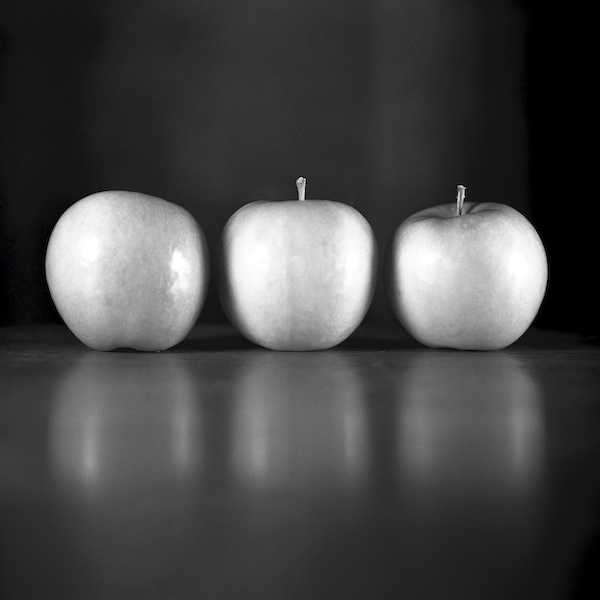
Rule of Odds

Fig. 2. Rule of Odds (unknown)

It is thought that uneven numbers of objects are more pleasing to the eye than even numbers. 

Triangles have also been used in many pieces throughout history due to their uneven number of sides.  Triangles may be included in art as such things as apex roofs or even a group of three people sitting together in a hypothetical triangle shape.

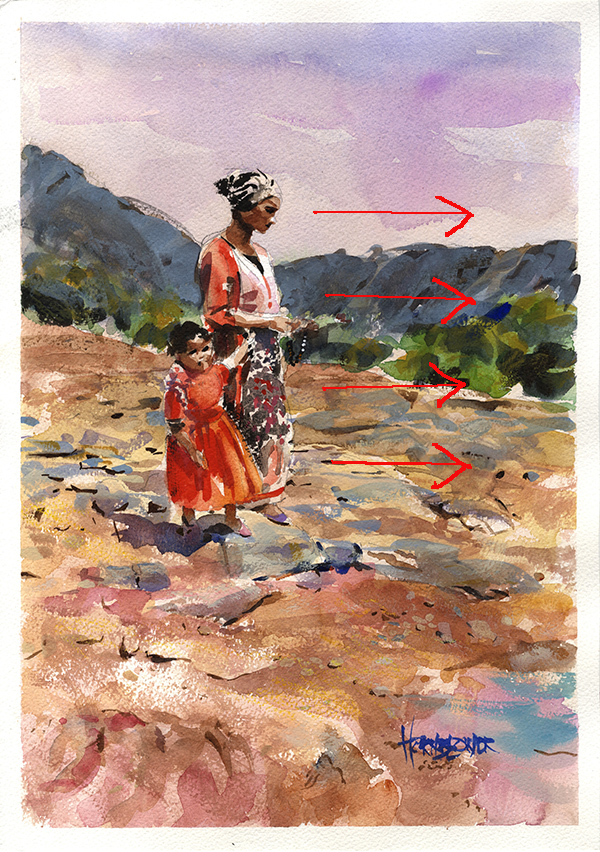
Rule of Space

Fig. 3. Hornblower, K Rule of Space (2016)

This rule is used when the artist wishes the viewer’s focus to be drawn in a specific way or to create the idea of movement such as the subject of the painting looking towards a certain direction with a lot of open space toward the same direction or the subject’s eyes following the viewer as they move around the room.

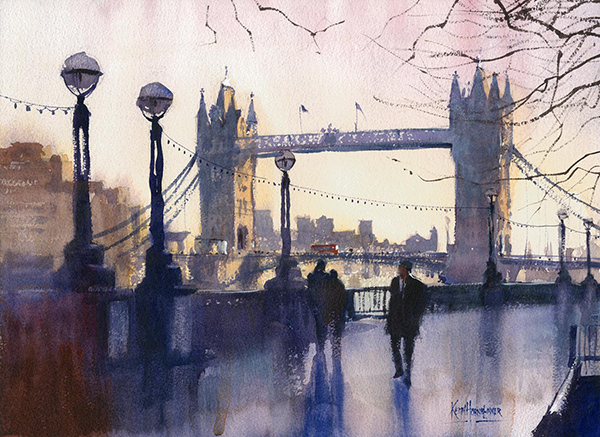
Simplification


Fig. 4. Hornblower, K Simplification (unknown)

I quite like this rule and believe I have used it quite regularly myself already without knowing the significance.  Being someone who does not really enjoy fine detail within their work, I tend to simplify backgrounds and other details of my work (such as simplifying writing and other finer details) anyway.

Geometry and Symmetry

Fig. 5. Niaz Composition with Cloud (2008)

This is another rule I think I use somewhat without realising within my work.  I rather enjoy symmetry within my pieces, but also enjoy challenging this (sometimes without meaning to if I haven’t measured my objects out correctly before beginning working into them and they then run off the page in places).

Experiments

I decided to carry out some quick experiments with some of the rules and composition in general within my sketchbook, as shown below:

Reflection

I find the whole concept of ‘rules’ rather daunting and understand why the course implies there aren’t any formal rules, but I have found that some of them do actually help me when considering how I want to display my pieces. This is definitely something I will try and consider moving forward, specifically the Rule of Thirds and the Rule of Odds. I think concentrating on too many of these ‘rules’ at once may become overwhelming and lead to a bit of a messy and overly complex composition.

NB: Citation for images used in my sketchbook can be found by clicking here.

List of Illustrations

Fig. 1. Rule of Thirds Landscape (unknown) [Photograph] At: https://pixelstrobist.com/rule-of-thirds/ (Accessed on 15 March 2019)

Fig. 2. Rule of Odds (unknown) [Photograph] At: http://compositionstudy.com/rule-of-odds/ (Accessed on 15 March 2019)

Fig. 3.  Hornblower, K Rule of Space (unknown) [Watercolour painting] At: https://keithhornblower.wordpress.com/tag/painting-technique/ (Accessed on 15 March 2019)

Fig. 4. Hornblower, K Simplify! (unknown)[Watercolour painting] At: https://keithhornblower.wordpress.com/tag/painting-technique/ (Accessed on 15 March 2019)

Fig. 5. Niaz Composition with Cloud (2007) At: https://en.wikipedia.org/wiki/File:Composition_with_cloud.JPG (Accessed on 15 March 2019)

Bibliography

Naghi, L (2017) ‘Rule of Thirds’ In: Pixelstrobist.com [Online] At: https://pixelstrobist.com/rule-of-thirds/ (Accessed on 15 March 2019)

‘Rule of Odds: Three’s Company’ In: Composition Study.com [Online] At: http://compositionstudy.com/rule-of-odds/ (Accessed on 15 March 2019)

Hornblower, K (2016) ‘Hornblower Watercolours: The Ramblings of an Artist’ In: Keith Hornblower.Wordpress.com [Online] At: https://keithhornblower.wordpress.com/tag/painting-technique/ (Accessed on 15 March 2019)

‘Composition (Visual Arts)’ In: Wikipedia.org At: https://en.wikipedia.org/wiki/Composition_(visual_arts) (Accessed on 15 March 2019)

Part Two: Intimacy – Preliminary Work

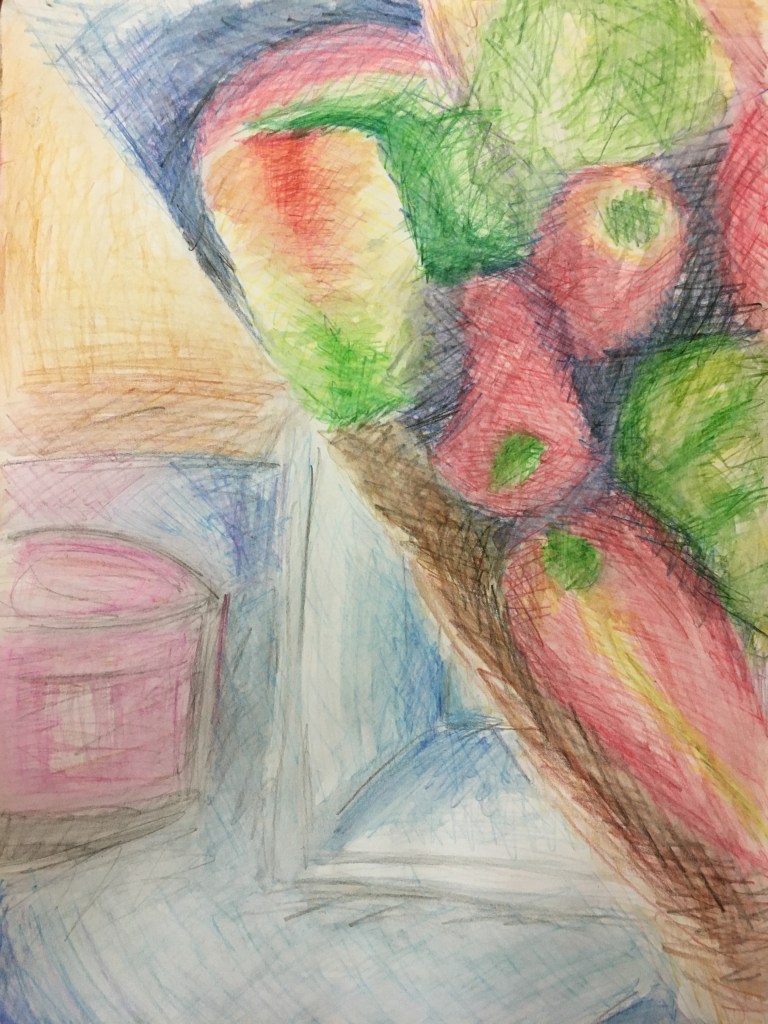
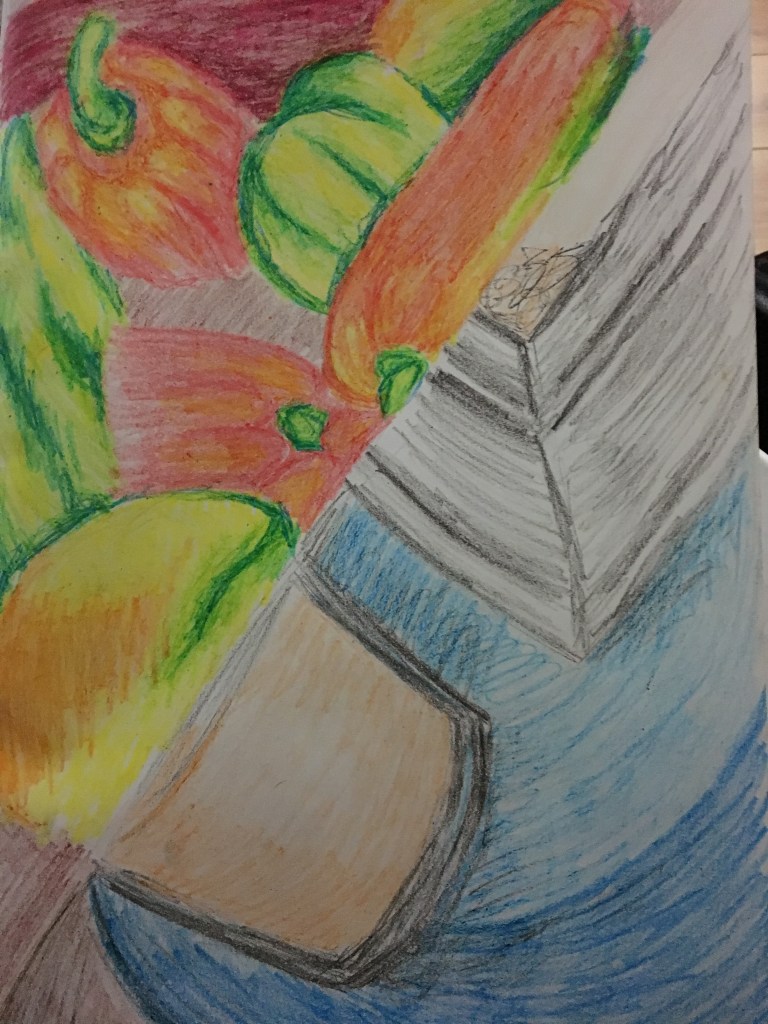
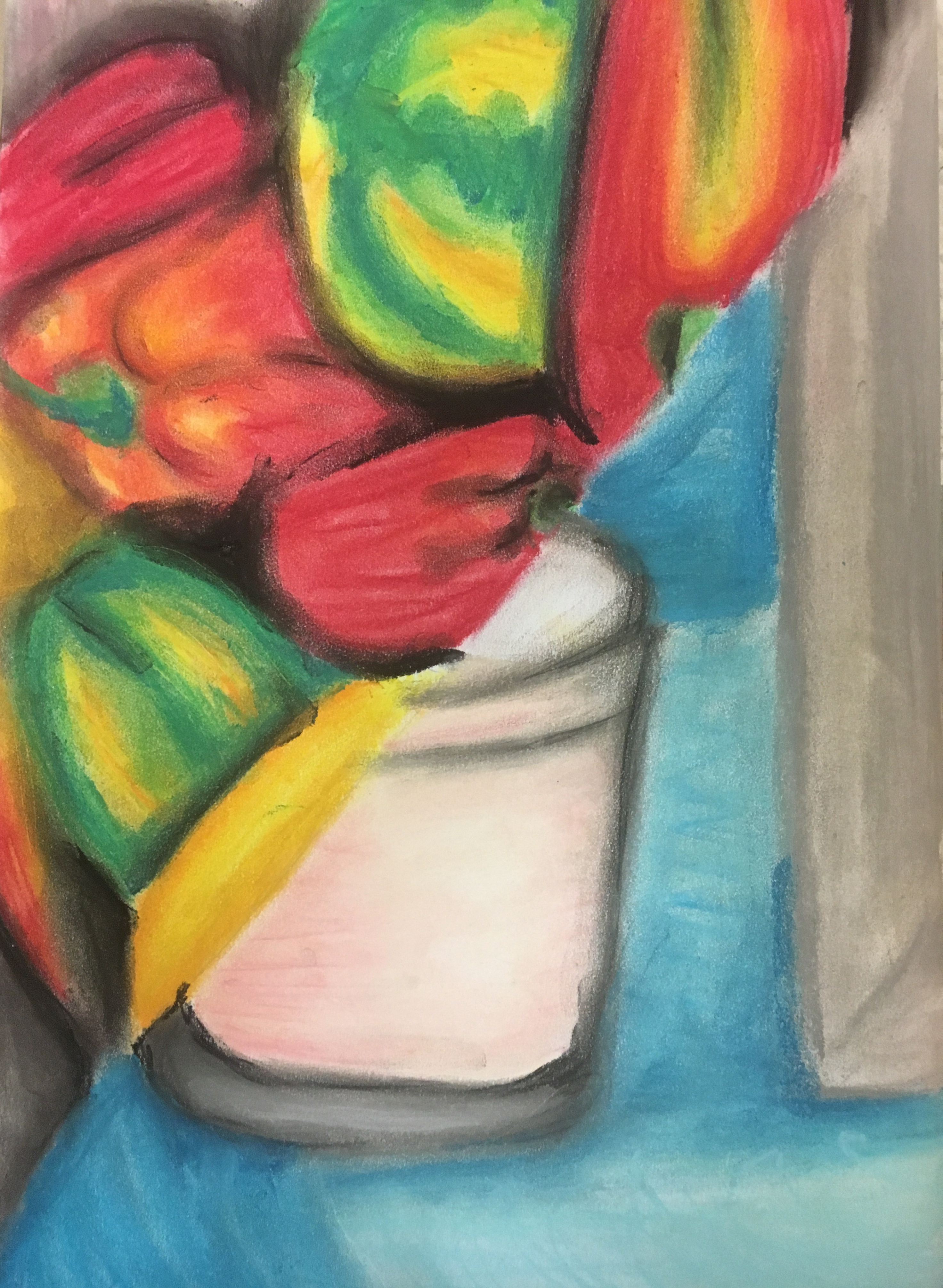
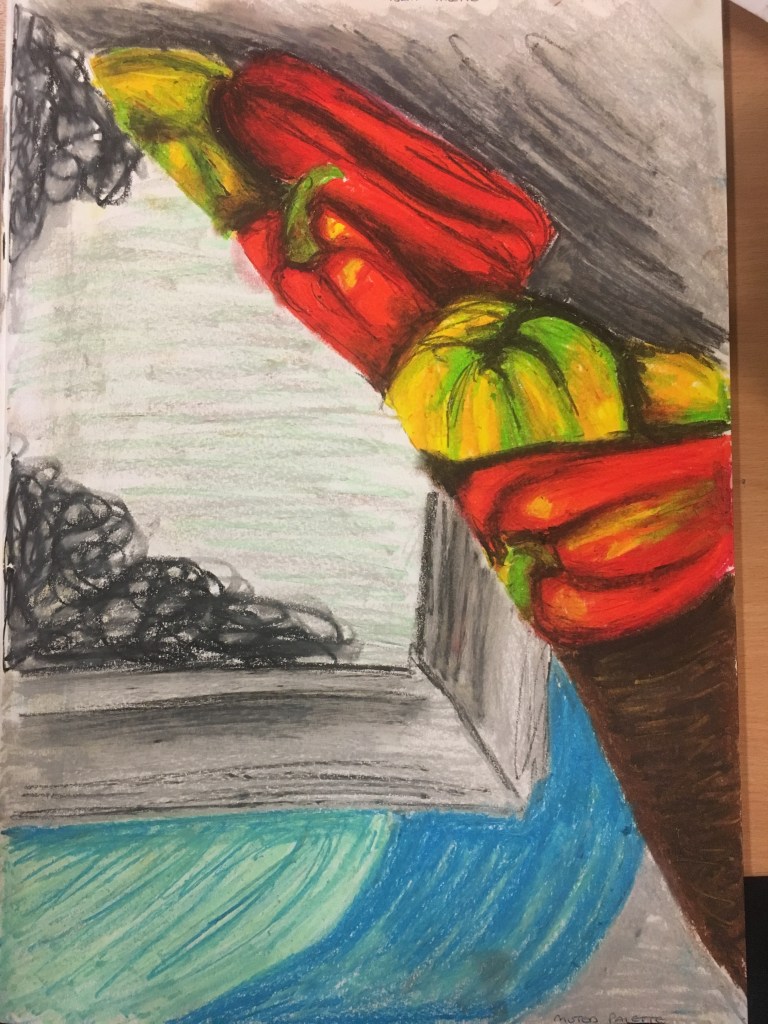
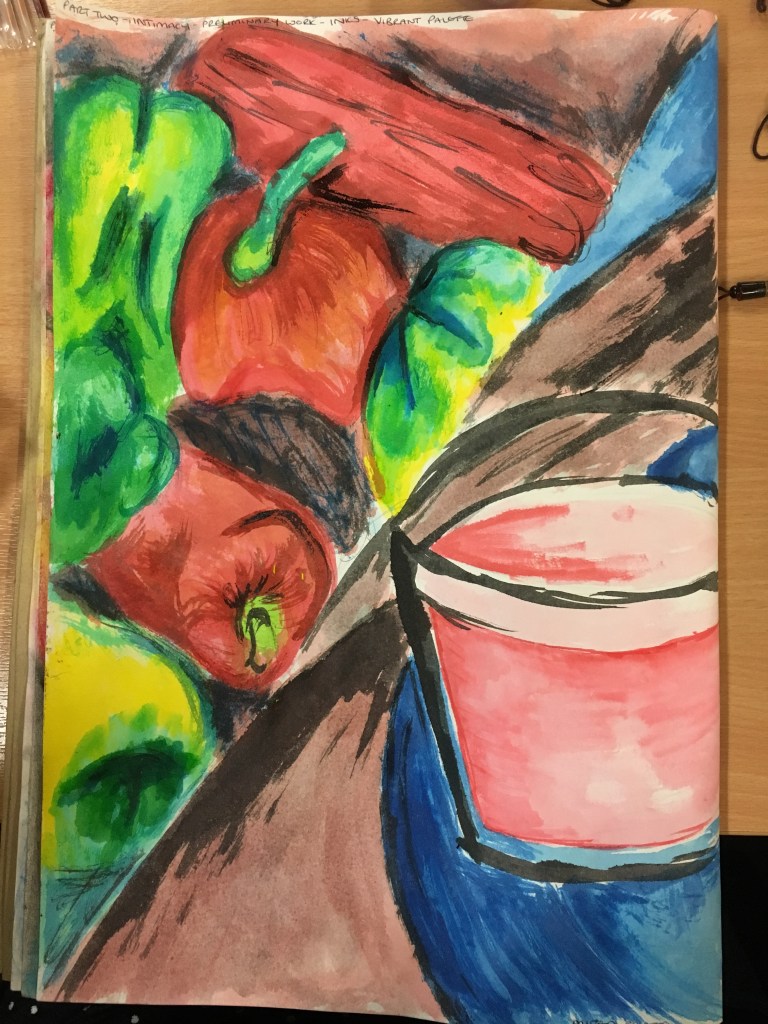
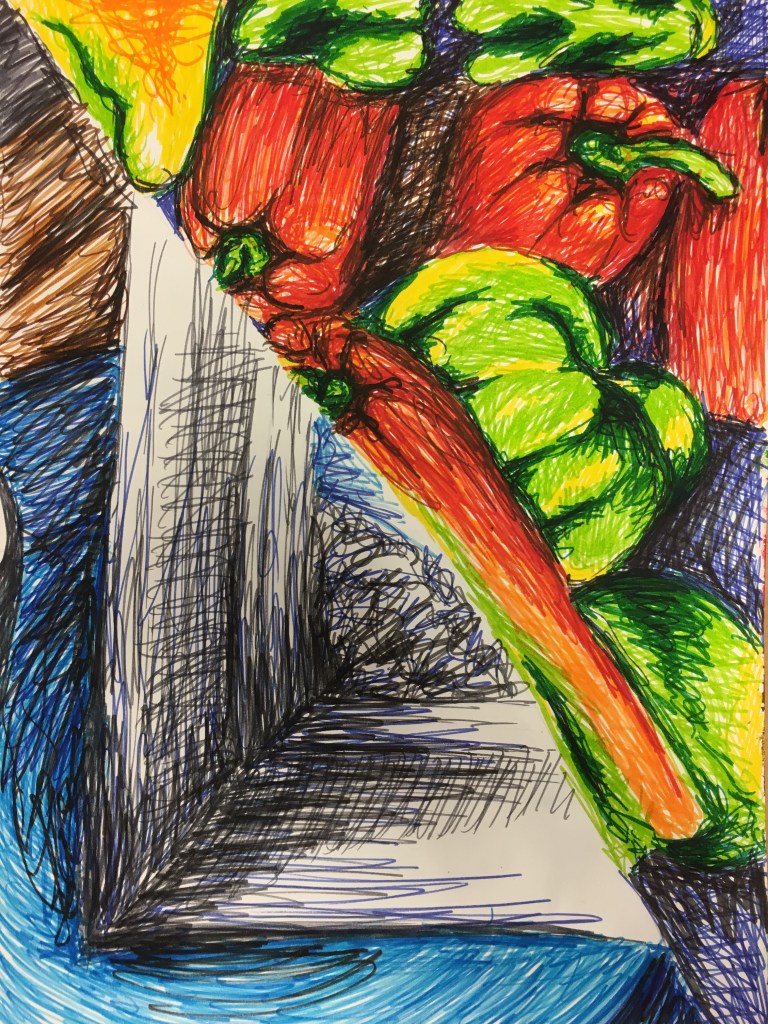
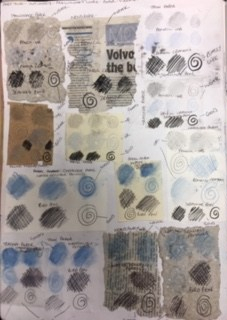
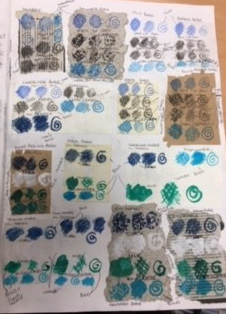
Before I began this part of the course (and before I received my tutor’s feedback), I decided to play with all of the media discussed in the course textbook by creating the same pieces in each media; one half of the page using a vibrant palette, the other using a muted palette, to see how the differing media worked and which ones suited which palette best.

Materials and Tools

Coloured Pencil

Vibrant and Muted Palettes in Pencil Crayon

Watercolour Pencils

Vibrant and Muted Palettes in Watercolour Pencils

Wax Crayons

Vibrant and Muted Palettes in Wax Crayons

Soft Pastels

Oil Pastels

Vibrant and Muted Palettes in Oil Pastel

Coloured Inks

Markers

Paper

Reflection

I think several media have worked better than others for both palettes. For the vibrant palette, I think the wax crayons, soft pastels, oil pastels and markers were all the best successful. The coloured inks were also successful, but were slightly less intense in their colours, which I was rather surprised at. For the muted palette, the coloured pencils, watercolour pencils and wax crayons worked best by far. Their colours were calm and gentle as opposed to bright and intense. Some other media worked rather well for this palette too, but were still rather bold in colour; the soft pastels and oil pastels. I believe this is due to their ability for blending and softening of the lines they were formed with. The markers and coloured inks were far too intense and bold to be viewed as muted. I will consider this as I move forward through this part of my course and try and use the best colours and media to suit the mood of the palette before me.

NB: Citation for the images used in my sketchbook can be found by clicking here.

Part One: Tutor Feedback and Own Comments

Overall Comments

Thank you for your submission Rachael. You have a variety of work going on which is good because this is a diagnostic first part and you need to see where your strengths and weaknesses lie. Don’t assume you have a style otherwise you will be too narrow minded with alternative ways to work. Your learning log is in depth and I can see that you are studying hard and understanding the fundamentals of what drawing can be and how it can be depicted. You work better with looser applications, charcoal and expressive media and the 3 vases has been the most successful to show this. There are technical aspects to work with, especially with perspective, measurements of objects next to each other and tonal qualities to give depth to your still-lifes.

I agree with the comments regarding ‘having a style’ and being ‘too narrow minded’ as I think I have thought myself too set in my ways so far, so I will definitely work on being open to trying new methods and exploring ways I would generally not use.

Feedback on assignment

Demonstration of technical and Visual Skills, Quality of Outcome, Demonstration of

Creativity

Project 1it’s good to see you delving into the expressive mark making but they are a little tamed. With these initial exercises, it’s about getting to know the characteristics of each media so be cathartic and see what they do. In terms of the temporary drawing- this means drawing, which is not created but exists already in the world, such as cracks, marks left, traces, residue. The fact you have found this through cleaning is good. However, do not make them stylised and finished otherwise everything becomes a picture.

I think I will take from this the need to experiment with my media more before I use them for my actual piece.  I will use my sketchbook to carry out these experiments and apply more effort to this than I have so far.  As for the temporary drawings, I will try to ‘see’ this type of ‘drawing’ more and make reference to it to potentially use it further down the line.

Project 2 experimenting with texture- I’m glad you are looking around your house to observe and depict textures. It is not always about making a picture but rather emulating surfaces through different media. I hope you remember these marks to apply to more of the still-lifes and other subjects.

I do very much struggle with the idea of leaving something ‘unfinished’.  I think I need to work harder on stepping back from my work and being ok with it not looking too pretty or obvious.  I will definitely be carrying this knowledge further and will experiment further as I go along.

Project 2 ex 1 group of objectsyes, it is about reading in between the lines. You have to go through the exercises to learn the fundamentals of drawing. This exercise is about measuring accurately and this should help you break down objects in front of you and observe better. You start by being simple, which is good because you need to train your eye to see shapes and scale of objects next to each other. Then you can be more expressive with your lines and mark making. The milk bottle in particular shows good understanding of shape and ellipse. Try not to lose this accuracy.

I definitely have trouble with measuring things accurately, as well as the breaking down of objects.  I have bought a small sketchbook to keep with me always to do brief drawings to practise these skills.

Project 2 ex 2 observing shadow using block of toneyou are being too concerned with what the subject looks like rather than looking at the simplicity of the blocks of tone. Work with different pressures, highlights, reductive drawing and variations of tone to depict the correct depth of shadows. Your planes are quite similar so be careful to observe.

Again, I think this leads back to me thinking I have to create a pretty, finished picture.  I think some of this comes from perhaps feeling embarrassed that some may see the work and think my skills weak, but I know I have to work through this and ‘get over myself’, so to speak!

I was slightly unsure what was meant by my ‘planes’ being quite similar, so I will look into this and how I can improve this area.

Project 2 ex 3- creating shadow through line and marks- it’s good to see you exploring marks and line with different media but try not to create the same qualities each time. The group of plants could be magnified so you are concentrating on the textures and tones rather than making realistic representations. This first part is about exploring. Treat each leaf and part of the plant differently.

I agree I have created the same qualities each time.  Perhaps this is because it is my comfort zone?  I will work to break out of this and work in ways which may not come so naturally to me so that, in time, they will.  I will definitely create more pieces which are of close observations.  I think this may also help me to break out of my ‘pretty picture’ comfort zone, so I am rather eager to do this.

Project 2- ex 4 shadows and reflected light- the piece of the three vases done in charcoal has very explorative mark making; it is raw, expressive and holds substantial gestural qualities. This is best left alone otherwise it becomes too polished and what you see what you get. The pencil piece is not as in-depth, as it has been done with timid marks. The charcoal piece does need work in terms of balance and measurements of shadows but the main factor is you are being expressive with the marks and the shapes of reflection is coming through.

Again, it is leaving pieces as they are which I struggle most with – I feel as though my tutor would give me a negative mark for not finishing work or not being able to see what I am trying to portray, so I need to work on this and not overthink things so much, but trust my intuition more.  I am surprised to see the comment regarding my pencil lines being ‘timid’ and the piece not being as ‘in-depth’ as I felt I put more effort into this piece and recreating the shadows than I did the three vases, so I will consider this more as I move forward.

Assignment- you have tried to use your skills of shadow; light and dark tone representation and composition into a piece, which shows progression. Overall, the whole piece is cumbersome with the amount of objects that are included because you have treated them all in the same way. Break down what is in front of you. Do this by building up your layers from the lightest to the darkest (close-up, foreground, mid, background and distance). This will allow you to differentiate the different tonal variations from light to dark. The perspective and viewpoint is awkward because the ellipse of the plant pot is different to the frontal view of the fabric. So really observe the measurements of your objects next to each other and break down the relationship between the lines. Overall, a very complex image that needs work technically.

I am a little surprised at the comment here regarding the group of objects being cumbersome as I thought I had chosen rather well, but I see it is because I have treated them all the same way – this is something I don’t quite understand either as I thought I was to work in the same media for the whole piece and I tried to change my methods to suit, but clearly I need to work harder on this; perhaps choosing mixed media to represent different objects, as well something such as collage perhaps?

I agree with the comment regarding my perspective and viewpoint, so I will take this into account and look into ways of increasing my skills in this area.

Sketchbooks

Demonstration of technical and Visual Skills, Demonstration of Creativity

I assume that some of your images on the blog are from your sketchbook? If so, it’s good to see you trying exercises a few times because you will only improve. However, use your sketchbook as a space to play, investigate what media can do but for you and more importantly practice the fundamentals of the technicalities. Keep these practices simple, by doing outlines, observing the simple shapes and forms and working out perspectives from different angles.

Some of the images are from my sketchbook, yes, but as I stated in my blog, I do not think I have used this well enough during this part of the course.  As I said earlier, I have now invested in a hardback sketchbook of A5 size and shall carry it with me everywhere, drawing anything and everything which catches my eye – whether relevant to the current part of my course or not – and work on improving my measuring and perspectives.  I am also going to go back and have a play with the various mediums, but with no apparent piece in mind – this way I cannot be tempted to ‘prettify’ and finalise the experiments beyond being just that – an experiment.

Research

Context, reflective thinking, critical thinking, analysis

You clearly enjoy reading about artists and your analysis of Redon’s work and the comparative study is analysed well. Do look at the artists I have suggested to help your current work to improve. Also, go to exhibitions, watch documentaries, read behind other artists work independently. The more you look and read, the more you can allow yourself to move on and build up your contextual understanding. Keep referring to the assessment criteria to self-assess. This is good practice.

I really have enjoyed reading about the artists and am actually wondering now whether I would prefer to change my path to History of Art!  I find it hard to find time to go to museums, but will try to work this in to my schedule.  Most notably, I would really like to go to the Leonardo da Vinci exhibition and will take my sketchbook and scribble away!

Learning Logs or Blogs/Critical essays

Context, reflective thinking, critical thinking, analysis

Your learning log is self-reflective and in-depth. You have given insight into your intentions; understanding of the fundamentals of drawing and seen where you need to improve. Make sure you listen to your own improvements and apply them to your work. Your commentary is substantial for this level and you have documented your progress well.

I’m really pleased with this feedback, though the word ‘substantial’ rather threw me as to whether it was a positive or a negative, but decided to settle on a positive and not spend too much time overthinking!

Suggested Reading / Viewing

Context

  • Giorgio Morandi drawings of still-lifes- keeping it simple and looking at measurements of objects.
  • Henry Moore- sheep drawings- look at the lighter cross-hatching technique to depict tone and form.
  • Giacometti- look at how he observes accurately but also depicting a more expressive style.
  • Paul Cezanne (still-lifes)- look at his work for depth and composition.

The artists recommended are so exciting and interesting and seem to suit me completely!  I will do some in-depth research into them all.

Strengths / Areas for Development

You work well with expressive media and with blocks of tone (3 vases). Don’t feel like you have to finish work and make them over polished. Keep this way of working but use reductive drawing to show lighter tones so you are not so heavy handed.

You have exciting and meaningful objects when it comes to your compositions. Break these down so you are concentrating on the fundamentals of drawing, especially tone, measurements and scale. You have different approaches to creating

shadow to depict tone so keep investigating this.  Angles, viewpoints and perspective need work so the work has more accuracy. Your learning log is in depth and you have been self-reflective. Research the artists I have suggested so you can see what I refer to with depth in your still-lifes.

From this, I have taken on board all of the comments, but most notably the ones relating to being less heavy-handed, concentrating on improving my skills in tone, measurement, scale, angles, viewpoints and perspective.

Part Two: Project Three: Exercise One: Still Life Using Line

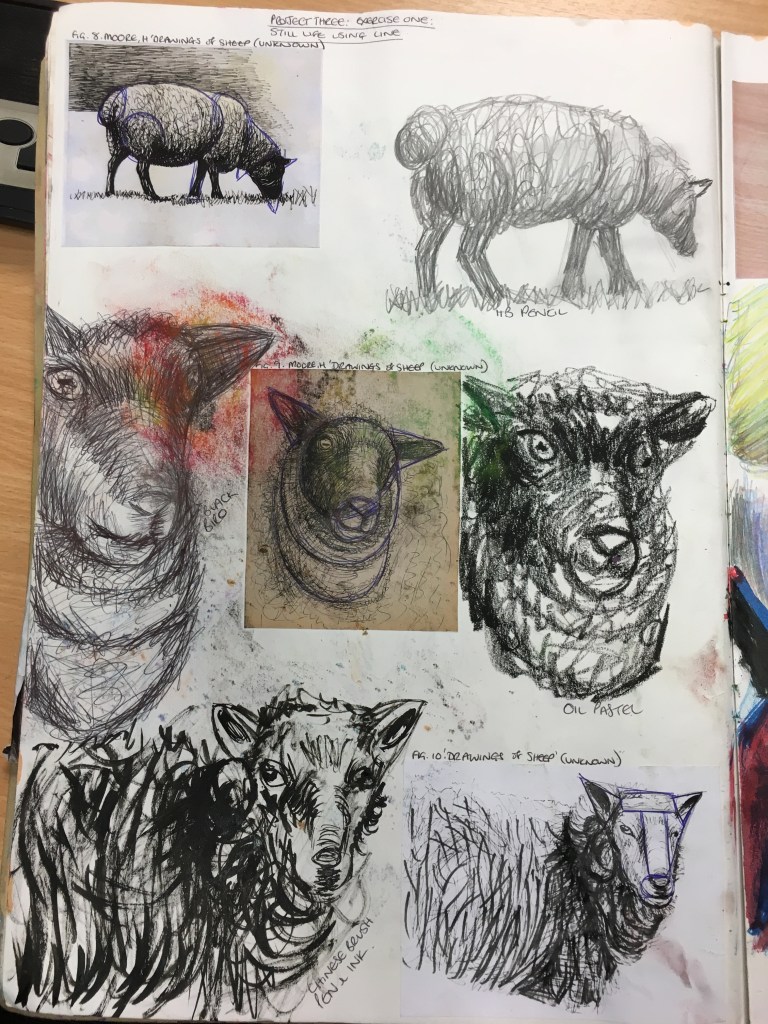
For this part of the course, I decided to begin by looking, at my tutor’s recommendation, at Henry Moore’s sketches of sheep and trying to recreate them in my sketchbook.

Sketchbook Experimentation

As soon as I saw these sketches, I was mesmerised.  I absolutely love Moore’s use of line in such an expressive, loose and uncontrolled manner.  Up close, the lines appear to have no control or order, yet at a distance, they appear to merge together to form an image of the sheep in question.

I decided to try recreating a few of the pieces in several mediums; pencil, biro, oil pastel and ink and Chinese brush pen.

I found the oil pastel the least controllable, yet was rather pleased with the biro and pencil, both of which appeared to show the lines with a better clarity, however, my favourite had to be the ink and Chinese brush pen as this was by far the most expressive.
Final Piece

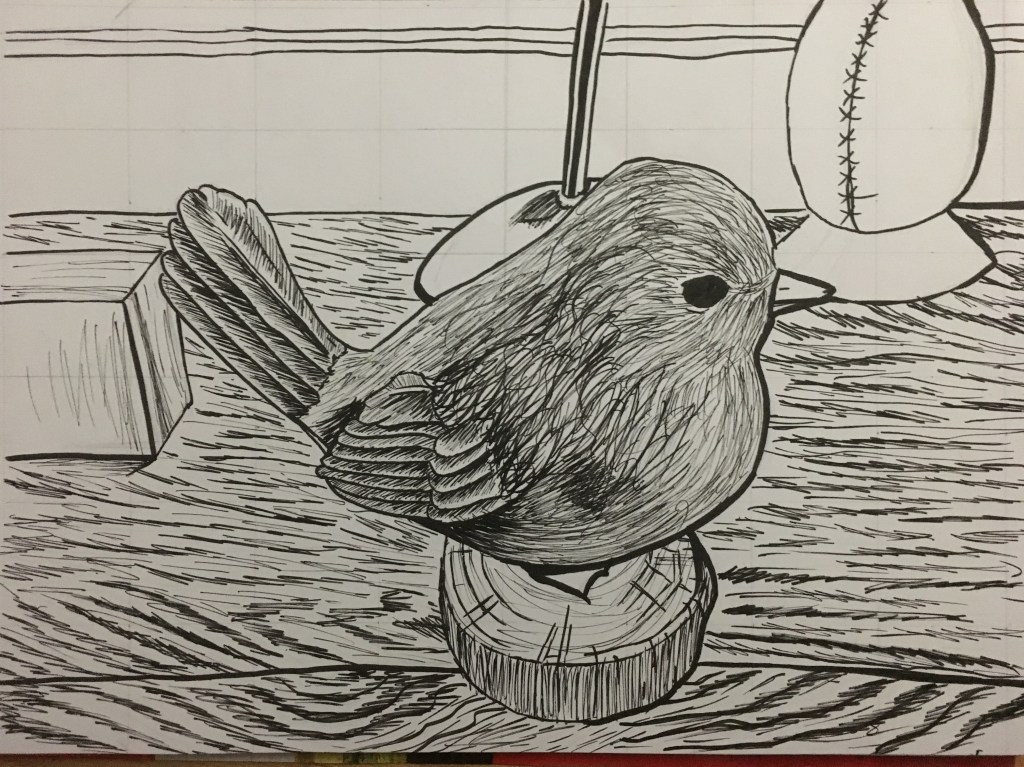
For my final part of this exercise, I decided to work with Chinese brush pens in the form of a pen as opposed to the paint brush type.  Whilst I am aware I should have focussed on a natural object, I was fascinated with a carving of a robin in my mother and father-in-law’s home and the surrounding surface.  I tried to stay true to the use of just line and think I have recreated this well.  I think my scaling and perspective are much better now as I used a grid to help me plot the basic image before carrying out the main bulk of the work. 

Line drawing of a robin and surrounding surfaces

Reflection

I really enjoyed the experiments with Henry Moore’s sheep and will try and remember the difference in intensity to represent the different parts of the pieces. 

Whilst I know my tutor told me to try to avoid making everything look like a picture, I have tried to allow this side of myself in my sketchbook for this part of the course and allow a ‘picture’ to form in my final pieces.  Whilst I think I have been rather successful with showing the depth and tone of the piece purely with line, whether close together or spaced apart, I think I may have messed up slightly by trying to represent shadow somewhat by using a thicker line for the outline of that area, such as the underneath of the robin’s breast and the right-hand side of the rugby ball.

Questions

Below are the questions in my course textbook, which I have decided to answer at the bottom of both exercises, as opposed to both together:

What aspects of each drawing were successful, and what did you have problems with?
The parts of this exercise I thought successful were the line-markings and the ability to distinguish between the different sections (e.g. the edge where the bird finishes and the table surface meet), as well as the change in their direction and thus the sense of depth within the piece. The problems I found in creating this piece is the inability to prevent the image from becoming too cartoon-like – perhaps this was due to the media used? Perhaps if I had used pencil the effect would have taken on completely different qualities? Perhaps the line created with the media used mirrors the outline of cartoons too closely?

Did you manage to get a sense of depth in your drawings?
What elements of the drawings and still life groupings helped to create that sense?

As above, the depth within this piece seems to come through at points where the lines change directions due to the change in shapes and forms in the piece, so I do think line is a good way of showing this. I also think that the accurate scaling of this piece has really helped with the dept formation.

What difficulties were created by being restricted to line or tone?

Whilst I feel I was able to include some sense of it, I think there is only so much depth you can include in a piece without the addition of colour to assist, which also rings true for shadow and texture. Certain parts of the piece seemed to have no texture visible by line, however, a slight hint of colour would have helped improve them, such as the wall and ball as these are left as blank, negative space, leaving the mind to have to fill the details in for itself.

How did using colour affect your working method?

No colour was used in this piece, so it was all purely down to the sheer contrast between the black and the white, the positive and the negative space. Due to this, other options had to be considered, such as the grain in the wood, direction of line and also the thickness and strength of the lines to portray different messages.

NB: All citation for images in my sketchbook can be found at the back of my sketchbook or by clicking here.

Part One: Form and Gesture – Assignment Criteria Reflection

Demonstration of Technical and Visual Skills (35%)

  • Materials: I have tried to use a wide variety of media and materials for my work but, having never studied at degree level before and there being a large gap between my college days and now, I have used this part of the course as a learning curve as to what is expected of me throughout the rest of the course.  I have found I have had to buy and find materials and media as I have gone along, so I have not had much time to use such things as the ink.  I think I need better control with such things as charcoal, soft pastels, ink and oil pastels and intend of working on this as I go forward.
  • Techniques: I have really enjoyed certain aspects of this part of the course – most notably the expressive mark making and crosshatching.  I definitely need to work on my ability to control the media to create finer, more delicate detail in my work, but I don’t intend it to be a massive part of my work as a whole as I much prefer the mess and lack of control.
  • Observational Skills: Whilst I think I am rather capable of drawing what I see, I think I need to work more on my ability to scale things properly as I have found in several of my pieces that lining objects or sections of the piece up can sometimes go slightly awry.  I think I need to do more quick continuous line sketches to really strengthen my skill in this area.
  • Visual Awareness: I thinkmy skill in this area is still developing, but I have found myself questioning almost every aspect of the world around me as to what media would best represent such things as the texture, tone and perspectives.
  • Design: Throughout this part of the course, I have found myself looking for natural ‘frames’ of things I feel would work well in a piece of work.  I think my skill in this area will only improve the further I delve into the course.  Again, I think I need to work more on jotting things down or taking photographs as and when they crop up so I don’t forget them. 
  • Compositional Skills: For this assignment, I feel I really took control of the choice of objects chosen instead of just grabbing anything I could find, as I had in the earlier exercise and set them up in a way which would provide me with the best layout for being able to translate such things as the negative space, tonal ranges, perhaps including something such as a the net bath toy bag with its loose objects inside.

Quality of Outcome (20%)

  • Content: Again, whilst I think I have put a lot of effort in throughout this part of the course, I feel I have given a lot of time to the more administerial aspects instead of the actual content.  My thought process for this was purely because I knew this part would not be assessed, so I wanted to ensure that when I did come to the parts which were assessed, I had created ways to be able to deal with the administrative side in a much smaller timeframe and leave more time to focus on creating more visual content.  Regardless, I feel my content in my final piece holds very strong emotion and is very meaningful to me.  However, I do feel I could have chosen more interesting objects which would make the viewer as what the relevance was, why it was significant and want to know more about their stories. 
  • Application of Knowledge:  Having gone back through all of the exercises for this part of the course, I feel I have done well in applying my knowledge gained so far.  I think this will also only improve as I move through the course when I learn new things.  I did find, however, that I seemed to have misinterpreted part of Project One: Exercise Two as drawing see-through objects, instead of drawing the shapes I could see within them.  I tried to rectify this by creating a version of this for my final piece, as shown above.  I think I need to work on ensuring I fully understand each exercise and project before I attempt to begin them, perhaps by making my own assumptions about it and then checking them against other students’ interpretations for that part.
  • Presentation of Work in a Coherent Manner: I think my learning log is rather accessible (I hope!) and easy to move through.  I struggled at first with how to use WordPress properly – again, eating a lot of time unnecessarily – but think I have managed to get my head around it now.  I think I may ask several members of my family to try and navigate their way to certain points on my site and then get their feedback and update it where needed.  Due to not reading the projects and exercises properly sometimes, as well as not having all the necessary media and materials at first, my sketchbook is rather scatty I think, as well as it being only A4 in size.  I had begun the projects before speaking with my tutor and her advising me to work on A3 or bigger, so I have invested in some larger sketchbooks and will try to make my work going forward more chronological in its order.
  • Discernment: I think my ability to judge my work well and critically is rather good, but I think there is always room for improvement.  Again, I have tried to find methods of speeding things up and have created a questionnaire relating to reflecting on my own work, which I will be using on every exercise going forward.  I also think my progression through the course will increase this skill naturally.
  • Conceptualisation of Thoughts: I have used several mind maps throughout this part of the course, but think I could have used more.  Again, I think this is purely down to time available to me.  I found that I tend to jump from one idea to another rather quickly without putting much thought into how they could be linked, when and how they could be used etc, so I intend on carrying a small sketchbook or notepad and pen around with me constantly to be able to jot down any thoughts, feelings or ideas I have for later use.
  • Communication of Ideas: My learning log is rather accessible and user-friendly, though I think I may need to make it more visually appealing going forward.  I think I need to reduce my word count and increase my visuals so viewers don’t bore easily. 

Demonstration of Creativity (25%)

  • Imagination: I have used imagination in my final piece in choosing the objects to create my group and also to represent my ‘secret’ meanings within them.  On the surface, they are just everyday objects, but once you read the explanation surrounding each object, I think it does become much clearer that each was chosen for a specific purpose and to represent different textures as well as personal meanings.  There is an evident lack in the variety of tools, media and material used in my work so far, but I hope to improve on this now I have discovered what is required of me and actually having access to such items now and even more as time progresses.  As already stated above, I need to jot down ideas more in my sketchbook so I don’t forget them and collect more and more samples of things to attempt to experiment with.
  • Experimentation:  I believe I have done this well in the build up to my final piece with my breakdown of each object, though I could have experimented more with the surfaces I chose to work on.  I was running rather close on time for the final piece, but decided that I would have more time going forward, so would focus on this more in my future pieces.  I also want to experiment by recreating artists’ pieces in my sketchbook when researching them to try to understand them and their work better.
  • Invention: I have created several sheets to help me speed up my processes moving forward – a task I believe has drained me of precious time, but one which I hope will speed my processing up in the future, leaving me with more time for experimentations, research and development of my skills.  Besides these sheets, I feel I have not done much in the way of inventing much else so far. 
  • Development of a Personal Voice: I believe I have a good sense of my personal voice – I know I like dark, moody, expressive marks and am not too keen on fine, patient detail (not to mention the effort this takes with my tremor), but I am not too stubborn or set in my ways to overlook these things and want to try to learn to embrace them as opposed to sticking to my strengths and avoiding my weaknesses.  I have been surprised on a number of occasions at to how much I have enjoyed things I thought I wouldn’t like; the temporary drawing was actually rather soothing as opposed to my initial thoughts that it would be frustrating and the same again in the fine detail of the polyester bag.
  • Research: I put a lot of effort into my research of Odilon Redon but, again, think I put too much effort into the wording as opposed to experimenting with replicating his work myself.  This is definitely something I will work on improving in future parts of this course.
  • Critical Thinking (Learning Logs): My learning log is well laid out and structured and the sheets I have made have helped somewhat and will only help more in the future.  I think I definitely need to work on my clarity of thought processes and also the types of questions I should be asking myself about my work and how best to improve it.  This is something I am trying to work on and will use what I have written here as well as any feedback from my tutor to develop this skill sufficiently.

Assignment One

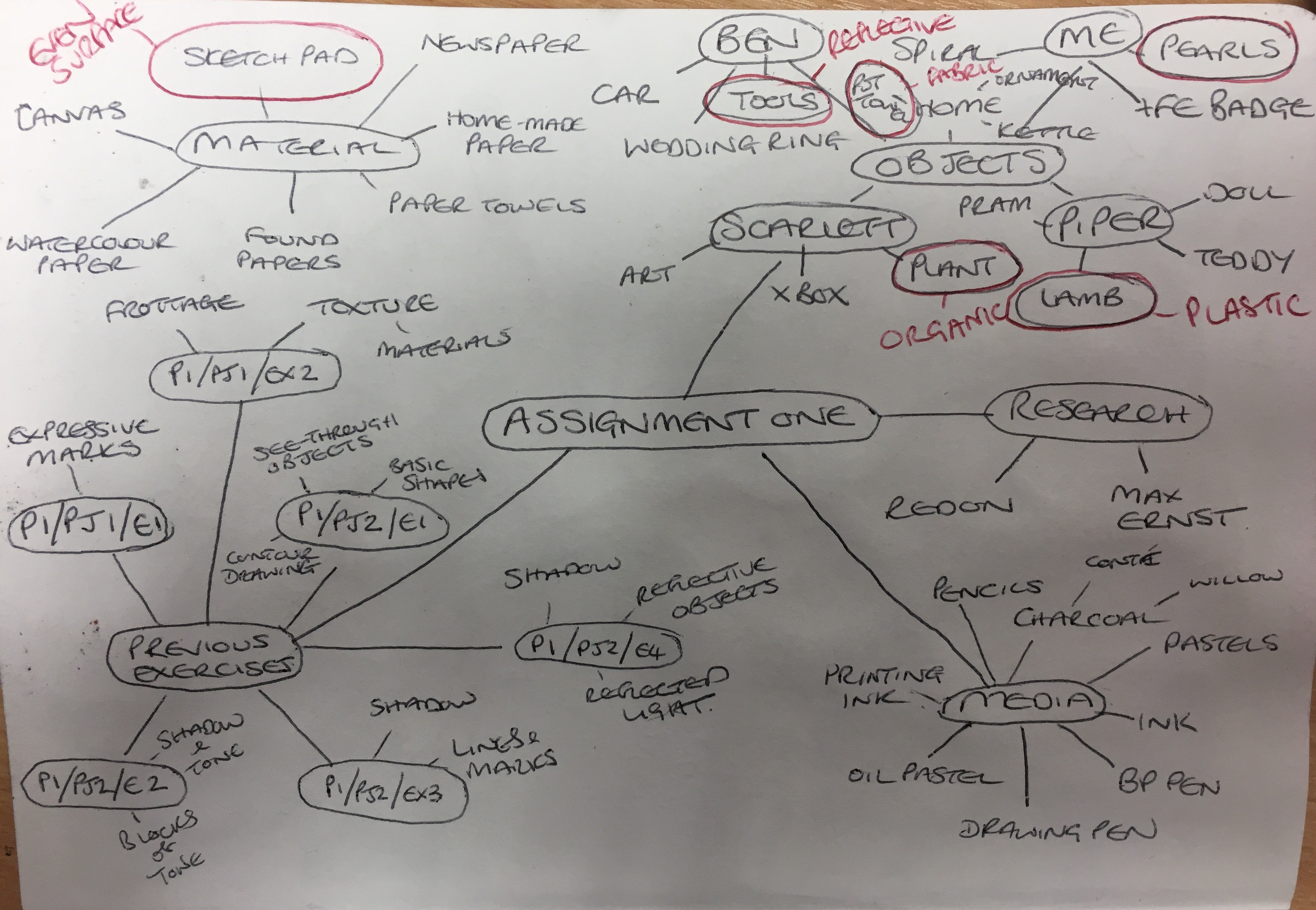
To begin this assignment, I decided to work through my previous exercises in coming up with my main piece.  I began by working out what I wanted to draw and why by creating a mind map:

Assignment One Mind Map

Preliminary Work for Final Piece

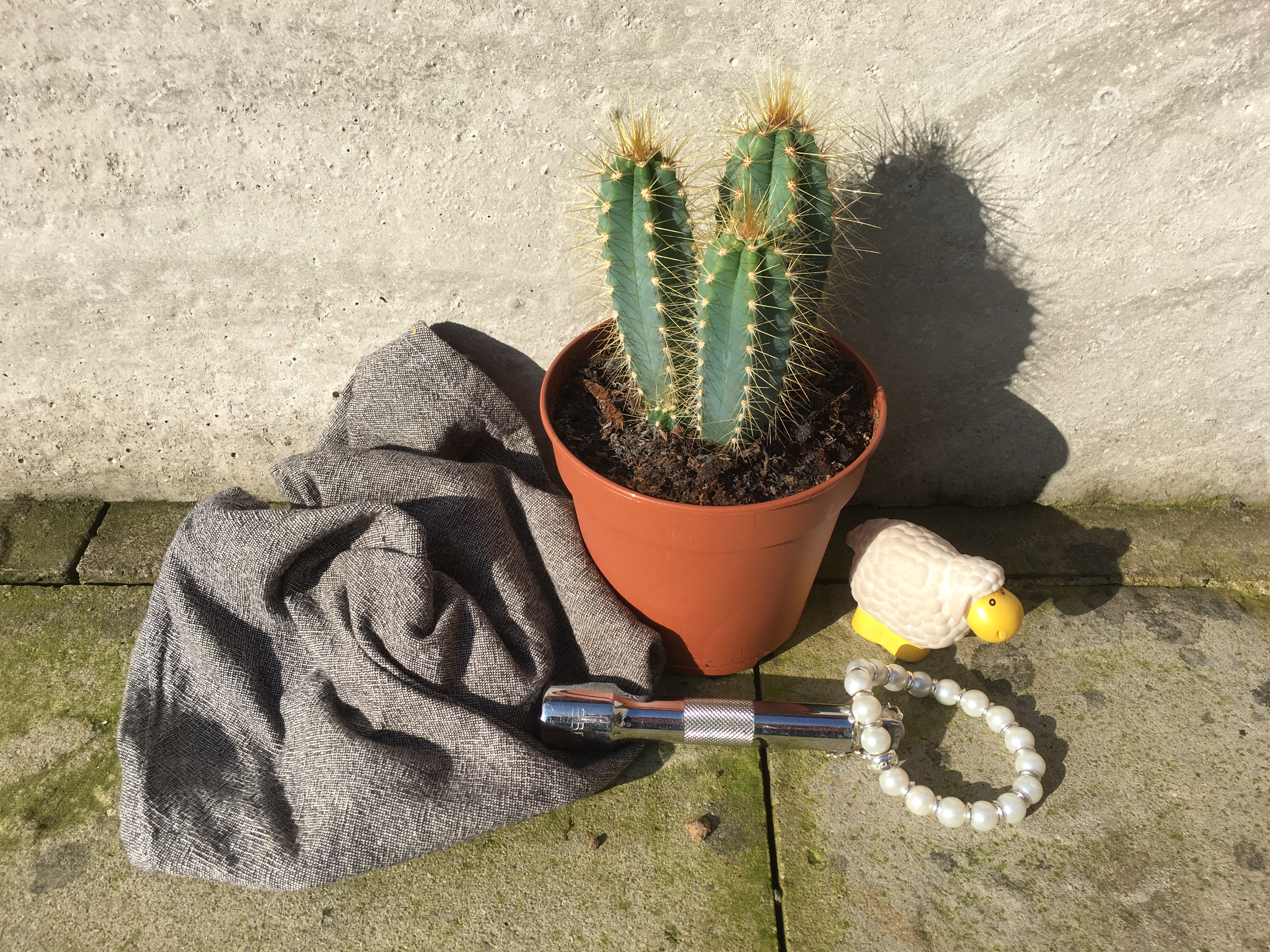
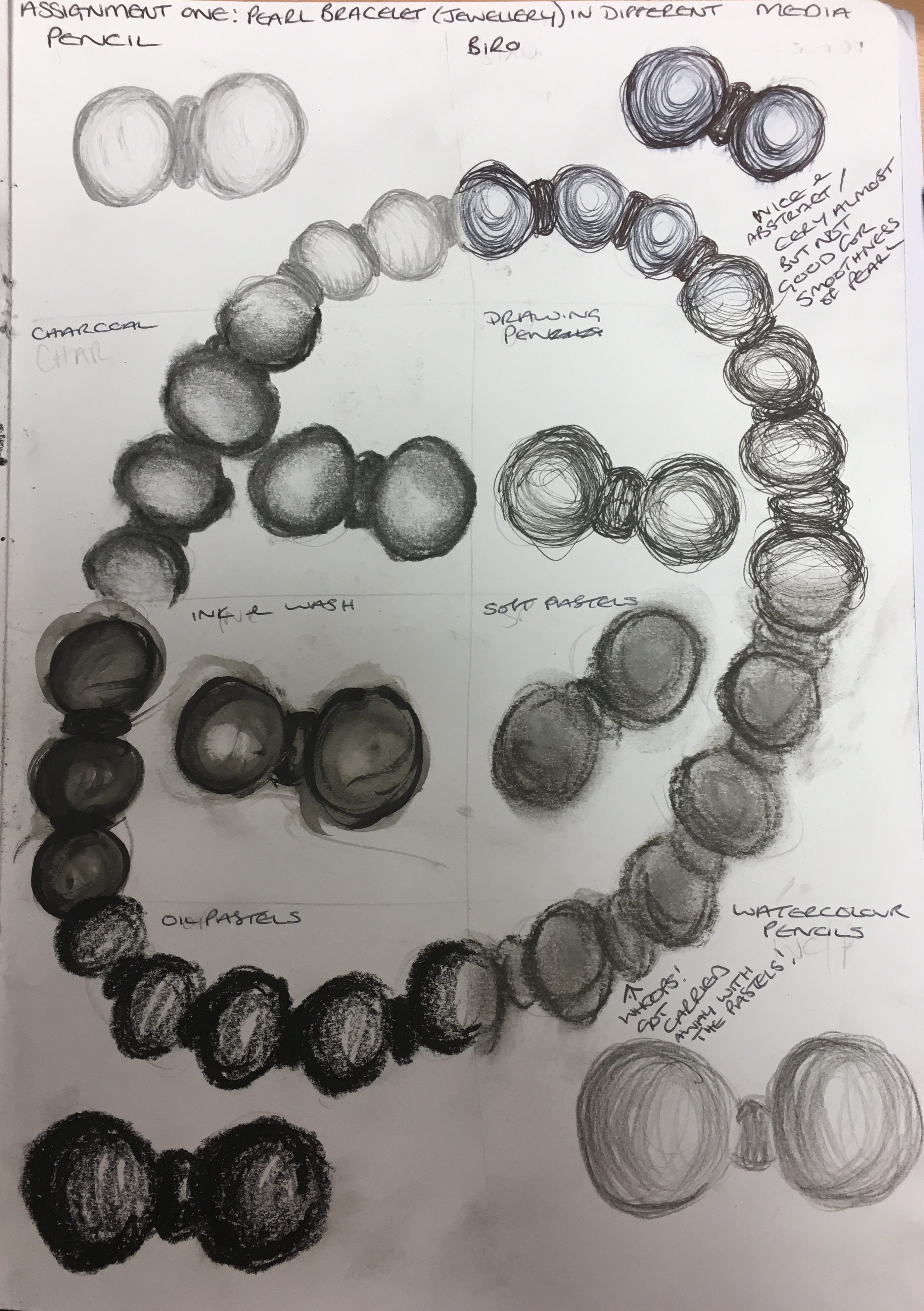
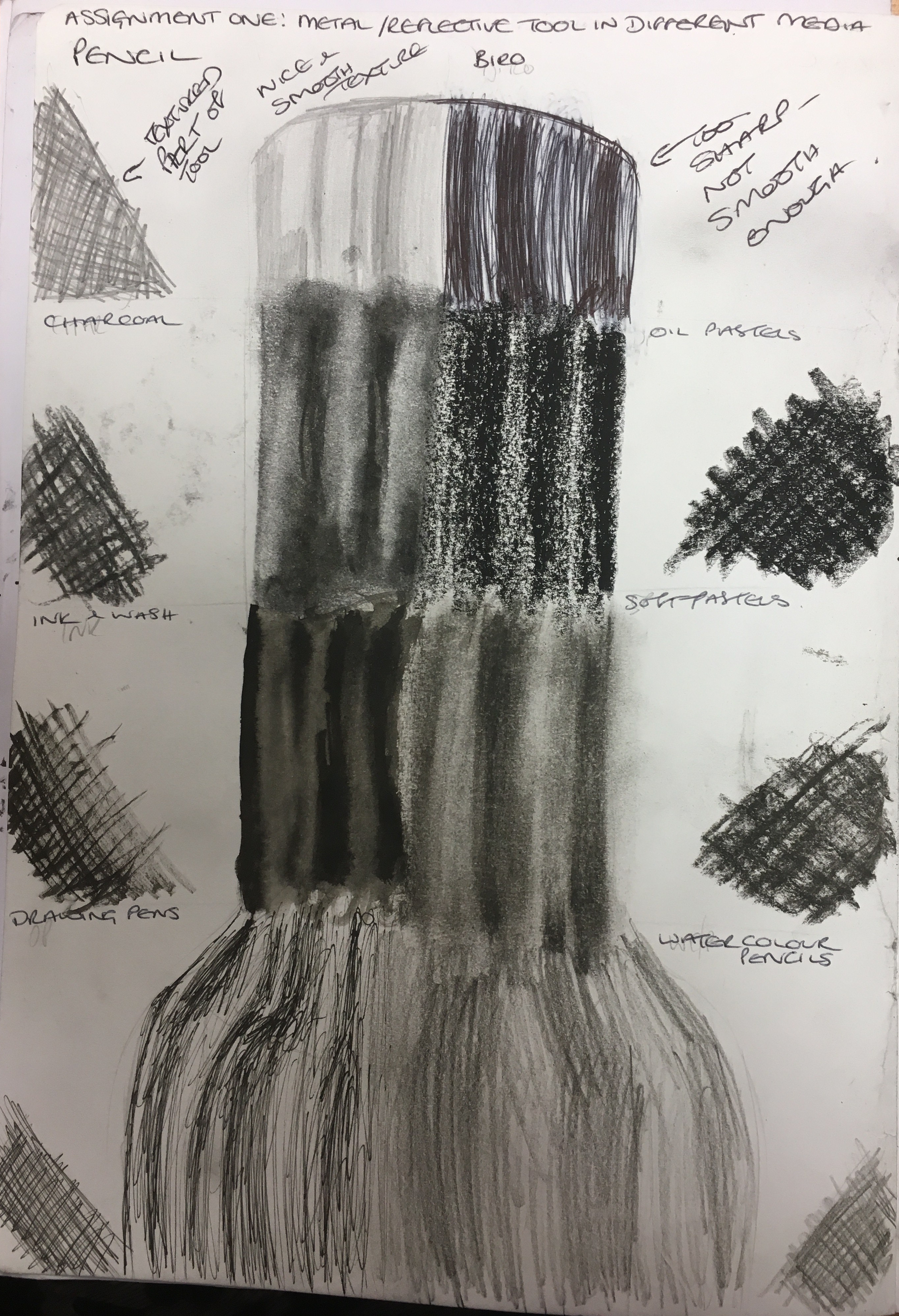
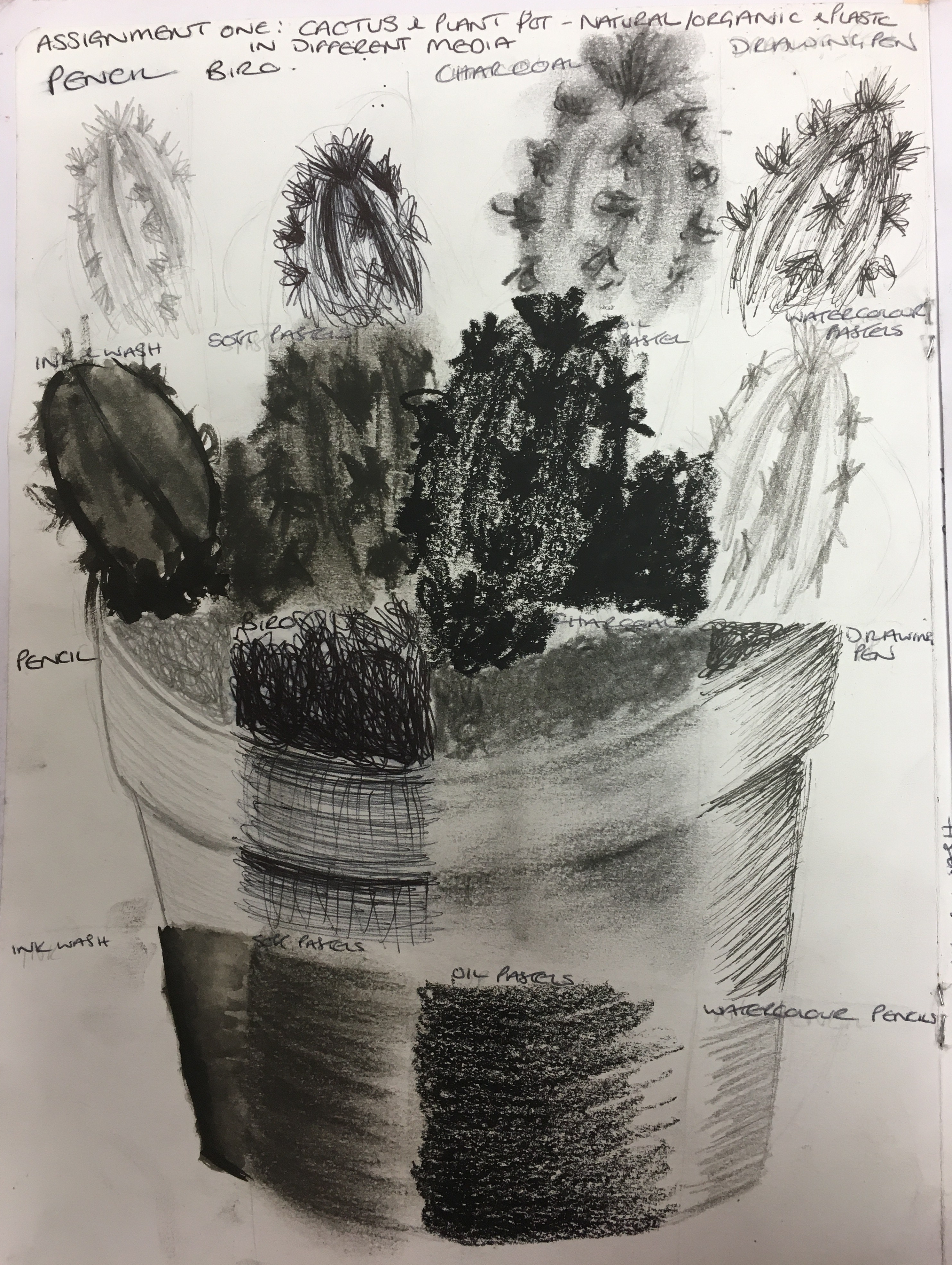
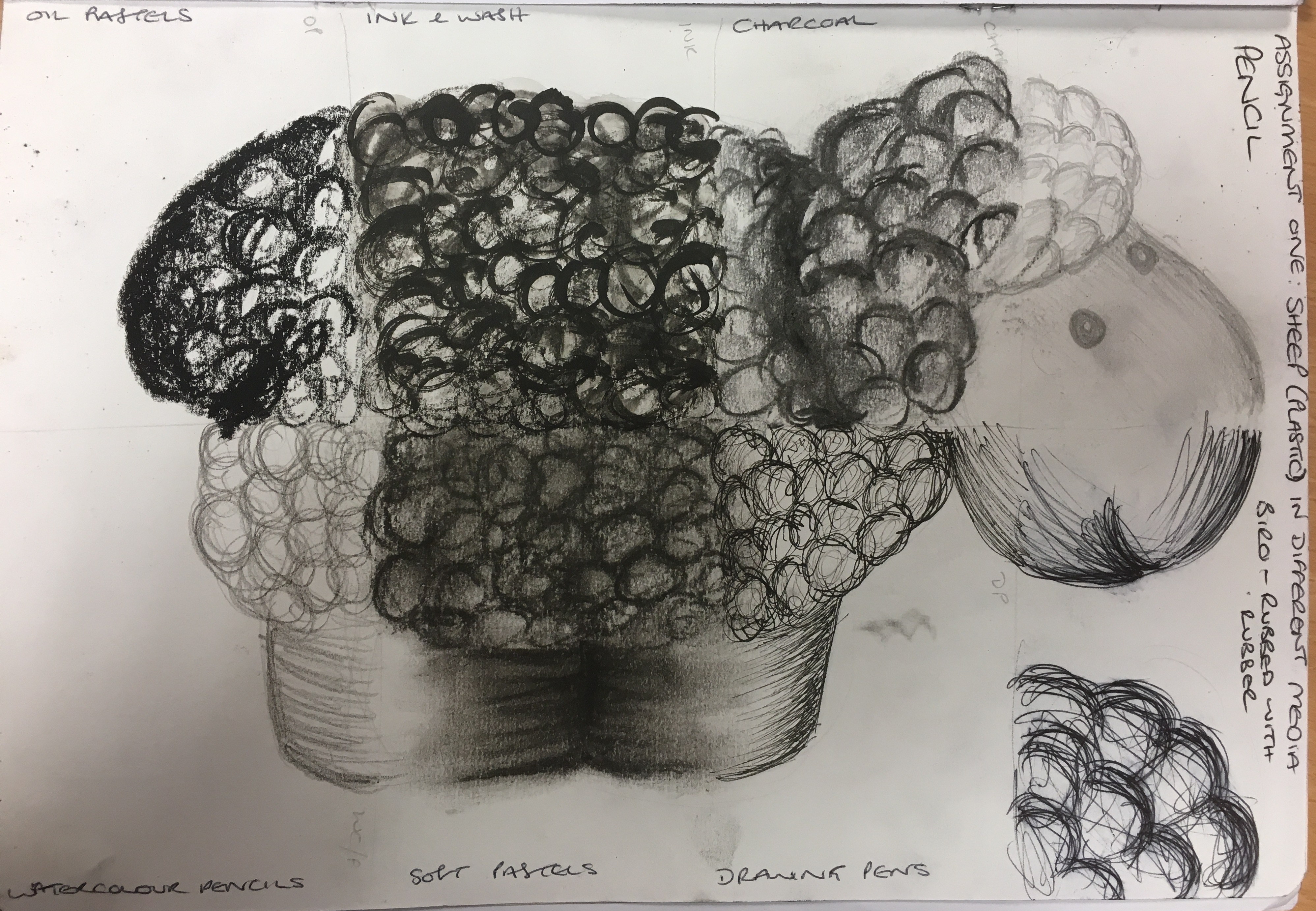
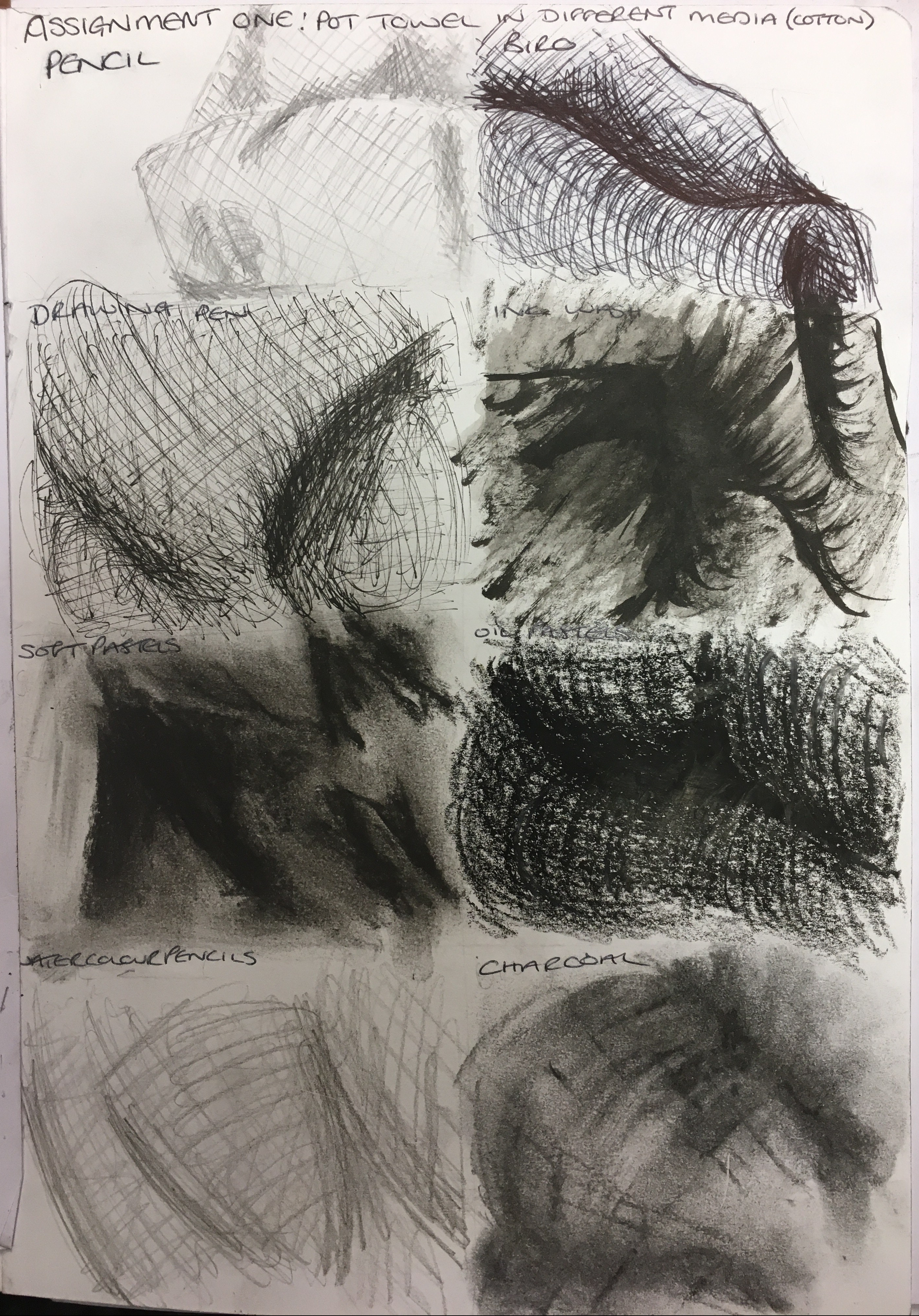
I had settled on several objects which were of significant importance to me, draw each one with eight different media (pencil, biro pen, drawing pen, ink and wash, soft pastels, oil pastels, watercolour pencils and charcoal).  I decided on the most suitable as follows:

Assignment One Group of Objects
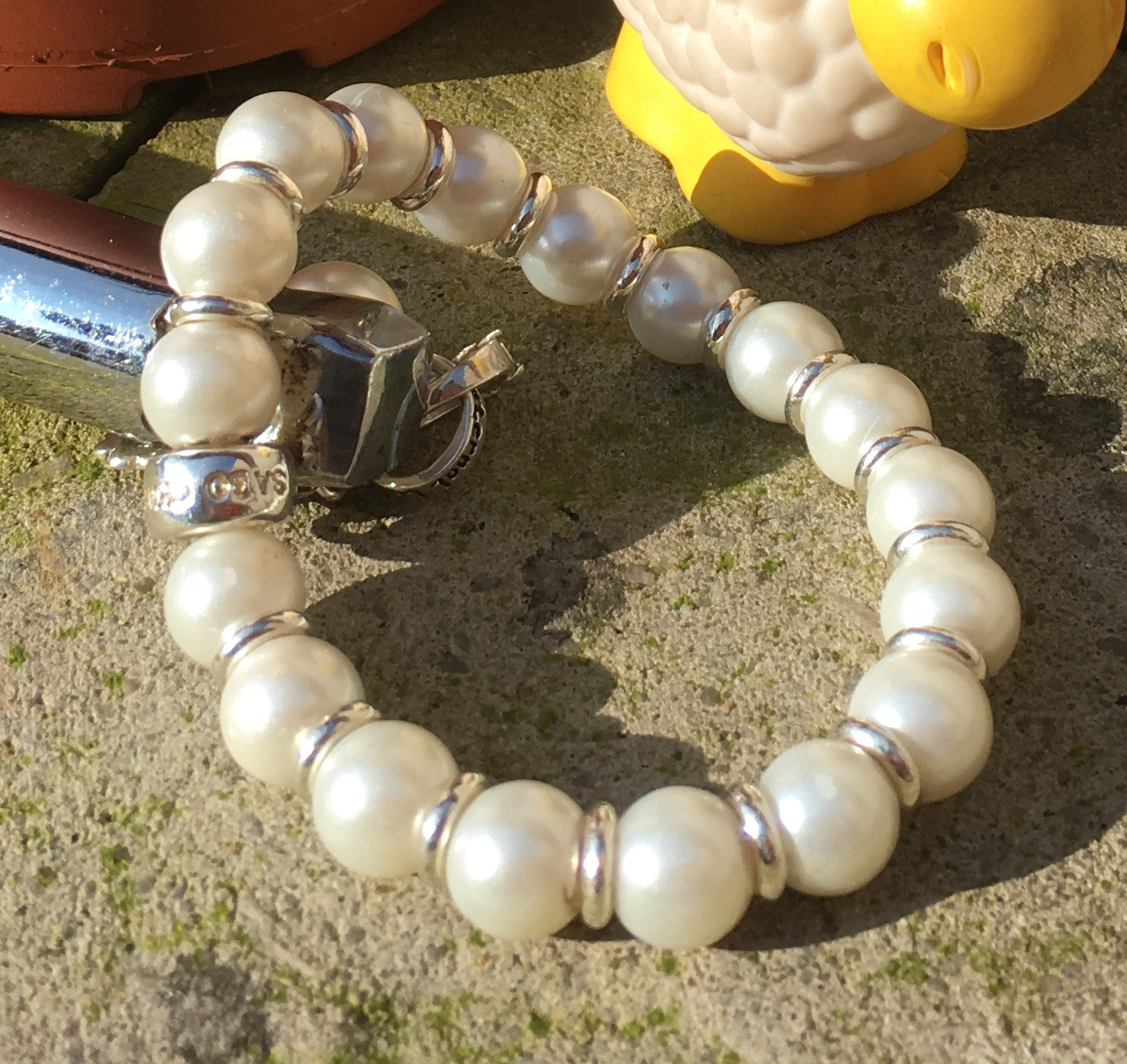
  • Pearl bracelet: This item represents myself.  I was given this as a gift from my best friend for my wedding, so my emotional attachment to this object is very strong.  I also like how this object allows me to attempt to recreate spheres and a pearlized surface.  I decided after the mixed-media experiment that I really liked both the ink and wash and the charcoal to best represent this object.  The charcoal is much more flexible in recreating the pearlized surface and can also be lifted with a putty rubber if needed for the lighter areas.  
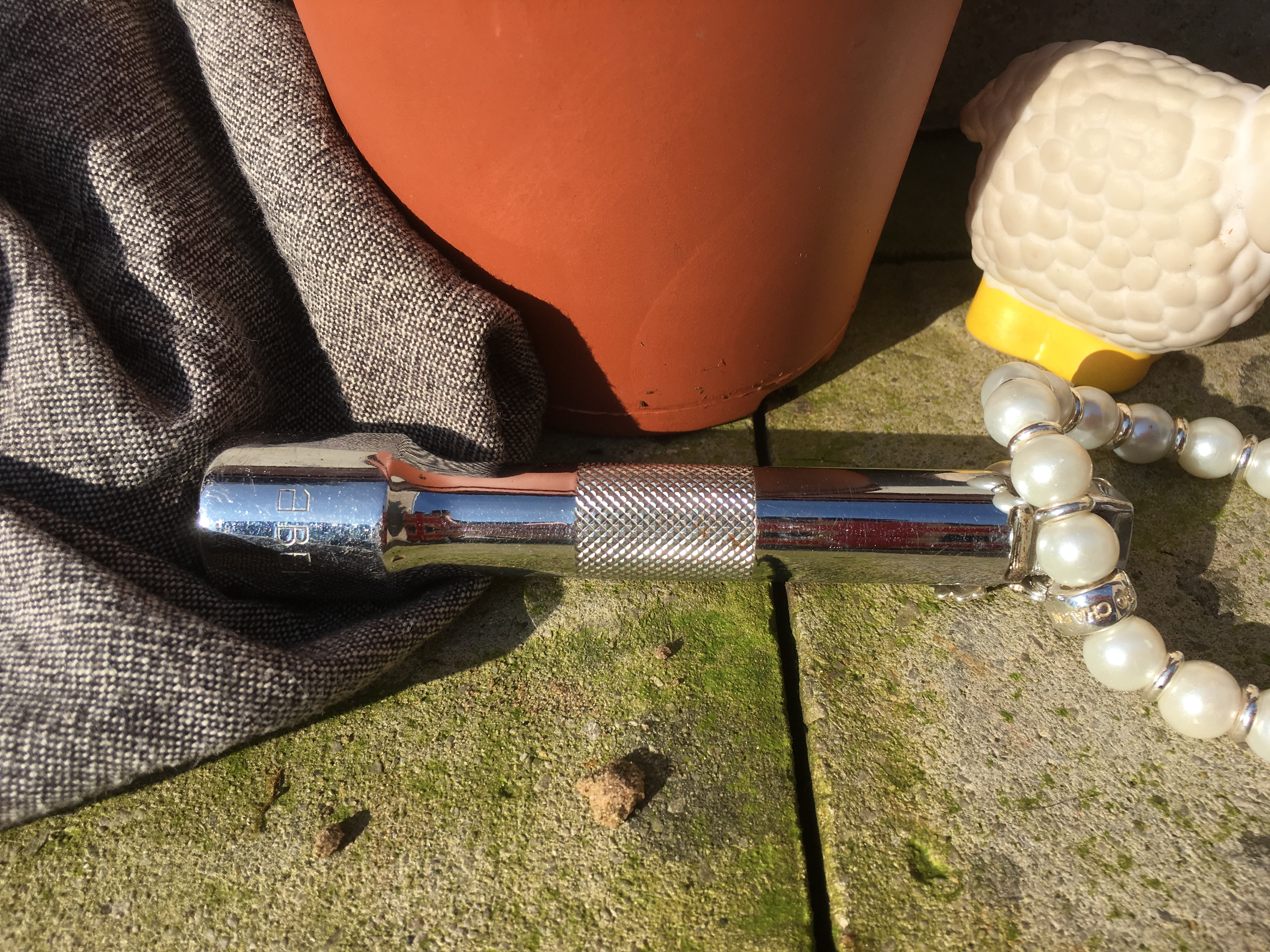
  • Metal tool: This item belongs to my husband, who is a mechanic and whose (almost!) whole life revolves around his phenomenal capabilities with objects such as this.  This object also allows me to recreate a reflective surface, but also offers a textured surface in the middle section, where I intend to use or recreate a piece of frottage.  My favourite resulting media for this object was the charcoal and soft pastels due to their ability to blend and be lifted with a putty rubber as and when needed.
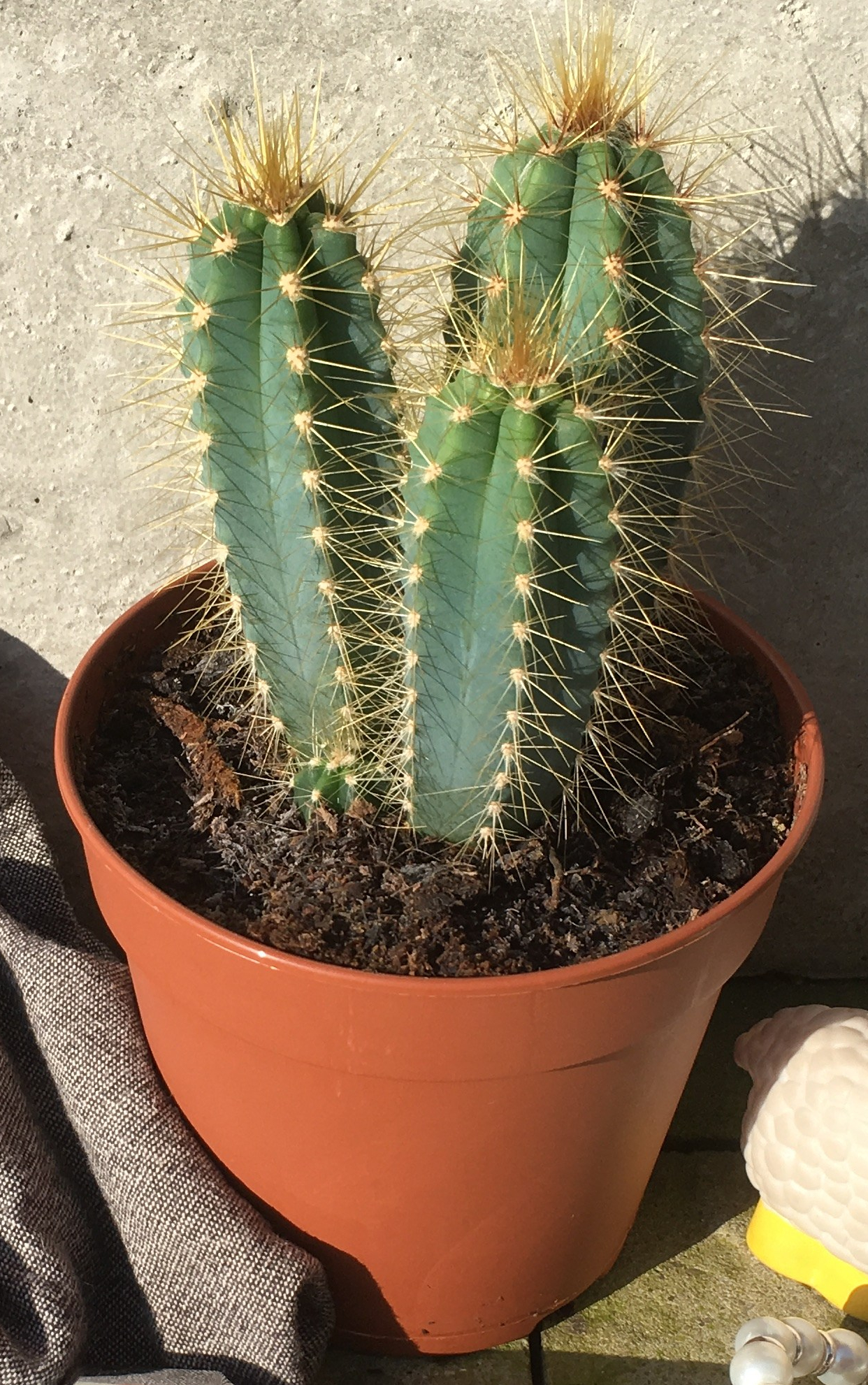
  • Cactus plant and pot: This object belongs to my eldest daughter, who has a love of cactuses (possibly because it doesn’t matter so much if she forgets to water them every now and again! Haha!).  For the cactus, I preferred the charcoal and soft pastel as I felt they gave the object the rough and furry appearance it holds in real life.  I also really like the drawing pen as this really recreates the spikiness of the plant’s spines well.  For the plant pot, I really liked the charcoal as it was the best result in creating a smooth, flat (but curved) surface, but also the messy texture of the soil.
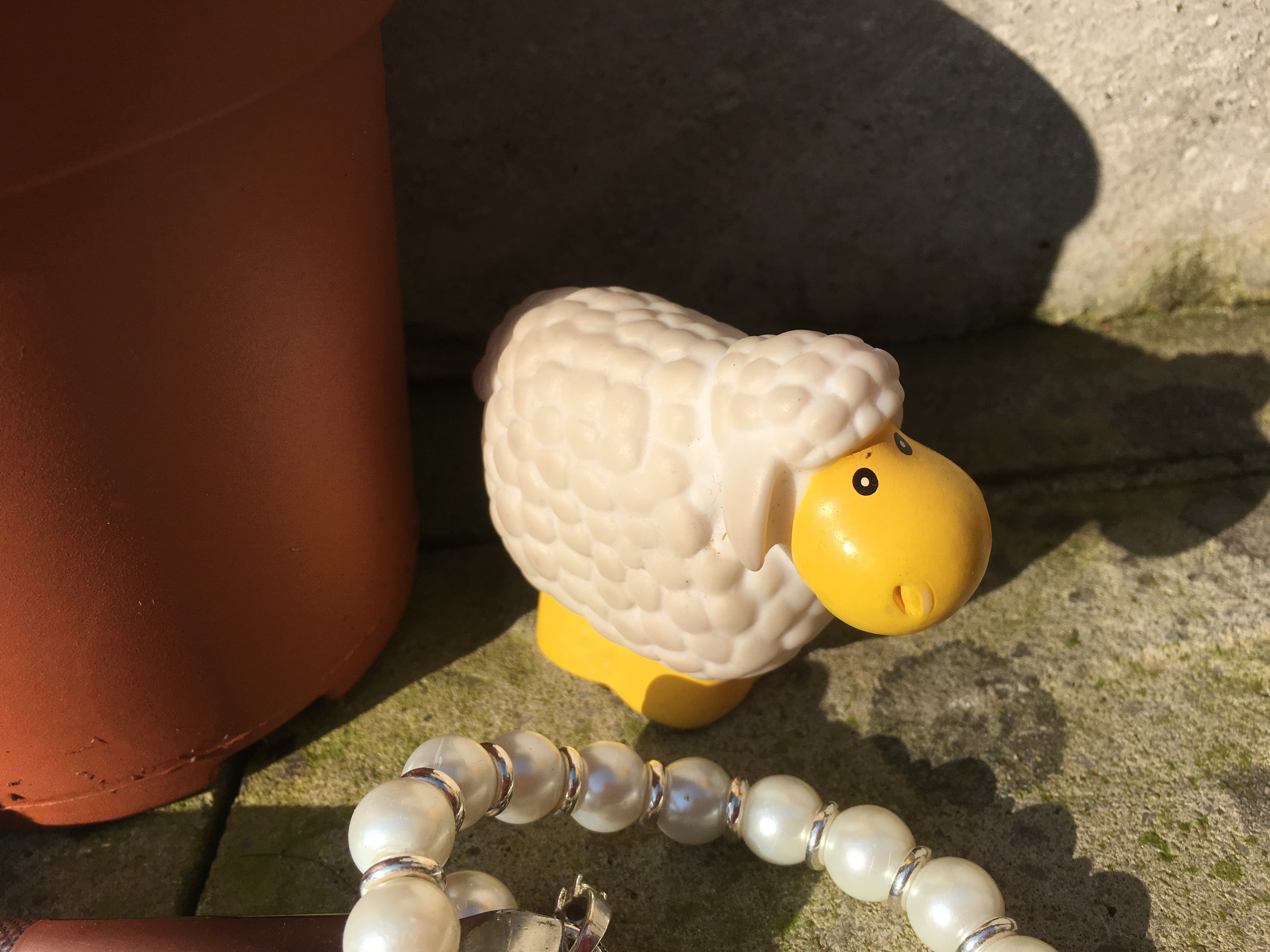
  • Toy sheep: This object belongs to my youngest daughter and was her bedtime buddy for a rather long time.  I found this object rather difficult to master with the majority of the media as they all seemed to add texture that would be present in actual wool, but not in a plastic toy.  I decided my favourite media for this was the pencil and watercolour pencils due to their smoothness.  I think, with more time and patience, the charcoal and soft pastel would also work better as they could be lifted with a putty rubber to show a reflection of light.
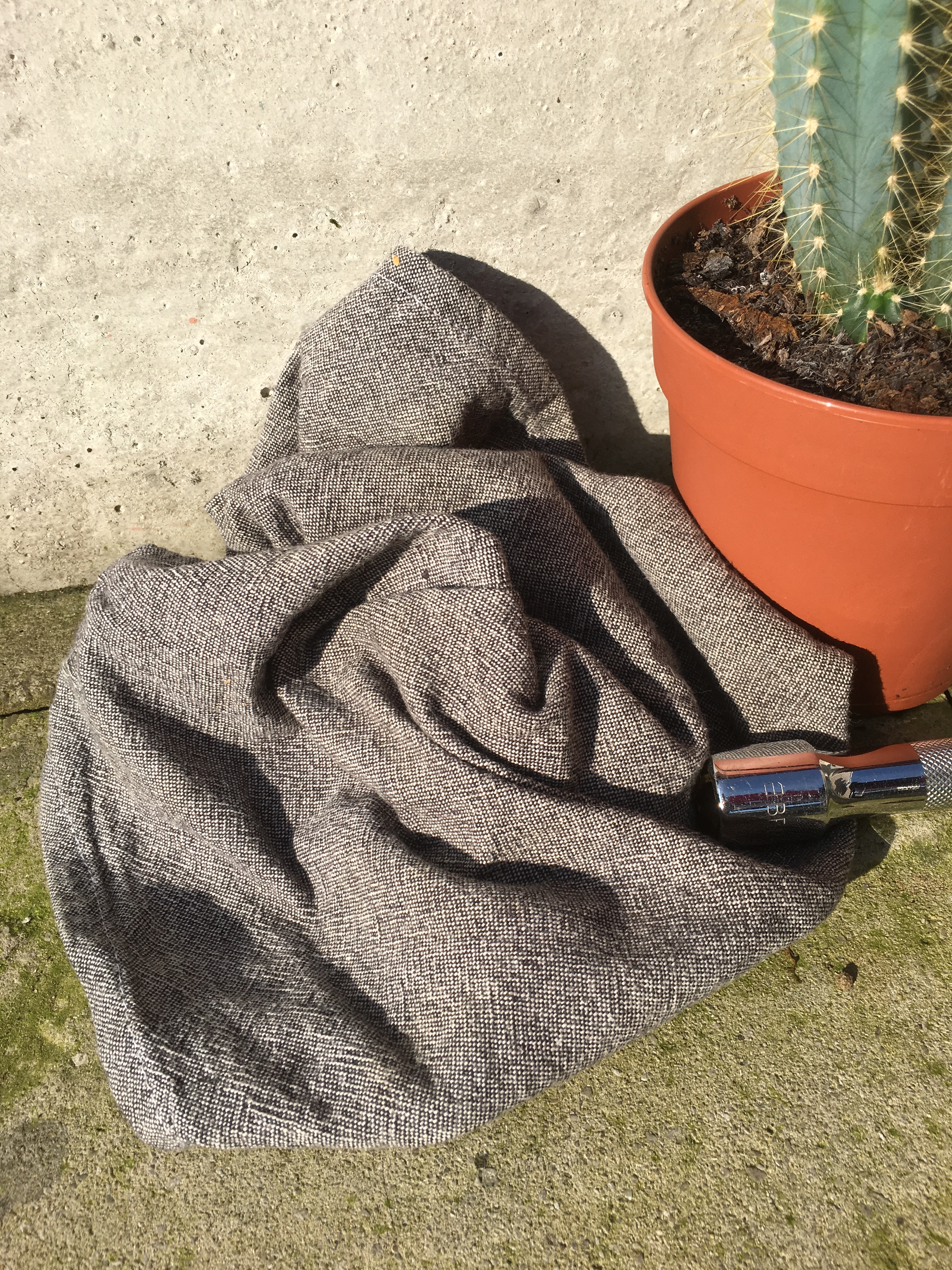
  • Pot towel: This represents our family home and life together.  Whilst a pot towel holds no actual significance, I liked that it is a good representation of fabric for texture and it was just the right size to put alongside my other items.  I found that my favourite media for this object was charcoal as it was the most accurate result.  My second favourite media was the oil pastel due to the white of the background showing through, similar to the actual object.

As a few quick exercises to familiarise myself with the group of objects before I got to work on my actual final piece, I decided to attempt some basic exercises I remembered from my school days:

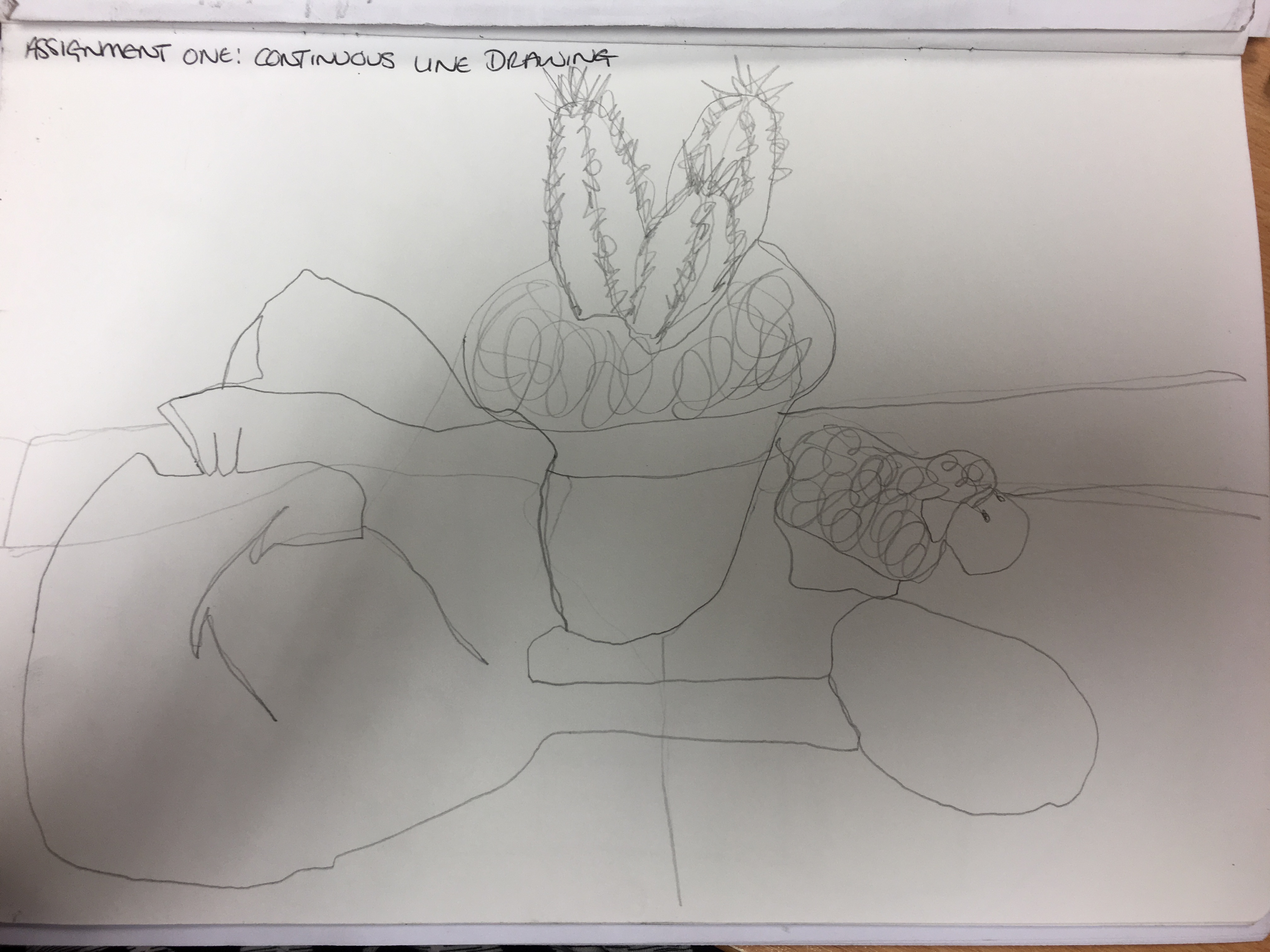
  • A continuous line drawing: I wanted to practice my skill of looking without removing my pencil from the page or looking down and relying solely on my hand / eye co-ordination to reach a final piece.  Whilst I think the piece looks like something my three-year-old could do, I can see my skill of looking is actually improving somewhat and it is something I will work on more going forward, especially if I am going to create quick, rough sketches of things which may move position quickly (such as people in a café etc).
Assignment One continuous line drawing
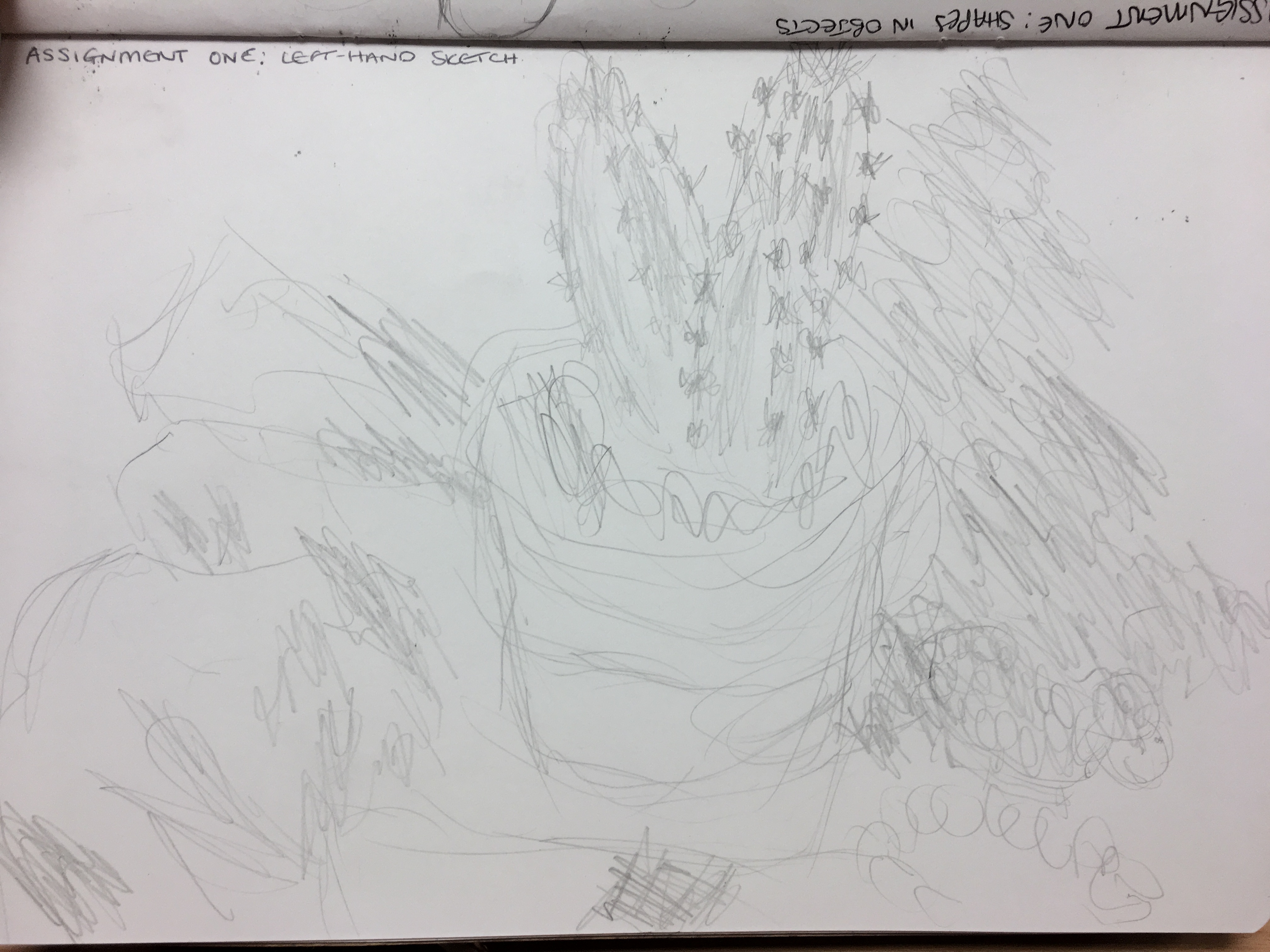
  • A drawing with my left (non-dominant) hand:  I am rather ambidextrous anyway, but I thought by attempting to use my non-dominant hand, I may be able to remove my inhibitions and potentially see something with the other side of my brain which I hadn’t previously seen.  What resulted was actually that I could not really apply any pressure to the piece with the pencil.  I also found that my scaling ability was rather
Assignment One left-hand drawing

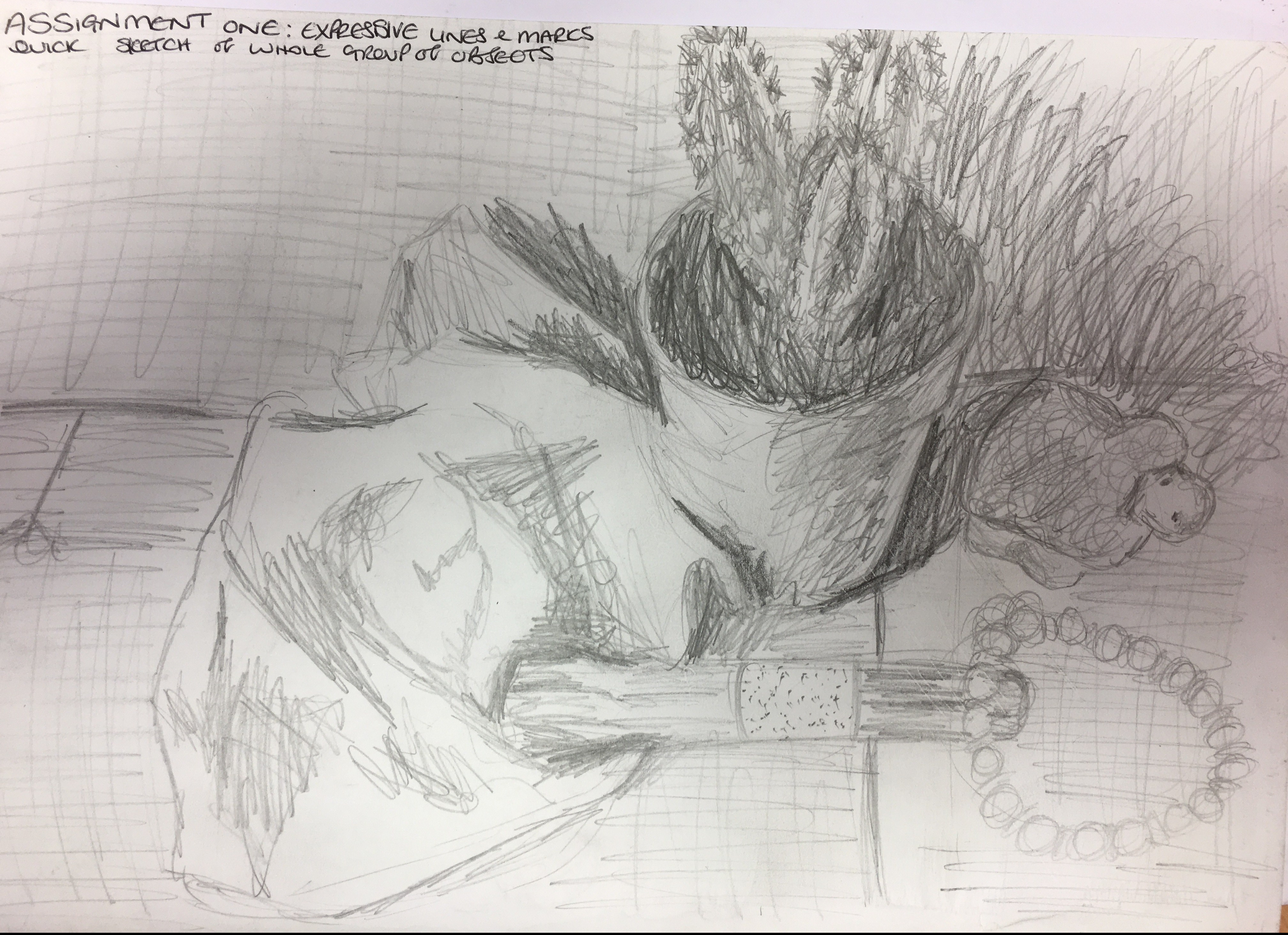
I also drew a ‘normal’ quick sketch of the group of objects, using very quick, rough marks to highlight points of note in the objects – the spines on the cactus, the folds in the material and so on.

Assignment One expressive lines and marks quick sketch

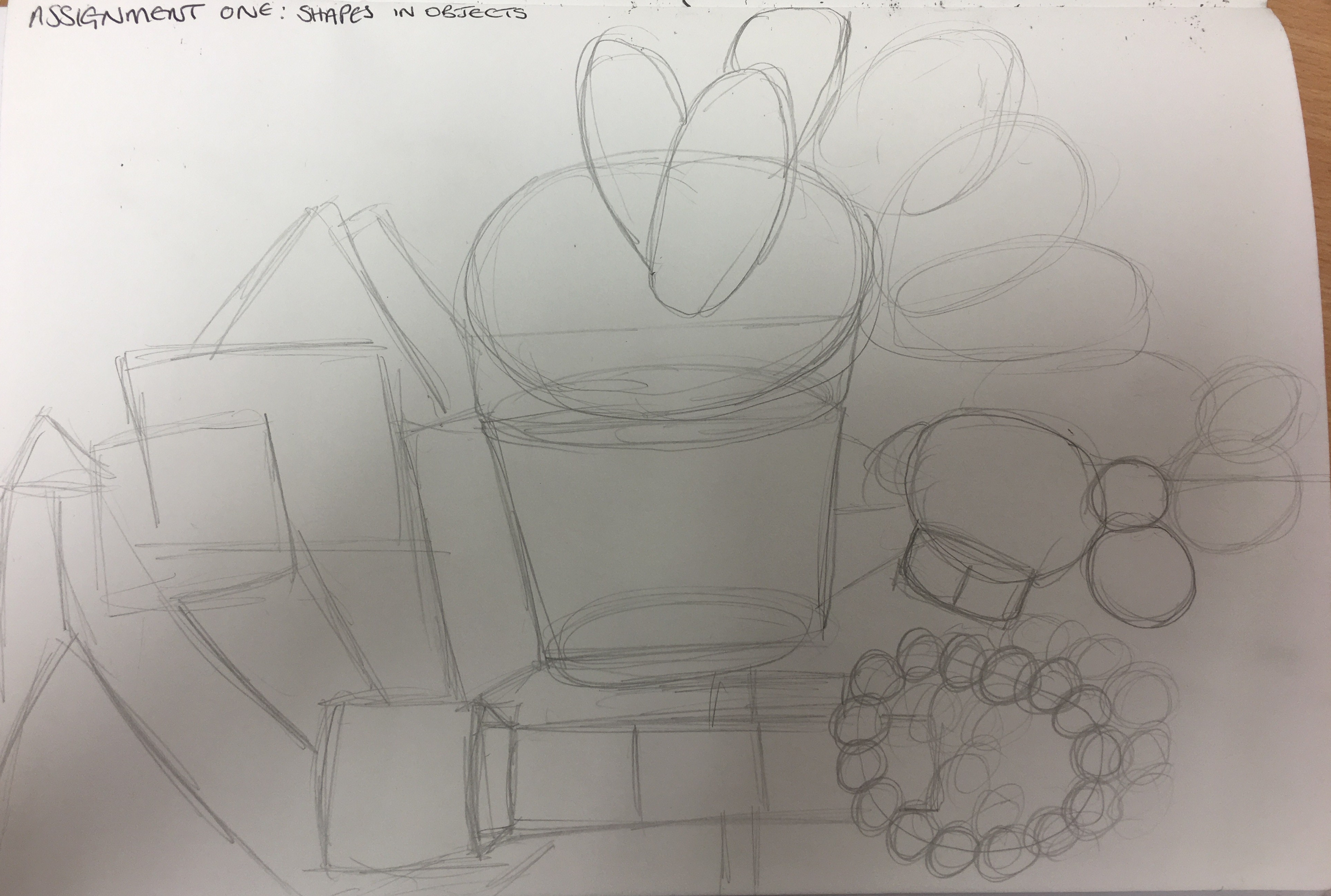
I then created another quick sketch of the basic shapes I could see in the group of objects as a point of reference when completing my final piece.

Assignment One basic shapes seen in group of objects

The End Result

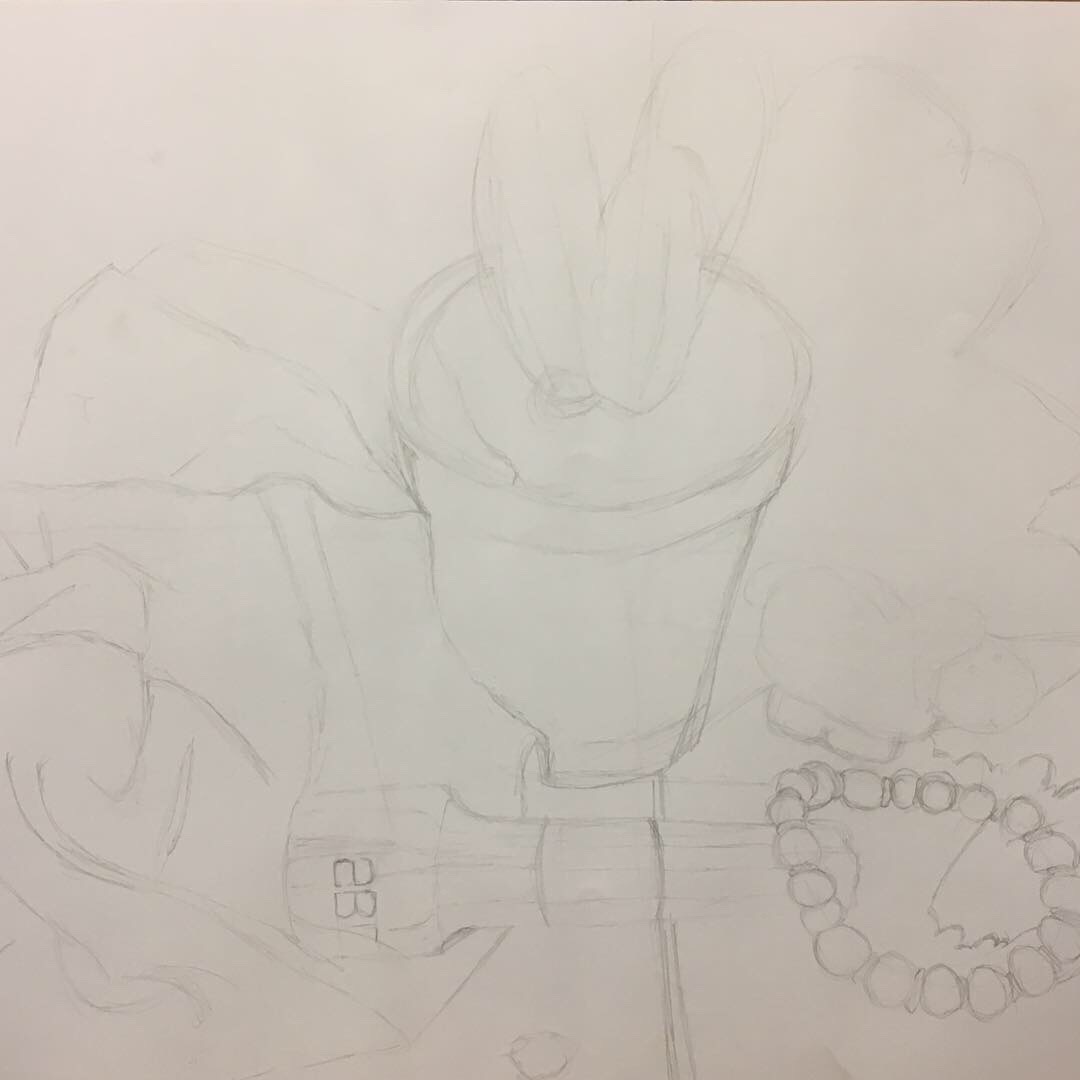
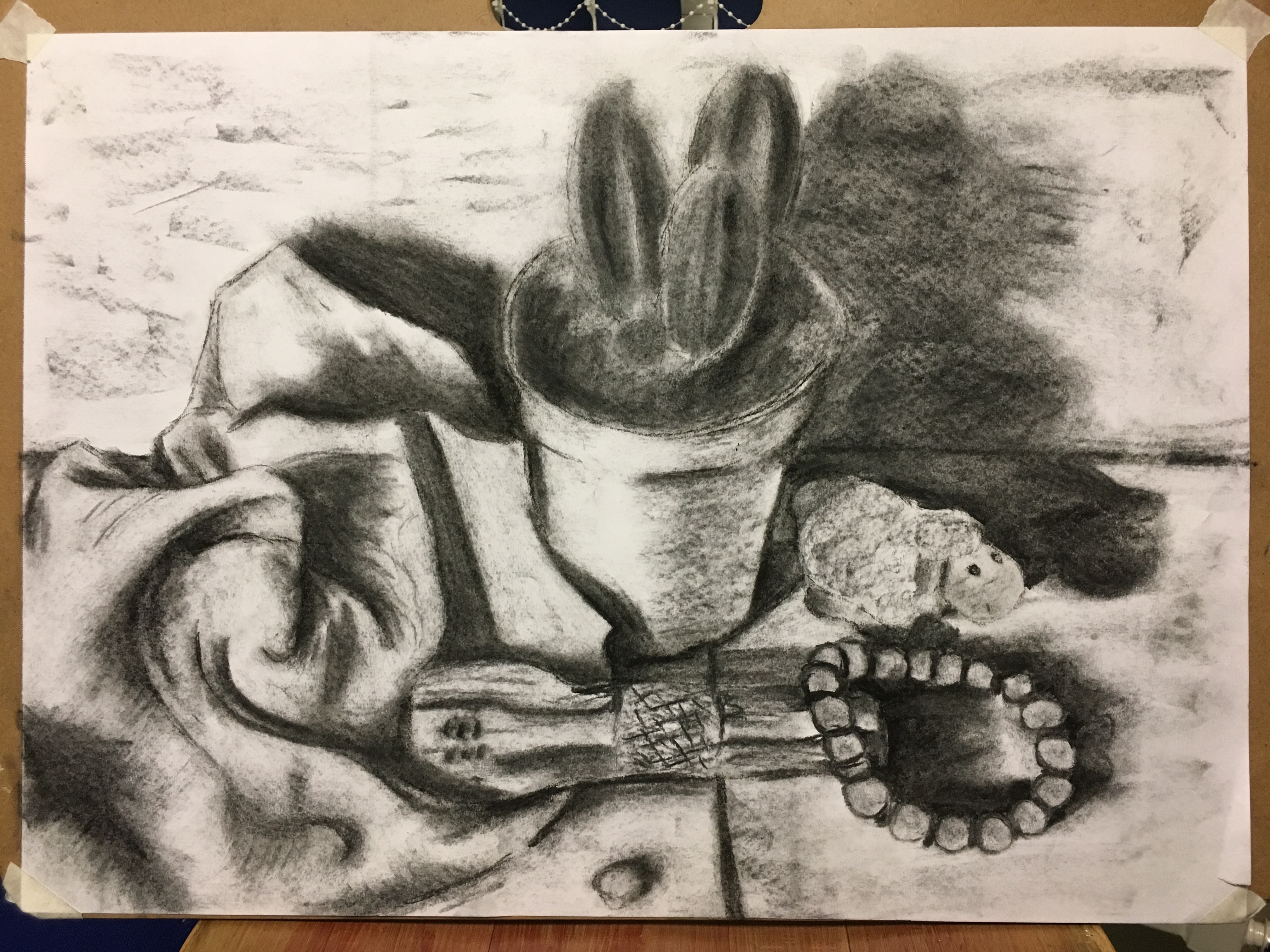
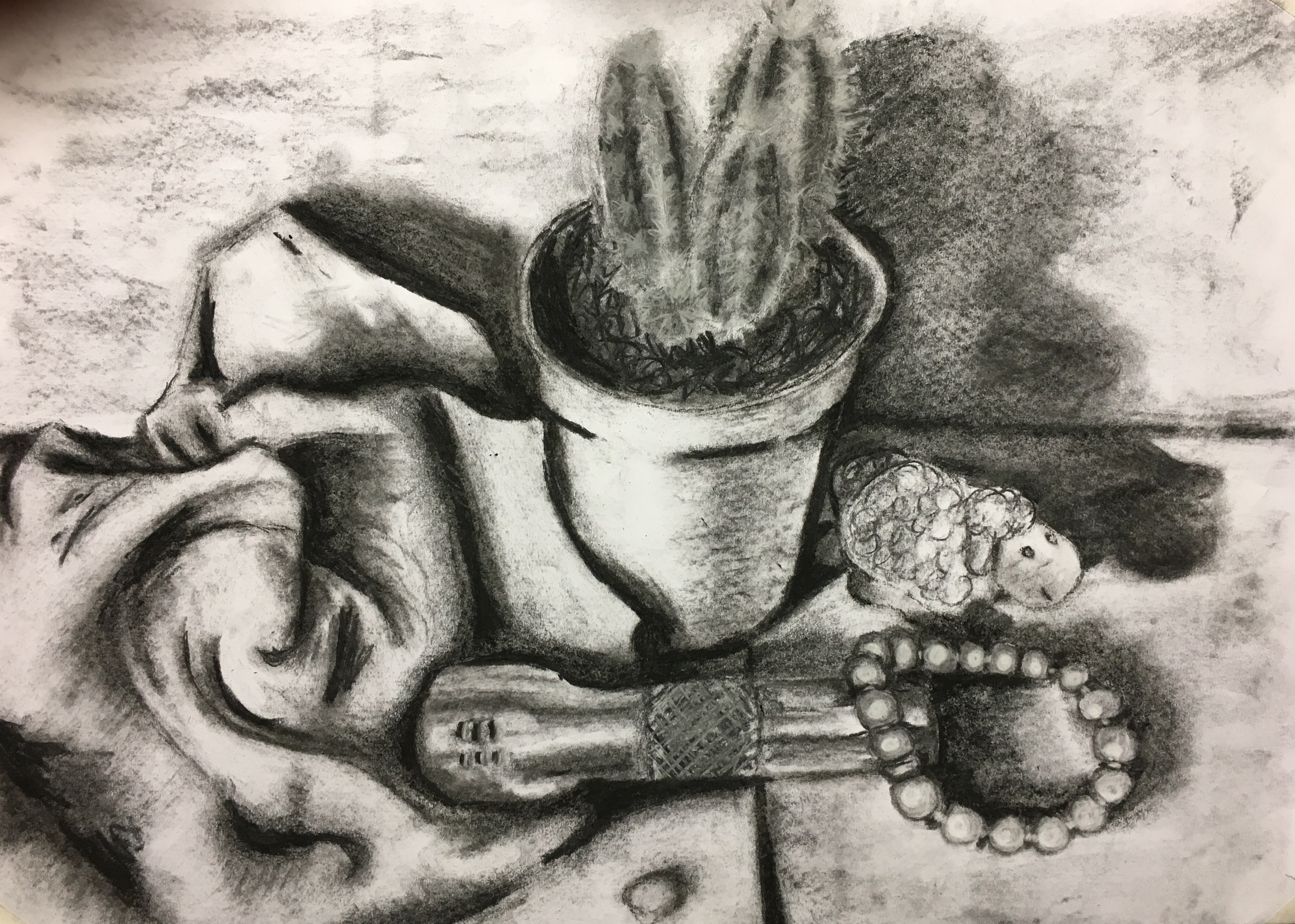
I decided to begin my final piece in charcoal as that had had the best results in my experiments.  I created a sketch of the basic shapes and outline of the piece, then moved on to creating a base layer of shadows and tone with willow charcoal.  Once I had finished that, I worked into the tone to deepen certain areas with a charcoal conté stick, lift areas with the lightest tonal value with a putty rubber and also used a white soft pastel conté stick for such areas as the cactus’s spines due to the ease of control provided.

Overall, I think this piece has been quite successful, however, I think I have misjudged the proportions and scale of the plant pot.  I really like how my pot towel worked out and have found a real passion for fabrics.  I found the metal tool rather hard to recreate due to still not having the best grasp on working with reflected light, but I think my pearl bracelet and plastic toy sheep has turned out rather well.  I really enjoyed creating the cactus, but think changing the spines to white instead of using the charcoal, as I did in my experimental sketch, has lost some of its structure and realism, although it does create a ‘fuzziness’ which is apparent in cacti, so maybe it is actually somewhat better than I think? 

Assignment One: Finished Piece

Looking at the piece from afar, I think I may have overworked the darkest tones and, in doing so, have created a cartoon-like response, which I was determined to try to avoid.  Maybe I should accept that that is just my style of working, but I am determined to improve in this area.  I have definitely learned some skills to take with me into the next part of my course.

Research Point: Odilon Redon

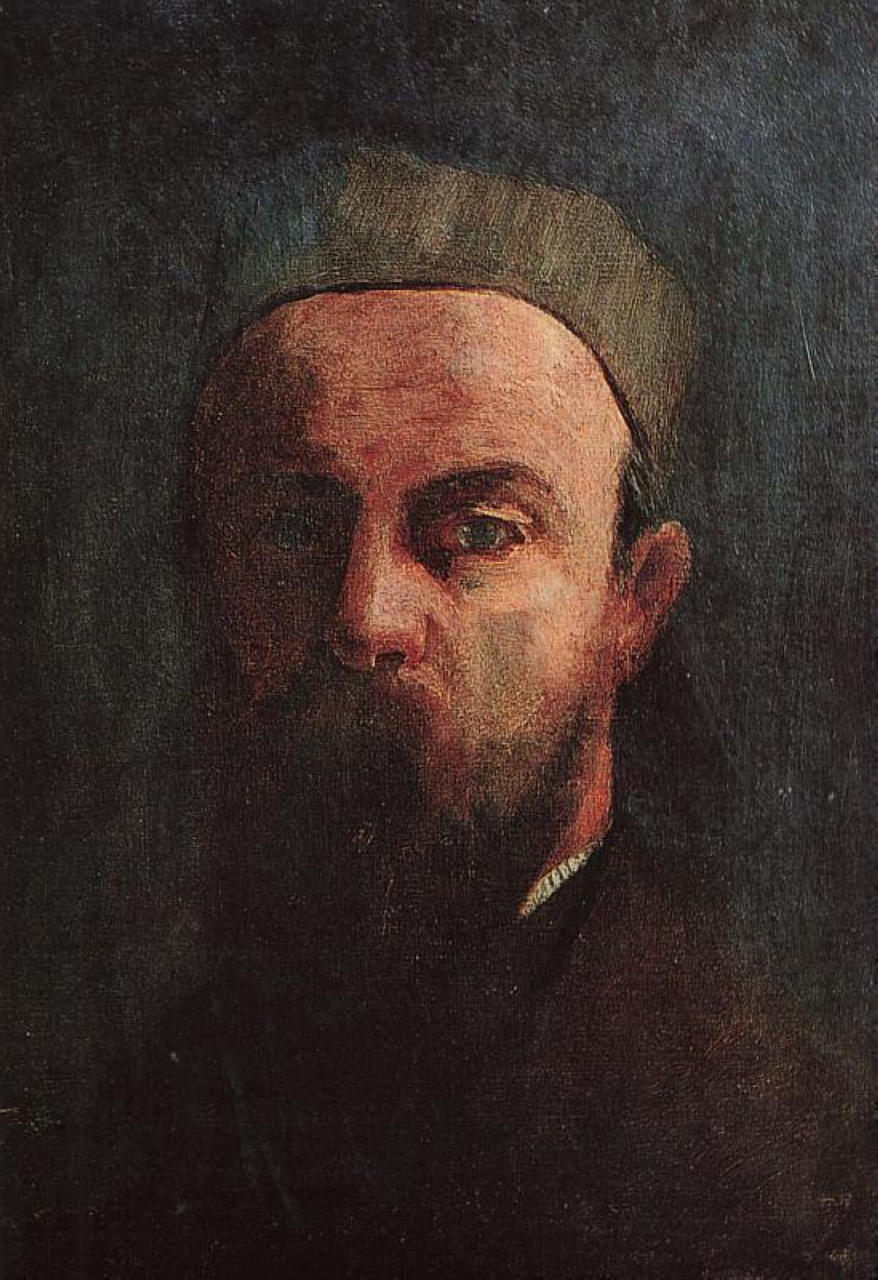
Bertrand ‘Odilon’ Redon was born in 1840 in Bordeaux, France and died in 1916 in Paris.  ‘Odilon’ was given as a nickname to Bertrand by his mother, whose name was ‘Odile’. 

Fig. 1. Self-Portrait (1880)

Redon won several prizes throughout his lifetime, including a drawing prize at school and the Legion of Honour, awarded in 1903, but was a relatively unknown artist until 1879, gaining further exposure in 1884 when he was noted in a cult novel.

Redon was instructed by and studied under Jean-Leon Gerome (painting) and Rodolphe Bresdin (lithography and etching).  Redon enjoyed poetry and was a great fan of the works of Edgar Allan Poe, with their darkness and sinisterism.

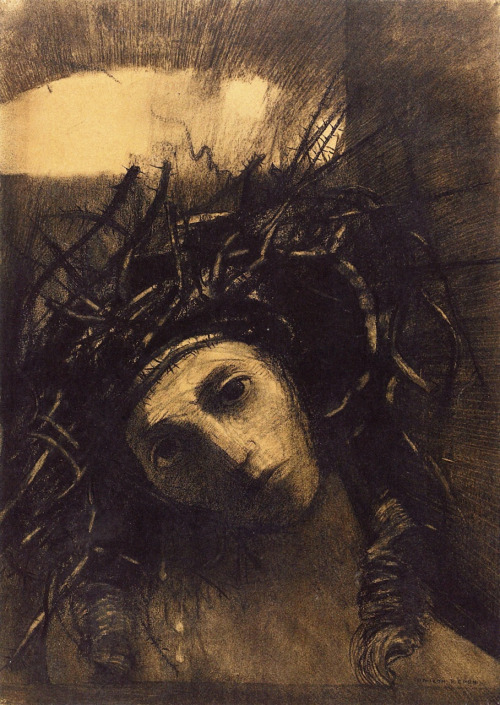
In his earlier years – after being drafted into the army and the war ending in 1871- Redon focussed solely on working in charcoal and lithography, and focussing on the contrast and constant battle between light and dark.  He called these works his ‘noirs’ and continued to create this type of work until he was around 50 years old, creating no more noirs at all after 1900, when he had entered his 60s.

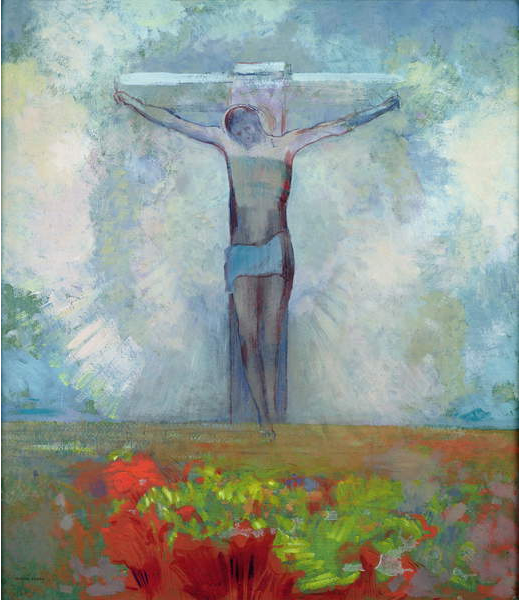
In the 19th century, the Symbolist movement came into full flow and this shows clearly in Redon’s work with his subtle emphasis on the spiritual image behind the physical image.  Whilst Redon was not a Christian, he was born during the time of the French Revolution when the Catholic Church was no longer seen as a legal obligation, allowing other religions such as the Protestant Church and Judaism to begin to thrive and allowed people with minds such as Redon’s, to explore more mythical and supernatural philosophies.  Redon created a great number of works focussing on Jesus Christ, both as a noir and in colour.

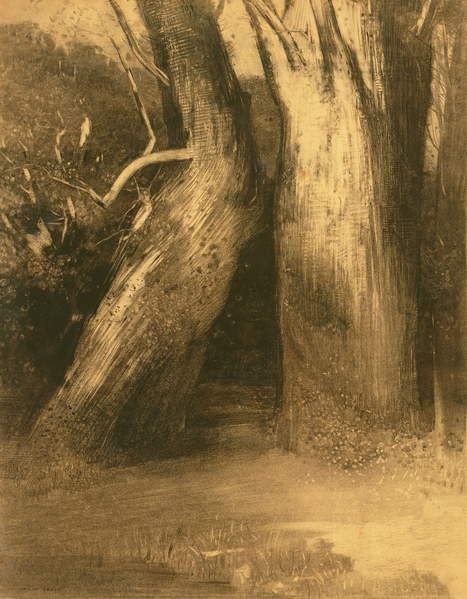
Two Trees, 1875

In 1875, when Redon was in his mid-30s, he created the piece Two Trees.  I believe the name for the piece is very fitting as it is literally what you see when first looking at the piece. 

Fig. 4. Two Trees(c.1875)

Upon first briefly seeing Two Trees, I was not very moved by the piece at all; I found it rather bland and would have simply carried on walking if I were on the apparent path in the picture, ignoring what appear to be ‘just another couple of trees’. 

The piece itself is rather timeless; it could have been drawn in a woodland somewhere 400 years ago, in Redon’s time or even yesterday.  A woodland’s age moves much slower than that of other areas of life (i.e. fashion or architecture) which would be more definitive clues as to the era depicted.

The more I looked at the piece, however, the more I seemed to become enlightened as to the mystery and sinister invitation behind the initial ‘normal’ façade.  I began to imagine where the ‘entrance’ between the two trees would take me if I were to be lured into it; would there be goblins and elves waiting for me?  Perhaps a monster or even a parallel universe?  It seemed to whisk me back to my childhood and fairy-tales of such creatures, I became suddenly enthralled by the piece and the magic which was hidden beneath the surface.  I imagined it as a world in which mere mortals (as I had been initially) would simply continue past the gap and not give it a second glance, but those with ‘the sight’ (as I now find myself to have) would be able to find the hidden entrance between the inconspicuous trees.  This excited me and made me feel almost magically powerful myself!  My inner-child was in her element! 

Moving on to the piece’s creation, I think Redon created the piece outside and that he actually was in front of these specific trees physically, however, I do think he played with the contrast between light and dark to emphasise the sense of supernatural and create a more sinister response.  I believe the piece was somewhat planned to have included the layer of paranormal to it and the result is perfect.

The piece was created with charcoal and paper.  Redon’s skill with the charcoal is fantastic to behold.  I really like how he has included what appears to be a little frottage in the piece (in the bark of the trees and the clear dots at the base of the straight tree).  Whether these were intentional or not, I am unsure, but I think they add another layer of texture to the piece.  Other techniques I can see in the piece are lines and marks going in several directions to show the way the form is moving, blending to create the smooth pathway and stippling (mostly within the leaning tree).

Comparison to Redon’s Other Works

I decided to look into other pieces of Redon’s work and tried to choose pieces from different times in his life, but of a similar composition.  I decided on two pieces: Tree and Stars (date unknown, but obviously pre-1900), created in charcoal, and The Barque (1900), created in oil on a canvas.

Fig. 5. Tree and Stars (unknown)

Tree and Stars, at first glance, appears to be a piece showing a lone tree in an open space slightly more overgrown than that of Two Trees (perhaps a marshland?) with several bushes and floating orbs surrounding it during a late-evening or night-time.

Fig. 6. The Barque (c.1900)

The Barque, at first glance, appears to show a tree on the edge of the land, surrounded by a flowerbed, overlooking a body of water (perhaps a lake?) which then fades off into the skyline.  There is a boat in the foreground with two pale, barely visible passengers aboard during the daytime.

My initial observations of the three pieces and the reason I chose them were how they all contain at least one tree – either leaning to the right or stood tall and straight.  I noticed how the straight trees were both located to the right-hand side of the pieces and the lone leaning tree in Tree and Stars was also placed over to the right-hand side.  I tried to fathom some reasoning as to this – perhaps it was a hidden message from Redon?  Personally, I think it may be an indication of his hand dominance belonging to his left side potentially.  I say this as, if you were to actually be the two trees in the image, the tall, straight tree would be the left-hand side and the weaker, leaning tree would be the right-hand side.  I also noticed in Redon’s self-portrait that his left-hand side is proudly displayed in the light, whereas his right-hand side is hidden in the darkness – perhaps another indication as to his dominant side? This got me thinking as to what messages I would like to put across to my viewers – whether directly or indirectly – and what I would like people to know about me and my private life that I would not necessarily always say aloud.

All three images seem to have a clear three-way divide also; Two Trees and Tree and Stars both have a sparse background and foreground as well as a cluttered middle-ground, but The Barque seems to create this divide in its colouring – the background is mainly blue, the middle-ground rather white and the foreground very bright and colourful.  I wondered whether this was an attempt by Redon to include his love of Japanese art and their technique of splitting images three ways perhaps.

Similar to Two Trees, these two pieces seem rather unremarkable upon first viewing them, but hold more intrigue and mystery the more you observe them.  I noticed how Redon has used darkness and light within these pieces in slightly different ways; where Two Trees uses shadow to create the sinister image of an entrance between the trees, Tree and Stars and The Barque appear to focus more on the light to emphasise the magical qualities of the pieces – the ethereal people on the boat and the floating orbs. 

I decided to make a list of all similarities and dissimilarities I noticed between the three pieces and have shown these in the grids below:

Similarities and Dissimilarities

Two Trees Tree and Stars The Barque
Pre-1900   Pre-1900 1900
Two trees: leaning tree (left) and tall, straight tree (right)     One tree: leaning tree (right), no straight tree One tree: no leaning tree, tall, straight tree (right)
Focus drawn centrally to the trees and the dark space between them Focus drawn centrally / right-hand side to the leaning tree   Focus drawn to the right-hand side to the bright and colourful tree
Open expanse to the foreground and background, busy middle-ground   Open expanse to the foreground and background, busy middle-ground Open expanse to the background and slightly to the middle-ground
Daytime – to create a false sense of security and peace in the mystical setting?   Night-time – to create a false sense of eeriness when the stars actually appear so gentle and peaceful?   Sunset? Representing the approaching end of the ethereal couple’s time on this plane?  
Texture created by lines     Texture created by lines Texture created by colours
Bushes but no flowers     Bushes but no flowers Flowers and slight greenery
Two apparent directions: from the bottom left and top right, but no obvious source seen in the piece   One apparent direction, but no apparent source One apparent light source from a setting sun in the background
No supernatural beings or objects visible in the piece, only what is conjured in the mind’s eye   Ethereal floating ‘heads’ which must represent the stars?  One of which appears to be glowing, as informed by the lines moving outward from it in a circle around it.  I think this confirms the suspicion of it being a star.   Ethereal beings on the boat which are not immediately clearly visible when first viewing the piece but become clearer upon closer inspection.  The beings appear to be in conversation with each other and rather closely located given the apparent space in the boat.  One appears to be a male and the other a female, so I believe this represents a married couple perhaps making their way to the next life / plane?  
Monotone and subdued colouring focussing on the contrast between light and dark as opposed to colours.  The darkness between the two trees is, I feel, in competition with the two trees as to the main focal point of the piece. Monotone and subdued colouring throughout, offering little assistance in finding the viewpoint of the tree besides from its physical-being.  The stars, even though in contrast to the darkness, appear somewhat subdued and do not immediately jump out as a main focal point.  This also adds to their intrigue as, as with the Two Trees, humans would not immediately see the mystery of the stars.   Vibrant colours within the forefront with slightly mellower colours in the background.  The figures are very subdued and are clearly not meant to be the first focal point before the vibrant tree. This adds to their intrigue as, as with the Two Trees, humans would not immediately see the magic within the piece.  

Overall, I really like the three pieces.  I am more drawn to Redon’s earlier work, with its darkness and moodiness as opposed to his later almost happier and eerily peaceful works, almost as though Redon had moved along a sort of spectrum throughout his life’s journey.  Whilst I do not know for sure when the Tree and Stars was created, I believe it must have been either around the time of the Two Trees or maybe not too long after it, as it still has the same eeriness, however, it seems less sinister in its outcome, leading me to believe, perhaps, that he created it toward the more peaceful part of his life, if continuing along the train of thought regarding a spectrum.  I think Redon’s work may indicate a potentially troubled childhood and fear of the world – he did, after all, endure a war – moving more towards a calmer sense of being towards the end of his life.  Whilst I do not think his appreciation for all things dark and mysterious ever left him, I think he may have found some inner peace towards the end and that perhaps the two people on the boat were meant to represent him and his wife and how they had come to terms with the mysteries of the world and would welcome the next adventure with open arms.

Moving Forward…

I definitely want to create some pieces with Redon’s work in mind – adding a touch of the sinister and darkness to my own work – and it is definitely something I want to experiment with further down the line in my journey.

List of Illustrations

Figure 1. Redon, O (1880) Self-Portrait [Oil on canvas] At: Wiki-Art (Accessed on 19 February 2019)

Figure 2. Redon, O (1894-1895) Christ (also known as Head of Christ Wearing a Crown of Thorns) [Drawing – Charcoal]  At: The Athenaeum (Accessed on 19 February 2019)

Figure 3. Redon, O (c.1910) The Crucifixion [Oil on card] At: Bridgeman Education (Accessed on 19 February 2019)

Figure 4. Redon, O (c.1875) Two Trees [Charcoal on paper] At: Bridgeman Education (Accessed on 19 February 2019)

Figure 5. Redon, O (unknown) Tree and Stars [Charcoal] At: Bridgeman Education (Accessed on 19 February 2019)

Figure 6.  Redon, O (c.1900) The Barque [Oil on canvas] At: Bridgeman Education (Accessed on 19 February 2019)

Citation

Wikipedia (unknown) ‘Odilon Redon’ In: Wikipedia.org [online] At: https://en.wikipedia.org/wiki/Odilon_Redon (Accessed on 20 February 2019)

Odilon-Redon (unknown) ‘Biography of Odilon Redon’ In: Odilon-Redon.org [online] At: https://www.odilon-redon.org/biography.html (Accessed on 20 February 2019)

Encyclopaedia Britannica (22 July 2010) ‘Odilon Redon’ In: Britannica Library [online] In: https://library.eb.co.uk/levels/adult/article/Odilon-Redon/62986 (Accessed on 20 February 2019)