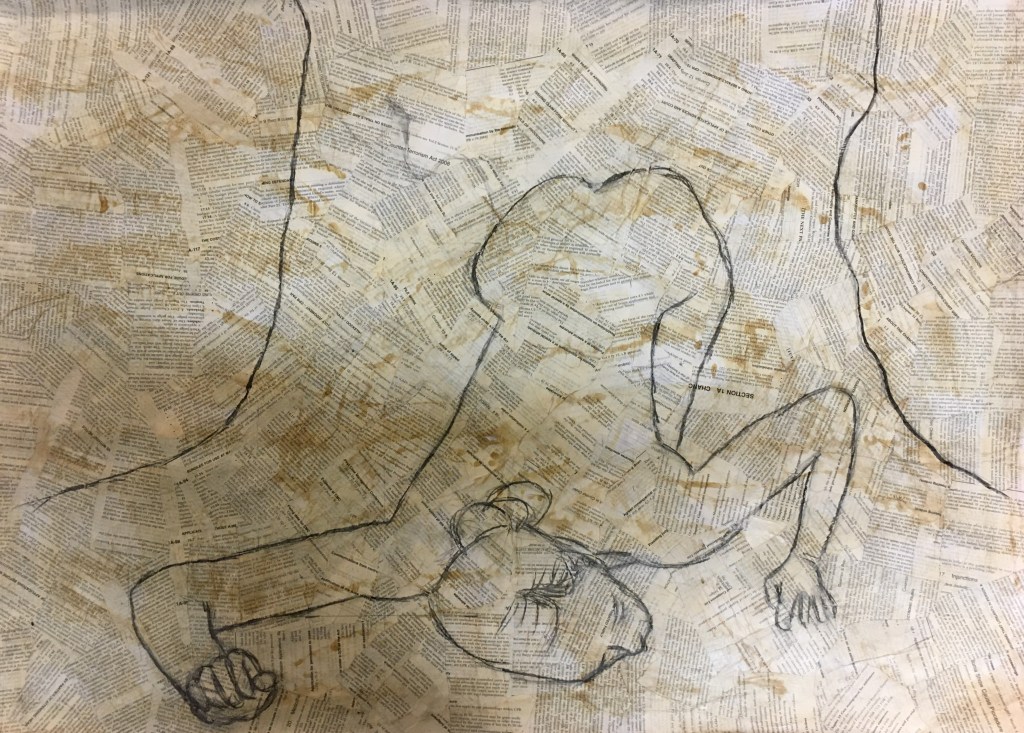
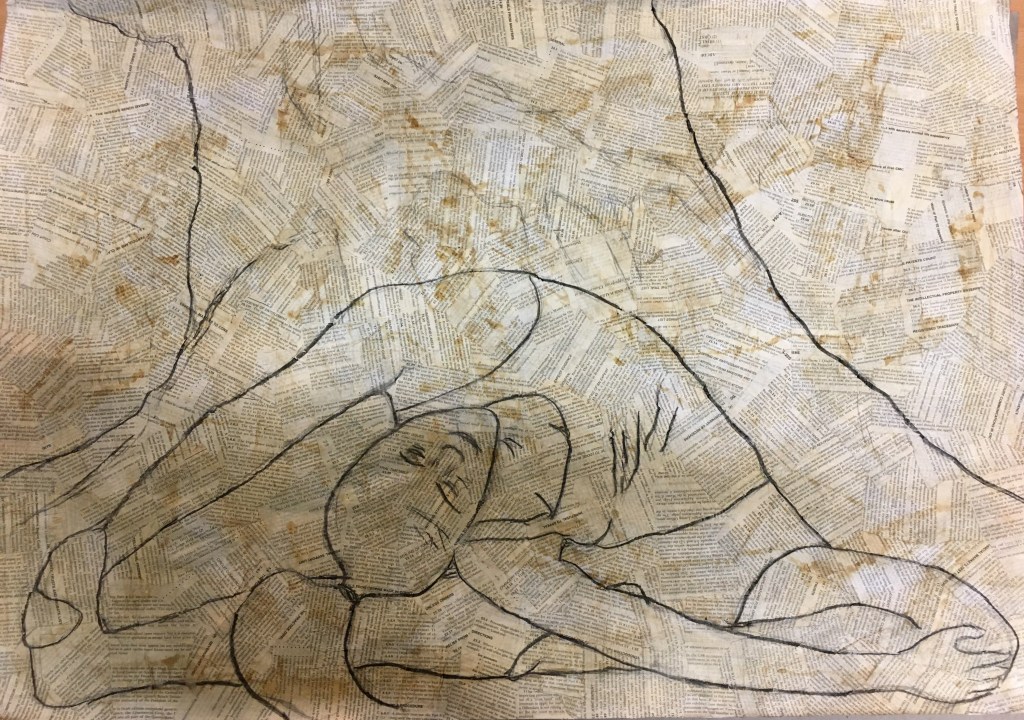
I began my final piece by choosing two subjects which I could not decide between and started with two pieces of A1 paper (knowing larger scales work best for my method of working). It was my hope that as I moved through the creative process with both pieces, it would become more apparent to me as to which piece should become my final piece and which was more successful than the other before finally settling on the one final option.
Surfaces
1
2
Surfaces
I decided from my experimentation that the strongest result was from that of a surface of newspaper and also the ink as I found these the most appealing, however, I later changed my mind and decided from looking at earlier experiments that I actually preferred found papers due to their cleaner black and white appearance as opposed to the grey of the newspaper. I also then decided that using tea staining would create even more texture than the ink due to the way in which ink appeared to dry smoothly, whereas tea staining would dry where it lay, creating a marbled effect on the found papers.
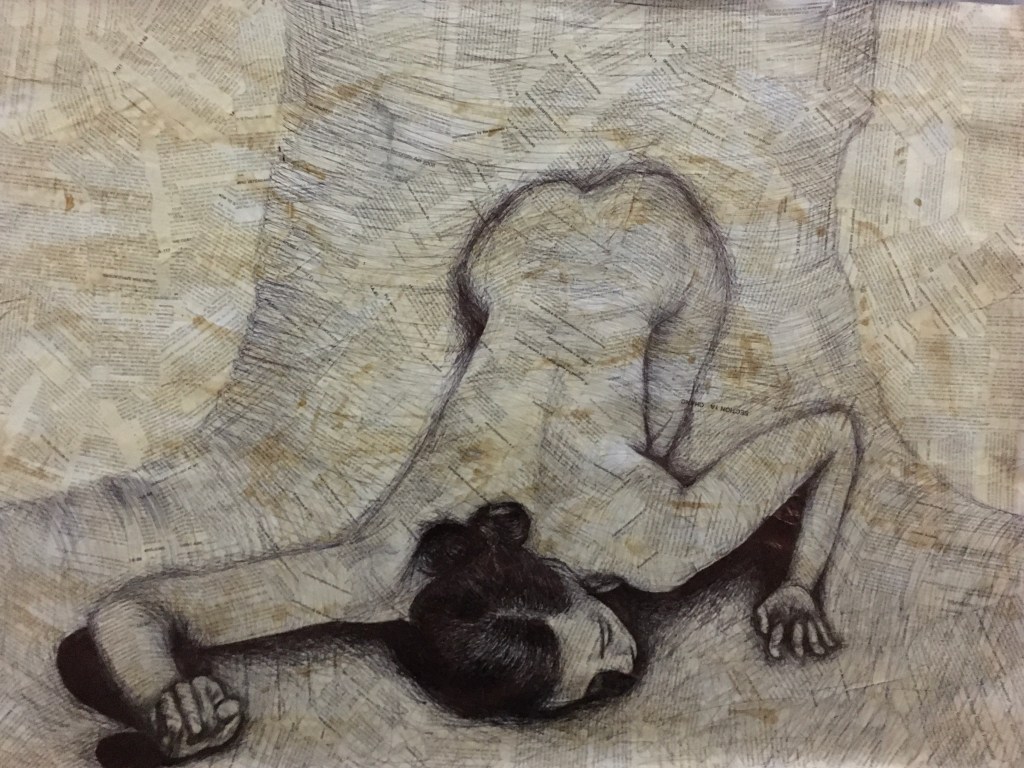
Once this surface was ready to work on, I decided to draw a grid on both pieces to assist me with laying my chosen subjects down roughly but accurately. I then removed the grids and outlined the subjects in charcoal to assist in being able to see it easier whilst working into the pieces.
It was at this stage that I realised that the second of my pieces was not really working. I found that the human subject only reached halfway up the page with the tree subject covering the remaining half of the page. I felt that if I were to continue, the tree would become more excess space than interesting detail, as well as creating a bit of a battle with the human subject to claim the foreground of the piece, when I would actually prefer the human subject to be the main focal point and the tree important but secondary in the background.
Initial Detail of the Human Subject in Biro
Face, Hair and Hands
Detail of face, hair and hands
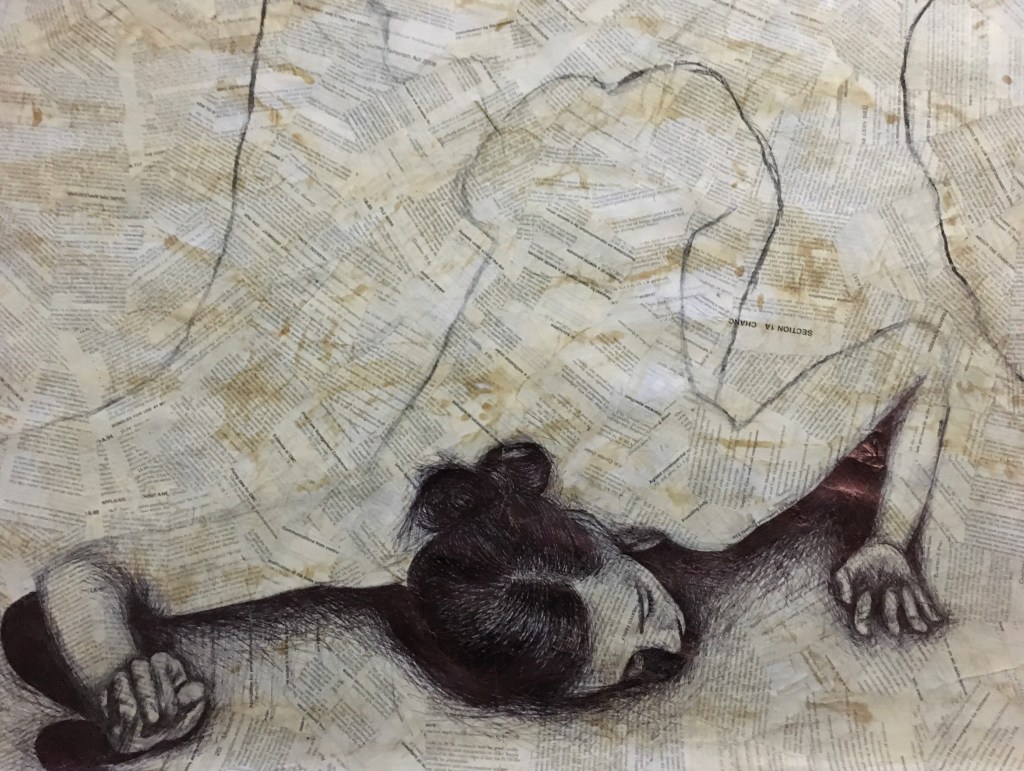
I decided to begin filling in the detail of the human subject by using black biro, as I knew there were a few very fine details which needed to be considered very delicately (the face, hair and hands) and my earlier experiments have led me to understand that biro is my strongest tool in this area.
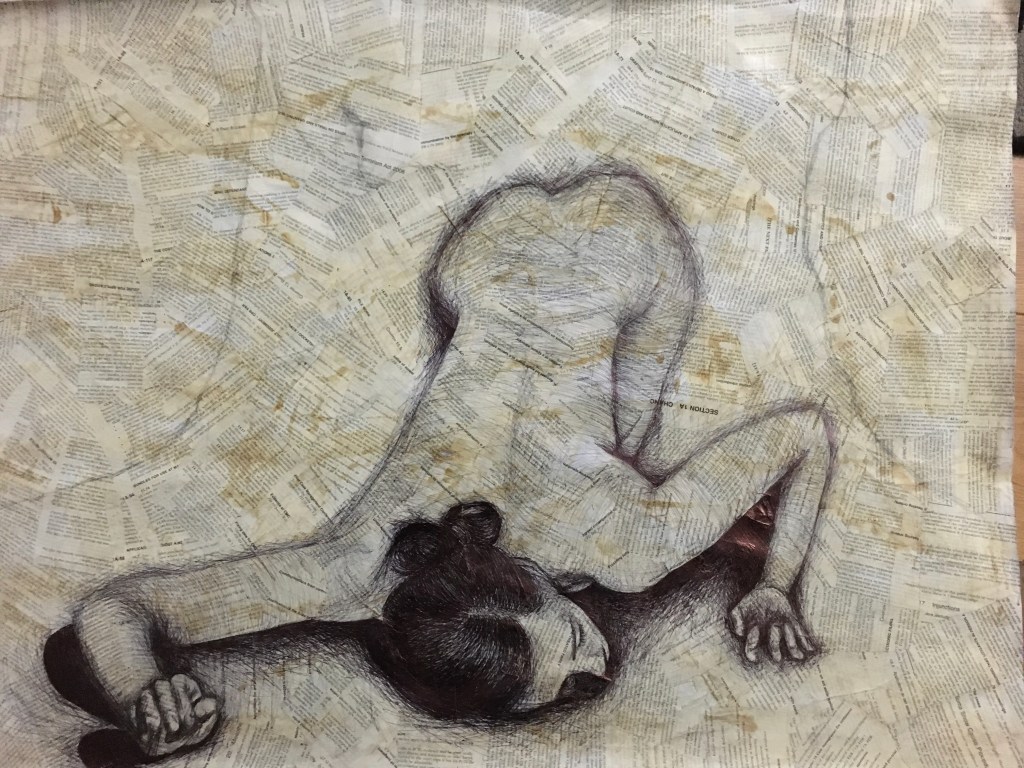
When working on these areas, I decided not to draw the actual shapes I could see, but the shadows, patches of tone and the contrasts within them all as I wanted them to be as deep and as strong as possible to create depth and the sense that the human was quite three-dimensional. With regard to the hair, I decided that the biro was the strongest tool for the base shape and flow of the strands as I could manipulate the direction and shape of my lines to create a realistic representation, but also to help assist the viewer in distinguishing the hair from the deep shadows and the rolls which make up the bun at the back.
Arms, Torso, Buttocks and Leg
Once I had completed the finer detailed areas, I moved on to the remaining areas of the human subject’s body and created subtle marks and cross-hatching to show the movement of the skin over the underlying bones and muscles to create depth and shape within the flat surface and to subliminally inform the viewer the direction the lines are moving in and the roundness this adds.
Detail of arms, torso, buttocks and legs
Initial Detail of the Tree Subject in Biro
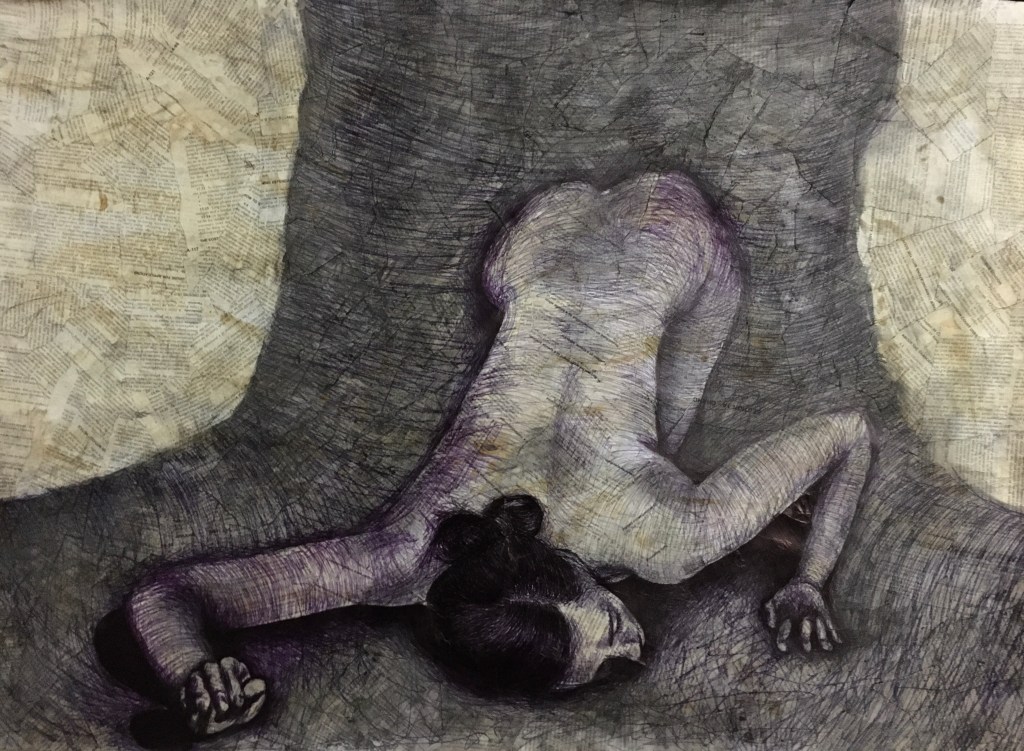
I then began using the same method with the biro for the tree as I had the human form, to stay light and delicate, but to simply give the tree its rounded form by subliminally showing the direction the lines are moving in.
Detail of Tree Subject
From here, I added a layer of charcoal to the tree and sealed it with pastel fixative.
I was quite surprised by the changes which developed in the marks created with the pen from the application of the fixative as it seemed to make the lines bleed somewhat and bring out the different under-layers of colour used to build the ink to its black hue. I actually rather enjoyed the surprise result and decided to try and work with it.
I later returned to my piece, having worked in stages throughout the development, deciding that the single layer of charcoal on the tree was effective, but needed more work to show a differentiation between the ground, the roots and the trunk of the tree, but also to stop the human subject from appearing to float in the air.
Additional Media Usage
I then moved on to adding several additions to the piece.
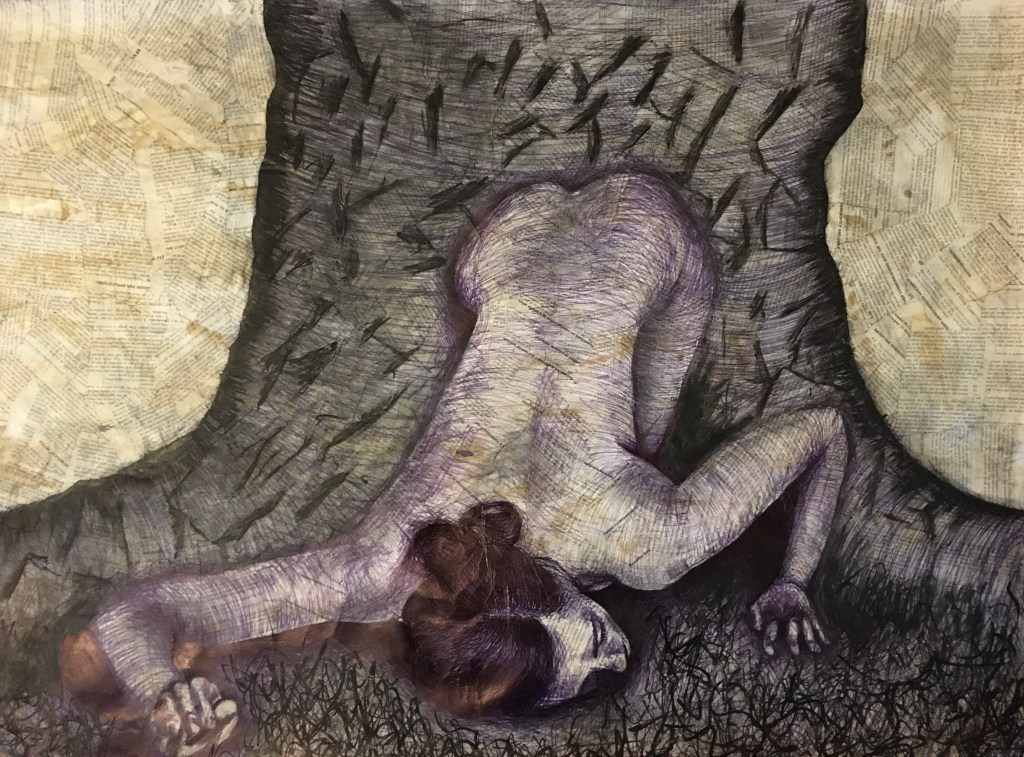
Firstly, I used a putty rubber to redact some of the charcoal to increase the definition around the edges of the collaged paper with the intention of this to subtly stand out as though real bark would itself. This did not really appear to work so well as the layer of charcoal was actually rather thin in the first place, so not much was lifted. There was also the matter that I had used the pastel fixative a little too prematurely, in hindsight, so I decided to rethink my methods and come back to the piece at another time with fresh eyes.
When I returned to the piece, I used the black biro to work back through the piece to create differentiated lines to break up the single directional lines previously created and to deepen some areas I had already created, but felt I had overlooked slightly.
Next, I added some black marker marks to the piece and finally a layer of black acrylic paint pens as I liked how the layers of black lines seemed to deepen and created that layered effect my tutor had tried to get me to develop earlier in the course. I also worked on creating a definition in my grounds by bringing a sense of grass to the area beneath the model and at the base of the tree’s roots.
I used the acrylic marker to also make apparent the different edges of the paper I had used to create a collage, within the tree to emphasise the bark. I felt doing this would be a much more natural way of creating the bark as opposed to trying to create my own example of the same. I felt it rather fitting to emphasise the use of paper in a piece expressing a love and appreciation of trees and the extent to which we humans rely upon the same.
Reflection
Once I had finished my piece, I took a while away from it to be able to see it with fresh eyes before returning to be able to reflect without continuing and potentially overworking the piece.
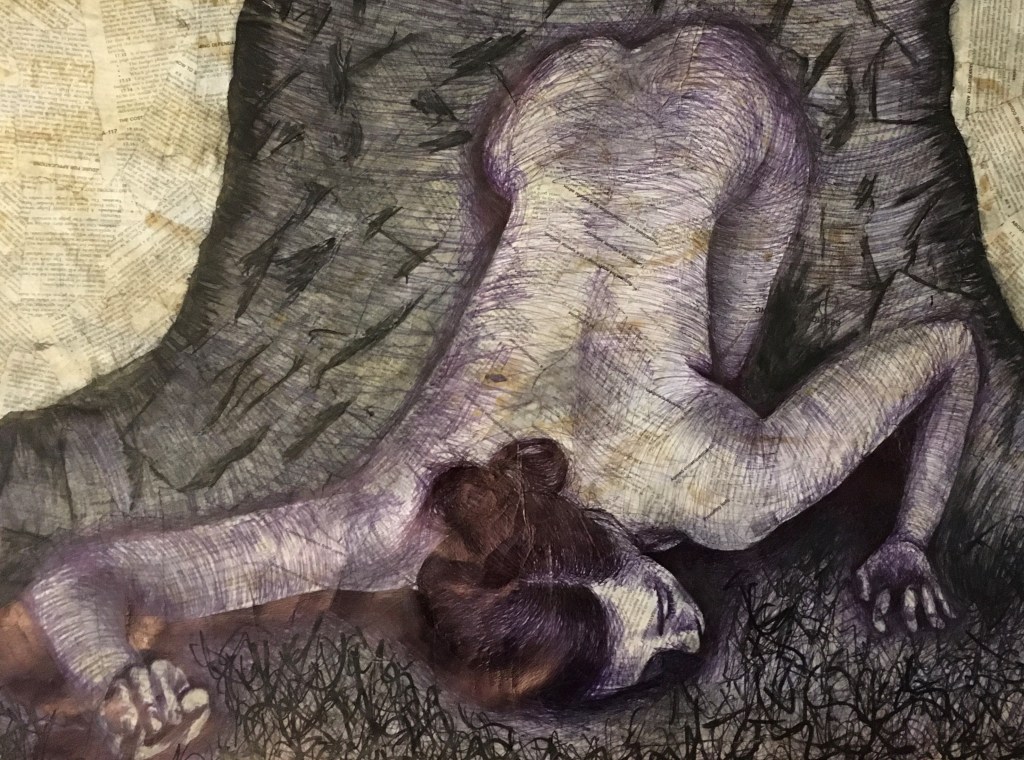
I think I could potentially added a little more shadow to the human subject’s flank on her right-hand side to assist in grounding her further and showing the form of the root on that side also. I think I could have worked further with the bark markings to create shadow to one side and add more texture as the result shown above appears a little cartoon-like.
Finally, I think there could perhaps be some excess space within the piece which could be removed and the piece cropped to have more of an impact (as shown below), however, I do think the space in the result above does add to the grandness of the tree.
For this assignment, I decided I wanted to recap on some of the key points I took from the first Part of the course, as well as those from this Part of the course, so as to try and keep a steady flow throughout my progress and to keep my memory of these things rather fresh.
Key Points to Remember
Part One: Form & Gesture
Work on a larger scale – A2 or A1;
Practice the shapes of the objects;
Create a space with interesting shapes and angles;
Look at the spaces between the objects as well as the actual objects themselves;
Use a range of drawing tools, mediums and surfaces;
Consider such things as the height, depth, textures, tones and how these will translate into a visual form;
Practice skills in creating perspective and scaling of pieces;
Consider methods used by Redon, Morandi and Moore in their works;
Reflect on and review the work using the Assessment Criteria.
Choose a medium which fits the subject, mixing mediums together to create interesting results;
Layer with darker marks or begin with the darkest and move to the lightest in layering;
Consider the positive and negative space of the piece;
Consider the choice of objects used, the composition of the piece, the background to the piece, the point of view, whether portrait or landscape and the lighting used;
Consider how to create the image in just line or how to create tone by using colour or by simply being monochrome;
Create several quick sketches to find the most interesting;
Reflect on and review the work using the Assessment Criteria.
Preliminary Experiments
I had decided earlier on that I would work with my fireplace to create my assignment piece and used my later exercises to create some of the preliminary work for the assessment.
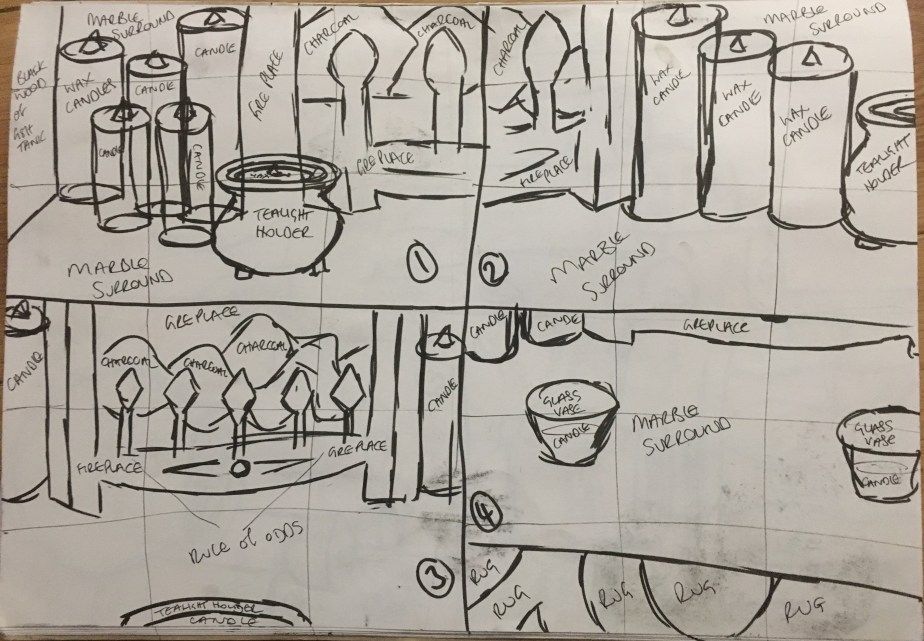
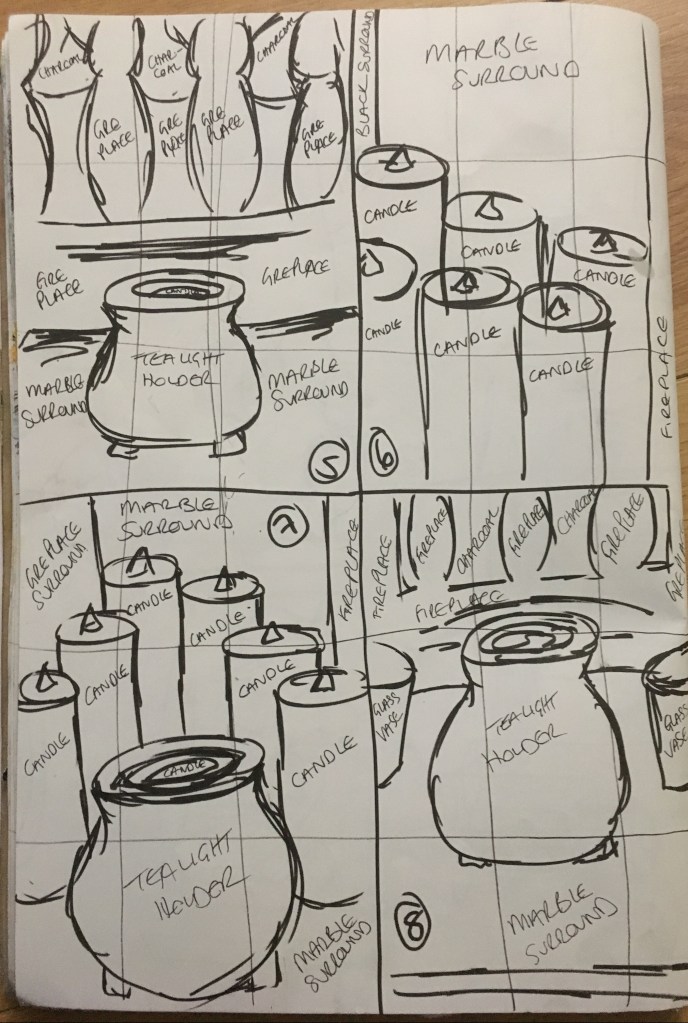
From here, I decided to carry out several experiments within my sketchbook. I began by reflecting on my research of composition within pieces and created several quick sketches in Chinese brush pen, simplifying the objects as much as possible to their general shapes and divided two pages into four.
Landscape Composition Experiments
I used the first page to create some sketches in landscape of some mixed combinations of objects and their placements. I then draw some quick rough lines over each box to split the images into nine boxes to assess them for the ‘Rule of Thirds’. My favourite of these four sketches was actually the first of the images due to the amount of information within in. I was surprised to find this as I do quite like images with less visual information. My second favourite was number four as I think the central square definitely speaks of an absence of something important between the two vases, however, overall I think the image a bit sparse and bland.
Quick sketches of different compositions in landscape format
Portrait Composition Experiments
On the next page, I created four images in portrait, again mixing the objects up and focussing on different sections. Again, I split each image roughly into nine squares. My favourite of these four sketches was number seven as it appears the candles are gathering around the tealight holder and feels rather cosy.
Quick sketches of different compositions in portrait format
Positive and Negative Space Experiment
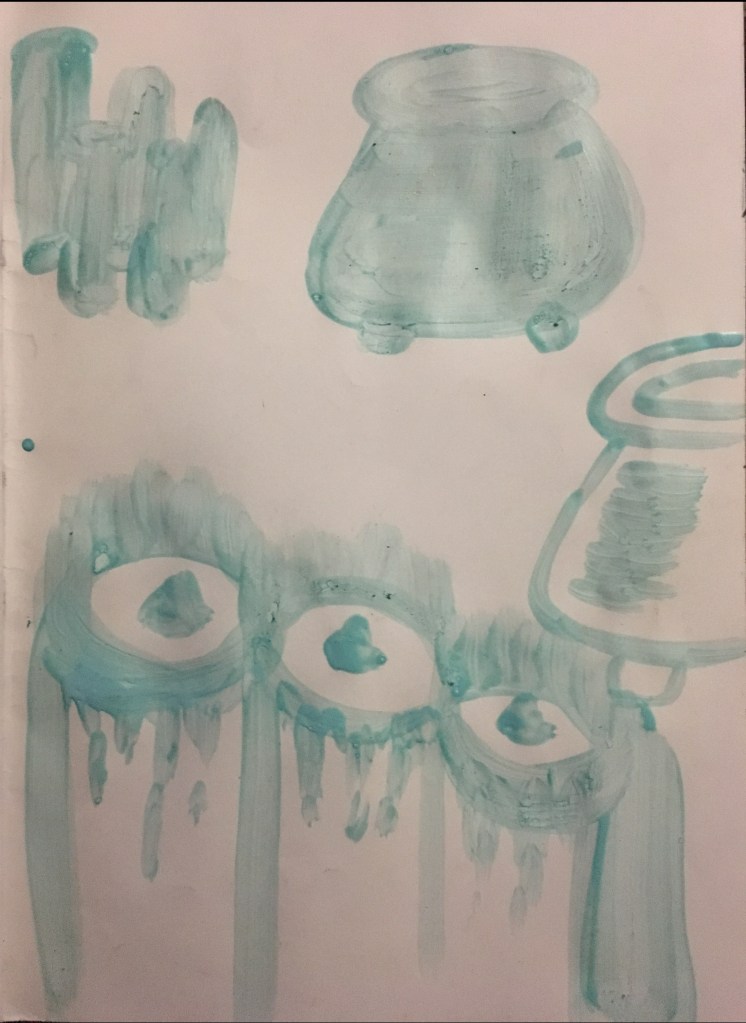
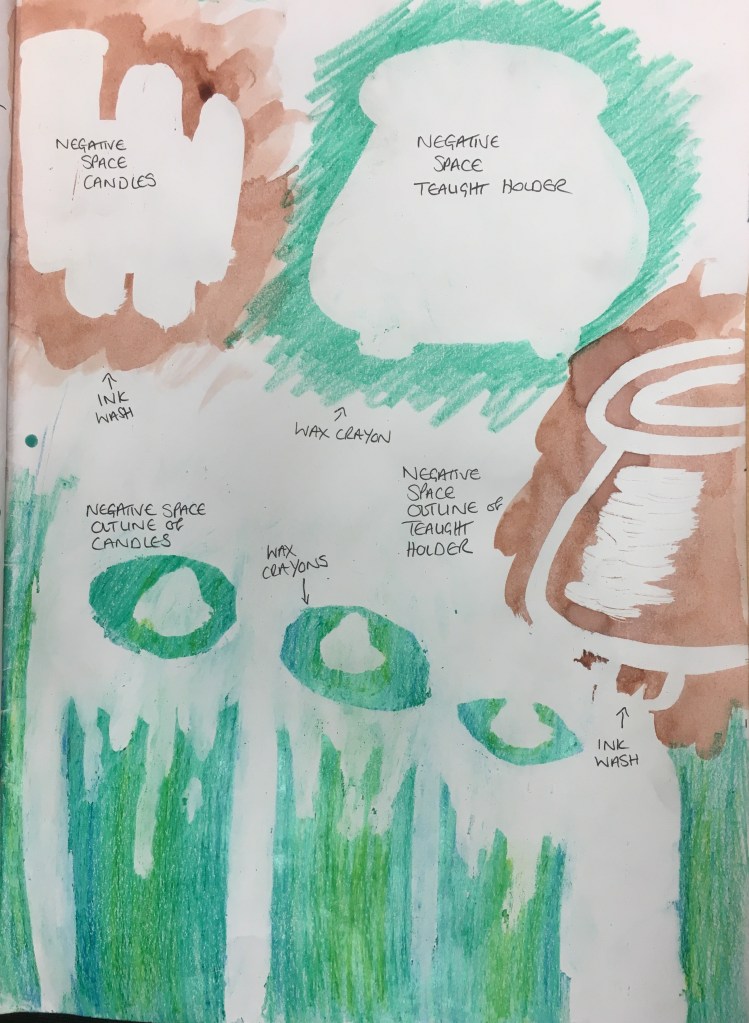
From here, I picked a couple of the objects to investigate further and to analyse the positive and negative space surrounding them, as researched in an earlier section of this Part of the course. I used masking fluid to ‘draw’ the candles in a group and then the tealight holder, filling the objects with the fluid. Then, I drew the outline of the candles and the dripping wax on them and then the outline of the tealight holder. I used an ink wash over the top of the silhouette of the candles and the outline of the tealight holder and then used a wax crayon over the silhouette of the tealight holder and the outline of the candles. I rather liked the outline of the candles after the masking fluid had been removed as the dripping wax looks rather realistic and the ability to mix the greens and blues before removing the masking fluid allows for a fair amount of expressive freedom without ruining the crisp contrasting lines when removed.
Masking fluid silhouettes and outlines
Objects after masking fluid removed
Experiment with Tone in Black and White
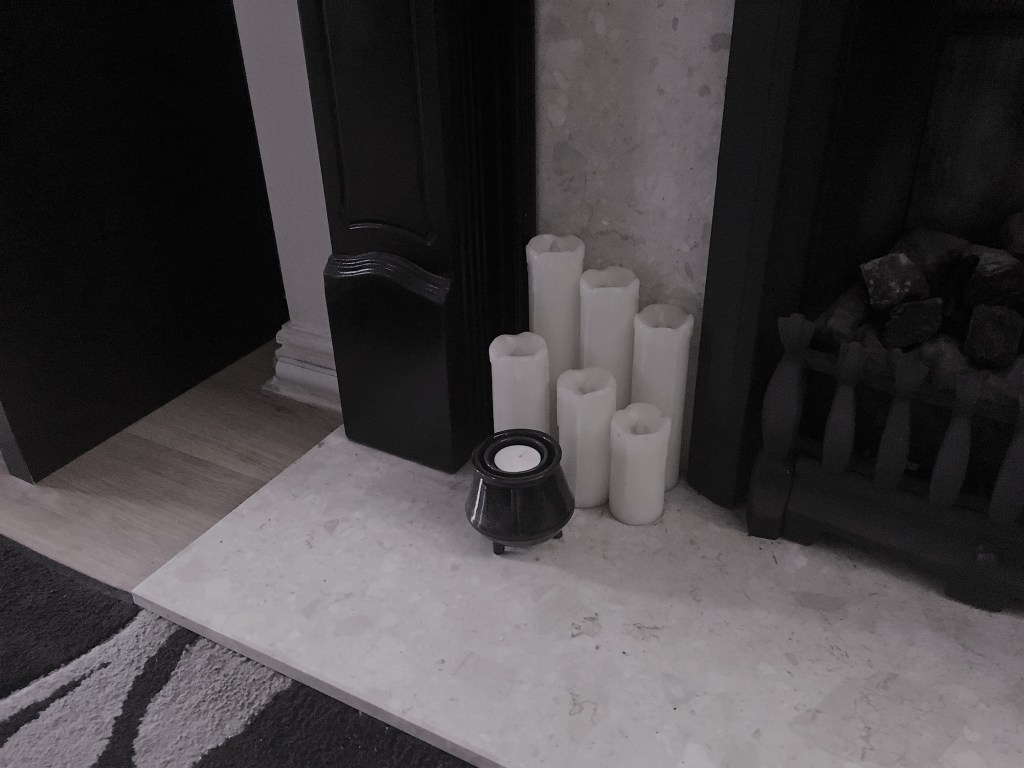
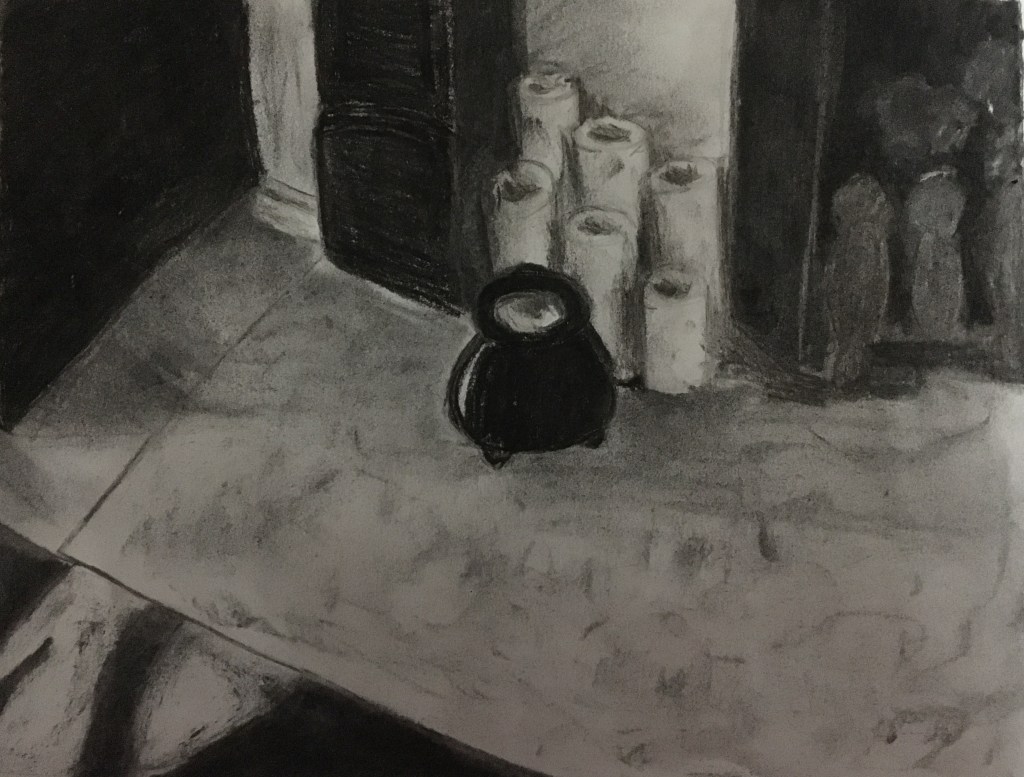
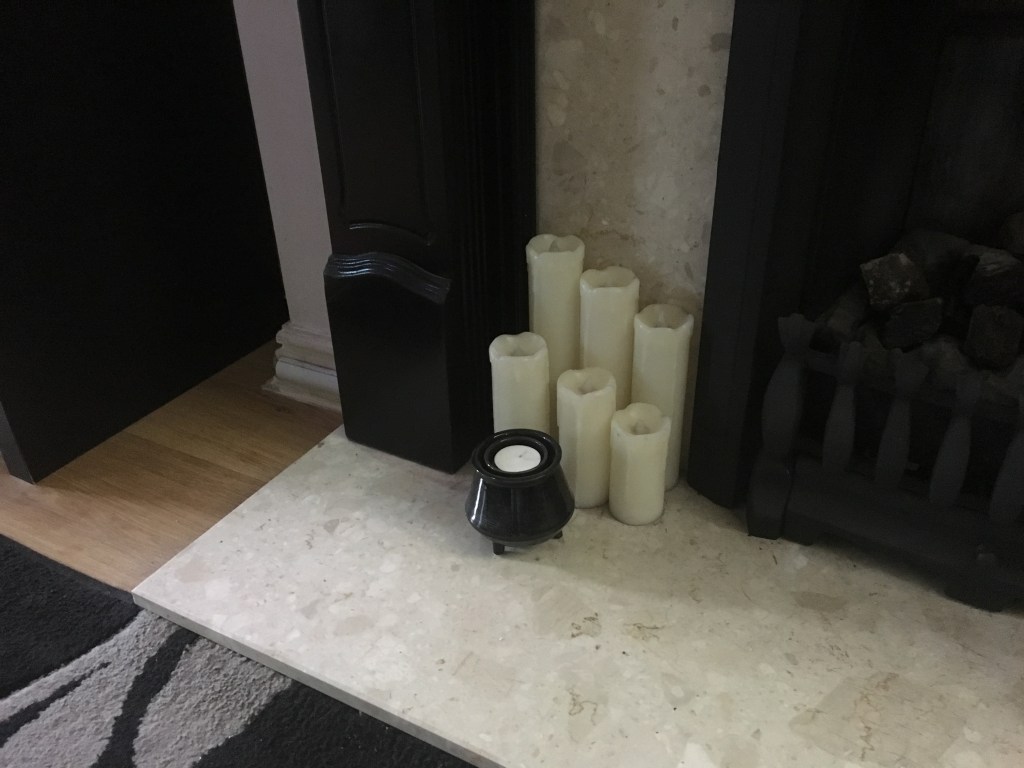
I had already settled on the composition I had created in my last exercise of the landscape tidy composition as this was the one I felt most comfortable with, but also which allowed me to explore most of the textures and surfaces. I had already created a larger scaled version of this for my final piece for the previous exercise, however, I decided to recreate it again quickly to refresh my memory of what was included and to also add some finer details which I had excluded from the previous piece due to being able to see more through the assistance of a black and white photograph of my chosen composition.
Black and white image of chosen composition for sketchbook experiment
Black and white experiment of chosen composition in sketchbook
Experiment with Detail and Tone in Colour
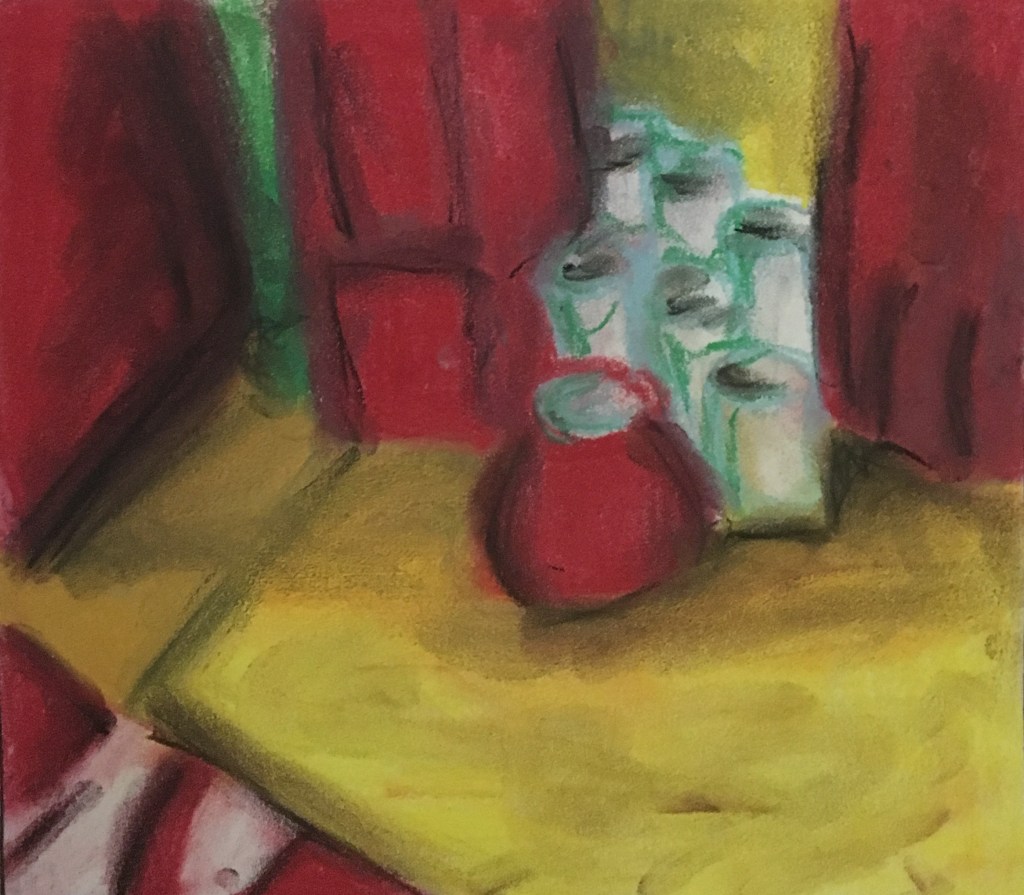
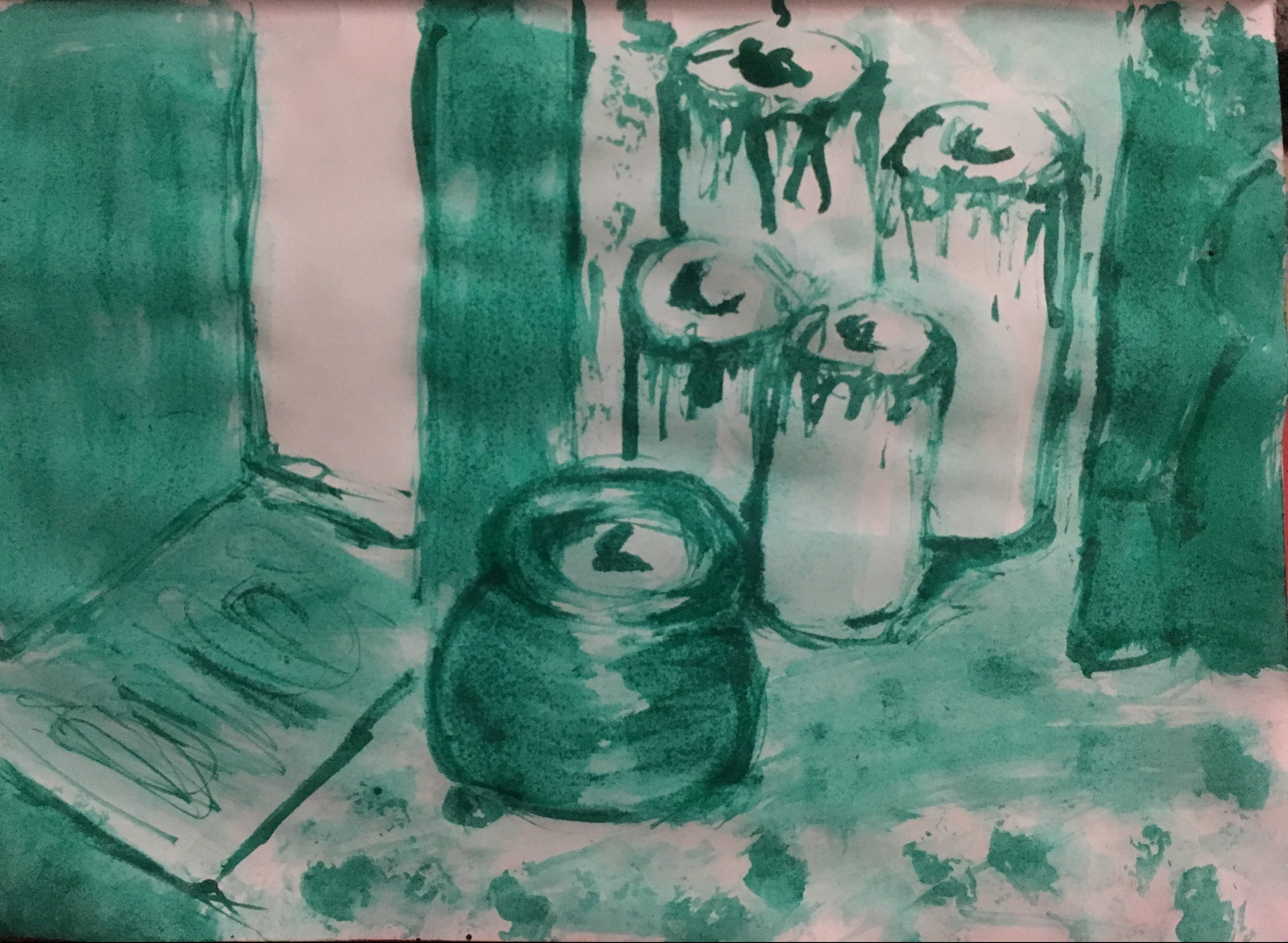
I then carried out an experiment similar to another previous exercise to add colour to the piece in a quick thumbnail sketch to experiment with the different shades of the image and to also attempt to create a piece in a similar way to Morandi’s work, except with bolder, more intense colours. I worked in soft pastels and tried to choose a different colour to represent the different tones in the composition. I chose red for the blackest tones, yellow for the lighter tones, with a touch of green for the white areas to show some shadow. To be completely honest, I did not really have a plan for this section as such, I just went with the flow and created a sample piece in whatever came to mind first. Considering there was no specific rhyme or reason to the experiment, I actually rather like the outcome as I think it just naturally seems to come together and work quite well. I chose the red and yellows to create a sense of warmth in the experiment as this is how I feel when I look at my fireplace. Again, I chose to keep detail to a minimum as I rather enjoy this method and the boldness of the colours created as a result but I think my composition doesn’t actually contain much in the way of finer details anyway.
Chosen composition in colour for experiment in sketchbook
Chosen composition in colour for experiment in sketchbook
Line Drawing Experiment
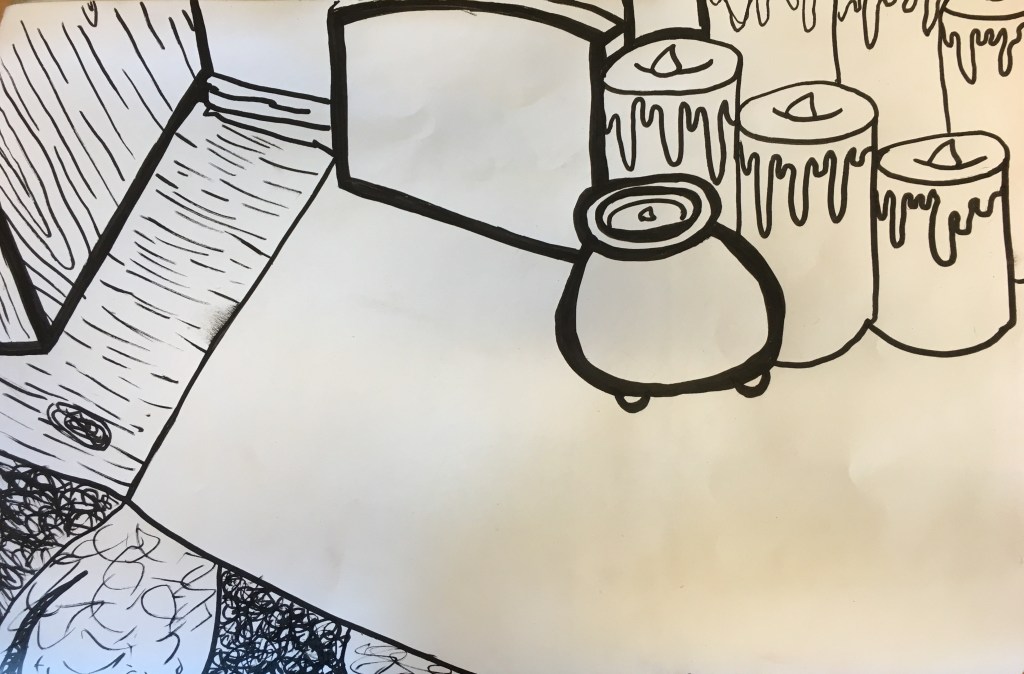
I then decided to carry out an experiment in line drawing, as done in an earlier exercise in this Part of the course. For this, I tried to envision the piece I came across during my research of domestic interior artists by Lichtenstein with its cartoon-like values and different use of line within the piece. I tried to show different directions of line for the wooden flooring to show the difference in the objects and their movement within the piece, as well as using thicker lines for the darkest areas within the piece. I figured that, this way, if I were only able to work from this piece for assisting to create my final piece, I would be able to distinguish the black areas, the direction in which they are moving, the texture of the rug, the delicateness of the candles (though I think I could have used finer lines for these). The only thing I felt unable to get across was the markings within the marble surround. However, I think the lack of any detail adds to the allowance of interpretation of the negative space to view this part as smooth and shiny of its own accord.
Experiment in line drawing
Monochrome Experiment
Final Piece
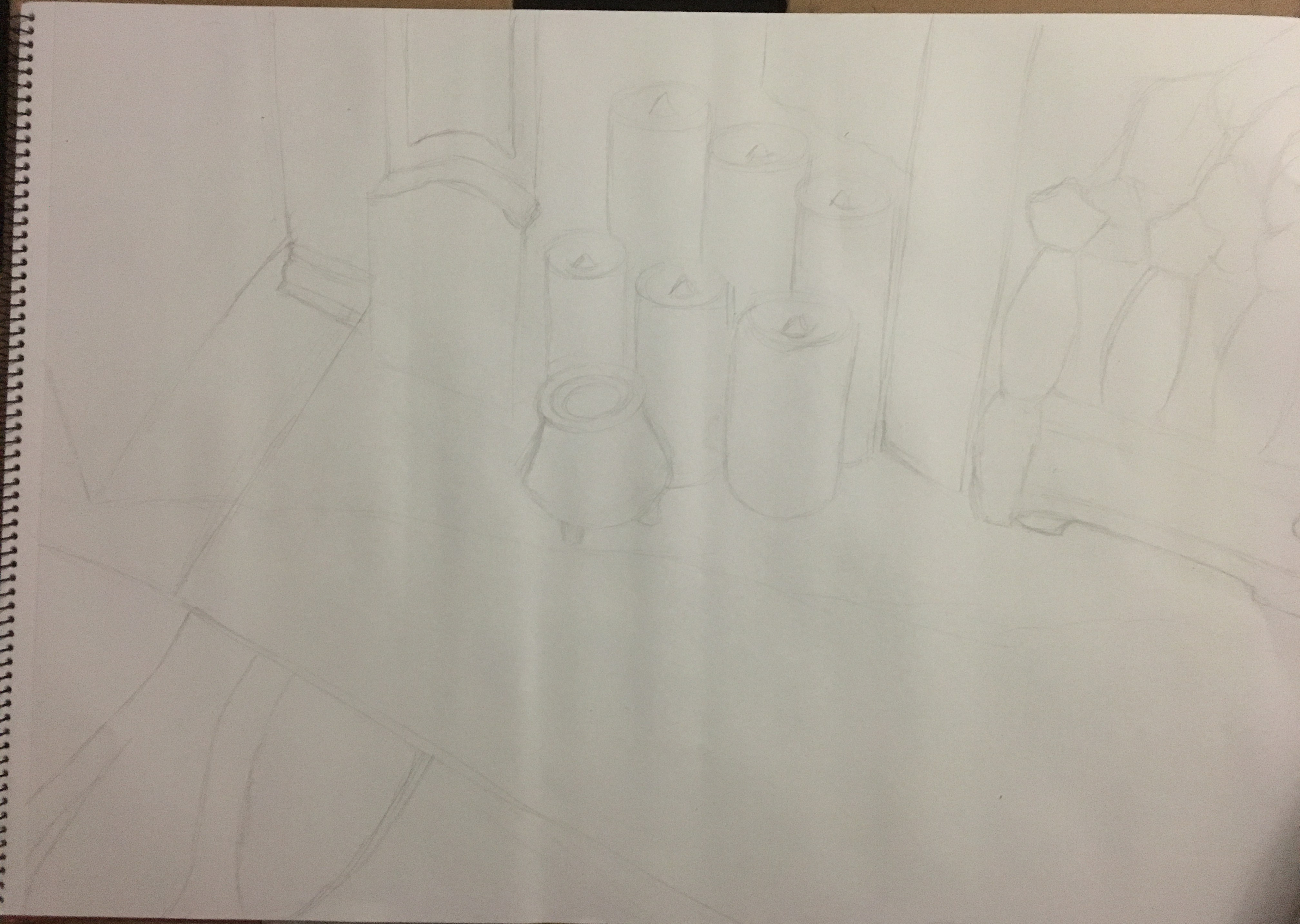
For my final piece, I tried to look at my preliminary work both for the assignment and the Part of the course as a whole and develop my piece from there. I took an A2 piece of paper and lightly sketched my image in. I was rather pleased with my result as it was on quite a large scale, however, I did not use a grid to create it, so I think my skills are improving somewhat!
Preliminary sketch of final piece
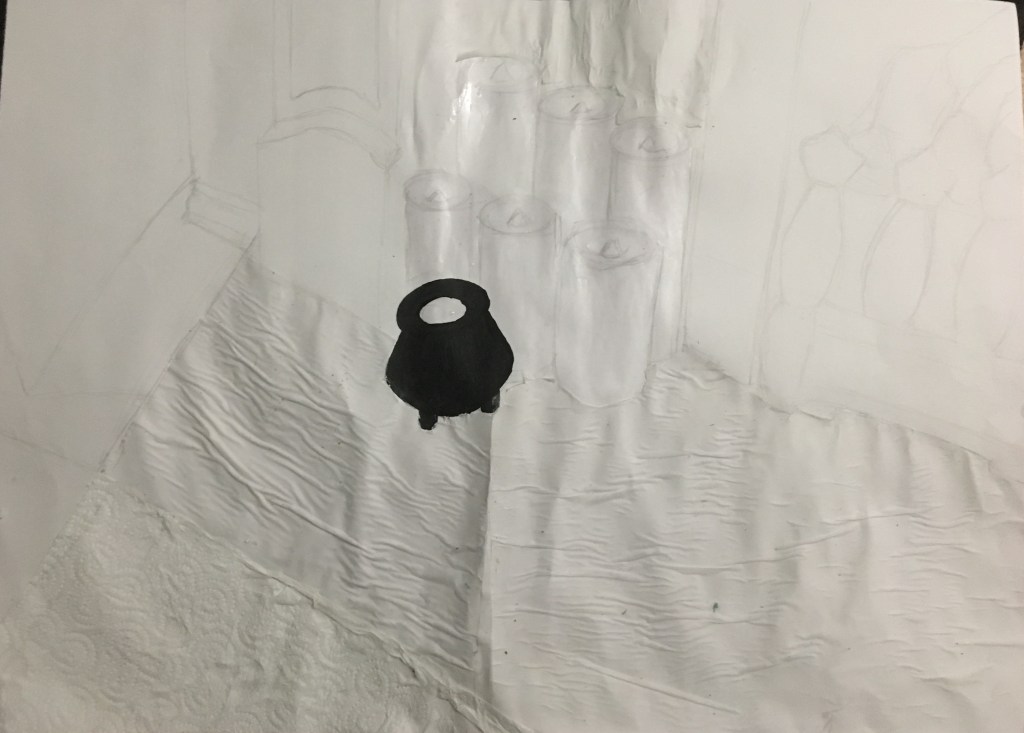
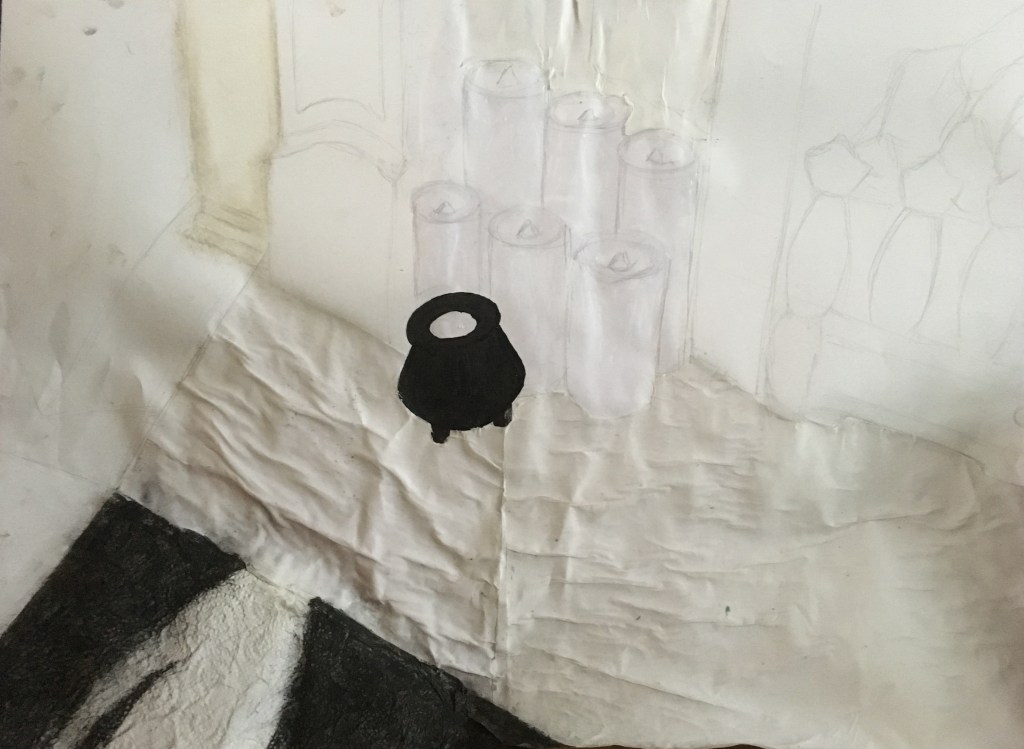
After this, I used an acrylic marker to colour in the tealight holder, then used PVA glue to fill the candles with a waxy coating since they are generally white anyway, as well as a layer over the tealight holder to help create the sense of the shiny coated ceramic. Next, I added the tracing paper ready to apply the tea staining over the top. I was actually rather disappointed with this due to it gathering and spoiling the appearance of a smooth, marbled surface. I am going to try and think of a way to correct this, but won’t spend too long worrying about it and will put it down to a learning curve if all else fails!
Application of acrylic marker, tracing paper, kitchen roll and PVA glue for the candles
I then applied some white chalk to the area which is the wall surrounding the fireplace. I added a bit of beige chalk and also some grey to create depth and tone. Once finished, I will add in any shading needed, but I am trying to keep it all as base layers where possible until the end. After this, I added the black soft pastel to the rug and was made up with the result! I think it really adds depth and texture to the piece and actually rather resembles the rug in question! I did notice, however, that I had lost the initial shape of the actual rug in my creation due to having stuck the kitchen roll down and not being able to see the preliminary sketch and taking the line for the white part of the rug to be the end of the rug. I put this down to artistic licence though and chose not to fret too much about it as now I would be able to show more of the wooden flooring texture as opposed to the small section I would have been showing if created picture-perfectly!
Application of black soft pastel on the rug and chalk on the wall
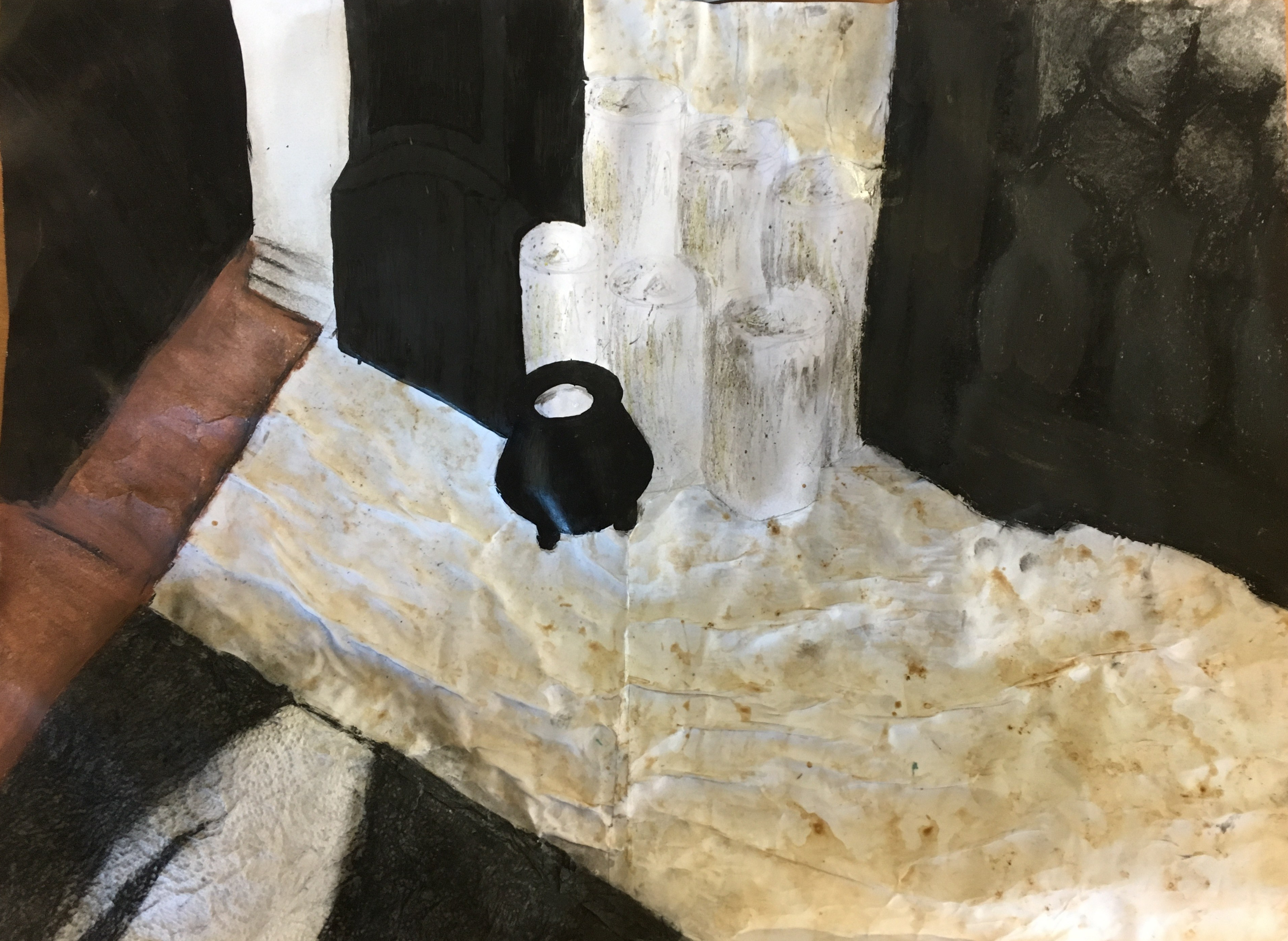
Next, I added the final ‘layer’ of main colours; I used brown and black conte sticks for the wooden flooring, using a wash over them to smooth the surface. I then used ink for the black cupboard to the far left of the piece, black acrylic marker for the fireplace surround, charcoal for the actual pieces of charcoal in the fire and a tea-staining wash over the tracing paper replicating the marble surround. I was happy with all aspects of the base layers besides the creasing of the tracing paper, which I was deeply disappointed in. I tried to think of a way to smooth this out and considered using PVA, but thought I had used this rather a lot already and should try something else. I just could not decide what that something else should be.
Application of ink, acrylic marker, brown conte stick and charcoal
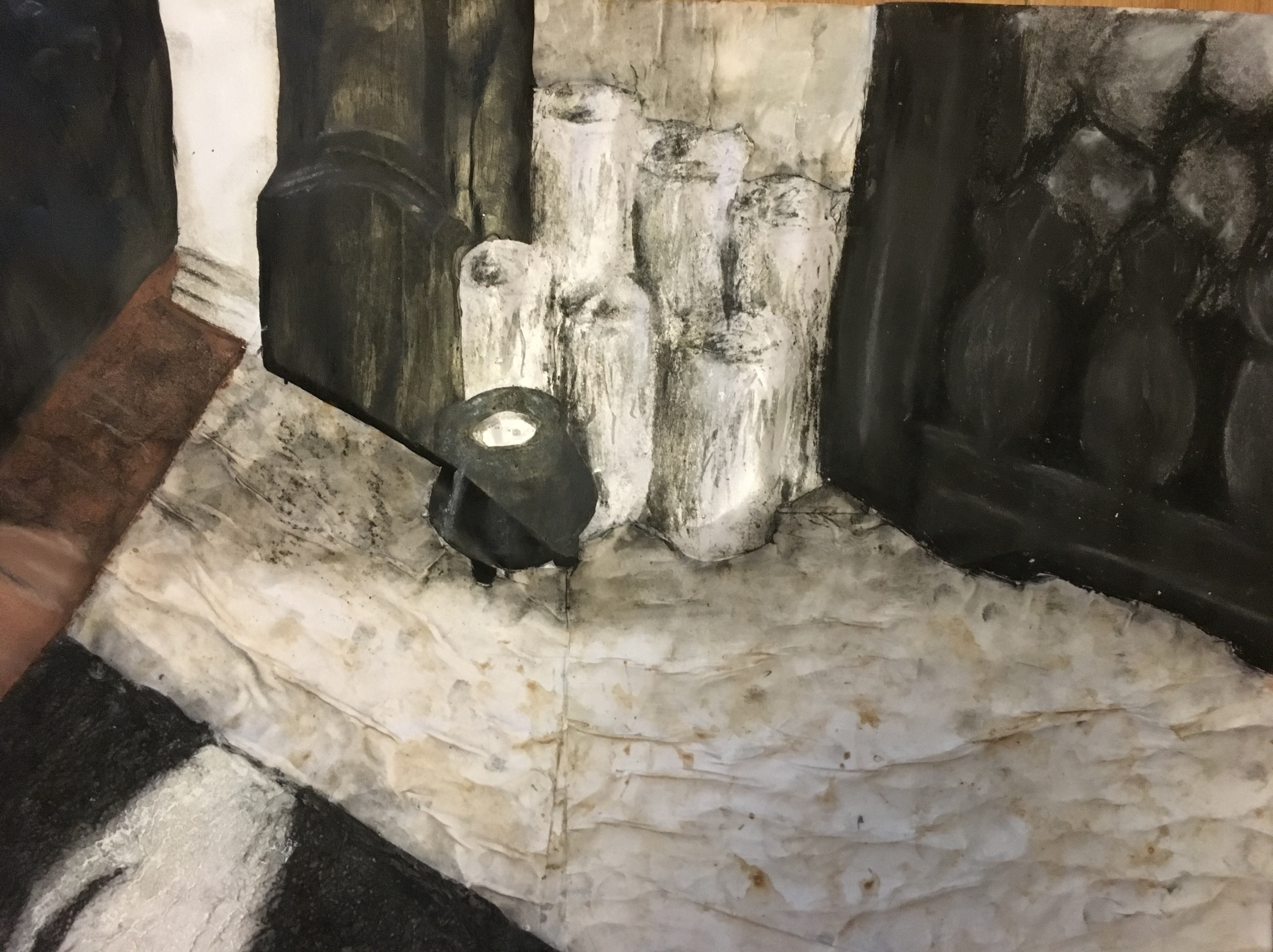
My next and final task for this piece was to add in the shadows where seen in my original photograph (since some time had passed since then) and to try and create some depth in places by adding highlights where needed.
Finished piece – Assignment Two
Reflection
Overall, I am really happy with this piece. I chose to create a warmer atmosphere in my
piece and pulled out the brown hues of the marble to warm the cold, solid blacks
in the composition. I sat in front of my
fireplace slightly to the right-hand side to create the view I did. I took a photograph of this area in the day
time as a reference for the darkest tonal areas of shadows and areas of
lightest tone, but generally worked from real-life sitting to gain the overall shapes
and loosest details of the composition, as well as for the textures.
Having learned some things in this part of
the course regarding tone, I tried to stay away from trying to actually draw depth within the piece, but to create
it naturally through shadows, highlights and the textures of each object, which
I feel worked rather well, especially with regard to the rug and the wooden
flooring to the left of it as I get a real feeling that the flooring is beneath the rug, as it should be.
Having already decided my chosen media for
each object through the material
differences exercise, I was able to apply them rather efficiently,
however, I think I would think again before using the tracing paper for the
marble effect if I were to redo this piece.
Whilst it has irked me since I completed this section, I decided to
leave it be as I actually really like how the light hits it and fragments off
from it. The marble surface itself has
small particles within it which seem to reflect the light in very fragmented
ways so, whilst it initially bugged me, I finally understood the sentence in
this part of the course “…remember that your subject matter might be quite different to your
source material” as my source material is definitely different to my subject
matter in this sense!
I think the objects I used and the background setting have a very obvious natural connection and the story / setting is rather clear. I have tried to show the differences between the objects through their texture and, thinking back to my tutor’s comments regarding my first assignment, I tried to treat each object very separately and uniquely, concentrating just on that object at a time, whilst building the piece up layer by layer.
Going forward, I would really like to
improve my method with regard to the marble surround to be able to create that
smooth, but textured surface. I also
really enjoyed creating the wooden flooring and the rug, so I think I would
like to perhaps do some more work with wood and its grains as it is so beautiful
to behold. I think the rug the most
effective part of my piece as the texture of the kitchen roll just works so
well to replicate the fluffiness and bobbles of the actual rug.
Overall, I have really enjoyed this part of
the course and have learned some valuable lessons along the way. Whilst I am sad to leave still life behind, I
will definitely carry forward elements of what I have learned as I think a lot
of it can be used through all aspects of art as a subject.
I feel I have developed my skills and understanding
of the use of colour and line and when each works better in their own way, but
also how to manipulate both to suit my purpose; using expressive or finer lines
where needed and strengthening my pieces with contrasting colours and combinations. I’ve definitely learned a lot in relation to
the aspects and ‘rules’ of composition and how to set up a group of objects in
an interesting and appealing way. I
think my ability to accurately depict scale has improved quite a fair bit. I think this is due to the rough sketches I am
carrying out alongside my course. I
still think I have a fair way to go and have enjoyed using grids, though I do
find them time-consuming and also restrictive as I can only really use them if
working from a photograph, so they are not very practical for real life
situations. I will, however, create a
viewfinder to use as I progress through the course as the markings on this will
allow me to create a rough grid for the basic idea of placement of some of the objects,
such as trees etc.

 Rachael's OCA Blog: Drawing One