Research Points 4.0 and 4.1.1: Ideas and Arguments Surrounding the Naked Form throughout History and Depictions

Ancient Depictions

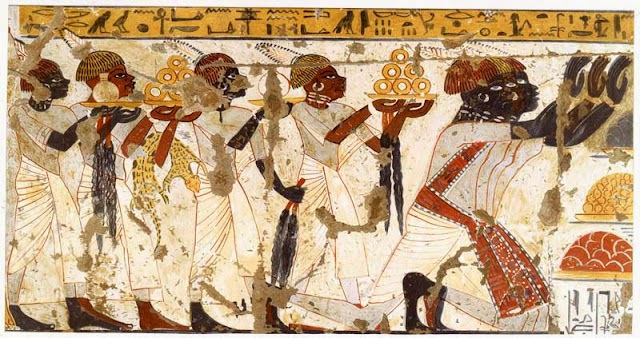
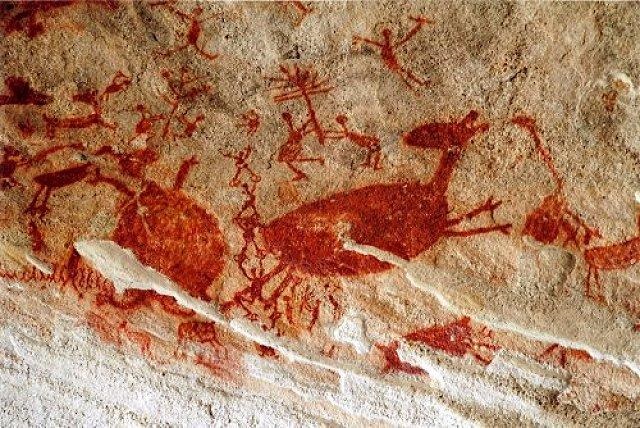
The human form has always been of great interest to artists. In very early times, cavemen would draw images depicting humans with tools mid-hunt, the Ancient Egyptians would depict humans to record stories of real-life events and of their religious beliefs. The Ancient Greeks would create statues of their gods, but also of athletes and other notable beings. They would also depict people on vases to tell stories. Even before this time, the ancient Chinese people would create collections of terracotta soldiers to protect their deceased emperors in the afterlife.

Religious Depictions
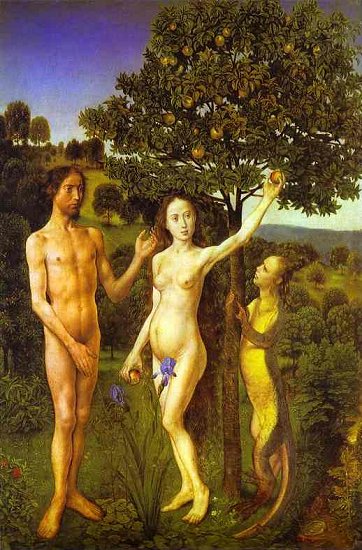
Fig. 3. Van Der Goes, H Adam and Eve (c. 1482)

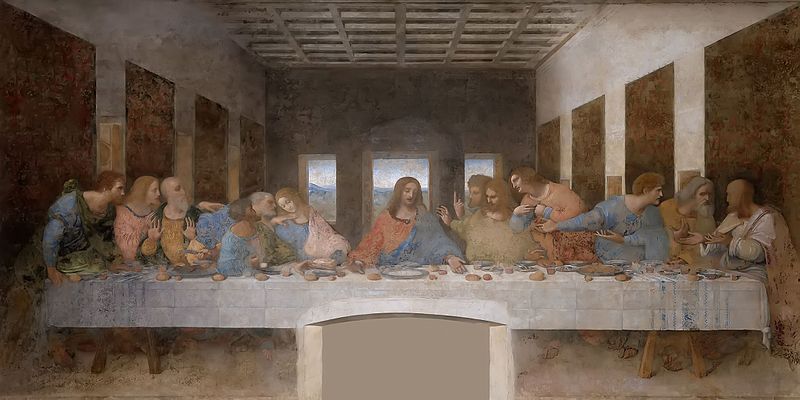
As time passed, opinions regarding the use of the human form in art changed with the differing beliefs and priorities of the times. A very common choice as a subject was Jesus Christ, who has been depicted in many ways throughout history and has often been the leading piece of several infamous artists’ bodies of works. Adam and Eve were also the subject of many famous pieces, mostly in their moments of weakness and their expulsion from the Garden. A lot of these works were commissioned by religious bodies to help people who were not able to read the Bible themselves, so these works would tell the stories for them.
Depictions of Beauty

The idea of what makes a person ‘beautiful’ is shown within pieces from different eras in many diverse ways; for instance the larger, more voluptuous figure was once seen as a symbol of wealth due to the availability of food, thus increasing the beauty of the sitter. One’s skin tone has largely been a symbol of beauty, with a history of people trying to whiten their complexion with powders and even drawing in blue veins to increase the illusion of the skin’s translucency. Both of these things would not be generally classed as typically ‘beautiful’ in today’s day and age, with people seeking a more sun-kissed and slender look as their ‘ideal’.
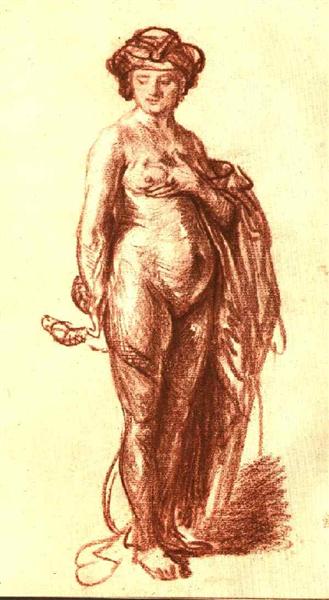
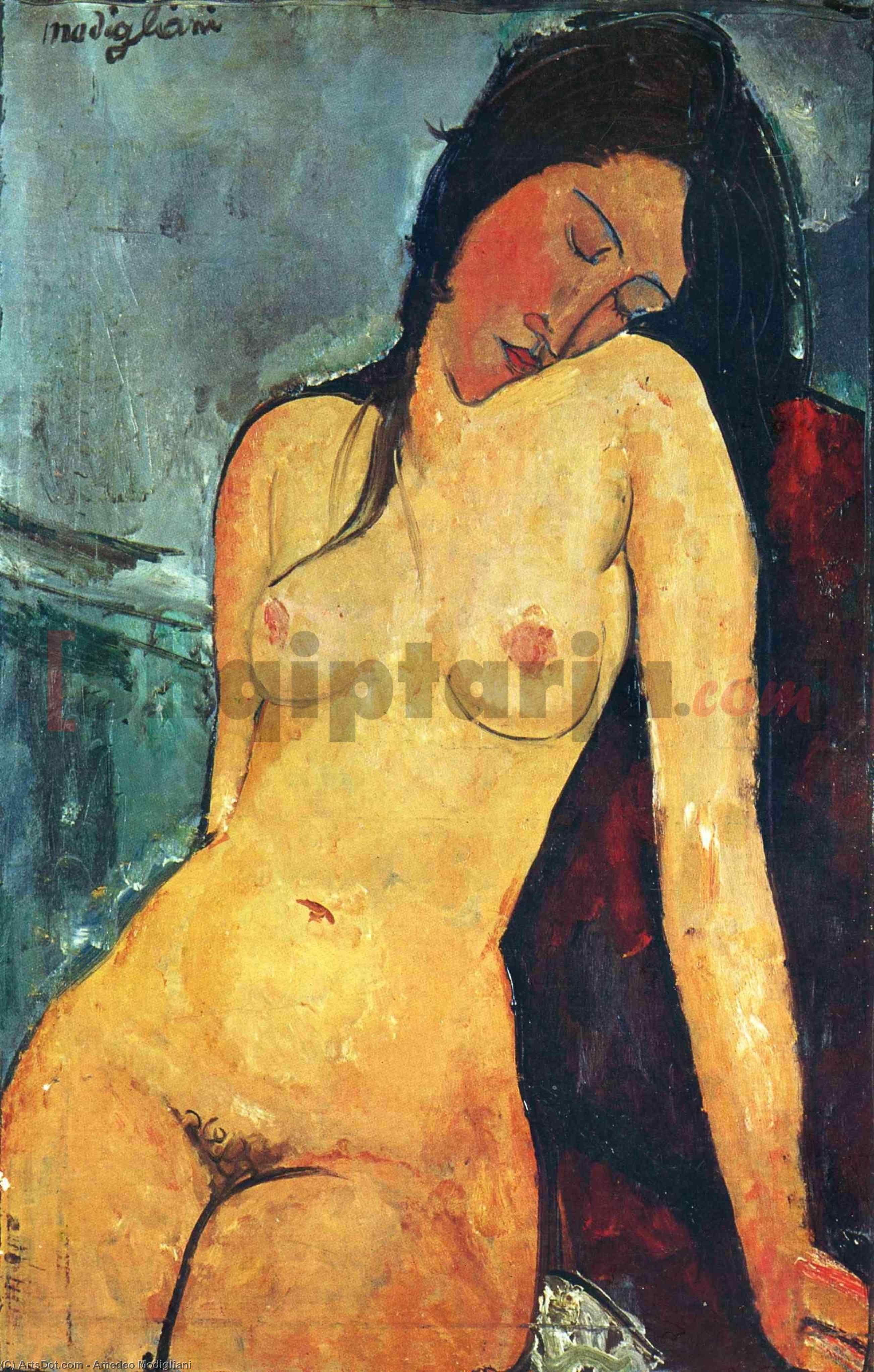
Fig. 5. Rembrandt Study of a Nude Woman as Cleopatra (1637)

It is interesting to me to see what is deemed beautiful in one country is often completely different in another, as can be seen in this article which I read several years ago, but which has been of interest to me ever since.
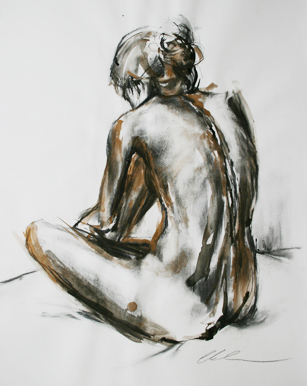
Fig. 7. Grossman, C Nude in Gold 2 (unknown)

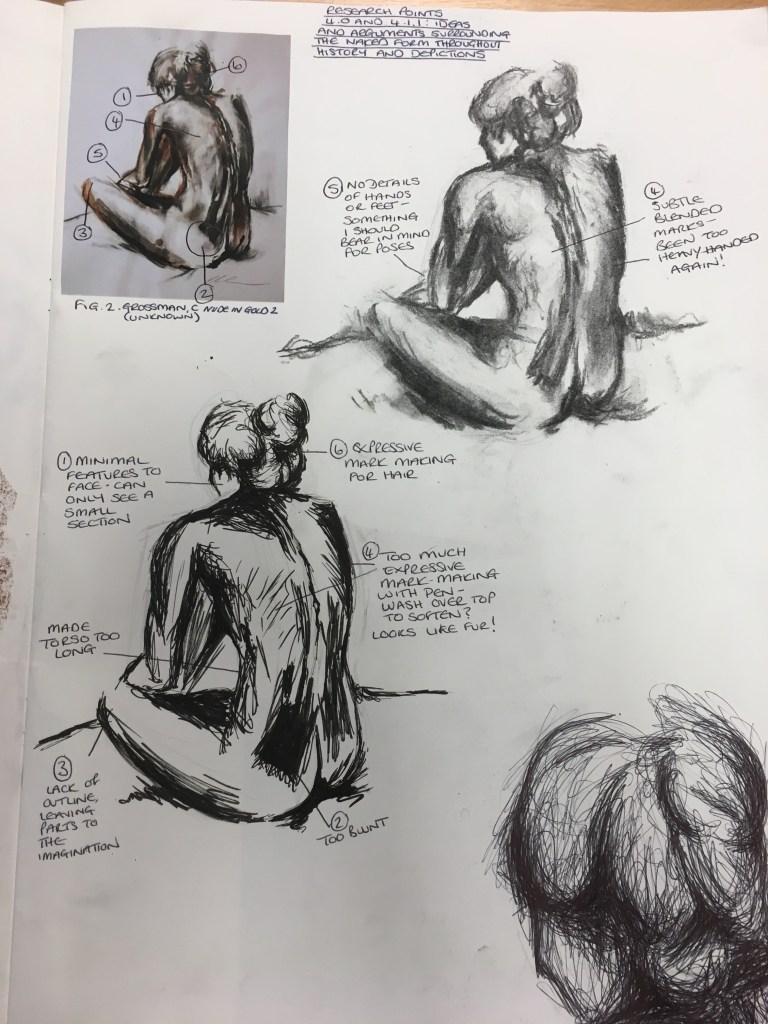
I really do like this piece compared to the rest due to the differentiation between the pressures of the charcoal for different areas, such as the dark and heaviness around the back of the neck (the place of most shadow) and then the delicate whisps of shadow to show the underlying ribcage. Whilst very neutral in its place in time, I think the gold really sets the piece in the here and now due to there being a real demand for the marble effect and the gold touches in respect of today’s fashion and interior design preferences, which I think is actually rather clever of the artist. Whilst my tutor has advised me against using colour, I wonder whether this would work should I try it since the artist has only used the one hue? It is also interesting that Grossman chose to combine the softness of the charcoal with the solid colouring of the gold.

I also came across a video showing the gradual change in perception of the perfect form:

How Women’s Perfect Body Types Changed Throughout History (2017)

I am really intrigued by the fact that the female form has been much more scrutinised throughout history than the male form; the female, I feel, has had to adapt to suit the times and the desires of the male throughout history, whereas the male has almost always been seen to be ‘beautiful’ when muscled and chiseled.

Looking at the pieces I have chosen to include in this research, I admit I found it rather difficult to find hardly any works from earlier times which matched my style of working; the figures were generally in colour and almost precise in detail. Besides the piece I found by Rembrandt, there does not appear to be much in a similar approach to this from these times. AS we move forward in time to the 20th Century, however, it becomes more apparent that artists were now not so focussed on the realistic aspect of their pieces, as opposed to a more expressive approach, as shown in Modigliani’s piece above. This piece is still rather reserved with having a main outline of the general shape of the body and, again, using rather traditional colourings, however, when we look at the piece created by Grossman, the lines are much more expressive and better suited to my style of working.

Own Interpretations
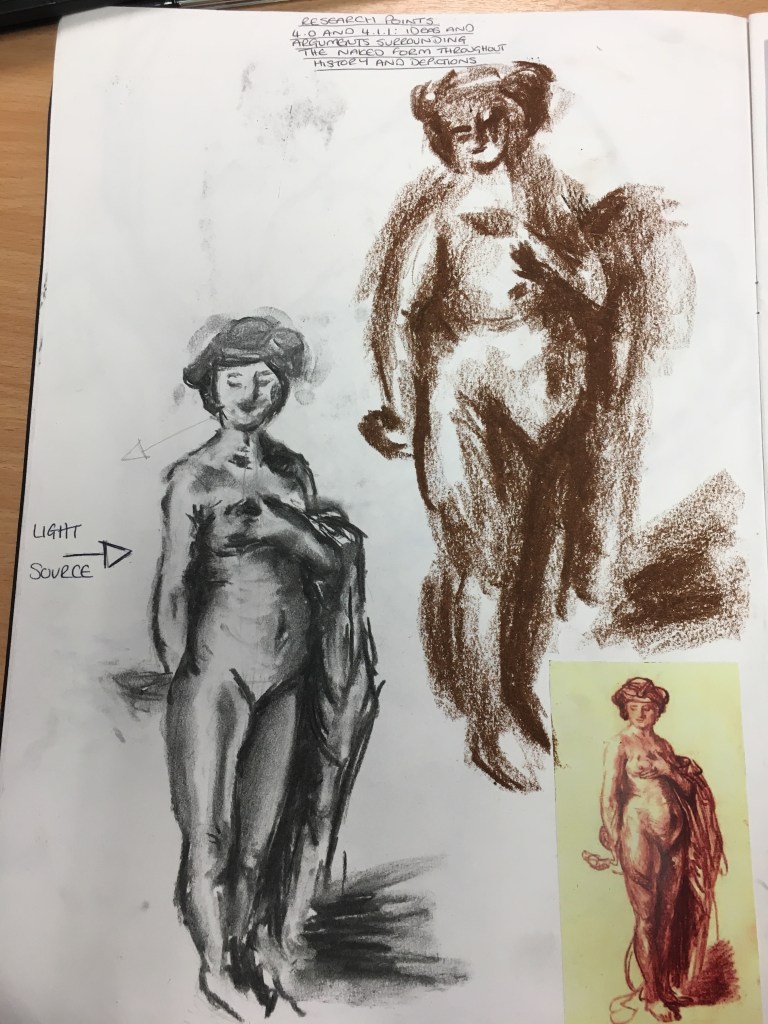
I enjoyed recreating the two pieces shown above in my sketchbook. I tried to stay as honest to the original pieces as possible, but with my own little bit of a stamp on them. I really do find trying to recreate the pieces helps me understand the process the artist went through in creating the piece originally and to be able to fully appreciate the information held within it. I see it almost like reading a book; you can look at the front cover, but to fully understand the story, you have to read the words inside it.

Looking at Rembrandt’s piece, I found that using the media to block in the tonal patches instead of focusing on the details of the features really worked in bringing some form of realness to the subject matter.

Recreating Grossman’s piece really felt like ‘coming home’ to me; the lack of detail and hidden hands, feet and facial features I thought was very clever and definitely a technique I will use in the future. I think creating facial features, hands and feet as part of a larger whole just does not work for me; unless depicted as basic shapes, I feel they often look too cartoon-like or simply unbelievable, however, I think I am stronger at recreating them with tone than I am line, which is also something to bear in mind going forward.

I am extremely fascinated by this area of art and will definitely be taking it further in the future. As I move through this part of the course, I will consider the questions asked of me in this Research Point and how they may assist me in my future studies.

List of Illustrations

Fig. 1. (unknown) Serra da Capivara [Cave painting] At: https://www.touropia.com/prehistoric-cave-paintings/ (Accessed on 15 July 2019)

Fig. 2. (unknown) [Painting] At: http://www.fineartandyou.com/2014/01/ancient-egyptian-art-sculptures-and.html (Accessed on 15 July 2019)

Fig. 3. Van Der Goes, H (c. 1482) Adam and Eve [oil on canvas] At: https://www.artbible.info/art/large/291.html (Accessed on 13 August 2019)

Fig. 4. Da Vinci, L (c.1495 to 1498) The Last Supper [Tempera on gesso, pitch and mastic] At: https://en.wikipedia.org/wiki/The_Last_Supper_(Leonardo)#/media/File:The_Last_Supper_Leonardo_Da_Vinci_High_Resolution_size_32x16.jpg (Accessed on 21 August 2019)

Fig. 5. Rembrandt (1637) Study of a Nude Woman as Cleopatra [chalk drawing] At: https://www.wikiart.org/en/rembrandt/female-nude-with-snake-cleopatra-1637 (Accessed on 13 August 2019)

Fig. 6. Modigliani, A (1916) Seated Female Nude [Oil on canvas] At: https://en.artsdot.com/@@/8XXN6E-Amedeo-Modigliani-Seated-female-nude (Accessed on 15 July 2019)

Fig. 7. Grossman, C (unknown) Nude in Gold 2 [charcoal and gold ink on paper] At: http://www.claregrossman.co.uk/from-the-model/4551445591 (Accessed on 21 August 2019)

Bibliography

Artbible. (Unknown) ‘The Fall of Adam’ [online] At: https://www.artbible.info/art/large/291.html (Accessed on 13 August 2019)

How Women’s Perfect Body Types Changed Throughout History (2017) [user-generated content online] Creat. The List 27 March 2017 At: https://www.youtube.com/watch?v=y4ipUdS8Td4 (Accessed on 22 August 2019)

Jessica Brown of Indy100. (2016) ‘What being beautiful means in 25 countries around the world’ [Online] At: https://www.indy100.com/article/what-beautiful-looks-like-around-the-world-7364346 (Accessed on 15 July 2019)

Robson, D (1995) The Art of the Nude. Bristol: Parragon Book Service Limited

Visit Uffizi. (Unknown) ‘Venus of Urbino by Titan’ [Online] At: https://www.visituffizi.org/artworks/venus-of-urbino-by-titian/ (Accessed on 13 August 2019)

Wikipedia. (2019) ‘Nude (art)’ [online] At: https://en.wikipedia.org/wiki/Nude_(art) (Accessed on 15 July 2019)

Wikipedia. (2019) ‘The Turkish Bath’ [online] At: https://en.wikipedia.org/wiki/The_Turkish_Bath (Accessed on 13 August 2019)
Part 3: Tutor Feedback and Own Comments

Overall Comments

Thank you for your submission. You are working well with technical aspects of working with vast spaces when it comes to depth and perspective. Honing in and monochrome allows you to do this, as does working with expressive media like charcoal and inks. When it comes to colour, your work becomes flat and too generic with your colour choices. Sometimes your work is too over-complicated because you have included too much. Try not to include everything you have learnt in one piece, otherwise it becomes overwhelming. Rather, be more sensitive and subtle with freer lines and expressive applications. It’s time to eliminate techniques, media and applications that do not work and work with strengthening the ones that do.

I am pleased to see that my tutor now thinks the technical aspects of my work are improving, as it shows my hard work and perseverance is actually paying off! The more I am continuing with the course, the more I am finding out about myself and my ‘style’ of working and what does and does not work for me. I am finding myself zooming in to certain areas more so and am strangely surprised to find that charcoal, the media I was not too keen on in the beginning and which I felt I could not use as well as other media, is actually fast becoming my weapon of choice! I was rather pleased to find out that I could now eliminate those things and areas which I am not strongest in and focus on those I am. I was rather concerned with doing this as I was worried I would be criticised for not trying to improve in those areas and pushing myself more, choosing to play it safe with my strengths. I have decided to really streamline my methods, media and techniques to really work towards the best final piece I can create for my final assignment.

Feedback on Assignment

Demonstration of Technical and Visual Skills, Quality of Outcome and Demonstration of Creativity

Project 1: Trees

The individual trees when done as an outline has been successful and you have looked at the character of the entwining of the trees. Using semi-abstraction has worked for you because it allows you to concentrate on textures rather than including everything you see in front of you. The finished piece of the single tree is successful with the detail. The studies of several trees in terms of composition are not too bad but, when working with this medium, overlap rather than being too heavy-handed.

I really enjoyed working with the trees and being able to allow myself to create expressive movements to create the trunks and limbs. I found the method rather similar to when I had drawn the figure in the past and was rather shocked at the similarities. I think semi-abstraction is definitely the way forward for me. I then barely see the actual object for what it really is and focus on the information within it instead. The piece of the single tree in pen was actually my favourite exercise throughout the course so far and I think it has shown through; the more I enjoy something, the more successful it seems to turn out. With regard to the several trees, I was a little disappointed with the comment as I had tried to do the best I could in overlapping, so this told me that I still need to work on this. I also really need to work on being lighter-handed. I will try to really work on this during Part 4 as I think I have garnered a much better understanding of this comment now.

Project 2: Landscape

The cloud formations have been applied in a heavy-handed way so think about subtle tonal qualities. The sketchbook walk is bold, expressive and free with the way you have used lines. Working quickly suits you so you are not overwhelming yourself with detail. The 360 pieces are also expressive, but make sure there is a distinction in tone of the main wall compared to the background.

Clouds really are not my strong point! I think this is, again, something I need to work on in the future, but something I will put to rest for the time-being. I really did enjoy the sketchbook walk and 360 studies exercises as I really just went to town working quickly and totally freely. I do see the lack of definition though, so I will bear this in mind for future exercises.

Project 3: Composition

Zooming in has worked for you in this piece because you are concentrating on perspective, which has worked. The two pieces of the wall without the green shows a diverse range of mark making and textures, which are convincing. The generic green in the final piece looks too cartoon-like.

In fore, mid and background, you are understanding the depth that vast spaces can create. This has been done with perspective and tonal gradients. However, when you use colour, the tones are too generic and become too forced.

I was actually very torn as to whether or not to include the green but decided to do so in the end. Looking back, I do think the piece just of the wall itself would have been much bolder an outcome. I think this is something I can consider recreating for my final piece for the Unit – perhaps in pen since I find that the best to control and to include finer detail and tonal patches.

Project 4: Perspective

This project is not the strongest in terms of outcomes, but what is important is that you understand perspective. The single line perspective is convincing and shows technical approaches. The angular perspective pieces shows convincing lines and depth. The aerial perspective needs more work as the viewpoints are distorted. Overall, this approach is not as exciting as your honed in, expressive work.

I think these comments really reiterate what I have said previously about the things I enjoy the most and which I find come more naturally to me are much stronger than those which do not. I’m glad my tutor sees an understanding here, but I do fully agree that it is not my strongest, nor is it half as interesting as the more expressive pieces I work on. I found this exercise really educational as to measuring things out correctly and taking time and effort at this stage of the creation of any pieces before moving on to the more expressive parts, so this is something I will definitely be bearing in mind as I progress through the remainder of the course.

Project 5: Townscapes

This subject is not your strongest as the lines and perspective is cumbersome. You are suited to more natural and organic forms so you can be freer with your mark making. There is an issue when working with colour, as it is tentative and is not reflective of the textures and surfaces we might see on architecture.

Again, I completely agree with this comment as I did not really enjoy this project. I persevered with it regardless, but I do think my lack of thorough interest has shown through. I note the comment relating to colour again and do believe this is something I will have to work on in the future – perhaps creating a separate sketchbook on a side project throughout the whole of the course to deepen my understanding of the use of colour as, whilst I think it wise to close this door for now, I do not wish for it to remain so indefinitely.

Assignment

Less is more! You have included many textures and applications in this piece and it becomes confusing. You have planned well but you need to be more selective. You have done this with the composition but not the techniques you have used. There are some expressive elements but they would be suited on a larger surface. The choice of colours (if you want to continue using colours) needs more understanding of tonal variations. As an assignment, it is not as successful as the individual tree studies.

Less is more! This has now been drilled very deeply into my mind and shall be at the forefront for every final piece! As I explained privately to my tutor, I was of the mindset that I should try to show as much as possible of the lessons learned through the previous exercises within my final assignment pieces so as to show I am learning these things etc. Clearly, this is not the case, so I have decided to only pick out the key points – those which I have felt strongest in the exercises – to develop in my final piece for the assignment. I was worried eradicating techniques etc would appear more as a weakness than a strength in choosing those things I am stronger with. Now I know this not to be the case, I am actually rather excited to see where this new knowledge leads me!

Sketchbooks

Demonstration of Technical and Visual Skills and Demonstration of Creativity

Your sketchbook shows good planning and dissecting of techniques and methods. You have analysed your primary sources well technically. There could be more evidence of improving the way you use media especially with colour. Do more practice with media to support your outcomes.

I am glad my use of the sketchbook has improved; At first, I found using it felt rather unnatural, but I have since tried to get past that and use my sketchbook more and more. I agree that I need to show more evidence of the use of media and my attempts to improve on this, so this is something I will bear in mind for Part 4 and in the future.

Research

Context, Reflective Thinking, Critical Thinking and Analysis

You continue to use comparative techniques to understand your subject and this is in-depth. Have more personal opinions to build up your contextual aspect of the unit. Also look at the artists I have suggested so you are more specific to your practice. Be independent and look at individual artists, which relate to your work.

I feel as though the feedback this time has been really eye-opening! I do like the idea of having a more personal touch to the research and choosing works I like and feel suit my working style best. I really enjoy reading and learning about artists, but I agree that it is time to begin focussing on artists whose work can actually inspire my own; as much as I enjoy the work of some of the Old Masters, I do not think I enjoy or feel as inspired by their work as much as some of the more contemporary and expressive artists.

Learning Logs or Blogs / Critical Essays

Context, Reflective Thinking, Critical Thinking and Analysis

You continue to describe your intentions as well and you have often been reflective. For this stage, scrutinise your work more, especially with picking out and unpacking technical and aesthetic elements, which have not worked. If you say something is successful – why and what part is successful?

I have noticed myself that I have not really been relying on the questionnaires I created as much as I could have, mostly due to time constraints, but think now is the time to go back to using them to be able to carry out the scrutiny which is needed.

Suggested Reading / Viewing Context

• David Hockney iPad drawing of trees: Relating to honing in and colour.

• Charlotte Verity: Her sensitive and subtle use of media and limited palette.

• Henry Moore sheep drawings: relating to your linear and expressive tree drawings.

• Anselm Kiefer: Simplifying vast spaces.

I have had a look at these artists and the results can be seen by clicking here.

Pointers for the Next Assignment

Strengths

• Line drawings and detail of trees and textures work well.

• You work well with monochrome and expressive media like ink and charcoal. This allows you to be freer with depicting the subject rather than being literal with colour.

• Organic and natural subject work better for you.

I agree with these comments and will strive to improve them further as I progress through the course.

Areas for Development

• Sometimes you include too much and the work becomes over-complicated.

• When working with colour, you need to understand your ranges of hues in one colour- sometimes the colours are too generic.

• Townscapes and architectural perspective needs work.

Again, I agree. I feel I have ‘heard’ my tutor much more clearly this time around and have a much greater understanding than before.

Whilst I do not think this my most successful Part, I do, however, feel that the piece of the single tree is one of my strongest so far so I am going to take what I have garnered from these comments and what I have learned so far and try to recreate the success of the piece again for my two final pieces in this Unit.

Research Point 4.6.1: Depiction of the Face throughout History

The face is a part of the body which has been the focal point to a lot of artwork throughout history. The first thing you look for when seeing a human figure is their face; taking into account their eyes, nose, mouth, hair colour and style, as well as the general face shape amongst other things. It is how we identify one person from the next and how beauty is generally measured before taking into consideration the rest of the physique of the person.

The measurement of facial beauty has altered throughout history and is different to each viewer. For instance, my own version of ideal in a male partner is dark, glossy hair and dark sparkly eyes. However, another may find this unappealing, preferring for instance blonde with blue eyes as their ideal.

The general ideal beauty of the face has also varied immensely throughout time; the Ancient Egyptians portrayed the face from the side as this was deemed the perfect angle, the hair was black, they wore heavy black eyeliner and their skin was a golden hue.

Fig. 1. Anonymous Fragment de la décoration d’une tombe : femme à une cérémonie. Règne de Thoutmosis IV ou Aménophis III. (Unknown)

Much later, in a different part of the world, the ideal for the female was seen to be that of pale skin with long blonde curls and a fullness to the face, all of which were seen to symbolise the virtue and daintiness of a woman. In the piece, below, the woman’s face is very dainty and angelic-like, with a rosy glow to her cheeks and lips.

Fig. 2. Borovikovsky, V Portrait of M I Lopukhina (1797)

The face has not only been used to represent the beauty of a person, but also the more sinister aspects. Munch, for example, created a whole piece appearing to show several people on a bridge, with the eye immediately being pulled to the brightness of the red sky, but when the eye finally moves downward to the figure in the foreground (whose colouring is very muted in comparison to the sky), they are met with quite a frightful sight. The face appears on a head in the shape of a skull. There are no eyebrows or hair to the face and the lips look as though suffering cyanosis. No eyelids can be distinguished over the bulbous eyes which appear to be looking at something just to the side of the viewer, leading one to wonder what they may see if they turn around! I have always found this piece to be the stuff of nightmares, but I am also strangely drawn into the fear of the piece. I really like the movement of the colours and how the foreground is much more muted than the background, creating that suspenseful moment before you see the actual horror within the piece.

Fig. 3. Munch, E The Scream (1893)

Below is another piece which I find rather disturbing due to the solid black voids where the eyes should be and the stark contrasts of black on one side and white on the other. I also really admire the artist’s capability to exclude outlines on the white side and create almost a straight line on the black side, as well as the different pressures used in the mark-making, yet you are still able to determine that this is a face and also the sense of depth in the piece. The addition of red towards the bottom of the piece is also intriguing and helps to draw the viewer in, leading to an imagining of blood, causing the viewer to wonder whether the subject has been attacked, is hurt or has hurt someone else.

Fig. 4. Juliussen, O Face (2016)

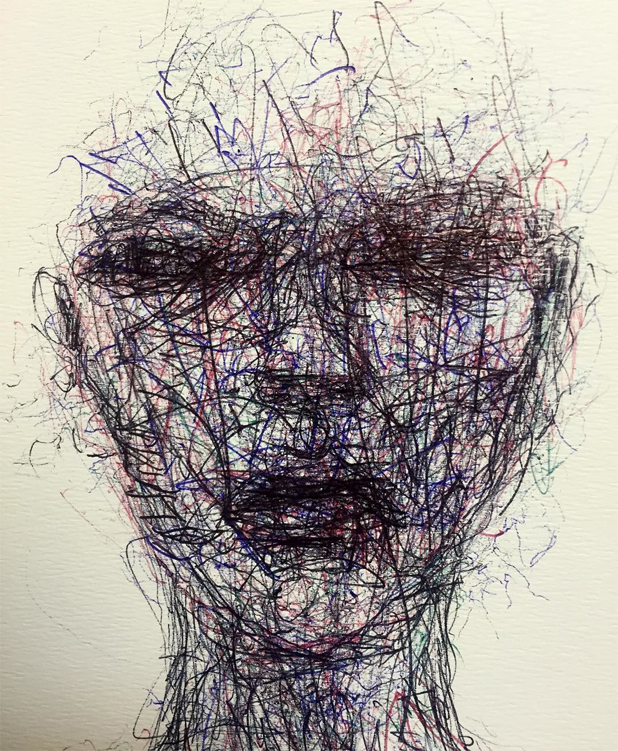
With the comments from my tutor in her feedback that I should look for works which I can relate to, I decided to look for more expressive pieces of the face and came across an artist called Naji Chalhoub, whose work is shown in Fig. 5 and Fig. 6. I was instantly drawn to these pieces and can really see a similarity between them and my 360 degree sketches.

In the two pieces, I can see quite a difference in the amount of pressure applied in each. Fig 5. has been created with a very heavy-hand (and is actually my preferred of the two!) and really emphasises the features of the piece much clearer than those in Fig. 6. Again, there are several colours included in the composition. I think they definitely add a little extra depth to the piece and make it more interesting. I am somewhat less drawn to Fig. 6 and think it is because it is much lighter and without the bold tones. The lines in this piece are much gentler and softer but somehow appears a little more sinisiter. I cannot quite put my finger on why this is? Perhaps it is because its faintness leads the viewer to imagine it in a more ethereal way, like the face is coming through from a different dimension? Perhaps the darkness of Fig. 5 helps the viewer see a more solid existence to the face and makes it that little bit more believable? Regardless, I will try and replicate these pieces in my own sketchbook and see if I can achieve the lighter touch!

Fig. 7. Audrey Anne (2018)

The final piece is somewhat more cartoon-like than the previous pieces, however, there is a lot of blank space, difference in pressure applied and a range of tonal values throughout the piece. The eyebrows and lashes are much darker than the shadowing to the neck, for example. There are also several different methods of application; for example, the colour to the cheeks has been applied using the flat side of the pencil and the general outline using the point, as well as areas of hatching, such as the shadowing to the neck and the hair above the ear. Overall, the piece is extremely delicate and has not been overworked. Definitely something to bear in mind!

There have been so many interpretations of the face over the centuries uses of media, line, tone, colours and methods. I have taken from this that I should be adventurous in my choice of surface, media and application as, as my tutor has previously said, the finished piece does not always need to look like a ‘pretty picture’. I would like to complete a piece in a ‘pretty’ way to be able to measure my skills correctly, however, I will also look at creating pieces of this kind without having to fully recreate what I see physically, but include emotions felt towards the subject to create something different and interesting.

List of Illustrations

Fig. 1. Anonymous (unknown) Fragment de la décoration d’une tombe : femme à une cérémonie. Règne de Thoutmosis IV ou Aménophis III [unknown] At: https://commons.wikimedia.org/wiki/File:Egypte_louvre_223_femme.jpg (accessed on 5 August 2019)
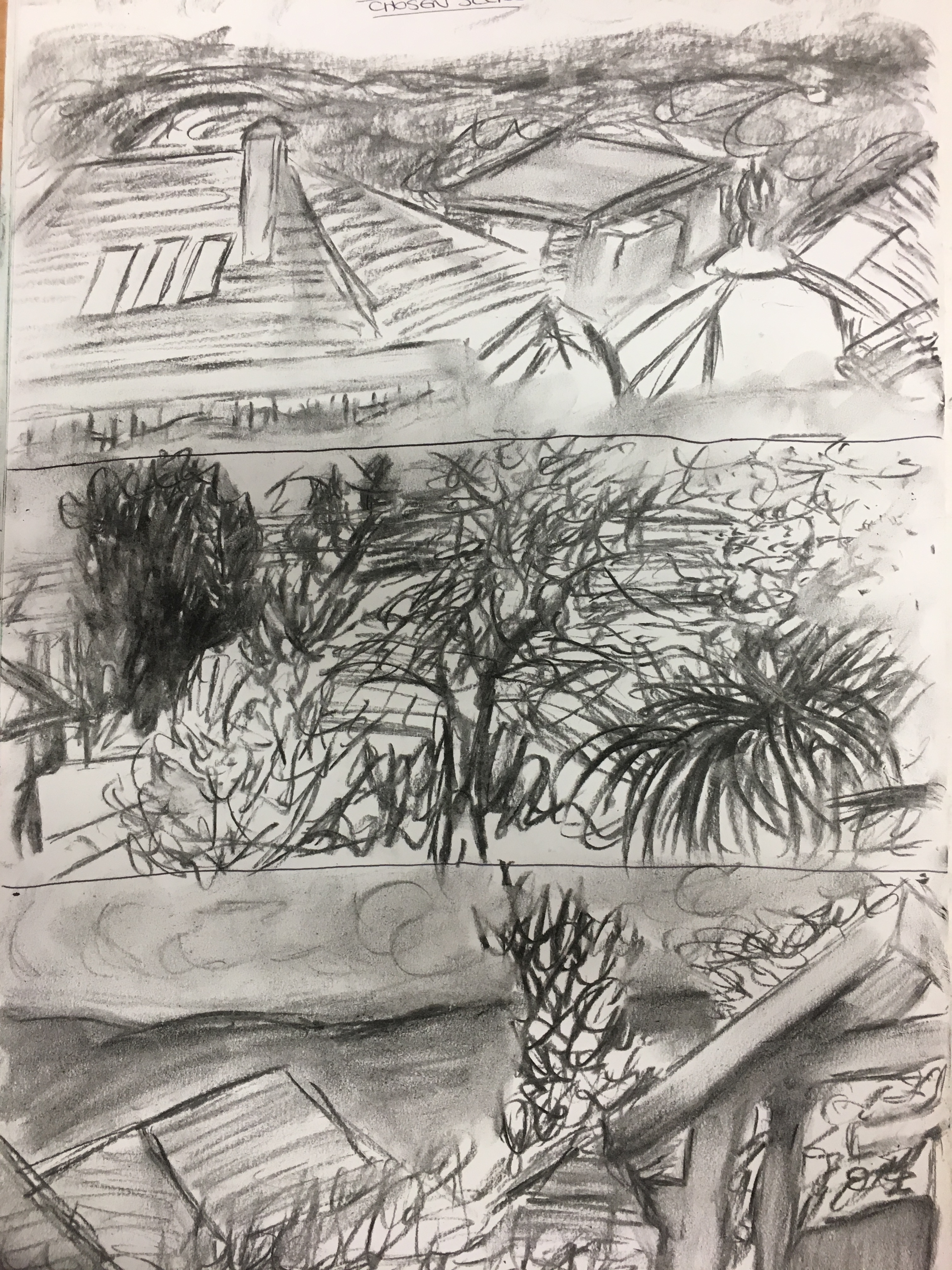
Fig. 2. Borovikovsky, V (1797) Portrait of M I Lopukhina [oil on canvas] At: https://www.wikiart.org/en/vladimir-borovikovsky/portrait-of-m-i-lopukhina-1797 (accessed on 5 August 2019)
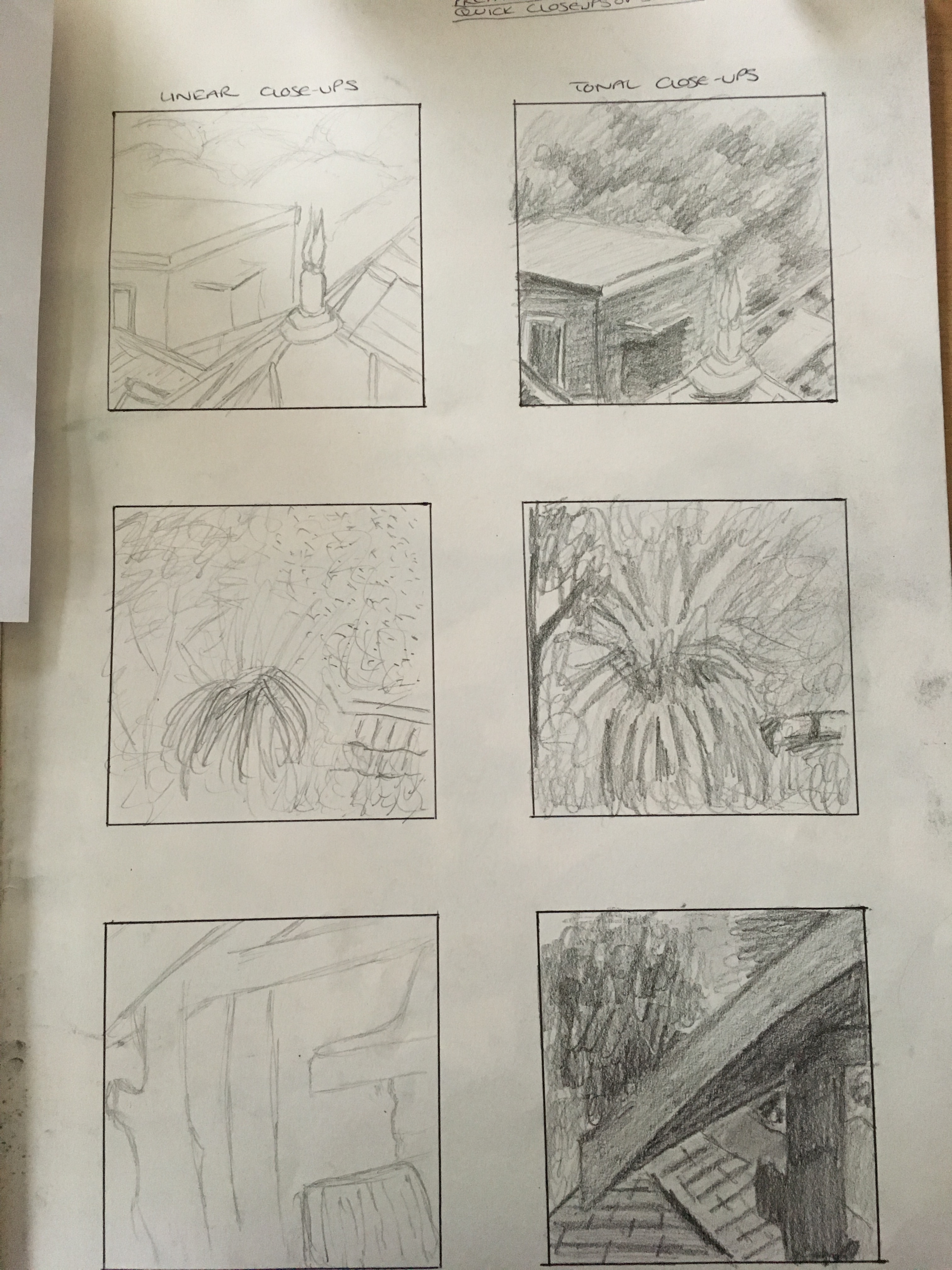
Fig. 3. Munch, E (1893) The Scream [oil, tempera and pastel on cardboard] At: https://commons.wikimedia.org/wiki/File:Edvard_Munch,_1893,_The_Scream,_oil,_tempera_and_pastel_on_cardboard,_91_x_73_cm,_National_Gallery_of_Norway.jpg (accessed on 5 August 2019)
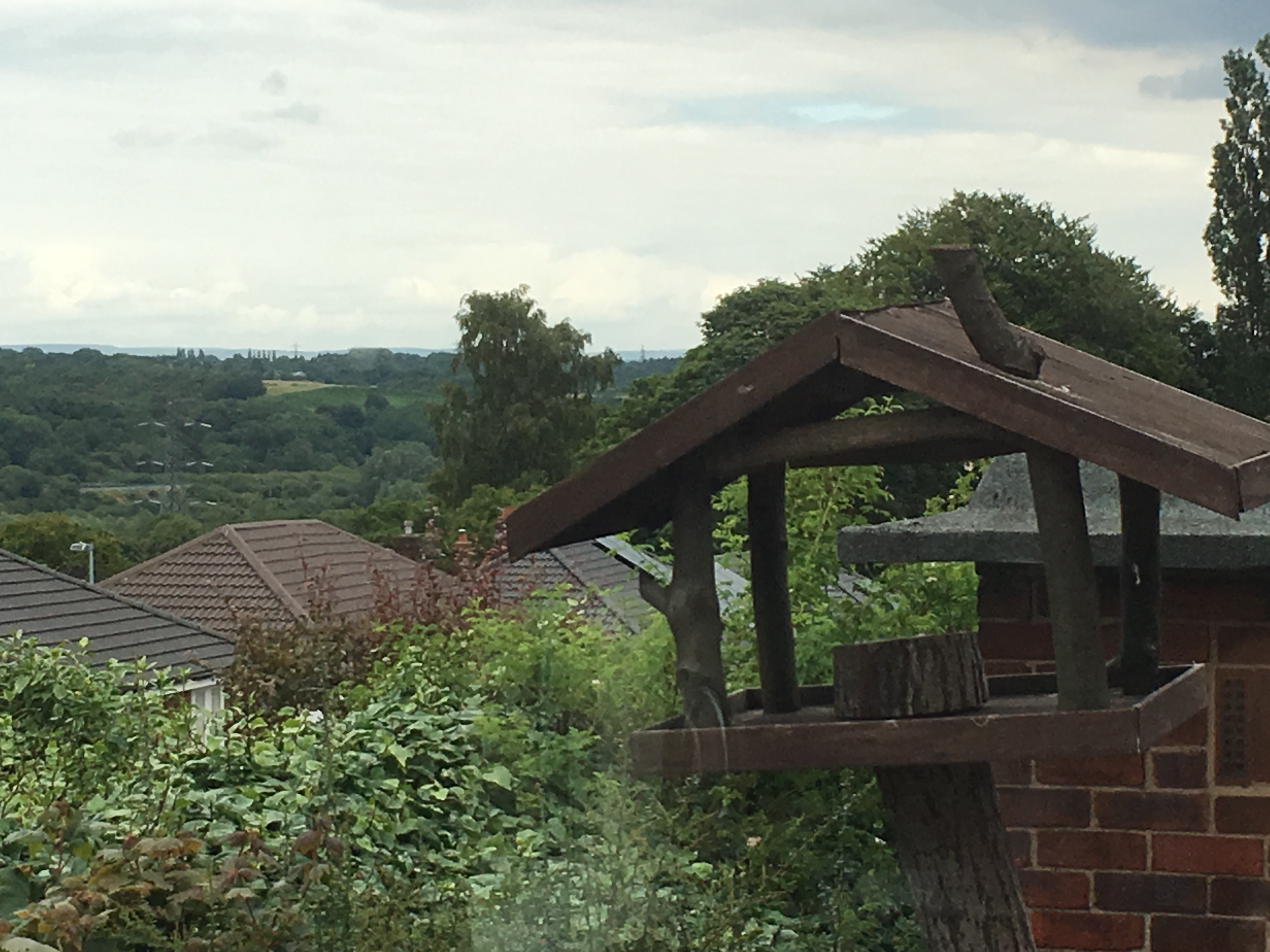
Fig. 4. Juliussen, O (2016) Face [ink on paper] At: https://www.beautonart.com/art-posters/art-prints-glicee/expressive-monochrome/ola-juliussen/face-1 (Accessed on 9 August 2019)
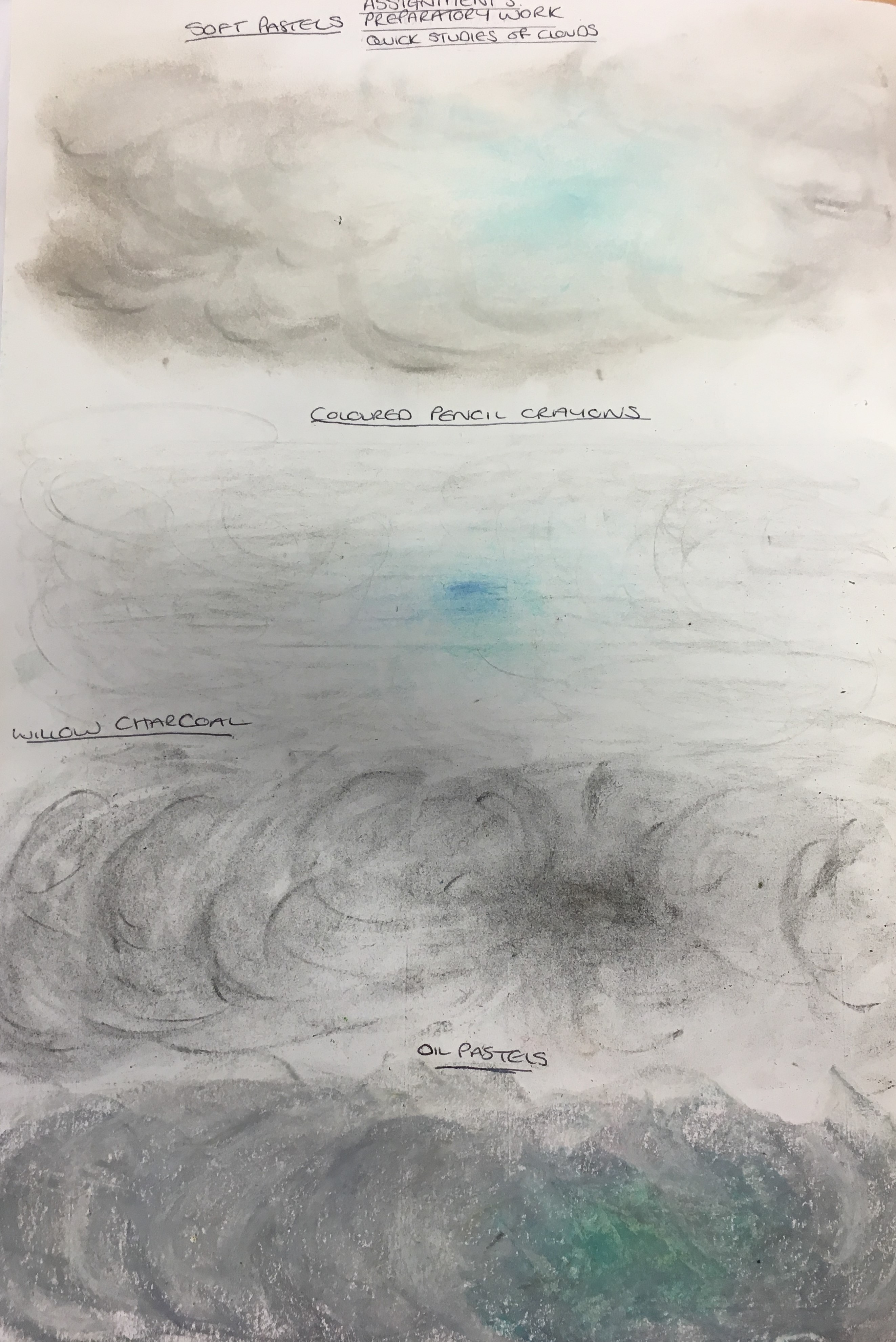
Fig. 5. Chalhoub, N (unknown) [drawing] At: http://inagblog.com/2016/09/naji-chalhoub/ (Accessed on 21 August 2019)
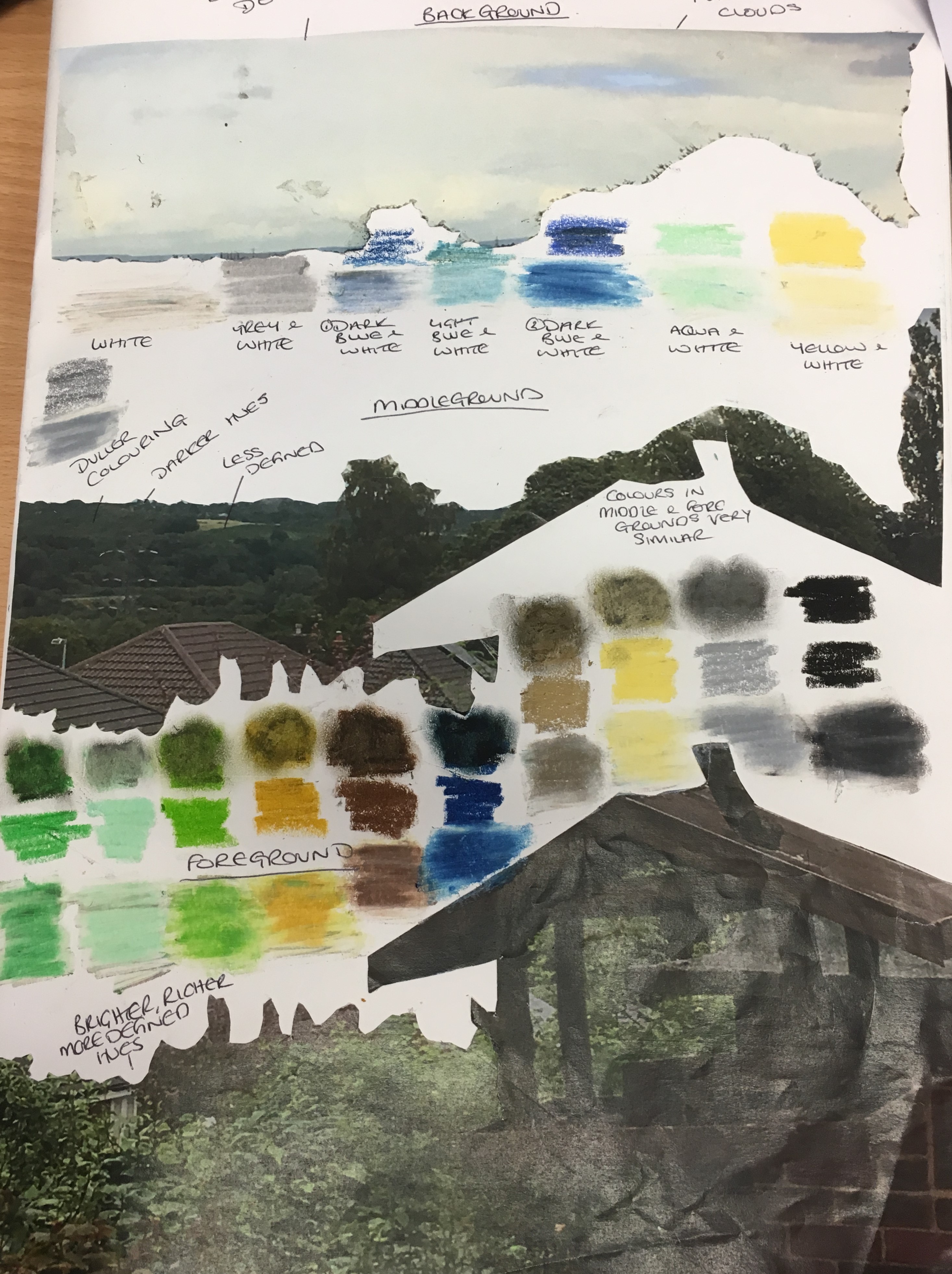
Fig. 6. Chalhoub, N (unknown) [drawing] At: http://inagblog.com/2016/09/naji-chalhoub/ (Accessed on 21 August 2019)
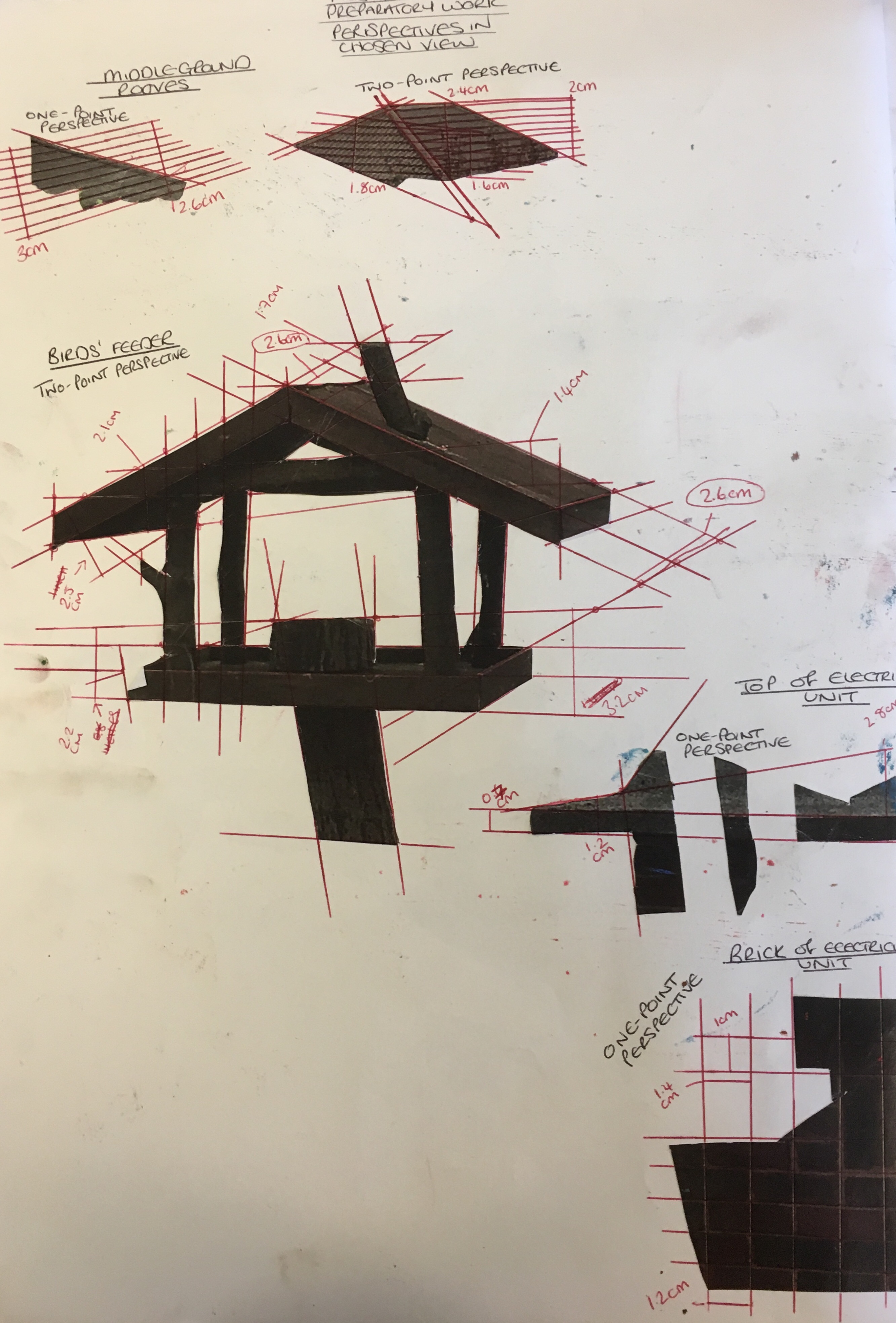
Fig. 7. Audrey Anne (2018) [pencil] At: https://www.instagram.com/p/Bl5FThQDkGB/?saved-by=lpremratnam (Accessed on 21 August 2019)
Bibliography

The Guardian (2014) ‘The Top 10 Unforgettable Faces in Art’ [online] At: https://www.theguardian.com/artanddesign/2014/may/08/top-10-unforgettable-faces-in-art (Accessed on 9 August 2019)
Part 4: Project 1: Fabric and Form

Research Point 4.0: Depictions of the Human Form throughout History

Please click here for my findings in this research.

NB: I have merged two of the research points together due to their similarities. These research points are 4.0 and 4.1.1.

Exercise 1: Drawing Fabric using Line and Tone

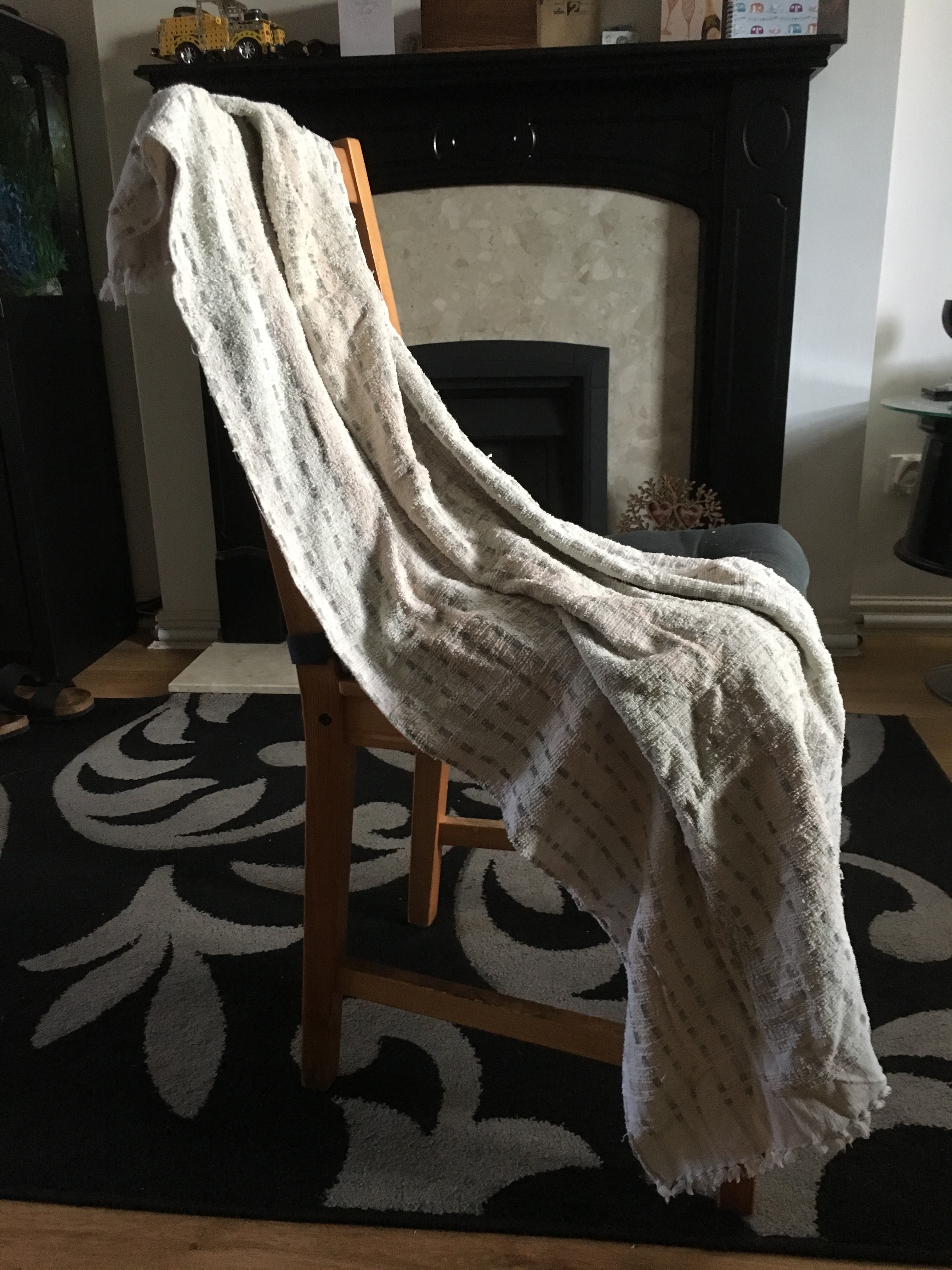
For this exercise, I did as was asked in the course textbook and draped the closest I had to drape a plain sheet across a chair to create some folds with shadowed areas.

Chair with draped towel

Line Sketch

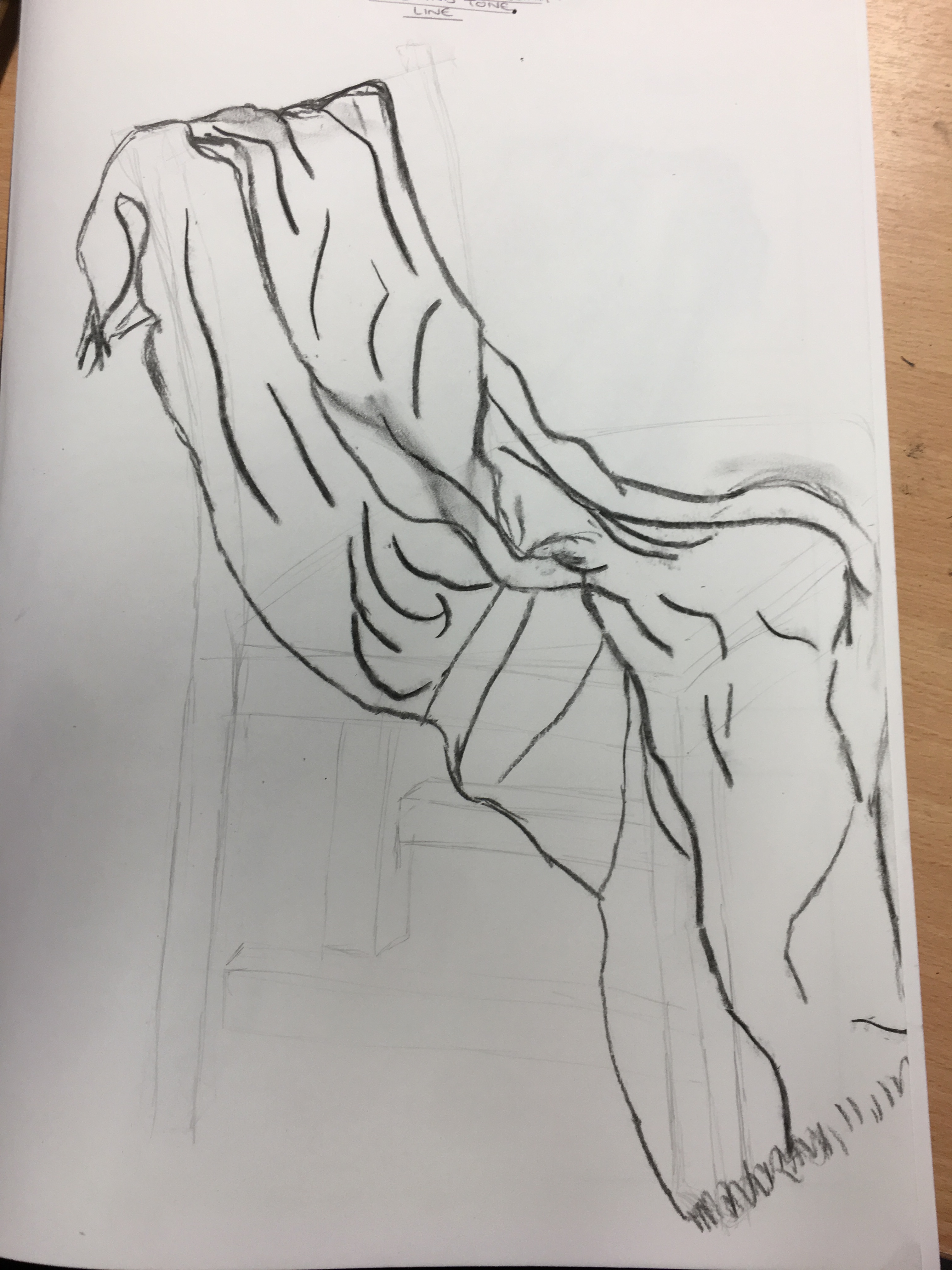
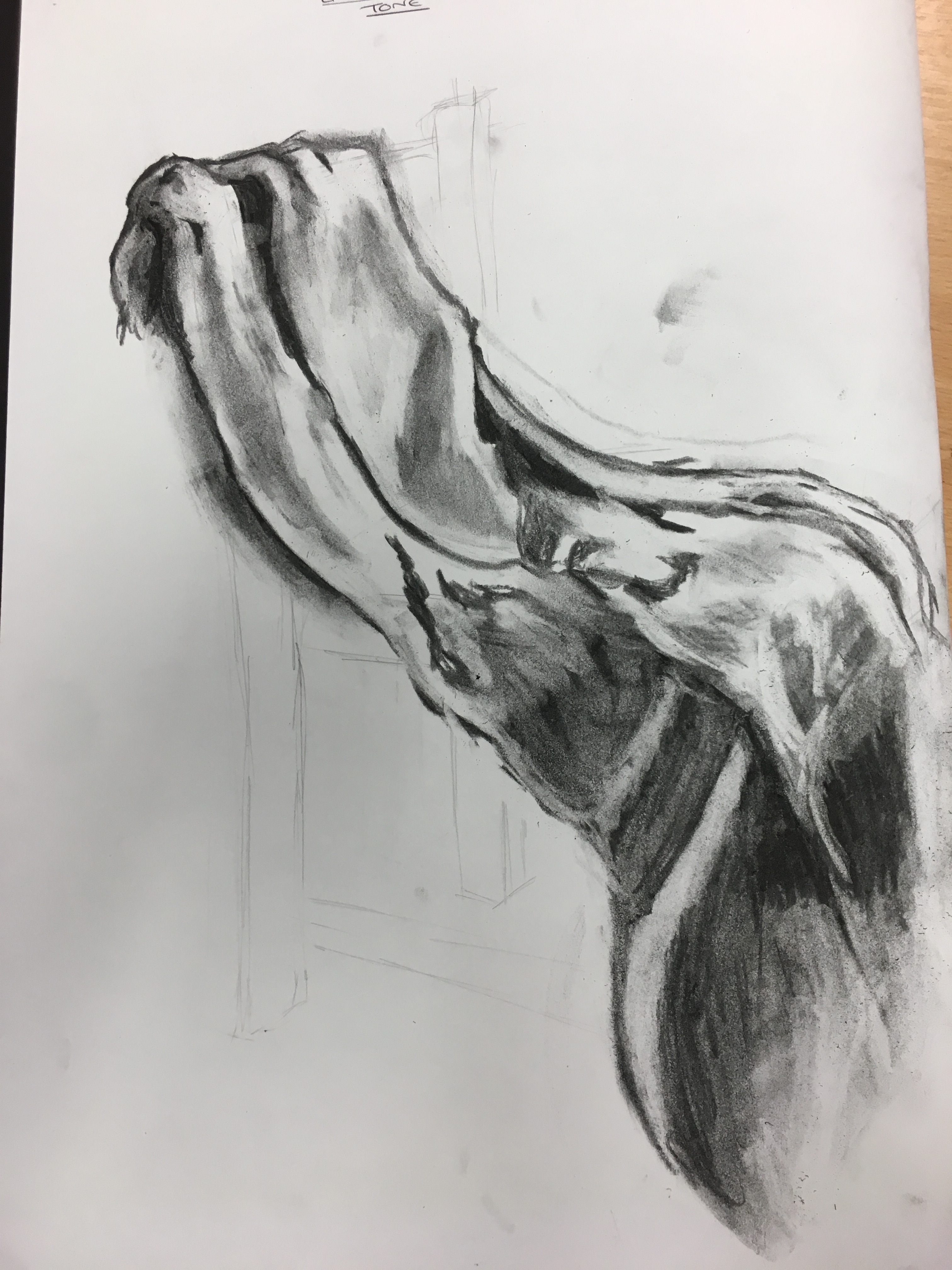
I used a page in my sketchbook to create a sketch in line of the draped towel. I decided to draw the outline of the chair in pencil so it was somewhat invisible compared to the charcoal, but was still there to provide a guide as to the weight of the fabric draping downwards. I decided to use charcoal due to my growing ease with this medium and its flexibility with movements across the page. I have discovered it can easily be smudged out (though not completely) to allow you to correct your measurements etc when using it to draw in line sketches.

Line sketch in charcoal

I enjoyed this task as it was nice to focus purely on the lines I could see, regardless of the concept that there are no actual outlines in real-life, so it was nice to look beyond so many ‘rules’ and just draw the lines I could see. I found it a little hard in some places to ‘read’ the lines correctly and work out if I was placing them in the correct position. I think I did a believable sketch here, however, I do think there are definitely sections in which I could improve my sketching skills. It was my intention to put across a believable sketch for the viewer to be able to see clearly enough what it was and where it was going.

I think I have been successful in creating a believable fold over the top of the chair and in creating the sense of folding within the material with my use of the line. I also like the tonal change for the tassels at the bottom of the towel. I think I have been able to understand the underlying structure and successfully recreate an accurate measurement of the chair and that this has helped translate the draping better as a result.

Tonal Sketch

I then used another page to create a similar sketch but this time in tone. I, again, drew the chair in pencil first and then moved on to using charcoal due to its deep tonal contrasts and ranges of tonal values. I concentrated on the broad tonal patches in the piece and then I used a rubber to lift out all of the lighter areas on the towel. This exercise really is very different to the line exercise as there is so much more to consider in terms of the tonal ranges, light fall etc.

Tonal sketch in charcoal

I really enjoyed doing this exercise and think it will come in very handy for future exercises, especially when considering the structure underneath the drapery and how essential it is to first have an understanding of that structure and its weight and placement etc to be able to ‘read’ the exterior correctly.

Whilst creating these pieces, I found myself losing measurements of some of the folds as I was moving along and that some had to be eliminated or redirected to assist with continuing to create a believable illusion. To have avoided this, I think I would have been better off trying to measure the the main outline or ‘shapes’ within my subject and then building this up from there as opposed to just working my way downwards from the top of the piece. Also, I think I should have stopped every once in a while to remeasure things and correct things as I was going, as opposed to leaving it too late.

This exercise has also deepened my enjoyment in using charcoal as, when I first began this course, I did not really enjoy this media and could not really control it very well. Whilst I still think I have a long way to go compared to some people’s talent and skill, I think I have also become a lot more capable in terms of my use and capabilities with charcoal.

Exercise 2: Emphasising Form with Cloth

Emphasising Form with Cloth

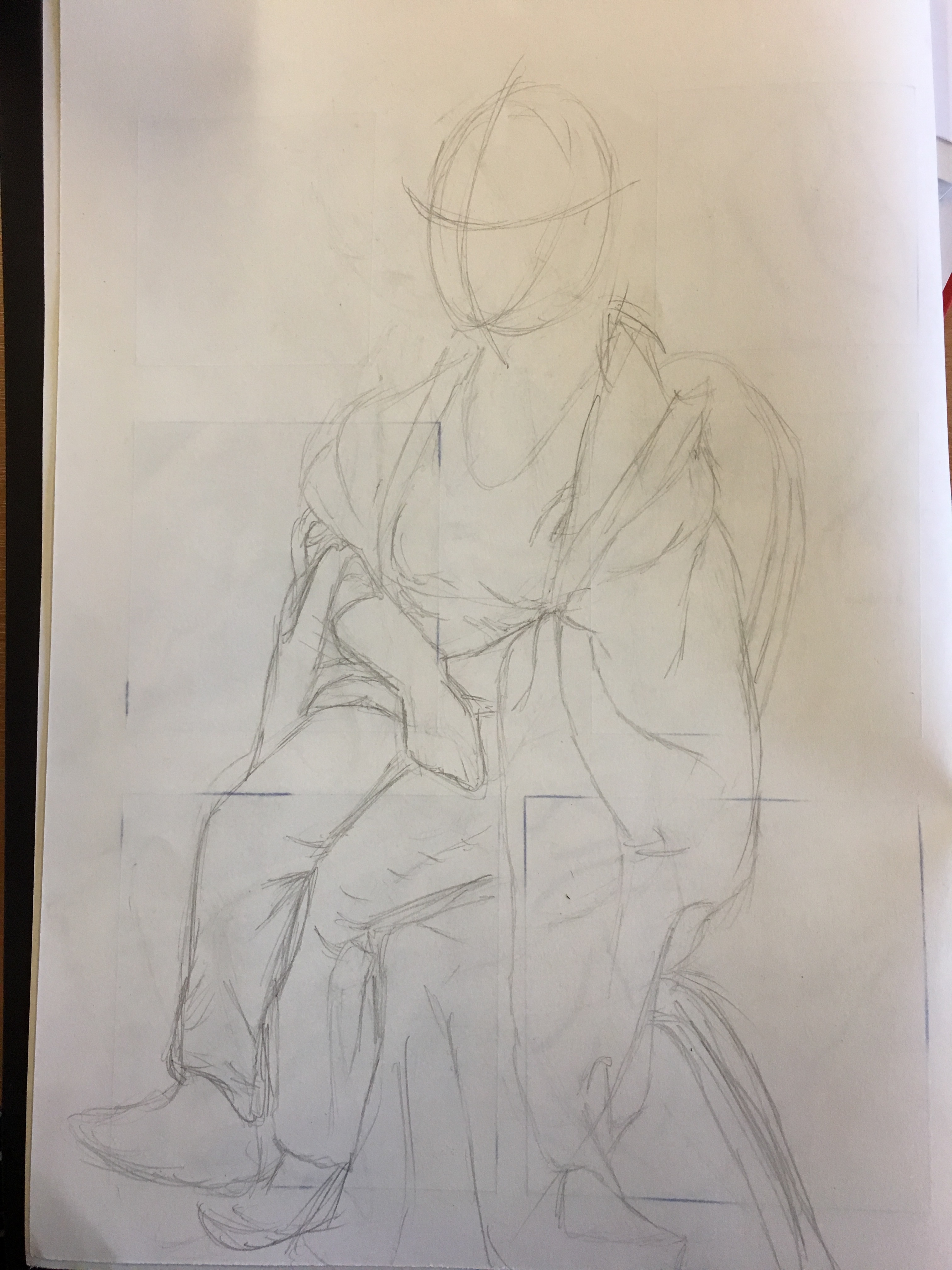
For this exercise, I had someone sit on a chair with a length of plain material wrapped around them. I tried to work relatively quickly, but still took my time on the overall sketch. I worked solely in line and worked through the layers as required in the course textbook. I tried to concentrate on the fabric and overall shape of the subject as opposed to the finer details of the fingers and eyes etc. I decided to draw in some guide lines of the head and indicate the direction in which the subject was looking.

I really enjoyed this exercise and think I have done quite well considering I had not used any grids or other guides and had only really spent approximately five minutes creating the sketch’s layers. I found it quite interesting to create the folds and weight in the piece, but do think my overall balance is slightly off somewhat – especially in relation to the chair leg to the bottom right which does not appear to sit correctly. I also noticed that, if focusing on the outline more so than the general placement of each part as a whole, it is rather easy to lose the overall structure of the subject and to have one point correctly line up with another part.

This exercise has taught me the importance of seeing the basic shapes of the overall subject first and to then build on it with the details and folds etc. It really does become clear that the underlying structure is just as important – if not more so – than the outer detail in creating the final piece, whether organic or man-made. It reminds me of telling a story; you have to create the character’s background first and then build upon this within the story to make it believable and to be able to relate to the characters and see them as a whole.

Research Point: Depiction of the Human Form throughout History

Please click here for my findings in this research.

Part 3: Sketchbook Pages

This page is to highlight some of the pages within my sketchbook for the third Part of this course which do not correlate with any specific exercise.

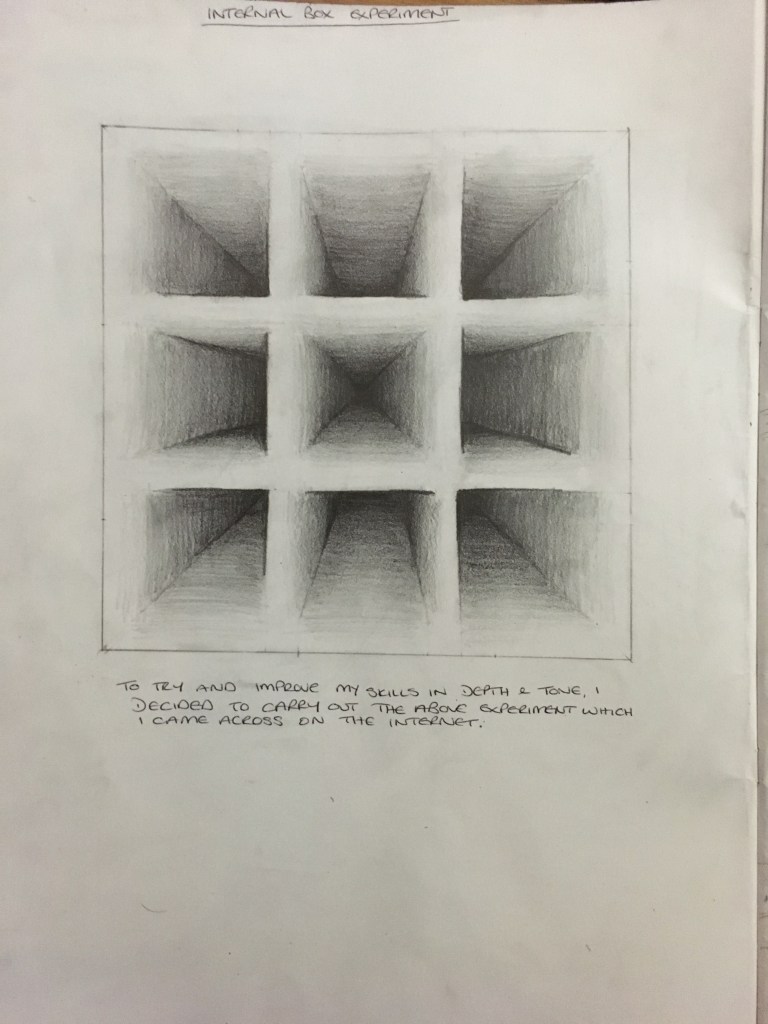
Internal Box Experiment

Working on my tutor’s comments regarding bringing forth the many layers of tonal ranges, I came across this exercise on the internet and decided to have a go myself in my sketchbook. I was quite pleased with the result and enjoyed the piece and tranquility completing it brought with it. This experiment will definitely assist me going forward.

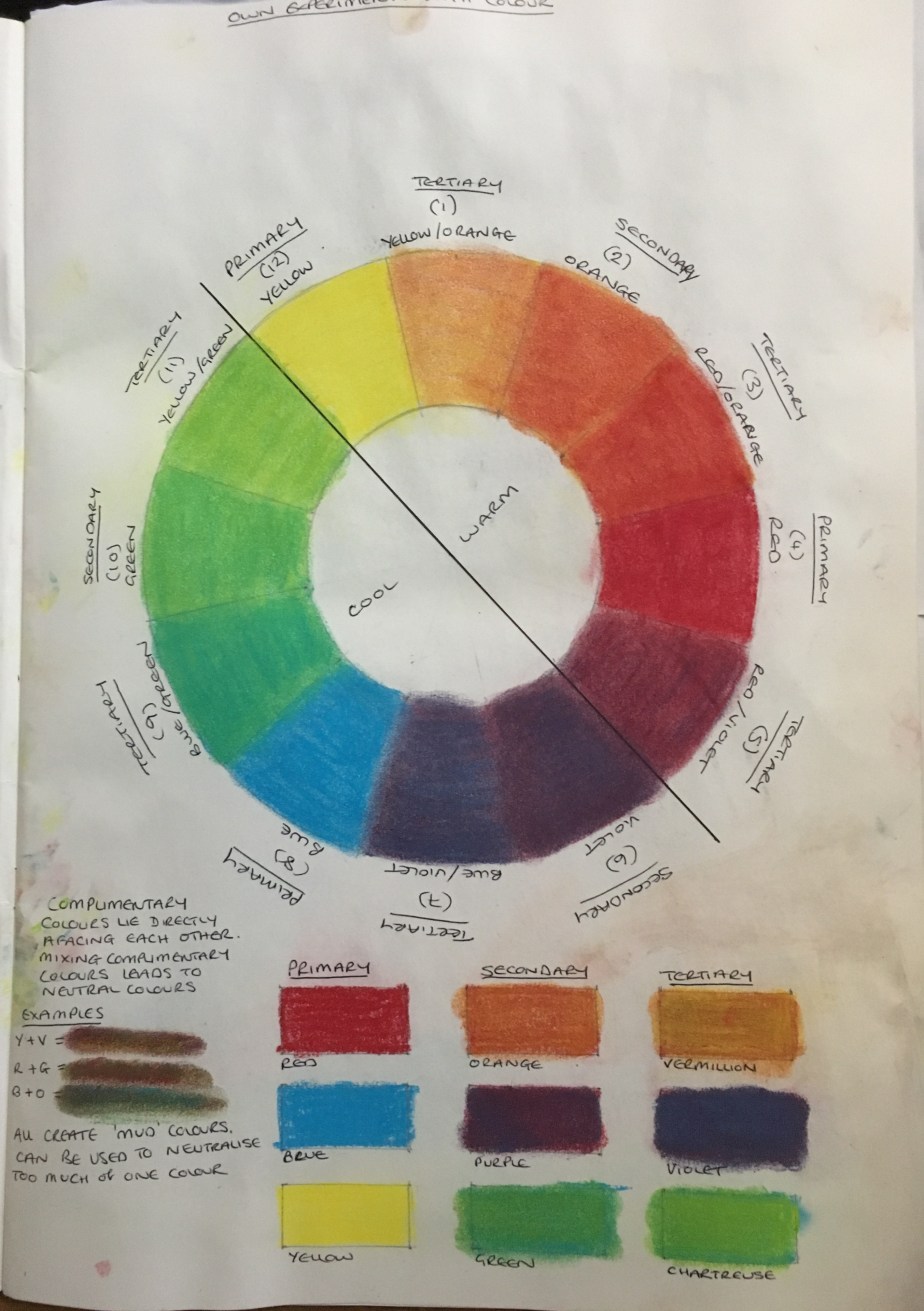
Colour Wheel Experiment

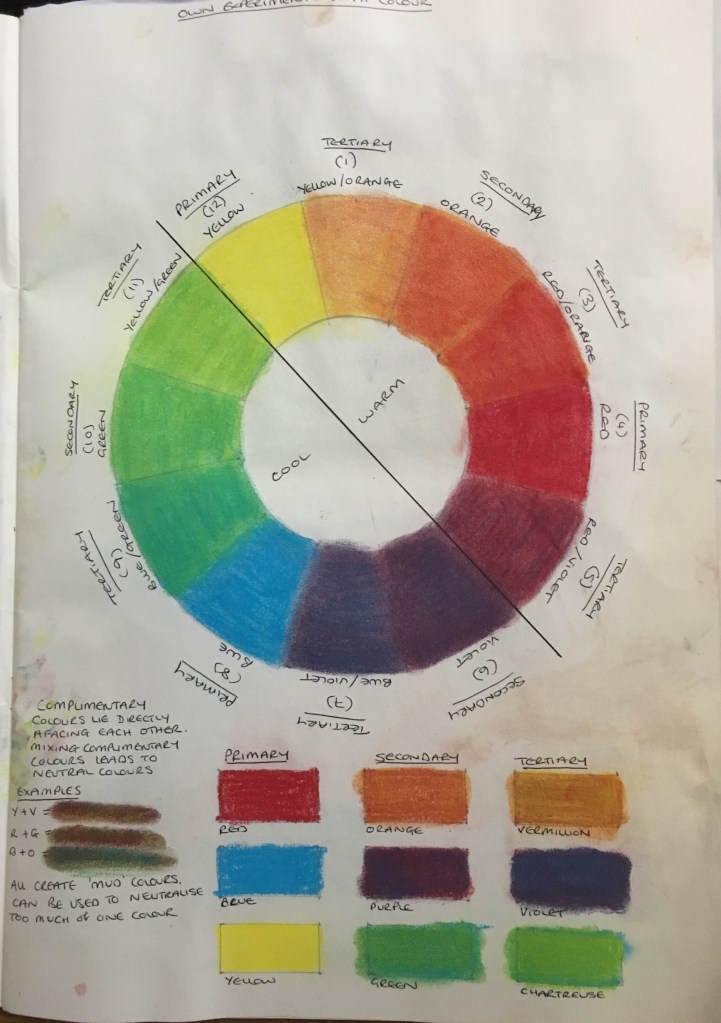
Following on from my tutor’s comments regarding understanding colour and its different attributes, I decided to carry out a creation of a colour wheel which, again, I had found on the internet. Whilst I could have just used their version to work from, I decided to create the piece myself and was happy that I did so as actually redoing it myself helped me to understand the mechanics and use of this wheel.

Perspective Experiment

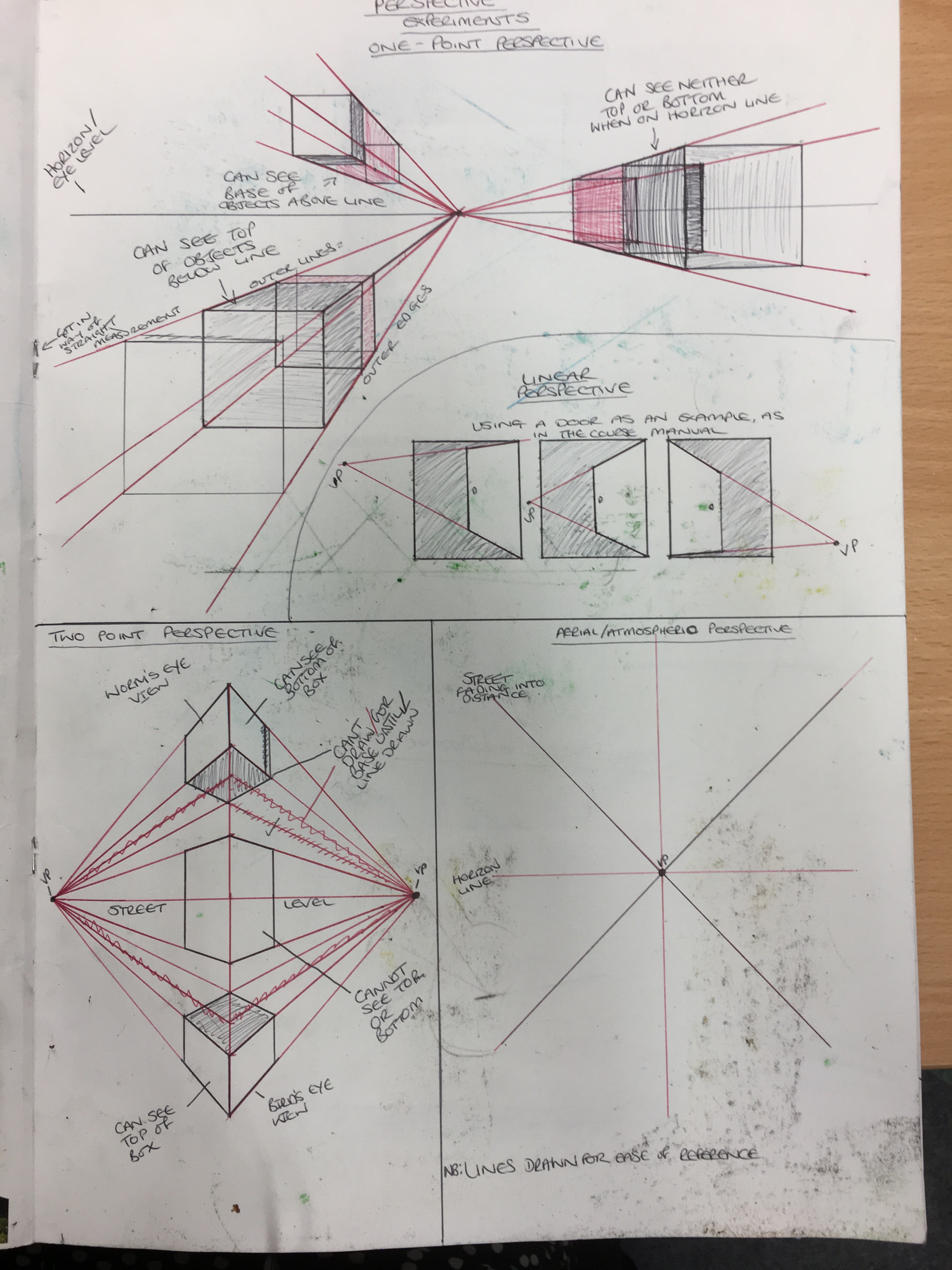
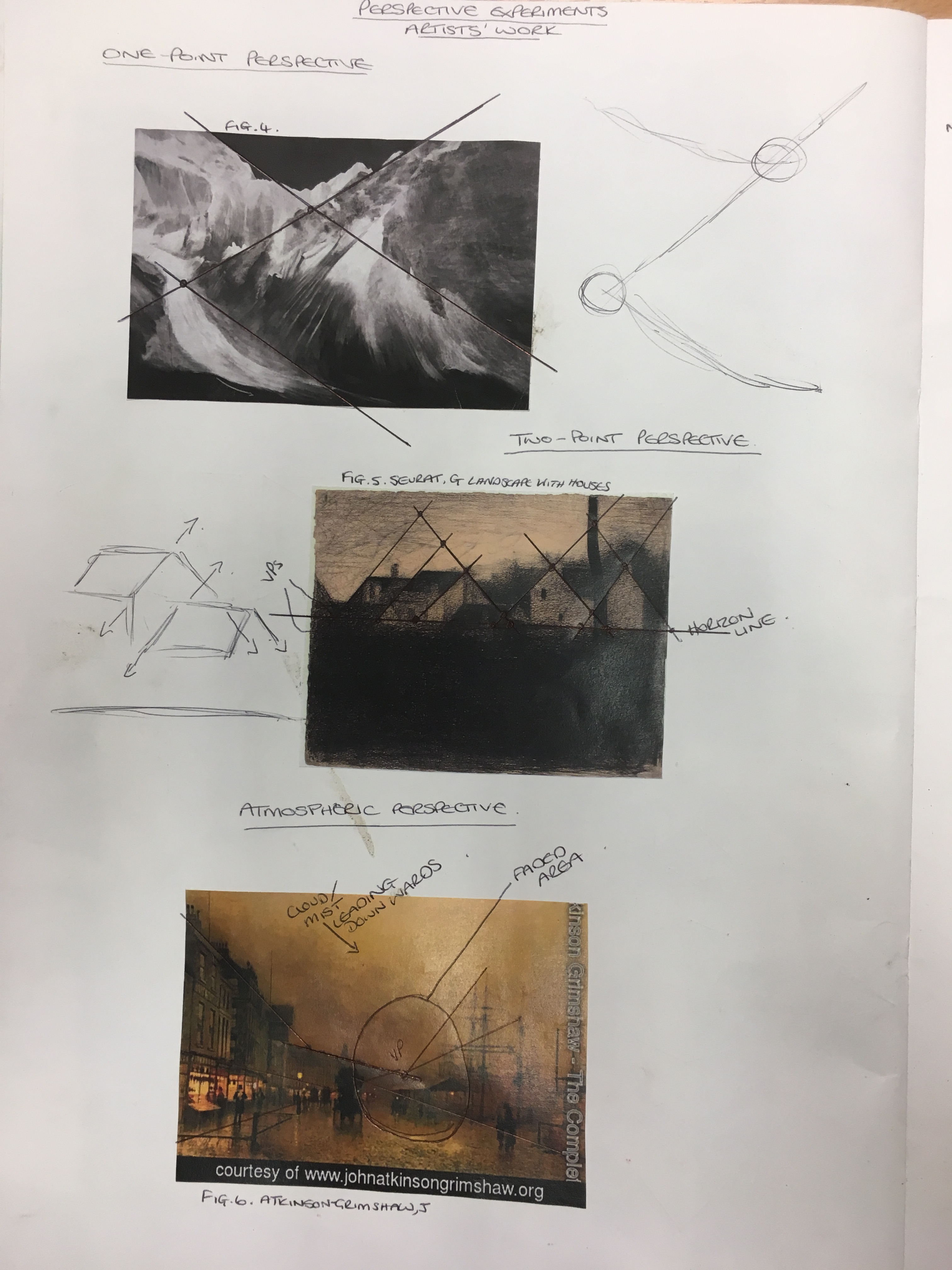
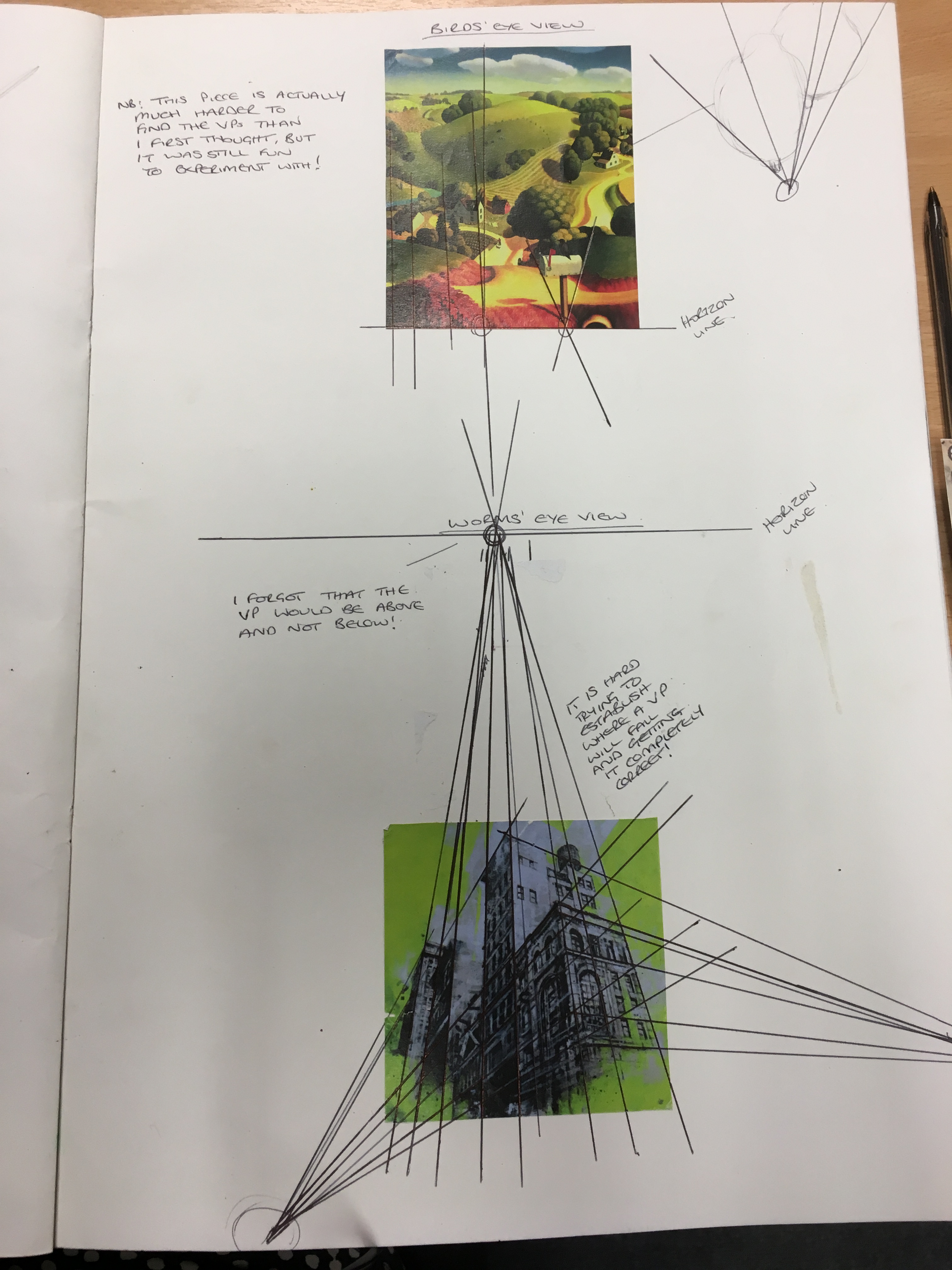
I decided that, since I didn’t feel I fully understood the concept of perspective having read the course manual, I would do my own research into it and carry out my own experiments to help me comprehend it fully in my own way. Below are the three pages of my sketchbook showing these experiments and the results of the same.

Sketchbook List of Illustrations and Bibliography

Please see the below document for citation relating to my sketchbook for this Part of the course:

Part Three: Expanse – Assignment Criteria Reflection

Demonstration of Technical and Visual Skills (35%)

  • Materials: I think for this Part of the course, I have stayed rather limited in my use of materials, but I also think each have suited the exercises carried out. Upon reflection, I think perhaps I could have been more experimental, using tea or coffee staining to create the effects of the bark of the trees, for example.
  • Techniques: I have learned a lot during this Part of the course in regard to the techniques used to create the perspective pieces. Where I have always used just freehand or grids before, I was now using a ruler and set-square to assist in the creation of my pieces, as well as actually looking for vanishing points within the pieces. All of these things I feel have helped me improve my perceptive skills and see where I am going wrong, for instance I have noticed I tend to curve my drawings somewhat to the left. Perhaps this is due to my being right-handed and the hand naturally moving in a curved manner. This is something I will have to try to work on and be aware of moving forward. I also tried to take on board my tutor’s comments regarding having my ‘outline’ and allowing my expressive mark-marking within these boundaries. I think I have still been rather heavy-handed within my pieces. Surprisingly, I found I was able to be lightest in my controlled and measured pieces. I think, perhaps, this is due to the time and effort I take on these pieces as opposed to how I tend to work rather quickly in others. This is something I think I need to bear in mind going forward.
  • Observational Skills: Again, I think I have progressed in this area as I am now seeing the world around me in a more artistic way; I look for vanishing points in streets, one-point and angular perspectives in buildings, the difference in grounds when looking over landscapes and into the distance etc. I feel I am progressing in this area slowly but feel I have come far in a very short space of time since beginning the course and am hopeful this will only increase as I move on through the many different parts and levels within the course. I feel my ability to choose and crop (as suggested by my tutor in my feedback for Part Two) has grown somewhat and I am still trying to improve this by choosing what I find to be interesting viewpoints and subjects.
  • Visual Awareness: As with my observational skills, I think this is rather linked together. I am constantly striving to see the world in a different way and from a more artistic approach. I think I have been able to find interesting visual stimuli to work from and have improved in my ability to convey what I see somewhat too. However, I still feel I have a long way to go with this.
  • Design: I think I have done better in this Part of the course with regard to less reliance upon photographs as I have tried to work in a method on occasion where I take a photograph of a specific viewpoint or subject to assist in creating a grid, notice of vanishing points and placement of objects realistically to create the skeleton of my piece to then build upon from real-life. I have found that this has worked rather well and is definitely something I will aim to continue and improve upon going forward.
  • Compositional Skills: Again, I believe the use of the photograph / grid / vanishing points have assisted me massively. I am hoping this will progress further in the future and I will be able to eventually see compositions without the assistance of these physical cues, but merely gain the ability to see them solely in my mind’s eye. I think it is rather hard to discuss composition of landscapes or trees since these are unmoving and unchanging. In Part Two, I was able to place objects where I thought best suited. In this Part, I found I had to move myself around the fixed compositions to find an ‘arrangement’ I thought the most interesting and intriguing.

Quality of Outcome (20%)

  • Content: I think I have been quite successful in my choice of subjects and the content of my pieces within this Part of the course. I think I have stayed rather true to my exercises for the most part, only changing certain things to suit where I deemed necessary, such as using biro as opposed to a 3B pencil. I think my choices have been interesting, however, I do think I could have perhaps been a little more experimental by choosing older buildings with more character to work from perhaps, but owing to time, weather, circumstances etc, I often had to work with what I had around me. I tried to choose areas of sentimental value to me, such as my home, a local park and so on, which whilst potentially not ‘exciting’ to the viewer, may lead some to question “why that house?” or “why that park?”, the answers to which I feel are interesting, deep and meaningful when understood.
  • Application of Knowledge:  I feel I have done rather well here as I am very keen on fully understanding how and why certain things are important. I couldn’t fully get my head around perspective, so I researched these topics and and carried out experiments to assist me with my understanding, which I genuinely found really did assist me. I then tried to incorporate what I had learned in these experiments into my pieces and found I understood what I was actually trying to achieve a lot more as a result. I think I have come a long way from the beginning of this Part of the course and can now appreciate the feedback provided by my tutor much more clearly, however, I do feel this is something else which will be a slow learning process for me and one I wish to continue practicing, learning about and improving on.
  • Presentation of Work in a Coherent Manner: There are a couple of pages within my sketchbook in this Part which are a little out of sequence due to my doing certain sections at similar times and having misread the manual slightly. However, I think the layout of my website is understandable and easy to manoeuvre and follow clearly. I have really enjoyed the use of the links within the different projects / research points as this allows me quickly to refer to previous exercises etc and for people to easily follow my thought process.
  • Discernment: As with the previous Part’s reflection, I have again watched shows, read books and looked for as much visual information as possible. I have made reference within this Part as to the relevant things I have come across, but I admit that I generally do not have much spare time to be able to visit art galleries etc very often. I hope to visit at least one more by the end of this course as I do find it very enriching and inspiring. I am, however, very much a book worm and find I cannot read enough, so I am definitely trying to invest as much time in this as possible. I admit I have struggled in certain exercises in the course so far with certain questions or requests asked of me. For instance, I struggled to grasp the concept of the perspectives at first, hence my extra research. I do think, however, that some parts aren’t are not easily read and I end up struggling to comprehend and spend too much time trying to work this out.
  • Conceptualisation of Thoughts: I think I still did not use my sketchbook for preliminary sketches as much as I should have and as recommended by my tutor. I also think I should have used more mind-maps, but I have found that I will generally think up my concepts and ideas on the spot and just run with them. I have found I have to be in the ‘place’ mentally to create my pieces and want to get this out as quickly as possible, so to spend time creating mind-maps or preliminary drawings would potentially zap me of my creative energy and prolong the process of completing the exercise in question. I have found throughout so far that I tend to work quickly through the exercises and view them more as experiments and then, when I reach the assignment piece, I look back over what I have done and try to come up with a concept for the final assignment piece from there.
  • Communication of Ideas: Again, I think this is where I have had a bit of a downfall in my approach to the exercises due to the lack of creation of mind-maps etc to plan things out efficiently. However, I think I may have redeemed myself somewhat with my preliminary work for my piece of the wall as I tried to get across to the viewer of my sketchbook what I was actually trying to achieve. Hopefully this has also been apparent in my pieces showing the vanishing points I had used. I think I have also been rather consistent with my online blog throughout this Part too.

Demonstration of Creativity (25%)

  • Imagination: I think I have shown imagination in the sense that I took the piece with the bridge from actually being from a nice, sunny, clear day to adding in some atmosphere to the piece and changing it to appear as though created in the winter months due to leaving off the leaves from the trees and focussing on the feel of the air surrounding the bridge to add a touch of sinisterism as I do not think the atmospheric perspective would have looked quite as good or effective had I done it for a warm summer’s day.
  • Experimentation:  I found I was not extremely experimental with regard to my media or surfaces for this Part of the course, having focussed on what I thought to be the main aim of this part; the ability to scale and depict things effectively. However, I did experiment with the use of tools such as a ruler, a compass and a set square, so I feel I am still constantly experimenting, just in differing ways with each Part’s requirements.
  • Invention: I think my grids and the use of the vanishing points to help me establish the backbones of my piece, have by far been my ‘invention’ for this Part. I am constantly trying to find ways of easing and speeding things up for myself and think this way rather suitable and effective for my style of working. I also find it really helpful in the short-term to aid me in seeing things properly, almost like armbands helping a child practice their swimming skills in the early stages.
  • Development of a Personal Voice: I think certain aspects of my work have begun taking shape into my own personal voice. I think it is becoming clear that I really enjoy being expressive in my work, working with a limited palette and zooming in on sections as opposed to trying to frame the whole.
  • Research: I think this is my forte and something I thoroughly enjoy. I have tried to compress my findings into what I specifically need to know and what is directly relevant to the reason for the research in the first place. I really enjoy learning about new artists and seeing so many different methods and styles. Learning about others’ personal voices really does help me question my own style and what I would like to put across in my own work.
  • Critical Thinking (Learning Logs): I have tried to continue to keep my logs concise and relevant to the exercise in question. I enjoy creating link-backs and tags to my previous exercises and research as I think it rather important to build upon my earlier work and the findings from them. I think this is important as when I come to my final assignment for this Unit, I will be able to look back and find key things of note with ease, allowing me more time to focus on creating my actual piece.

Assignment 3

Preparatory Work

I decided to begin this assignment by working my way back from the start of this Part of the course and to include as many techniques from the exercises within it.

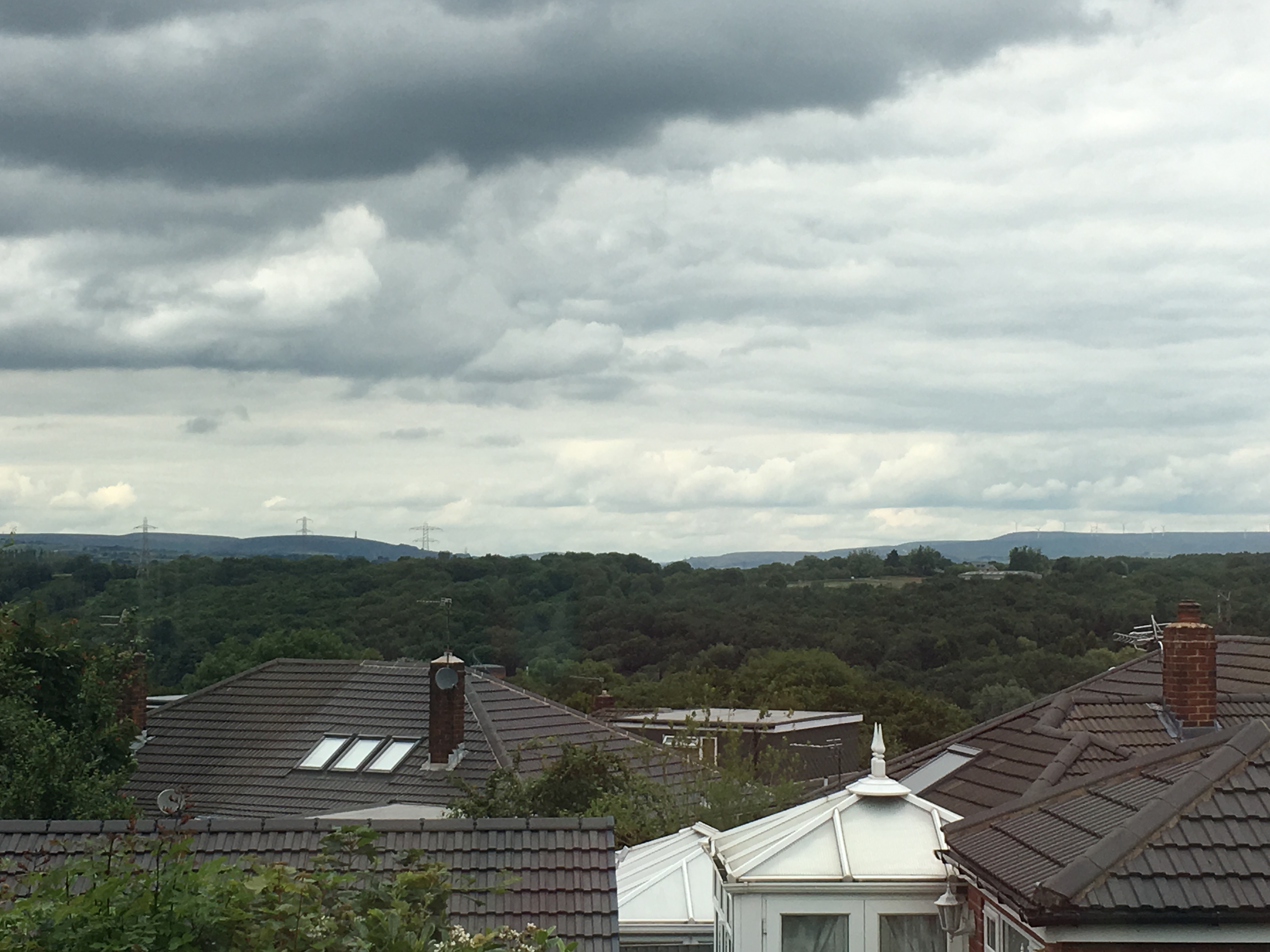
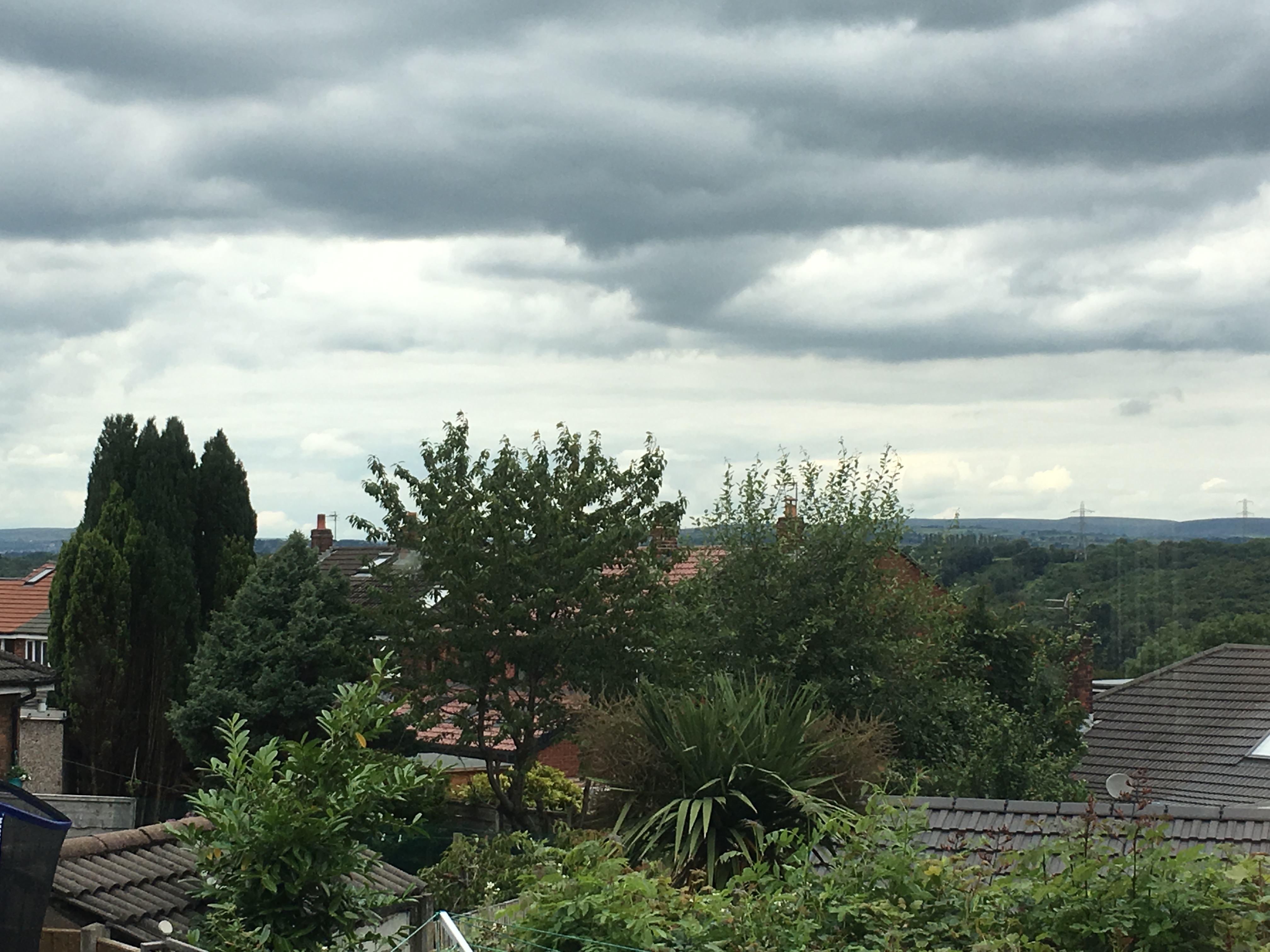
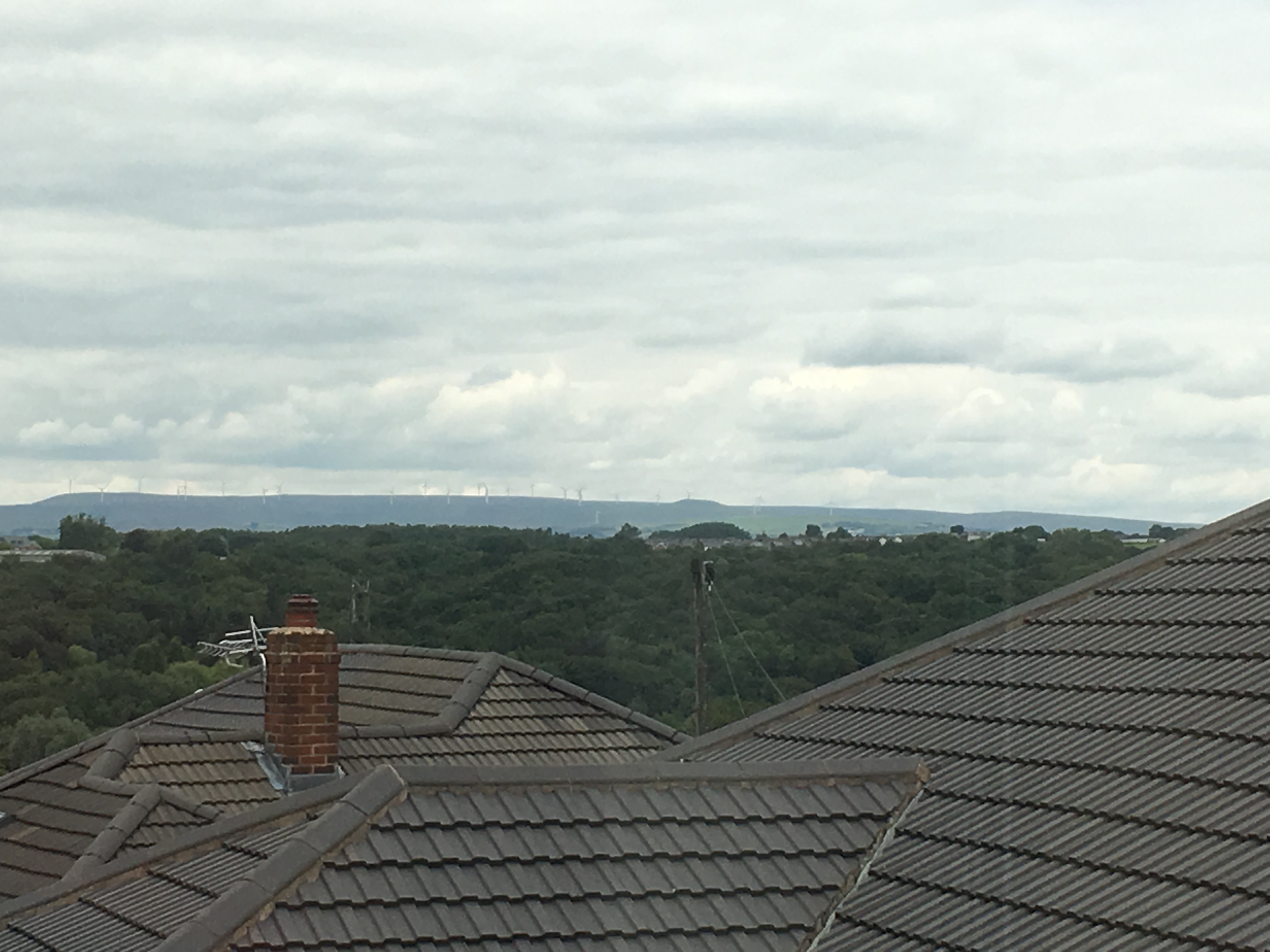
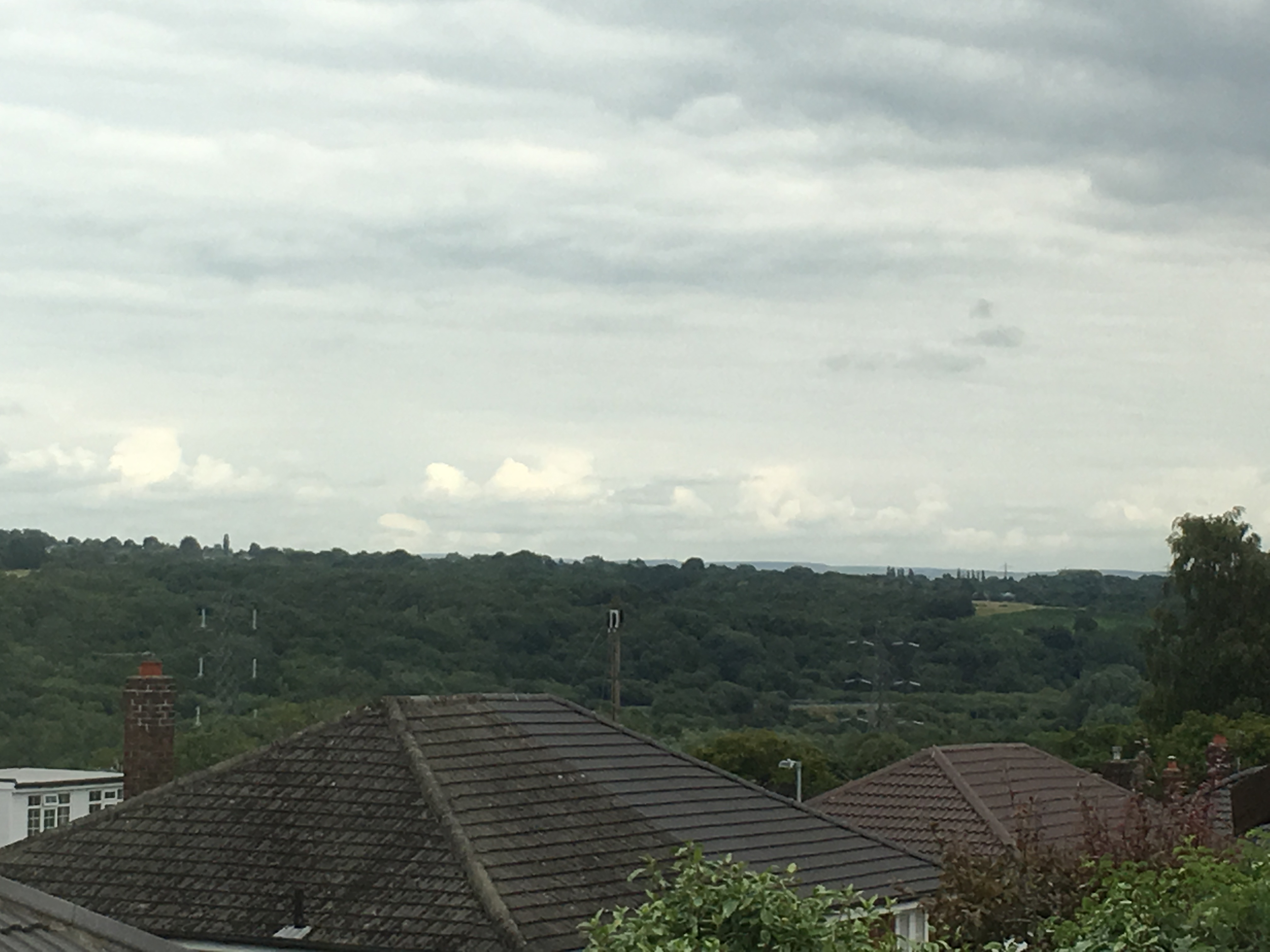
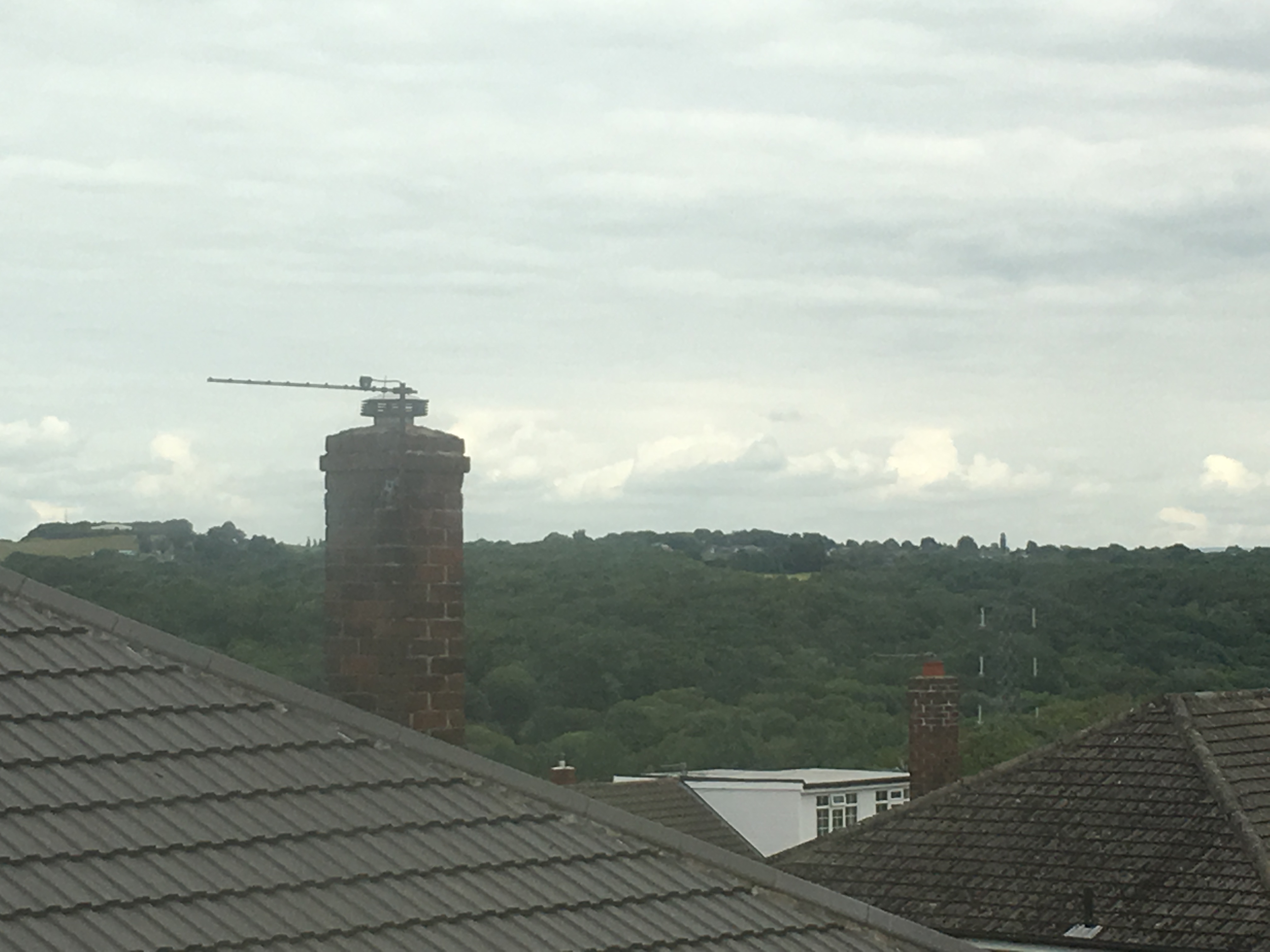
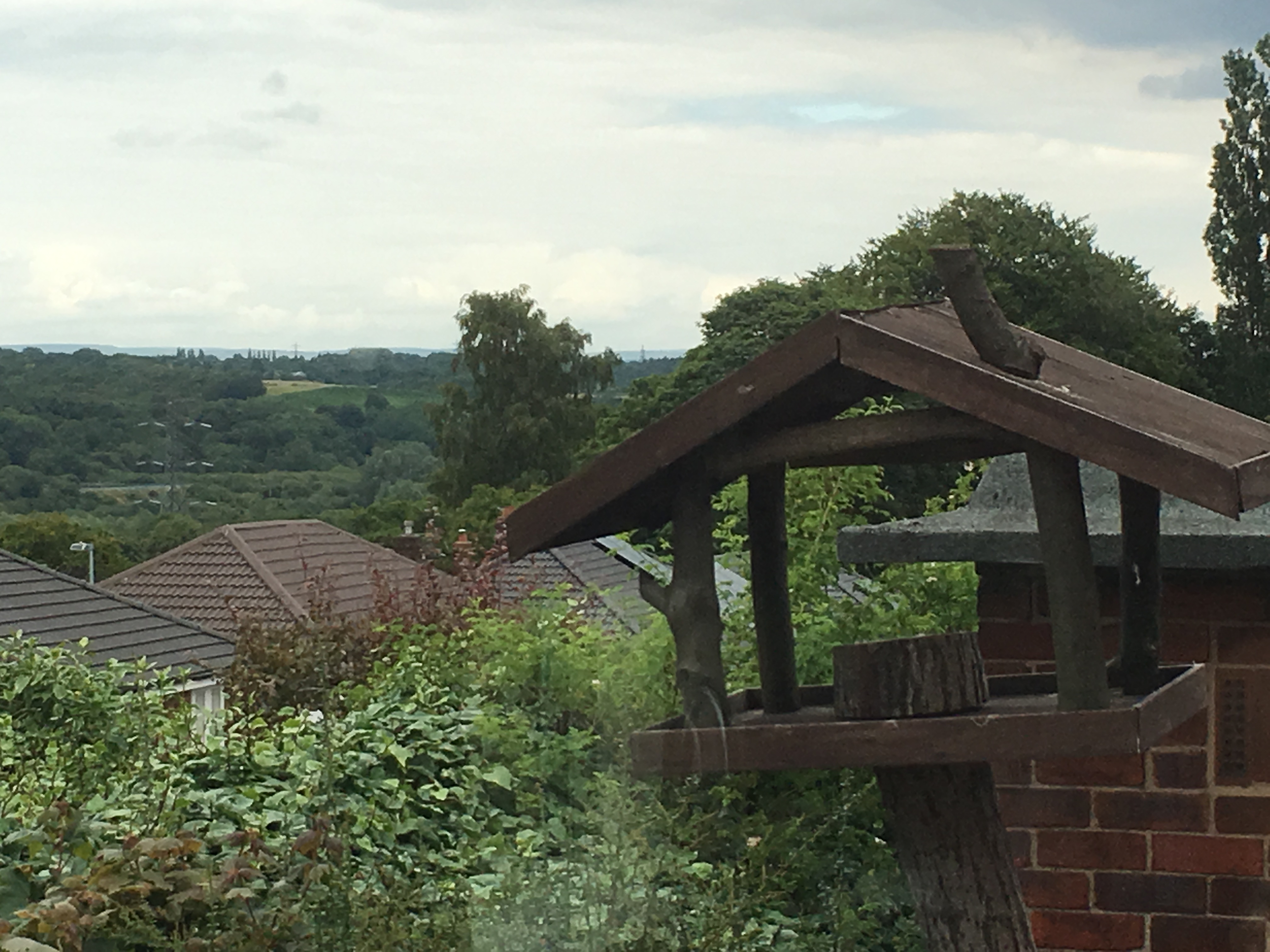
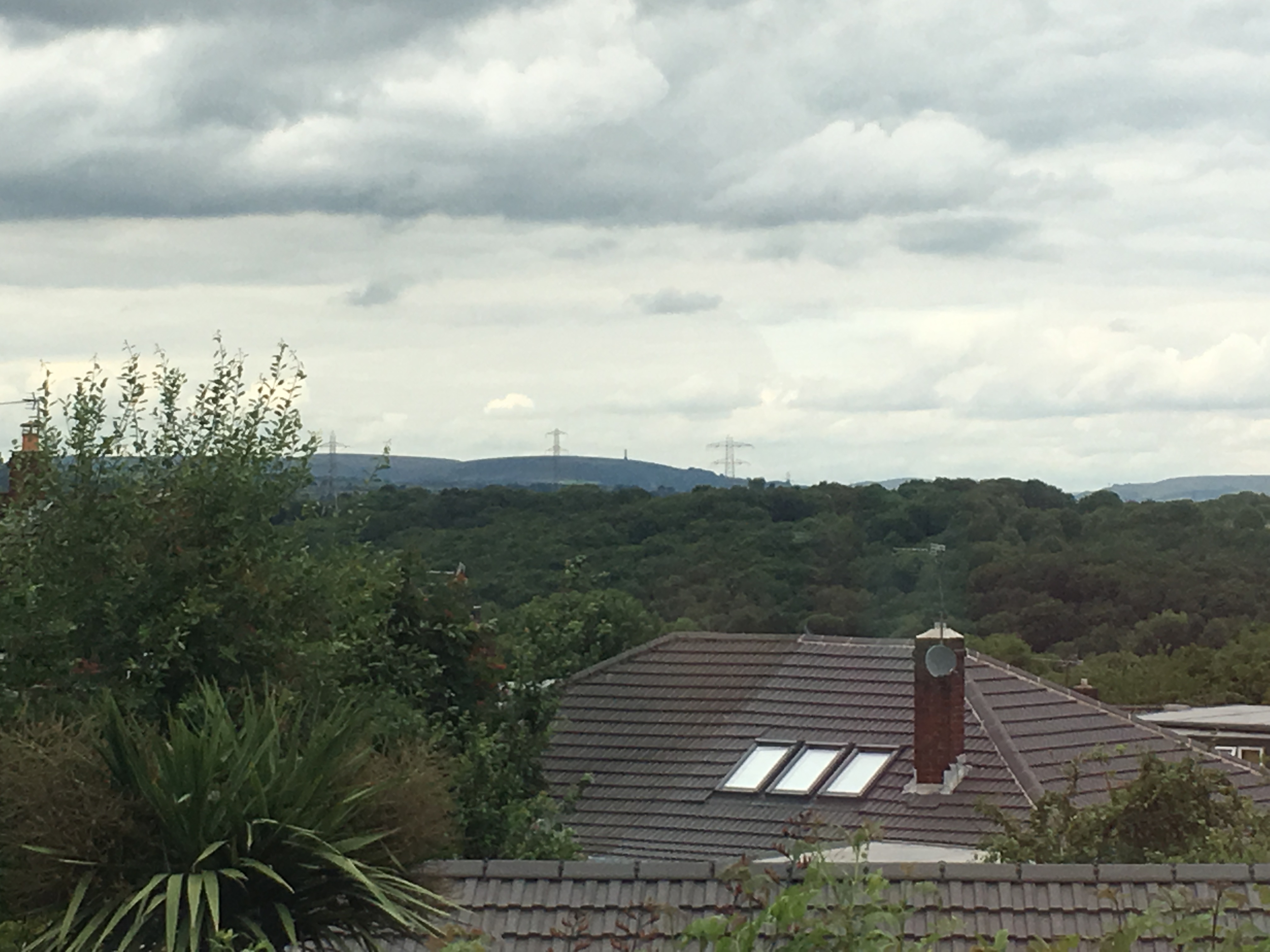
My first task was to choose a viewpoint which included a bit of all, or as many as possible, of this Part. I had been looking around for a while but then decided on the view from my in-laws’ home, which overlooks a lot of trees and other greenery, sky and clouds which lead to an atmospheric / aerial perspective in the distance, houses which show the other different perspectives, and a statue (a birds’ feeding post) in their garden.

Photographs of Chosen Scenery

Looking around, there was a lot of scenery, atmospheric perspective and beautiful rolling clouds. It was an overcast day and there was a dampness in the air, yet there was not much wind.

Whilst I could choose from any of these viewpoints as they were all beautiful to behold. I decided to create a quick sketch of some of the more interesting and diverse scenes to assist me in deciding, as I felt I could only see things properly through actually drawing the scene to understand it better and in more detail.

Quick Sketches

I began by carrying out some quick sketches in willow charcoal of the area by turning and zooming in on sections I felt were interesting and which held several different angles, sharper areas and softer curves.

Quick sketches of viewpoints

10cm x 10cm Square Sketches

From the sketches above, I then decided to create six 10cm x 10cm squares; one zoomed-in box for each quick sketch and each in line and tone, as with the earlier exercise in this manner.

Linear and Tonal 10cm x 10cm Boxes

I really enjoyed doing this exercise again as I genuinely really enjoy zooming in on certain areas and I am rather pleased my tutor suggested it. My favourite was by far the bottom right tonal piece as I really like the angles and sharp contrasts within it as well as the softness of the greenery.

Selecting a Viewpoint

I decided that my favourite viewpoint which held a bit of all the previous exercises was the view with the birds’ feeder in the foreground, houses in the middle ground and sky / clouds in the background. Whilst I actually thought the last 10cm x 10cm square was really interesting, I decided to look at the full viewpoint again for my final piece.

Quick Studies of Clouds

Next, I decided to revisit the clouds experiments to assist me with developing my final piece. The coloured pencils I felt were rather unsuitable as I could not manipulate them in the way I wanted. I really liked the soft pastels and how subtle the colouring could be within it. I liked the willow charcoal as I was able to manipulate this rather well, however, it was a little heavy in the delivery compared to the soft pastels. The oil pastels was the most disappointing, however, I think that may purely be down to my approach and heavy-handedness.

Foreground, Middle-Ground and Background

Next, I decided to break down the three grounds within my chosen viewpoint as I had done in an earlier exercise as I really found that that helped me to distinguish between the three rather well. This time, however, I decided to use some oil pastels to quickly jot down the colours I could see (and which I had the closest representative to).

Separating grounds

I noticed that the background was very washed out with barely any intensity or detail at all. There were only small areas where the sky broke through the clouds. It was a very overcast day, which I thought perfect for assisting in creating an atmospheric perspective within the piece.

The middle and foregrounds confused me slightly, however. From my earlier practice, I had found that the more distant the object, the lighter it would appear. These two grounds appeared to be in reverse. The greenery of the middle-ground was rather dark, yet dull, whereas the greenery in the foreground was rather light and rich in colour. Besides this, it was apparent that there was much less detail to the middle-ground than the foreground. I decided that when it came to my final piece, I would lighten the middle-ground to assist in following the method I had previously used, leading to the light background.

I decided that the houses which I had put in the middle-ground section would help create that sense of distance and I had read in my research of grounds that including an object such as a building within your piece in the middle-ground will assist in the divisions. I chose to leave the house closest to the bird feeder out of the piece as I think I would have made it harder to distinguish between the grounds and make that area generally too cumbersome.

Perspectives in Chosen View

Having chosen my viewpoint, I the used a page in my sketchbook to look at the perspectives of the objects in my piece. I found that there the roof of one of the houses and the electricity unit were both seen in one-point perspective and that the second roof and the bird feeder were both two-point perspective. Due to not having enough room to find the actual vanishing points for these objects, I decided to measure the widest area and then the narrowest area of the angles as it was not always clearly distinguishable that the lines were narrowing just by looking with the naked eye. For instance, the base of the bird feeder looks as though it is completely parallel upon first viewing, but if you look closer and actually measure the distance between the lines, it becomes clear that they definitely narrow over towards the left-hand side of the page, so the vanishing point would clearly be over in that direction as opposed to over in the right-hand direction. However, other areas, such as the top right of the bird feeder’s roof seemed to run almost parallel. This would really assist me when plotting out these details for my final piece as I think it really does help me to see the facts of the objects in a much clearer way as opposed to what I think I see.

Perspective experiment

Choice of Palette

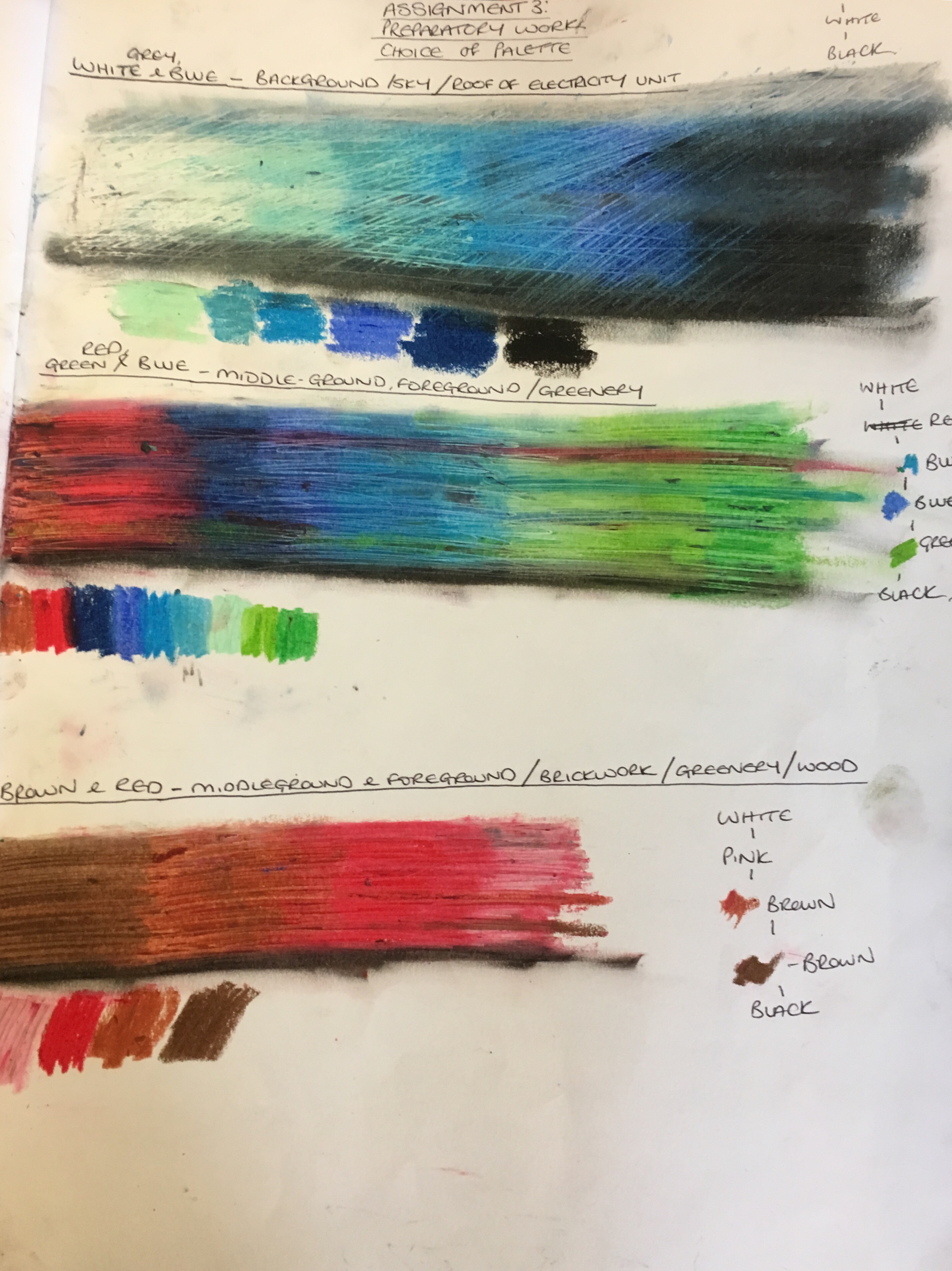
Next, I played with the different colours I could see within the three grounds and different objects of the piece. I merged the next colour with the previous one and so on. I then worked over the top of the shades with other colours in the same category to see how they would interact with each other.

Once I had done this, I decided to work into each with the lid of my pen to blend the colourings, add a lightness to them and also to add a little texture.

I really enjoyed this exercise as I found a few colour combinations I had not considered previously. I also really liked the scratchings as I think these will be really useful for the greenery and also the wood of the bird feeder to create some texture within the piece.

Choosing a palette

Quick Sketch of Whole Composition

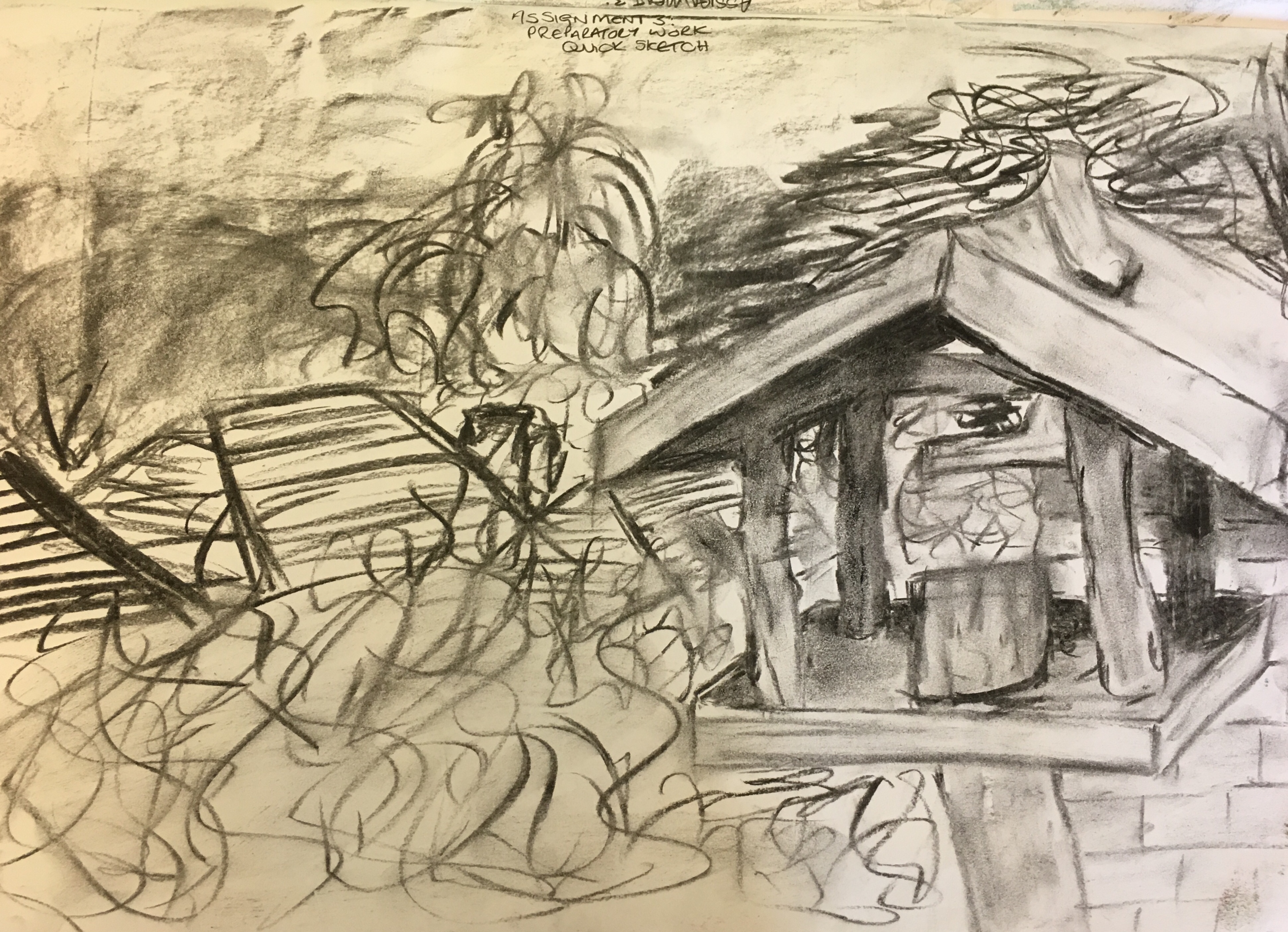
I then decided to create a line study of the whole piece quickly in charcoal in my sketchbook. I tried to look up during the creation of the sketch to see what I was drawing as opposed to what I thought I was seeing.

On reflection, I think I have actually done rather well with this sketch as the depth in the bird feeder is good as a result of the tonal differences created with the charcoal. I stayed with the natural darker middle-ground, but I think I was correct earlier when I decided that the darker middle-ground would not be the best way to complete my piece.

Quick sketch in charcoal

I then created a piece purely using the side of my oil pastels to create broad strokes of the general colours within the chosen piece. This time, I swapped the middle-ground and foreground tonal ranges so that the foreground was darker and the middle-ground lighter to blend easier with the blue and white of the background.

It was only when I had finished that I realised the outline of the A4 piece of paper on the page behind had come through. I actually really like it. I think it frames it rather nicely and adds a sense of intrigue to the sketch. Whilst it was an accident, I think it would have the viewer question why it was there, why it is not central etc and would draw them in to the piece.

Final Piece

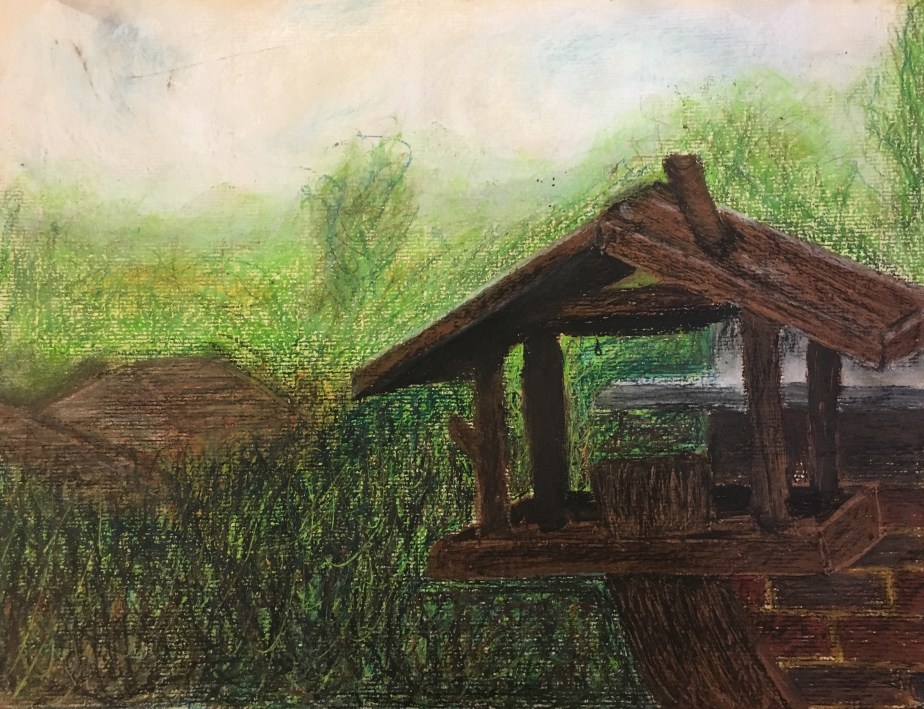
I felt finally ready to begin my final piece and decided I would use oil pastels to help me do so as I had really enjoyed working with it in the preliminary stage.

I began by taking the photograph of my chosen viewpoint and drawing a grid over it. I decided to do this as I wanted to be as accurate as possible with my perspectives, measurements and structures of the skeleton of the piece. I had found this really useful in my earlier exercises and wanted to use this method within my final piece.

I decided to use a piece of pastel paper which had a good texture to it and which I knew would work well with the oil pastels in creating even more texture within the piece. I drew the objects into place and roughly drew the divides between the three grounds.

Luckily, due to having a wet and miserable summer, the day I returned to complete my final piece, the weather was exactly almost identical to the day I had originally taken my photograph and had created the preliminary sketches.

I then put in the base colours on the three grounds in an almost solid colour so I could build over it. I then began working in the detail of the roofs and building the greenery up, which I decided to stay rather expressive with as opposed to adding much in the way of actual detail.

I got to a certain stage and took a step back from the work to look at it and see if I needed to make any changes. I realised that the rooftops appeared to just be floating in mid-green sea, so I decided to bring the tones used in the greenery of the foreground up to the roofs, thus separating the roofs specifically into the middle-ground.

For the sky, I considered my earlier experiment with the oil pastel to recreate the clouds and thought them too much, so tried to recreate the effect of the soft pastels with only the slightest touches of blue, grey and silver to add density to the clouds, which I believe has been rather successful.

Final piece – first stage

I kept on building up several layers of colours and scratchings (changing the movement and flow to suit the object) to create depth and definition in the foreground until I finally decided I had gone as far as I could without overworking the piece.

Finished piece

Overall, I am actually rather pleased with this final piece and think it rather successful. I have managed to include a lot of the exercises and projects worked with in this Part of the course and believe I have learned an extraordinary amount in such a short space of time.

I think the piece is believable and the grounds distinguishable. I am happy with the atmosphere I was able to create in the background with the rolling clouds and the subtle density and thinning to the blue sky behind. I think my greenery could perhaps have been a bit more distinguished, but I thoroughly enjoyed being really expressive within these parts of the piece and feel I allowed this to come through, yet be restrained when needed (such as the roofs and the electricity unit).

Project Five: Townscapes

Research Point: John Virtue

Please click here for my findings from this research.

Exercise One: Sketchbook of Townscape Drawings

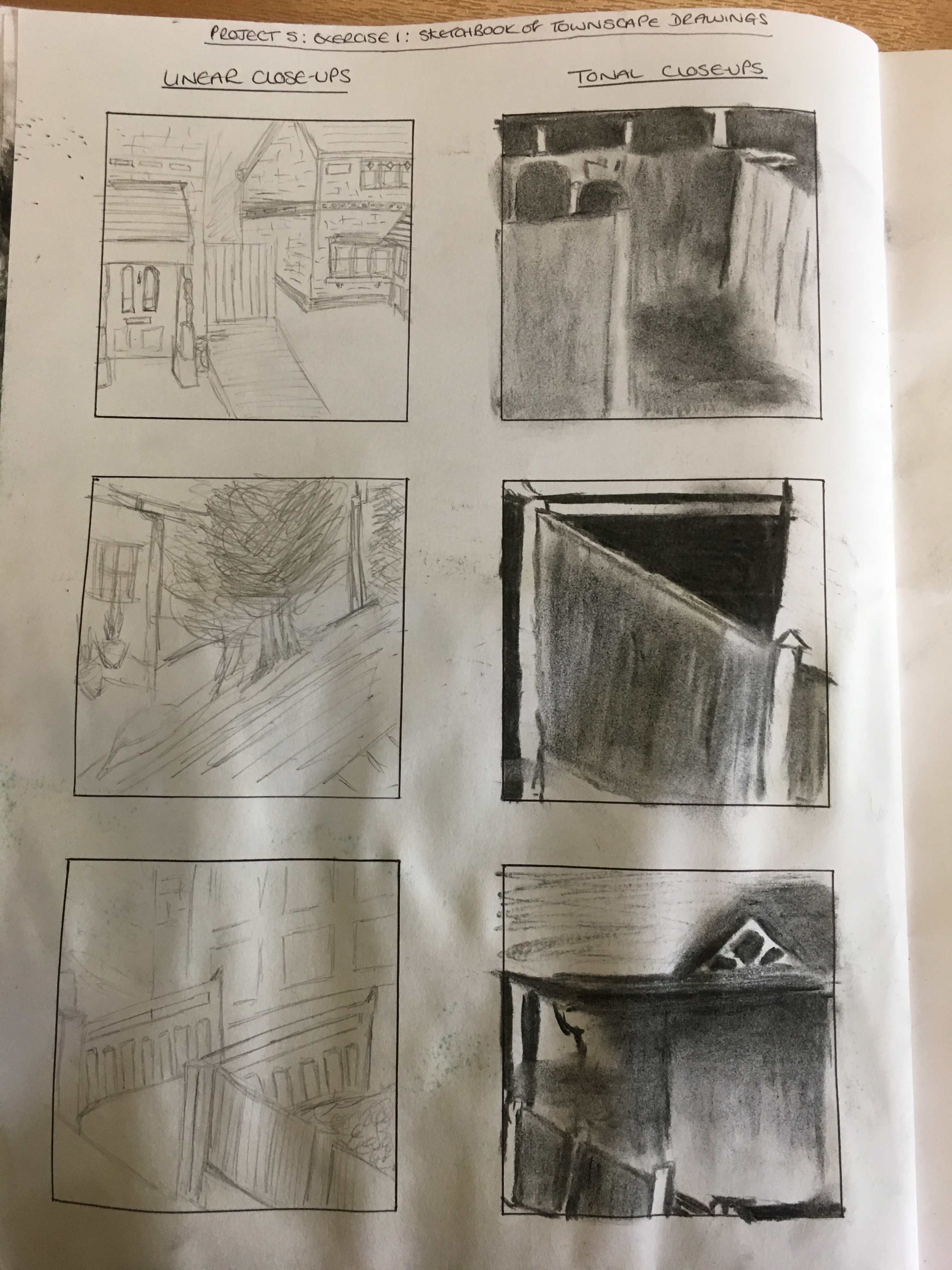
Sketchbook page of 10cm x 10cm close-up squares

For the first part of this exercise, I created three squares which held close-up quick line sketches of points which interested me and then another three squares which held close-ups of tonal sketches.

Having learned what I have learned so far, it is very apparent to me that my perspective skills when used without assistance still need a lot of work. However, I have found I am looking for ‘clues’ now which I wasn’t before. Bearing this in mind, I am happy with the outcome of these as quick sketches, as I think they do show some improvement.

For the next part of the exercise, I created two quick sketches in biro of two interesting points of view.

Sketches of townscape

As with the previous part of this exercise, I have found again that my perception is not completely accurate. I was aware there were errors during the creation of these sketches, however, I tried to work through these errors and correct them during the process. I really tried to imagine the vanishing points again when creating this, but do think this is going to take some time and practice to be able to see naturally, however, I am happy with the results and how I am progressing in this way. It will take some time to perfect, but I think I am getting there slowly!

Exercise Two: Study of a Townscape using Line

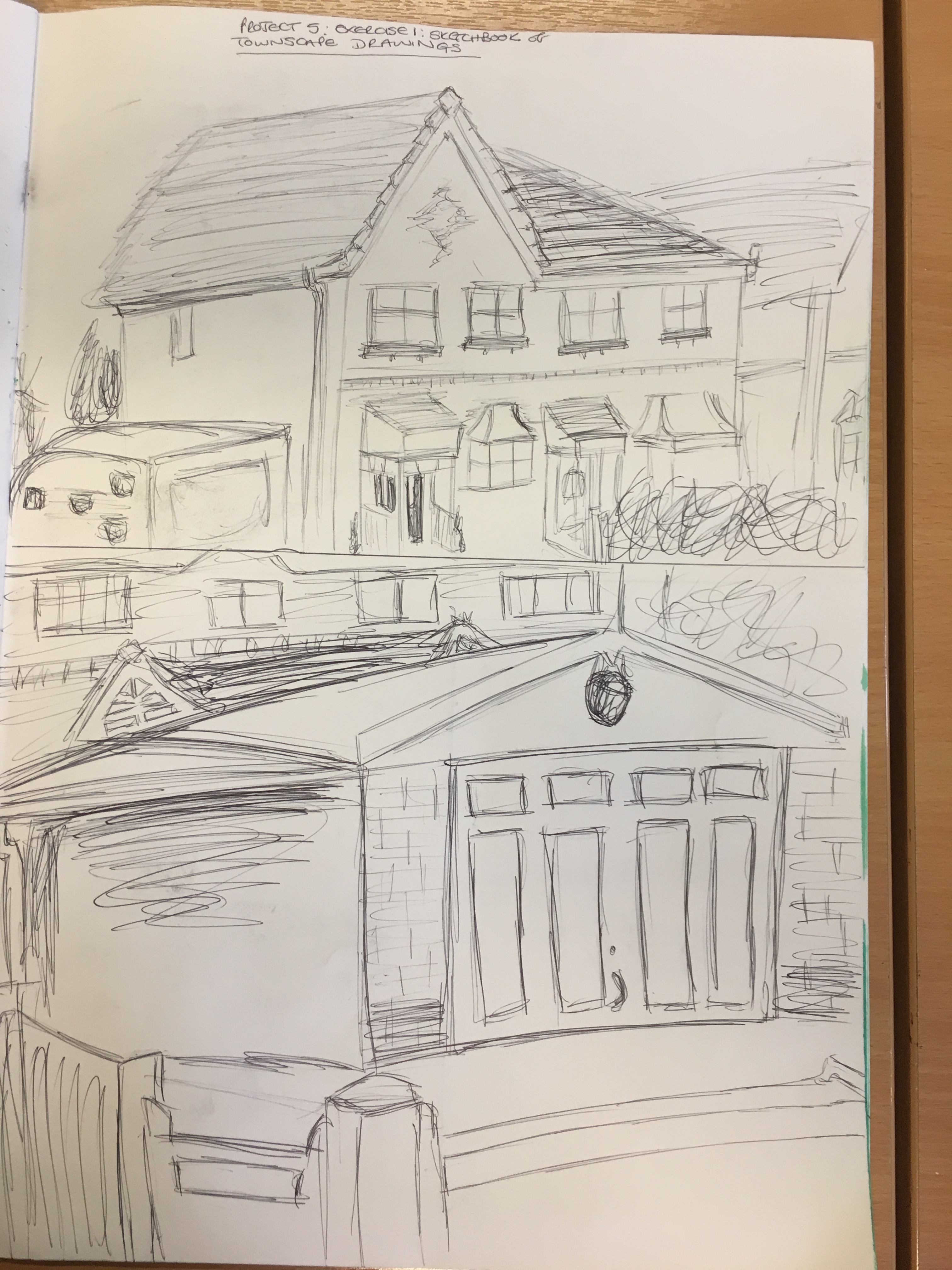
Preparatory Sketch

Preparatory drawing in sketchbook

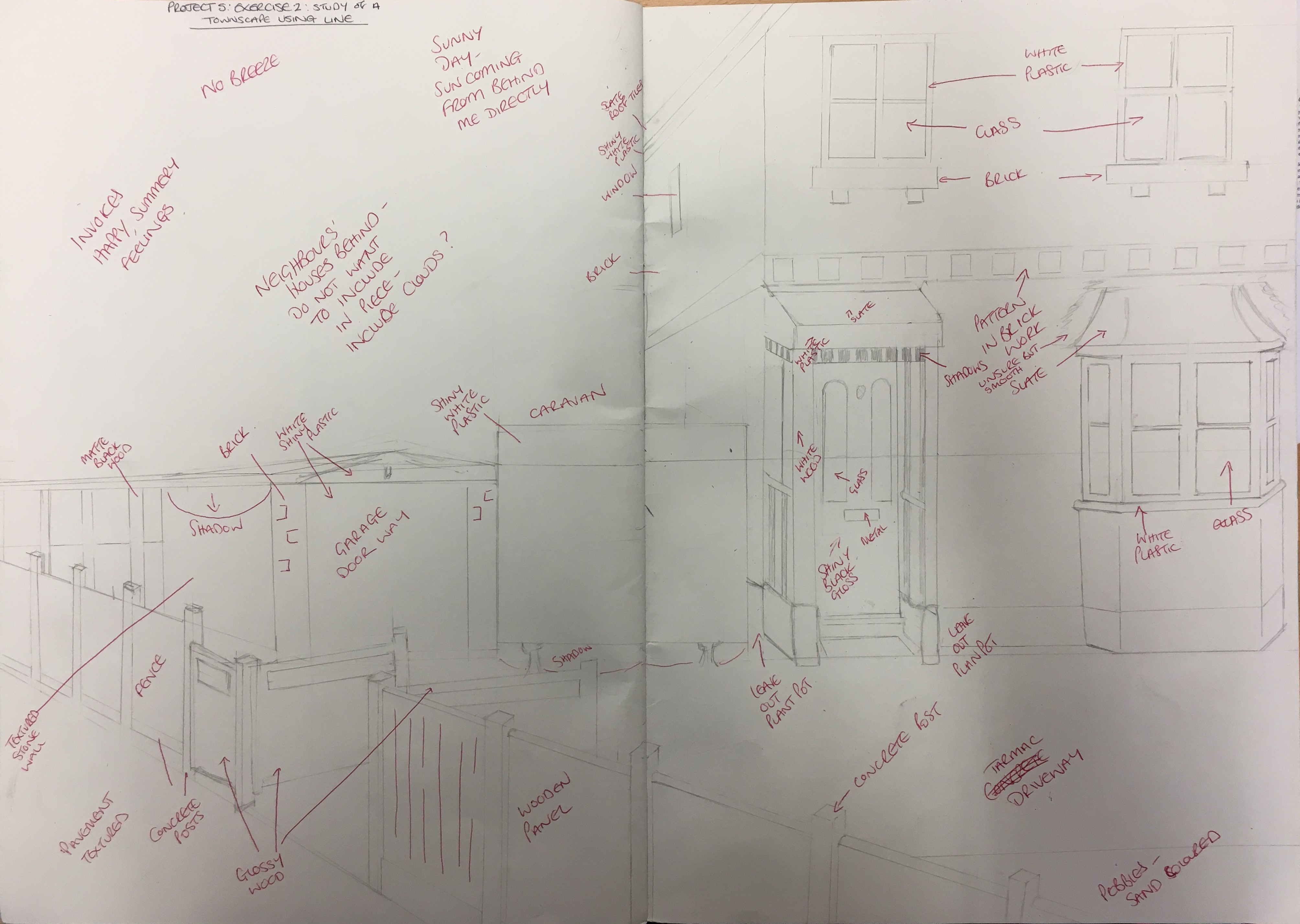
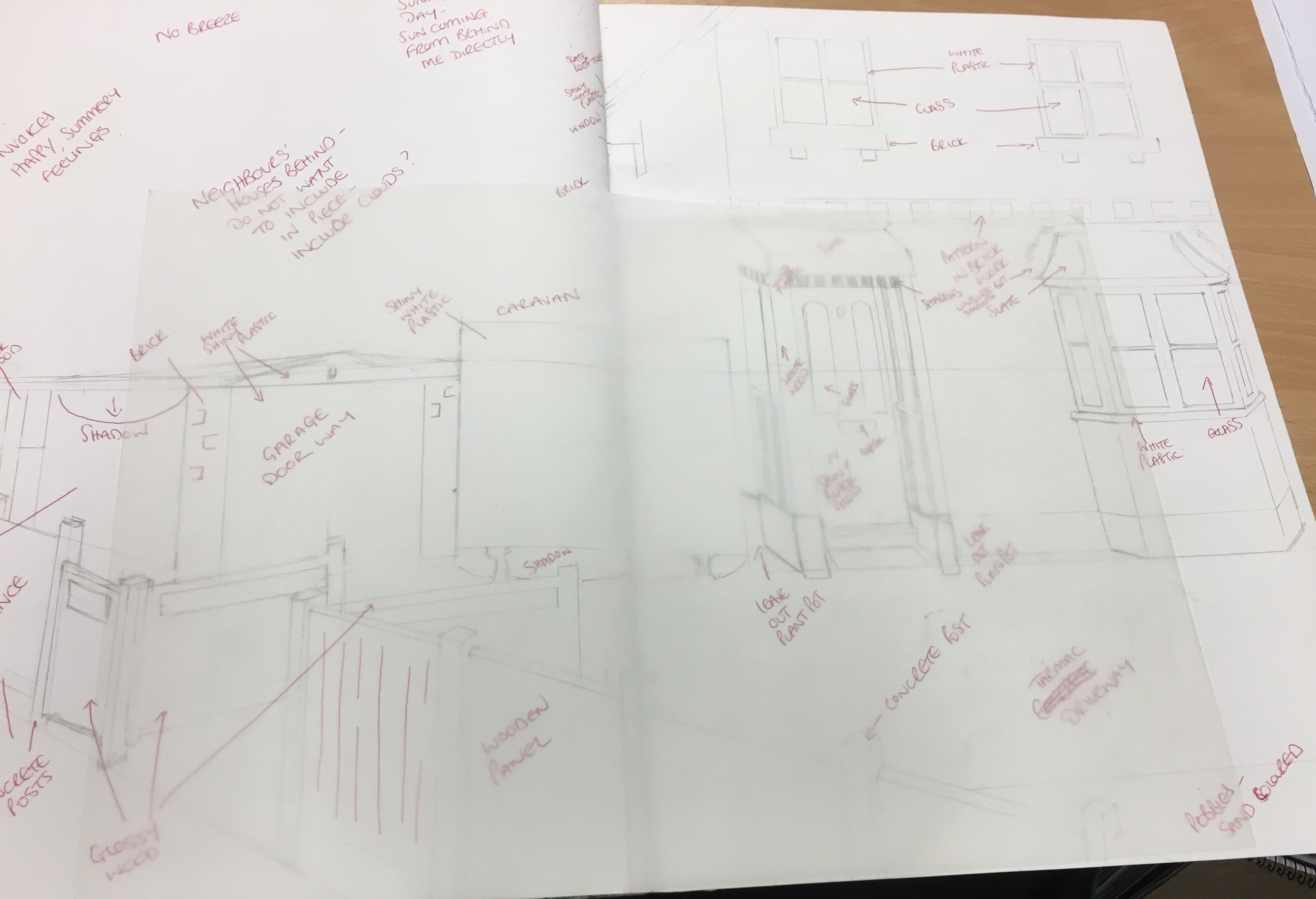
For this exercise, I began by creating a sketch in my sketchbook over two pages, as instructed to do, of a townscape scene I thought appealing. After the previous exercise, I decided to continue the study of my own house in an attempt to ‘work in series’, showing my continued development of my understanding and appreciation of the details of the exterior of my home. I have actually found this rather enjoyable as, not only is it very sentimental to me and I enjoy working with sentimental things, I feel I have looked more closely at things I have merely taken for granted and walked by obliviously when coming and going from my home, day in, day out.

Composition for Final Piece

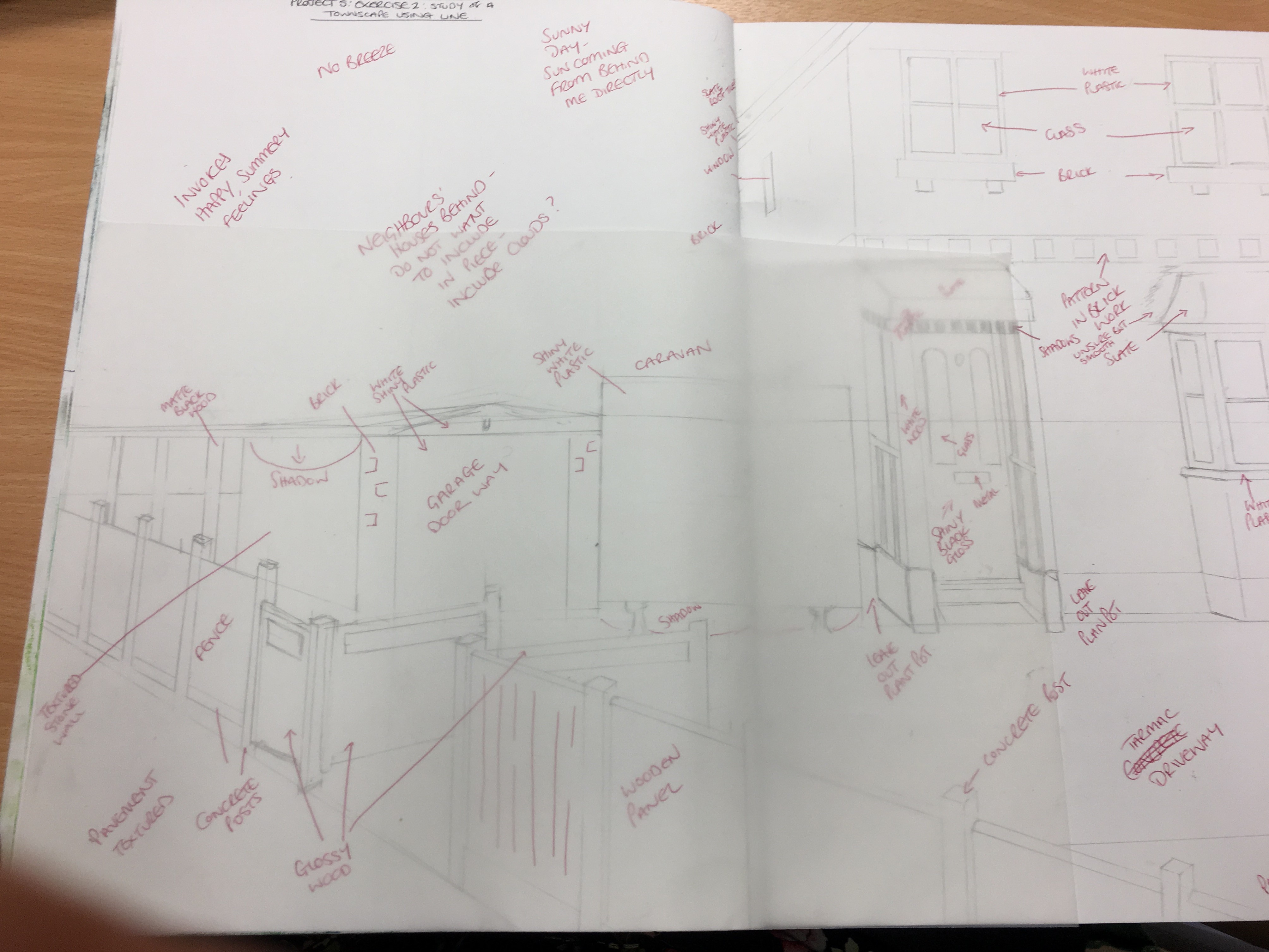
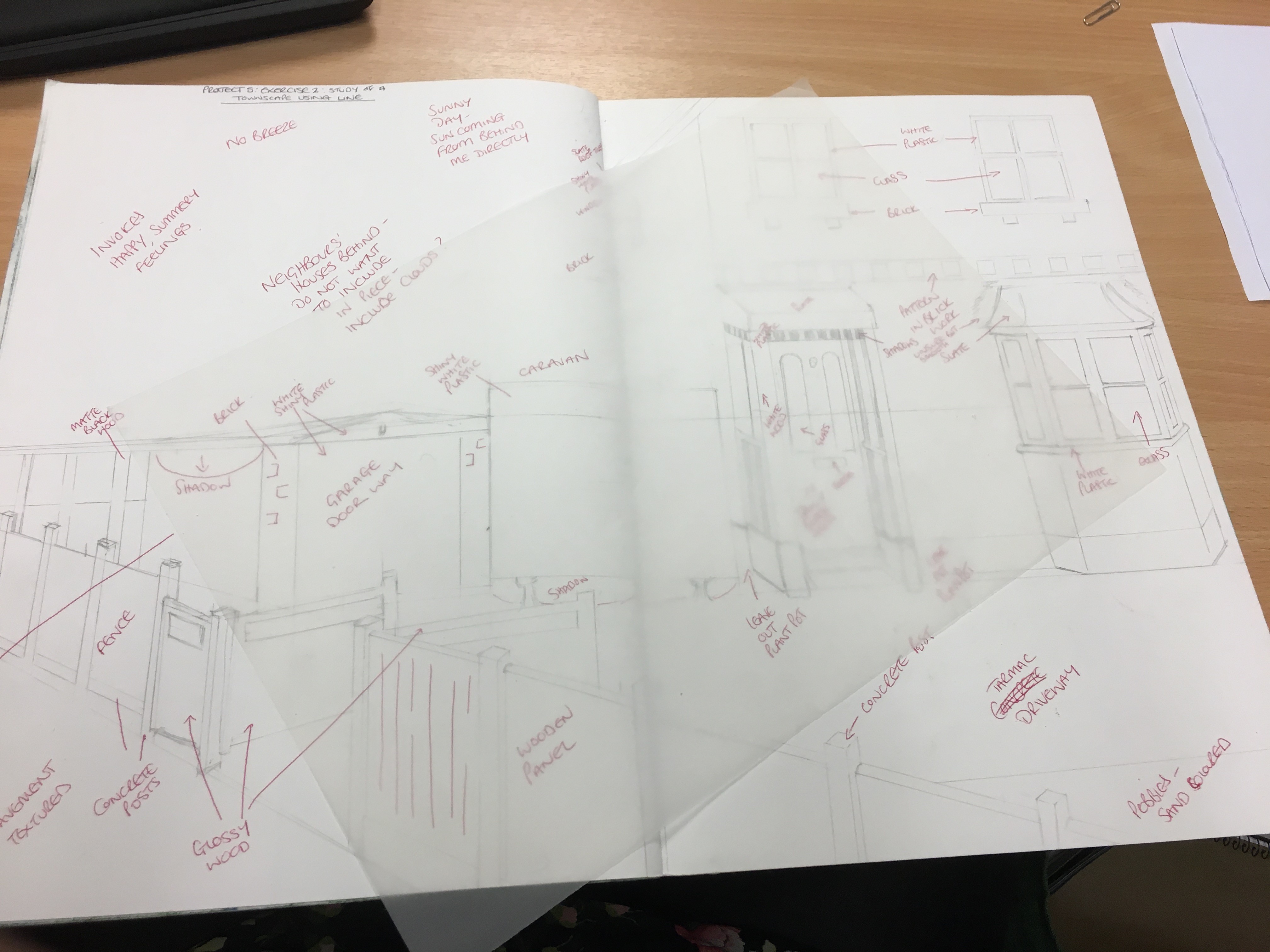
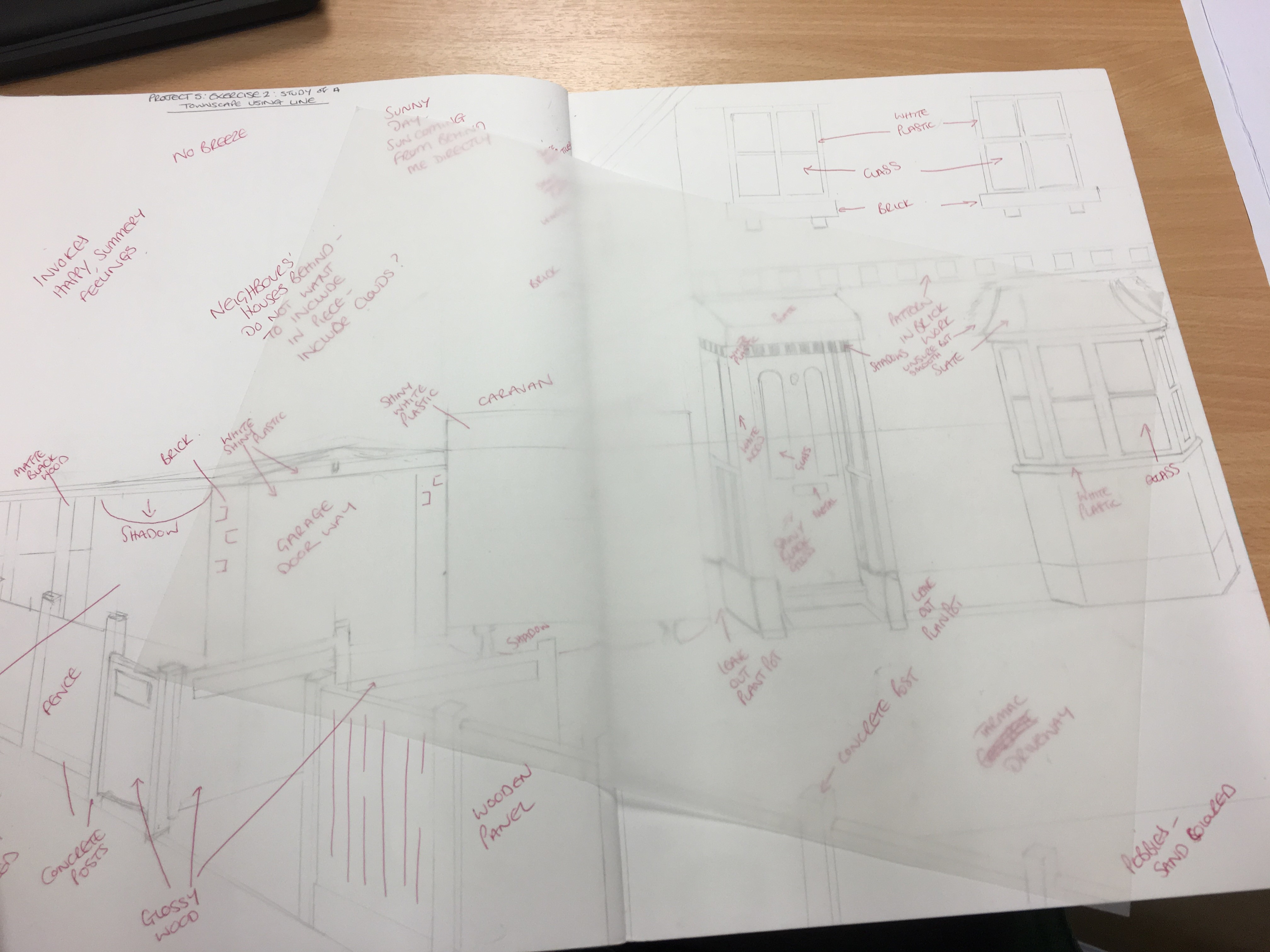
I then decided to use a piece of tracing paper as a view finder as the view finder I had made for myself was only roughly A4 in size. I placed the tracing paper at different angles on my preliminary sketch (as can be seen in the pics below – if you squint hard enough!) before choosing my favourite.

In all honesty, I actually really liked Viewpoint 3 and thought it rather abstract and interesting, but decided to play it a little safe and go with Viewpoint 4 as it held a lot of visual information and different parts of the preliminary sketch.

Final Piece

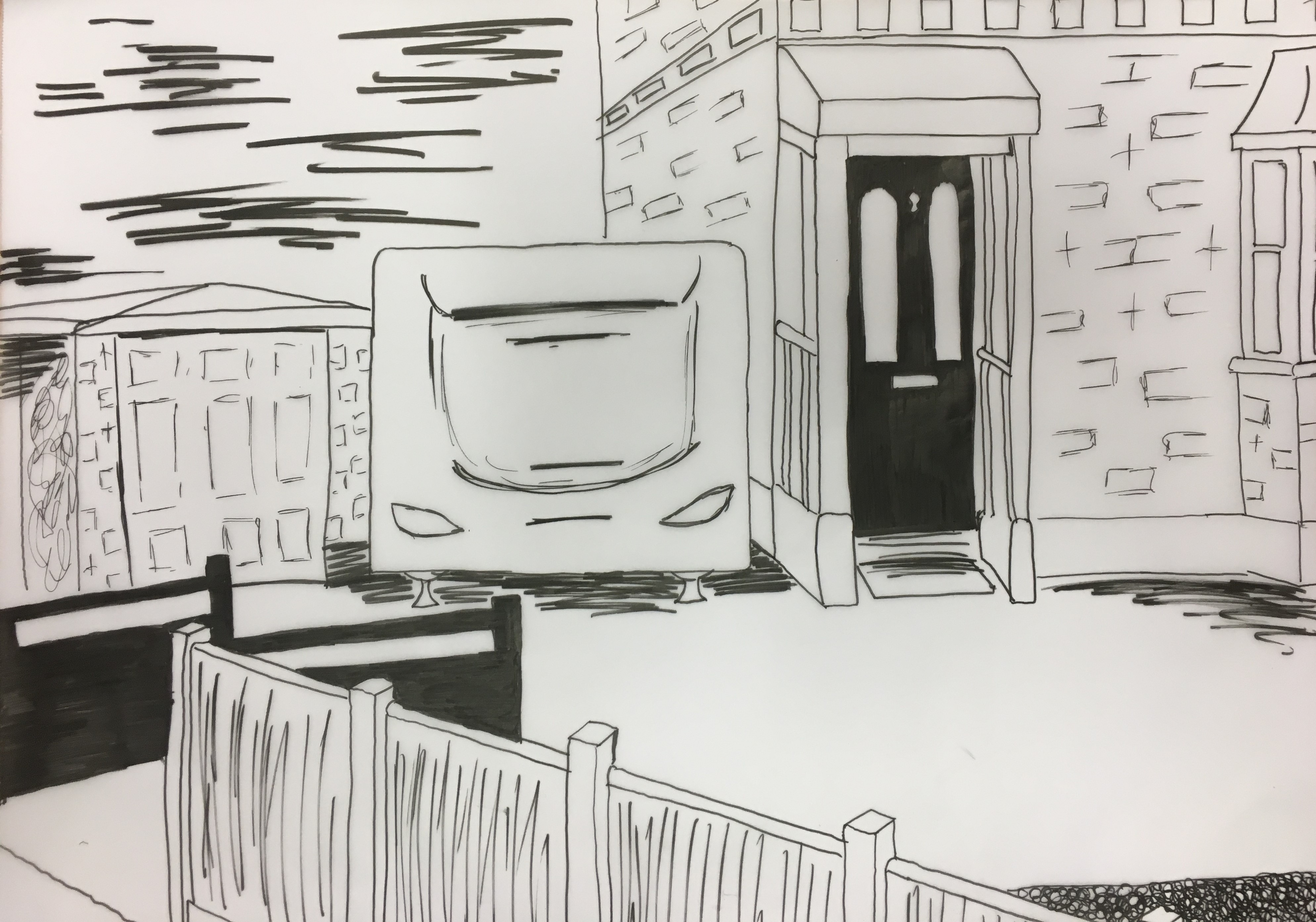
I decided I was rather intrigued as to what the piece would look like if completed on the tracing paper and – although a bit of a cheat on my behalf – traced my preliminary sketch with my finer drawing pen before adding in the extra bits of detail with thicker pens, using the thickest to show the darkest (and actually black) areas of the composition as well as the shadows and darker parts of the clouds.

Final piece

Whilst I think I have been rather successful with this piece in respect of the depth and perspective, I did struggle somewhat with my really straight lines as my tremor was rather strong when I created the piece, so i was a little disappointed with that. I actually wanted to keep the slightly wobbly lines more for the brick walls, but my arm had other ideas! Also, I think I have definitely overdone it with the clouds as it was a beautiful sunny day and I think the markings used would represent a more dense and rain-filled cloud as opposed to the light and wispy clouds which were actually visible. Again, this is a little disappointing, but definitely something I can consider for future pieces. I also think they try to jostle for the foreground focus too much too – another reason to keep them thin and dainty. I don’t think I have been all that successful in separating the grounds in this piece, but I do think it rather difficult when working with line. This is something I will have to try and work on.

Exercise Three: A Limited Palette Study

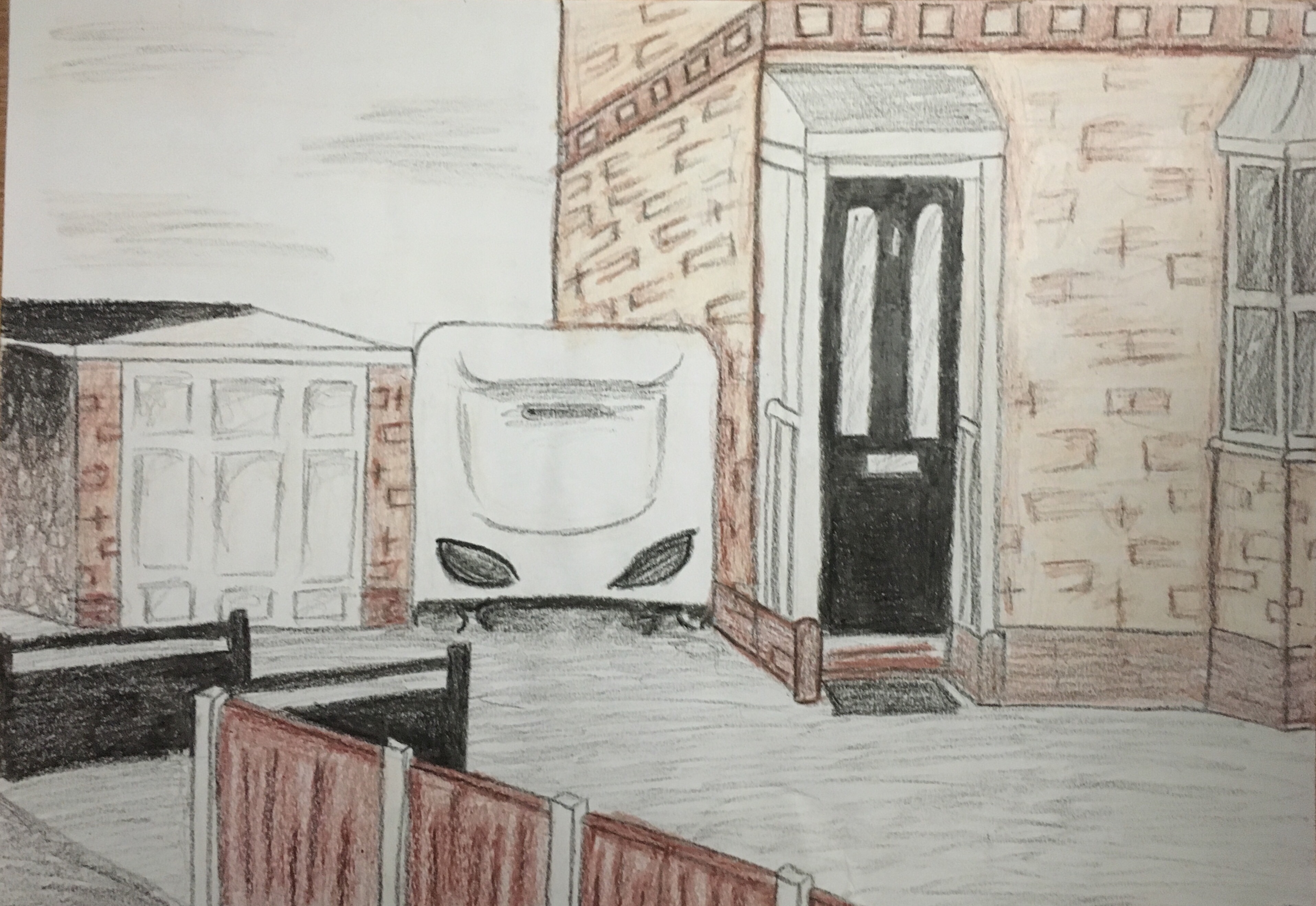
For this exercise, I chose again to continue studying my home and to recreate the same piece again, but this time using as close to the traditional colouring as possible. Again, due to my increased tremor and a little weakness in my hand, I chose to work with wax crayons. I made this decision as I thought the finer grip / motor skills needed would cause much more cramp in my hand, so I chose to avoid these. I then considered soft pastels, but did not have a good enough match to the colours (I had black, but no brown, only yellow and orange). Then I considered oil pastels but decided they were too loose and expressive for the piece as I did want to keep it delicate, bearing in mind the weather of the day (I waited -a little too long! – for the sunshine to come back and for the conditions to be roughly the same as the day I had created my preliminary sketch in my earlier exercise.

Limited palette final piece

Whilst I think there are still a few issues with my work which I need to address (the bricks I drew in quickly do not fully sit at the right angle, so this spoils the effect somewhat, the door is too narrow and the garage roof was difficult to recreate due to its strange angles, to name just a few), I used this exercise to practice my lighter touches in the clouds and in the shadow on the white sections of the piece. Again, I think my angles still need a lot of practice and I did struggle to see things clearly, but I think I have definitely improved dramatically since beginning the course and, hopefully, this will continue.

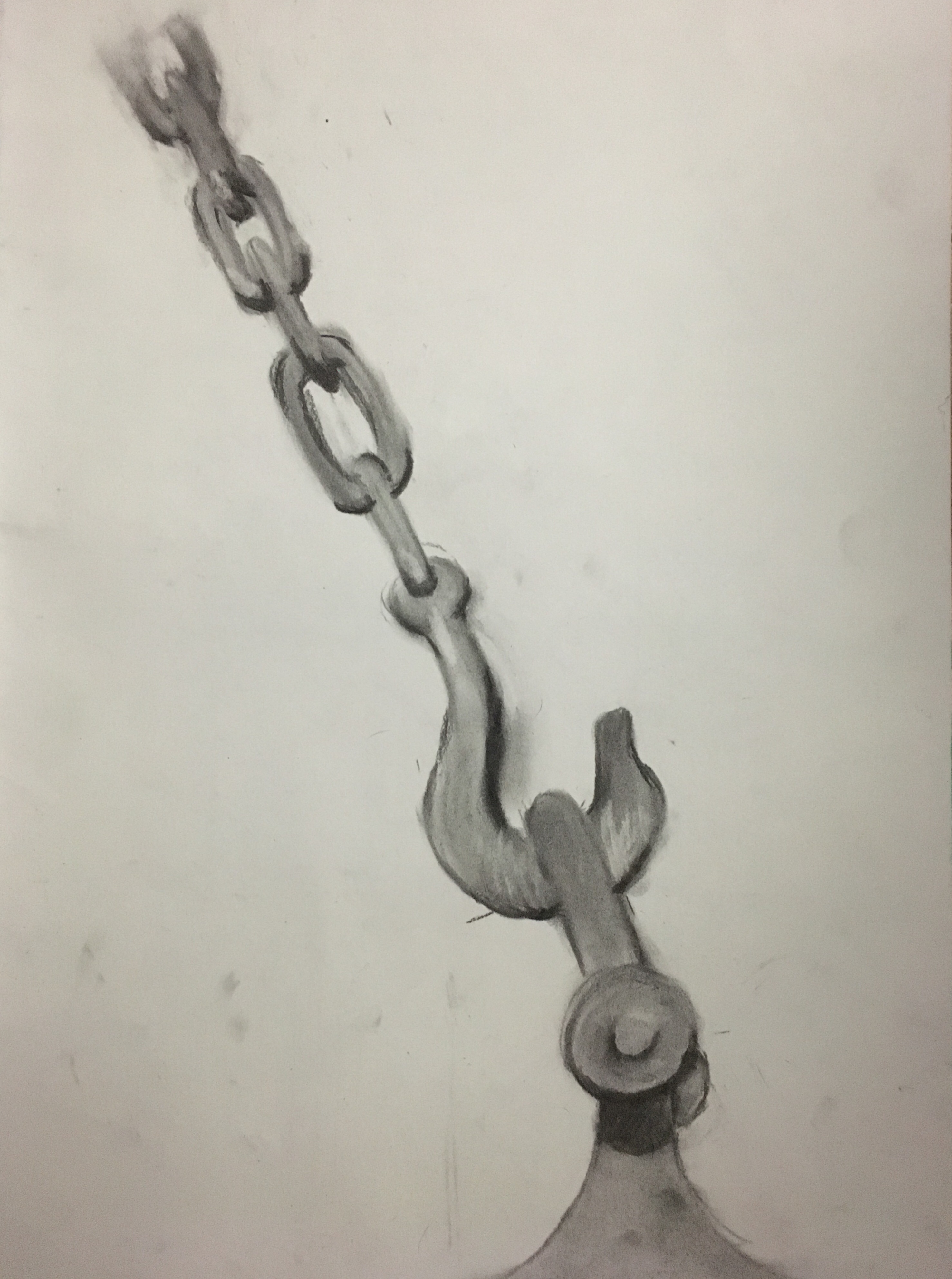
Exercise Four: Statues

When I first thought of this exercise, there was only one statue which came to mind that I wanted to study due to its place in my memory; having grown up driving past this statue on numerous occasions, I had always been fascinated by the ‘magic’ it held as it seemed to reach up to the sky at an angle, as though anchoring the giants’ world from the ancient fairy tale, Jack and the Beanstalk, to ours!

I went to visit the statue and noticed things I had never noticed about it before, having always been solely focused on the ‘magic’. The shadows were fantastic for working on my tutor’s comments regarding patches of tone and the contrast between the two. Also, the fact it disappeared into the distance and everything became smaller as it became further away was also really good the help me practice my foreshortening skills. I tried to move around the statue for different viewpoints, but also zoomed in on key points of interest to try recreating.

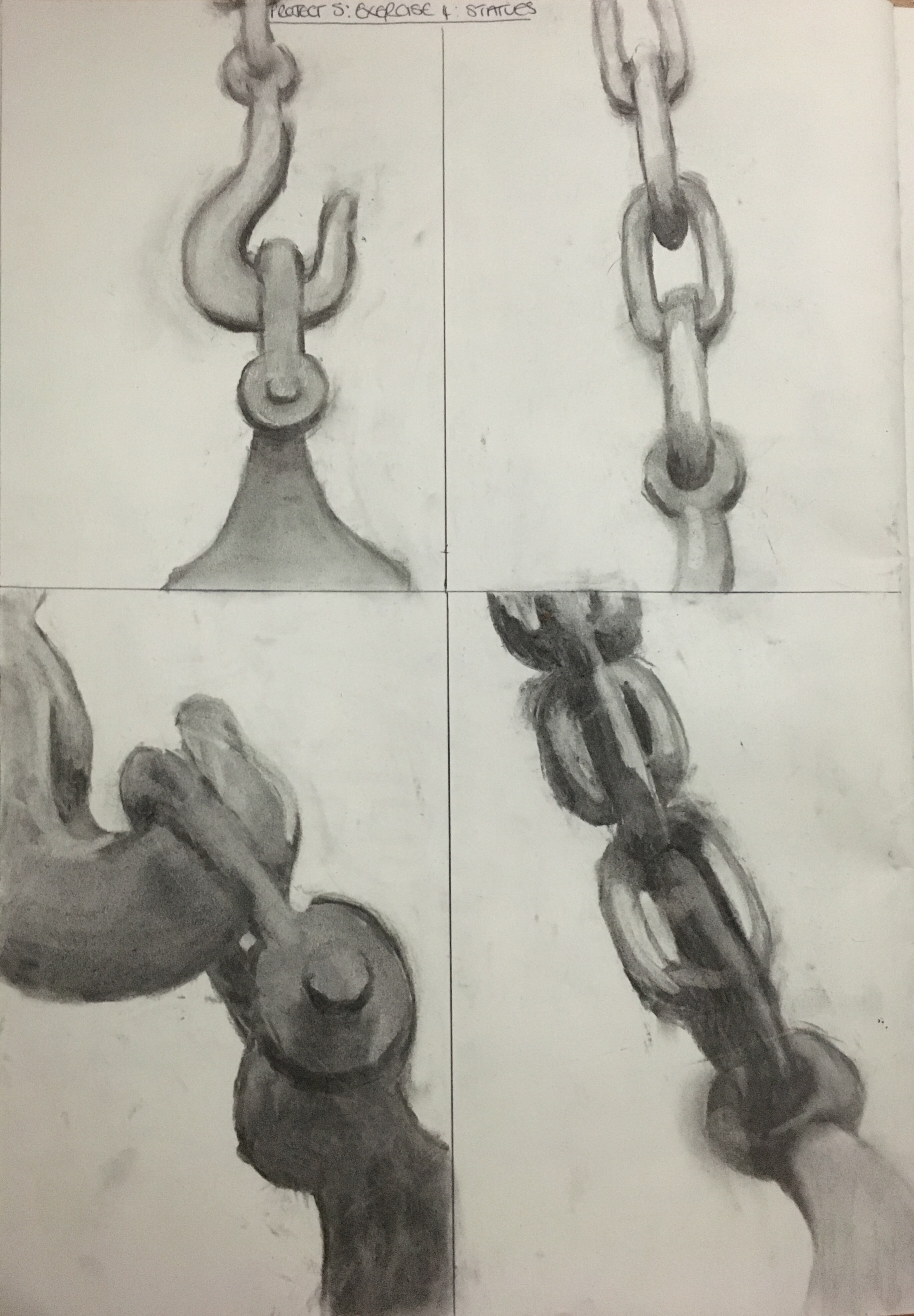
Sketches from varied viewpoints

I think I was a little tame with my first two sketches (top left and top right) as I stood in a position where there was not much shadow (I was here for some time, so the light changed position too). I think I have made the mistake again though on the top two of giving them too defined an outline. I just cannot seem to get away from this!

The bottom two are much more interesting I feel and are less outlined than the previous two; I think the lack of tone in the top two compared to the bottom two really seems to affect me. It is as though I just cannot get my mind around the fact the very solid outline does not have to be there for it to look realistic. I think I should have blended it a little better so it was not so solid a line. I am, however, very pleased with the links in the bottom right piece. I used the lifting method with a rubber to lift to the lightest value and I think it has genuinely paid off! I tried to draw the links roughly in place so I knew where I was going, but then just followed the tonal changes and worked my way downwards. I think this has really helped make the sketch look convincing.

Final piece

After doing the four quick sketches, I decided to draw the whole statue on a page in my sketchbook, trying to take note of what I had gathered in the quick sketches I had made. As a whole, there was not masses of shadow and tonal contrast from the view I had now chosen (and with the sun’s placement changing etc), so I decided to work quite lightly in tone and use very deep tonal areas for the shadows, as well as lifting areas (such as the scratching to the lower half of the hook) and the reflected light on the links.

I was actually quite impressed with the finished result and, again, think it has helped my understanding of foreshortening massively, which I think will help me no end in the next Part of the course.

Project Four: Perspective

Exercise One: Parallel Perspective – An Interior View

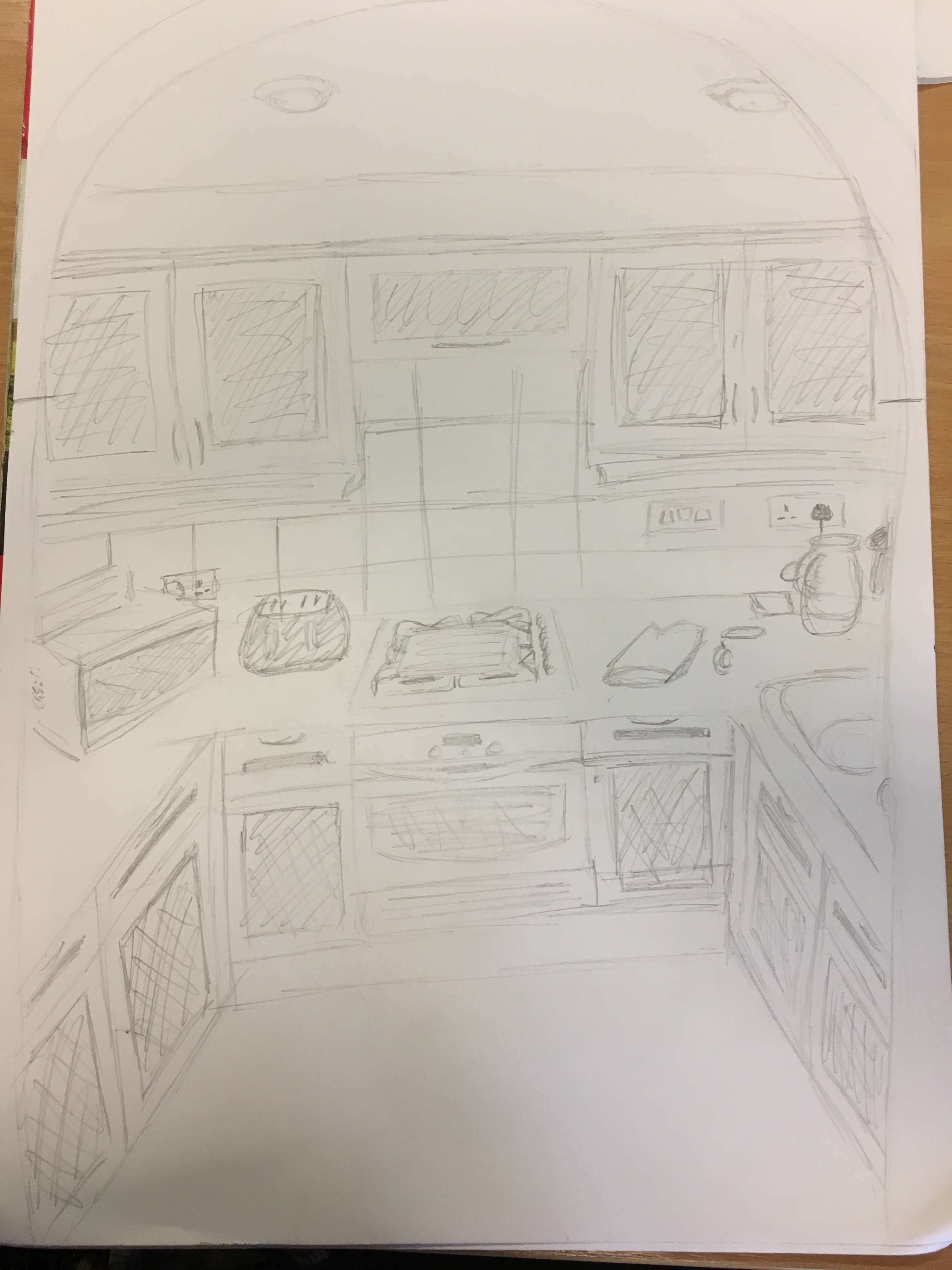
For this exercise, I decided to revisit my kitchen, as I had created a piece in a similar position in an earlier exercise and, thinking back on my tutor’s comments regarding this piece, thought it would be a good idea to rework a similar piece for this exercise to try and understand the comments through actual practice. Reading the first part of the exercise, I decided to draw a freehand sketch of the kitchen as I saw it through my doorway, but trying to bear my tutor’s comments in mind and trying to consider the perspective and geometry issues discussed.

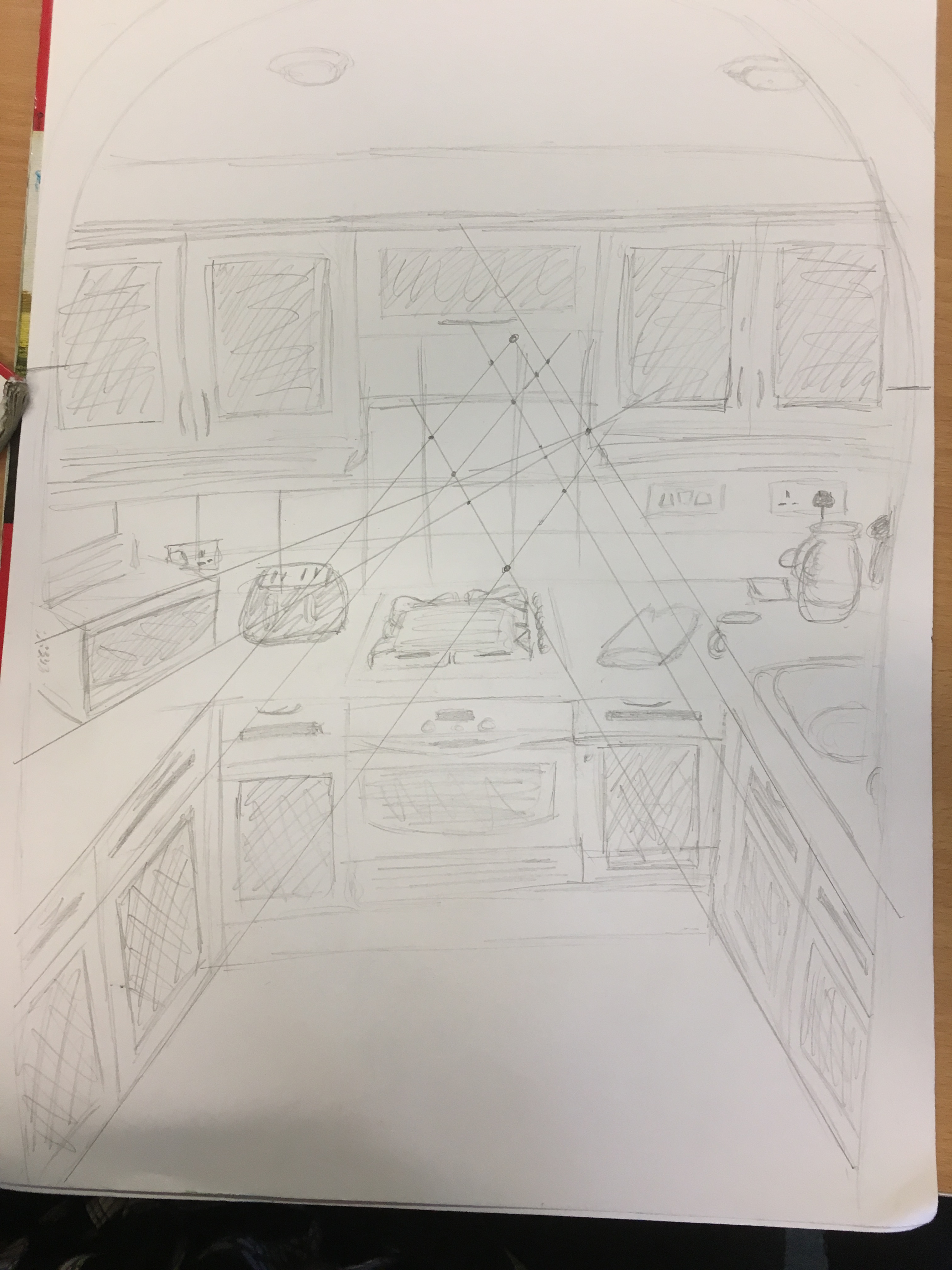
When I had finished, I grabbed a ruler and started trying to find any and all vanishing points within the piece. I hoped there would be one main vanishing point but, this being my first attempt knowing what I did now from the feedback, I wasn’t pinning all of my hopes on it! I had marked on the piece where I felt my eye level fell and tried to aim for the vanishing points to hit there. I tried to keep all flat pieces flat and then build on the angles within the piece to create the depth held within the kitchen.

When I had finished connecting all of the lines, I was actually rather impressed with myself as, although they didn’t all line up perfectly as they should, I think I had managed to get it quite good for a first attempt. I realised once I had finished that I had drawn the cupboards first but had drawn them slightly at an angle – perhaps this was the way I had been stood? – but this had had an impact on the rest of the piece, so the rest was all slightly crooked. Whilst there wasn’t one single vanishing point, I was pleased to see they all fell rather in the same area and where I think my eye level was roughly.

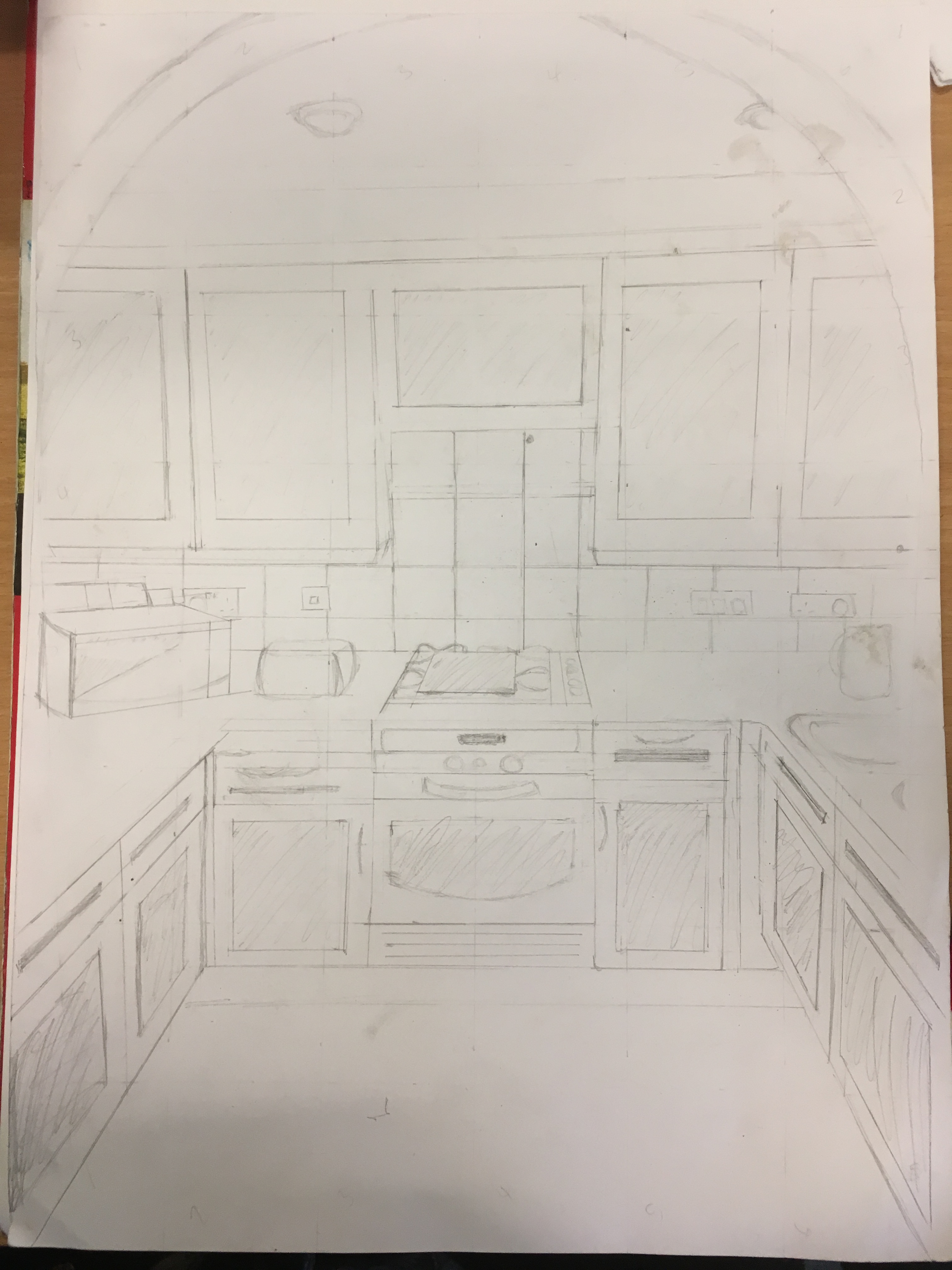
For the second part of the exercise, I decided to create another version of the same piece, but with using a ruler this time and remembering where I had gone wrong with my first freehand attempt. This time, I chose a specific view point (marked with a dot on the piece, just below the centre cupboard) and drew the cupboards from that. At first, I had a bit of an issue with ensuring the cupboard doors fell correctly, but then realised what my set square was actually for! Once I had figured this out, I realised that these things should all be at 90 degrees from the bottom of the page.

Once I had completed these pieces, I decided to create a comparison list to point out the similarities and differences between them when seen side by side:

  • I was much heavier-handed in the freehand piece than in the controlled one.
  • In the freehand piece, my angles are tilted too much to the left as opposed to being drawn straight on.
  • Due to the time needed to create the controlled piece, I found I took much more notice of finer details than I did in the quick freehand sketch.
  • There is much more accuracy within the second piece, perhaps also as a result of the time and effort applied.
  • The top cupboards within the freehand piece have been drawn on a much smaller scale than those in the second piece, showing a lack of accuracy within my freehand skills.
  • Overall, the angles within my freehand piece are generally slightly off, whereas those in the second piece appear to be much more accurate, if not perfect.

Exercise Two: Angular Perspective

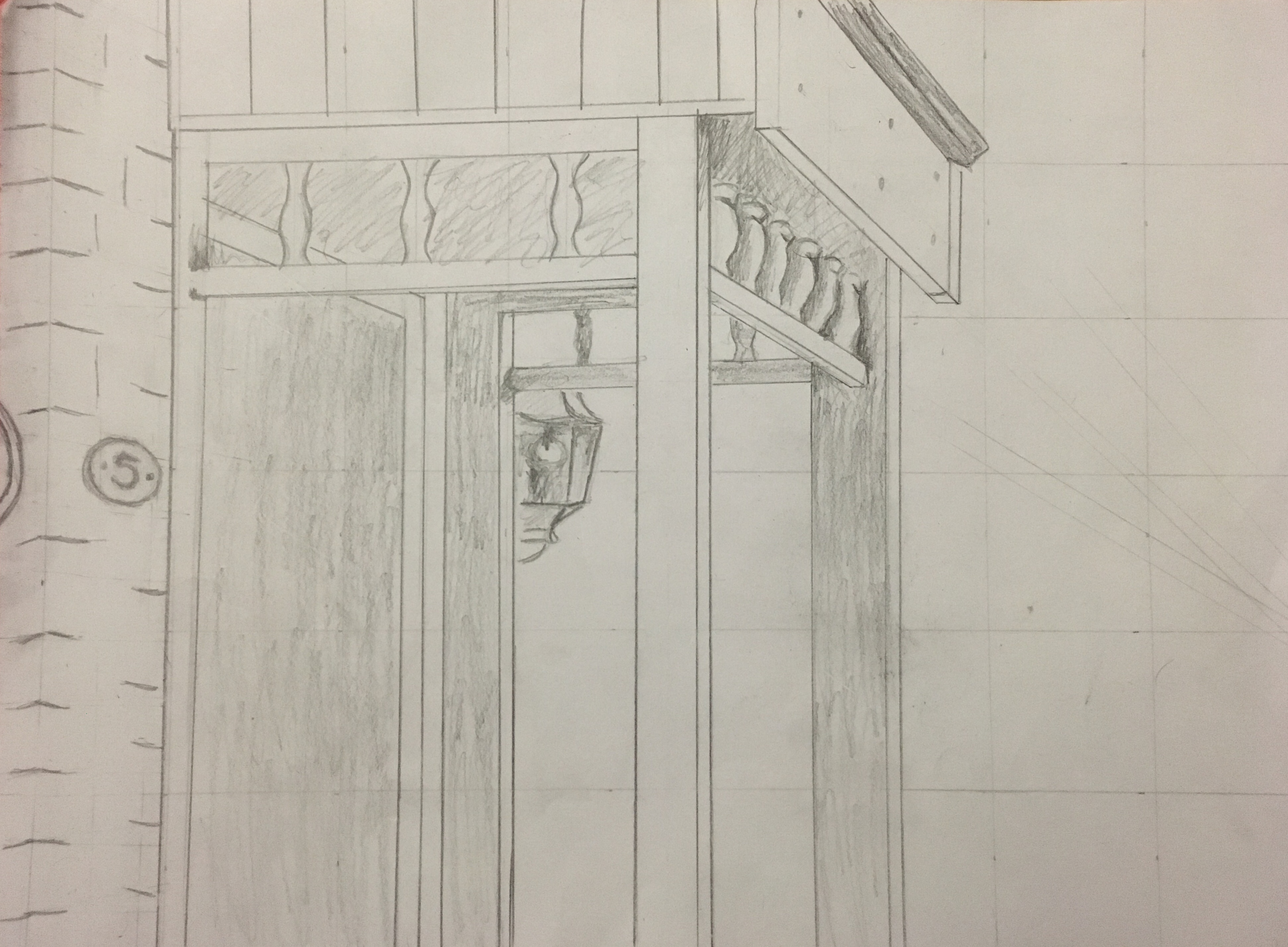
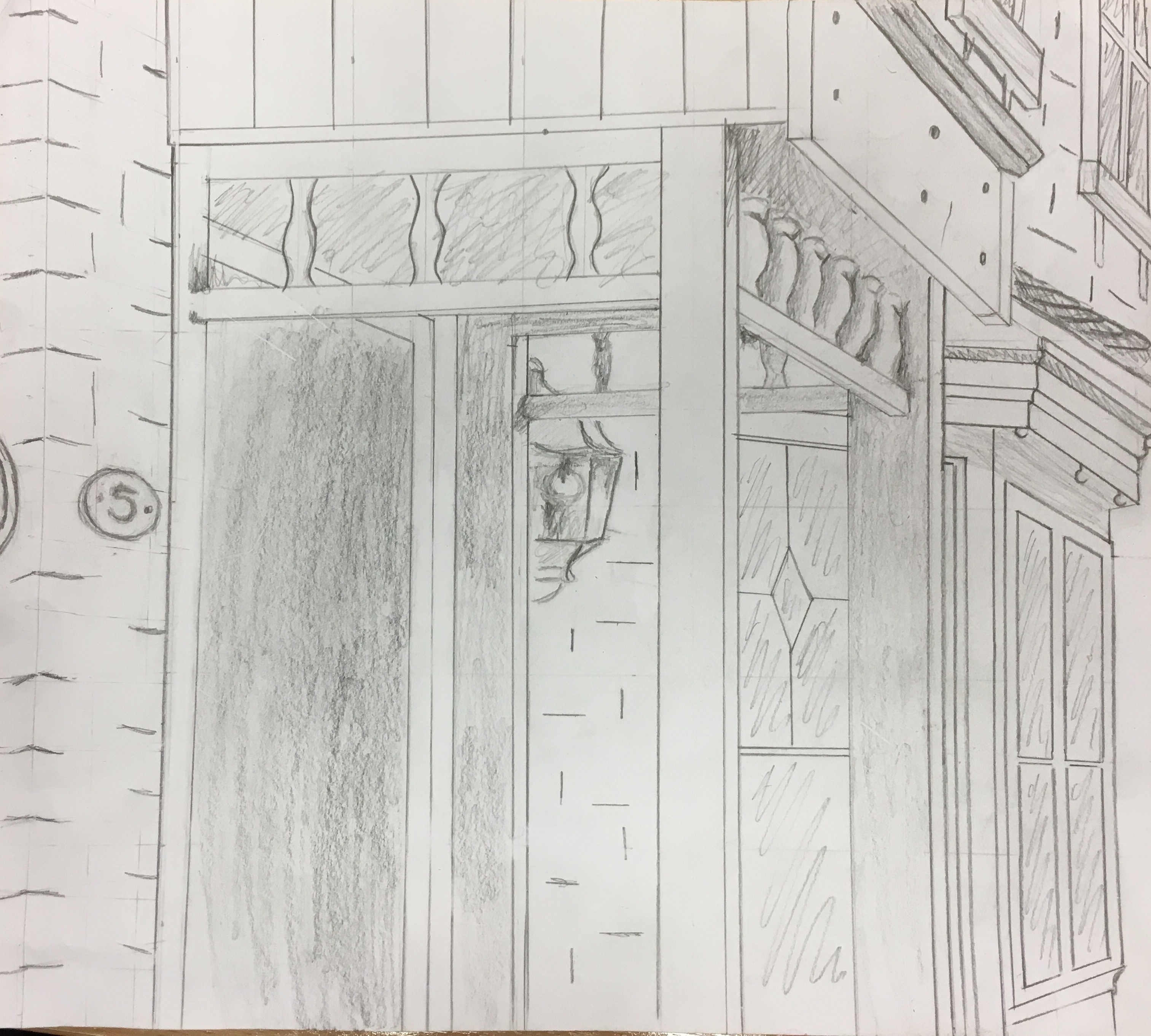
For this exercise, I decided to initially take and build the structures of my piece from a photograph of my porch due to the request to draw a building side-on. I wanted to practice creating a similar result to my controlled piece in the previous exercise as I think I have found a brilliant way to assist me with my accuracy issues.

Firstly, I drew a grid on the photograph and then inserted all of the vanishing points. Once I had plotted the basics, starting with the straight line of the corner and ensuring others were accurate too (i.e. the door frame and porch), I then began to draw in the detail, using the grid lines and perspectives to assist me.

Having used a 2H pencil to draw in the structure, I then took my piece outside and completed the finer details and tone in real life. I figured that whilst the structures would never change, the colours and shadows would, even though I was only creating this piece as a line drawing. I added only a little tone to help differentiate between numerous lines all clustered together.

I was rather pleased with this result as I think I may have found my way with using grids and vanishing points to assist my work. Whilst I won’t be able to use these for every piece I make, I will use them as and when I am able and it suits. For instance, I am aware I won’t be able to use them when working with the figure or during such things as sketchbook walks etc as these pieces will require my immediate and quick attention. In fact, I believe these situations would actually work in reverse; I would have to work quickly and potentially only use photographs to assist should the weather change or the sun move its location or the model need to change their pose.

I think I definitely need to work on my observational skills to improve in this area, but I think I have come such a long way in a very short space of time as I can ‘see’ the issues I have fallen victim to in the past much clearer now and know how best to attempt to rectify them.

Exercise Three: Aerial or Atmospheric Perspective

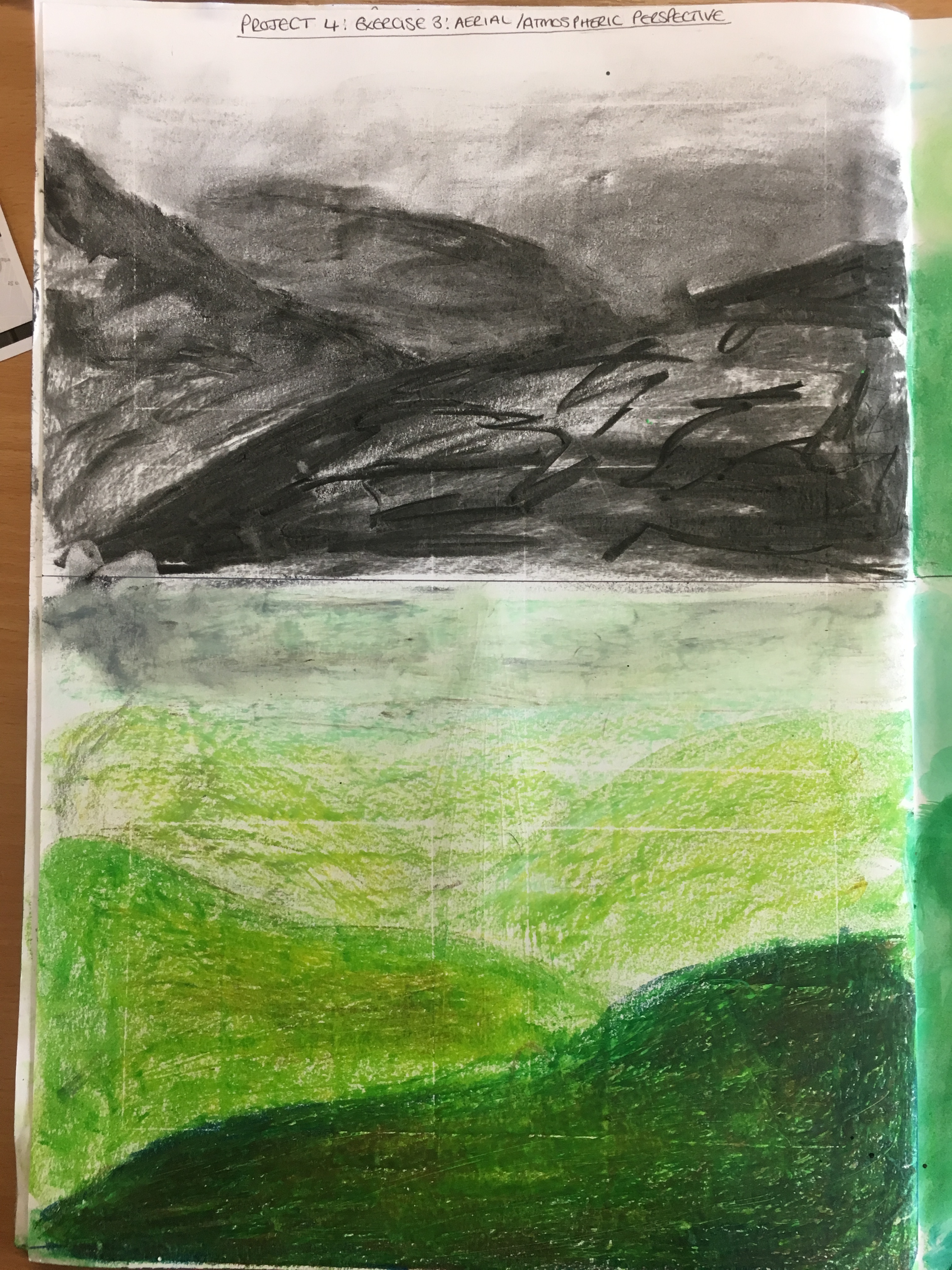
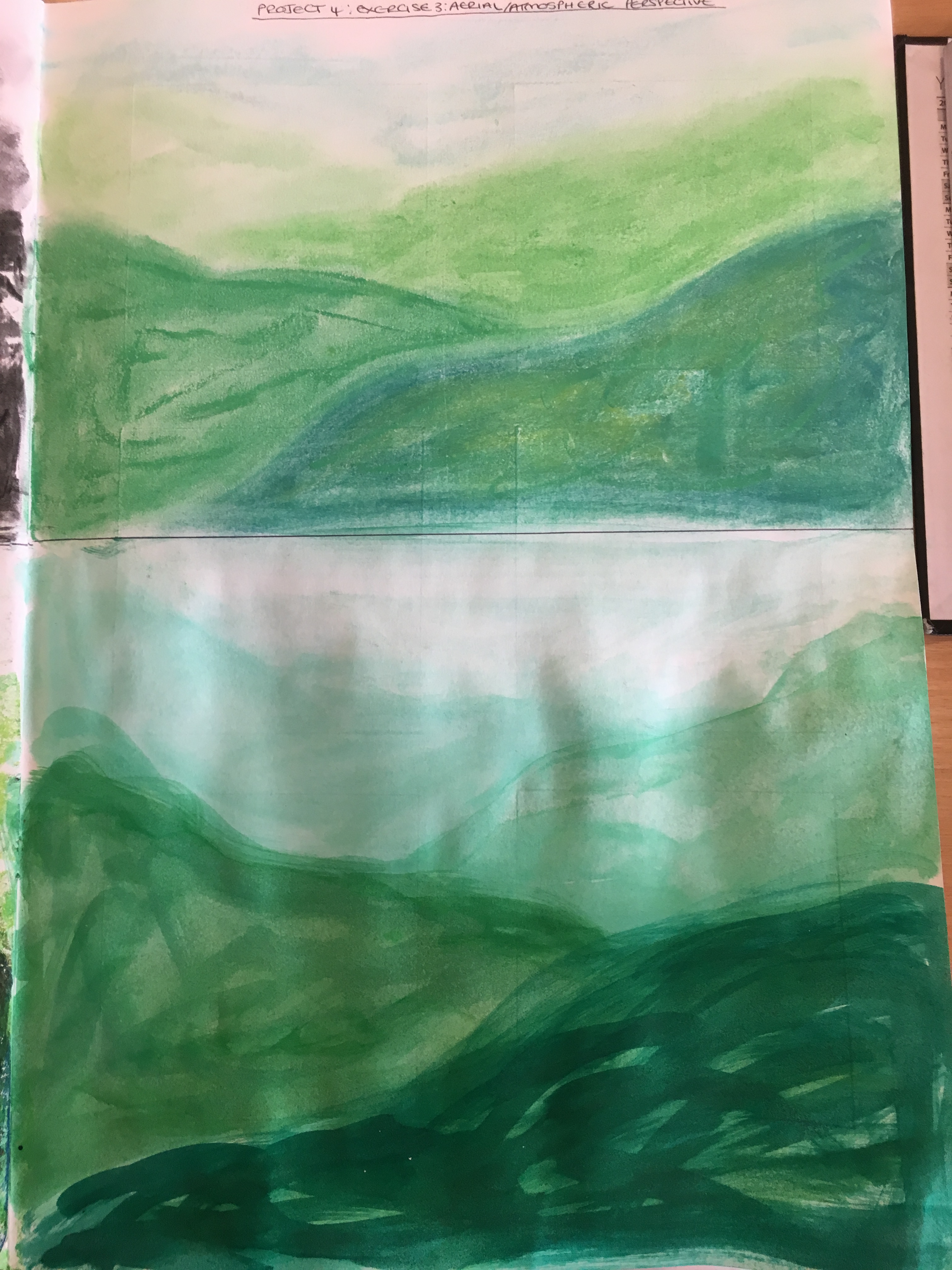
For this exercise, I firstly carried out four experiments in my sketchbook of a set of hills I came across locally. I created atmospheric studies of these hills in charcoal, oil pastel, ink and soft pastels.

I really liked the outcome of all four pieces as I feel they all offer something different. The charcoal allows for greater shadowing and tonal changes I feel, whereas the oil pastel allows for greater vibrancy of the colours. The ink works best for showing the lightening of colours and hues.

For the final piece for this Project, I decided to once again draw a grid, but tried to work freehand with the grid as opposed to from a picture – ripping the plaster off, so to speak!

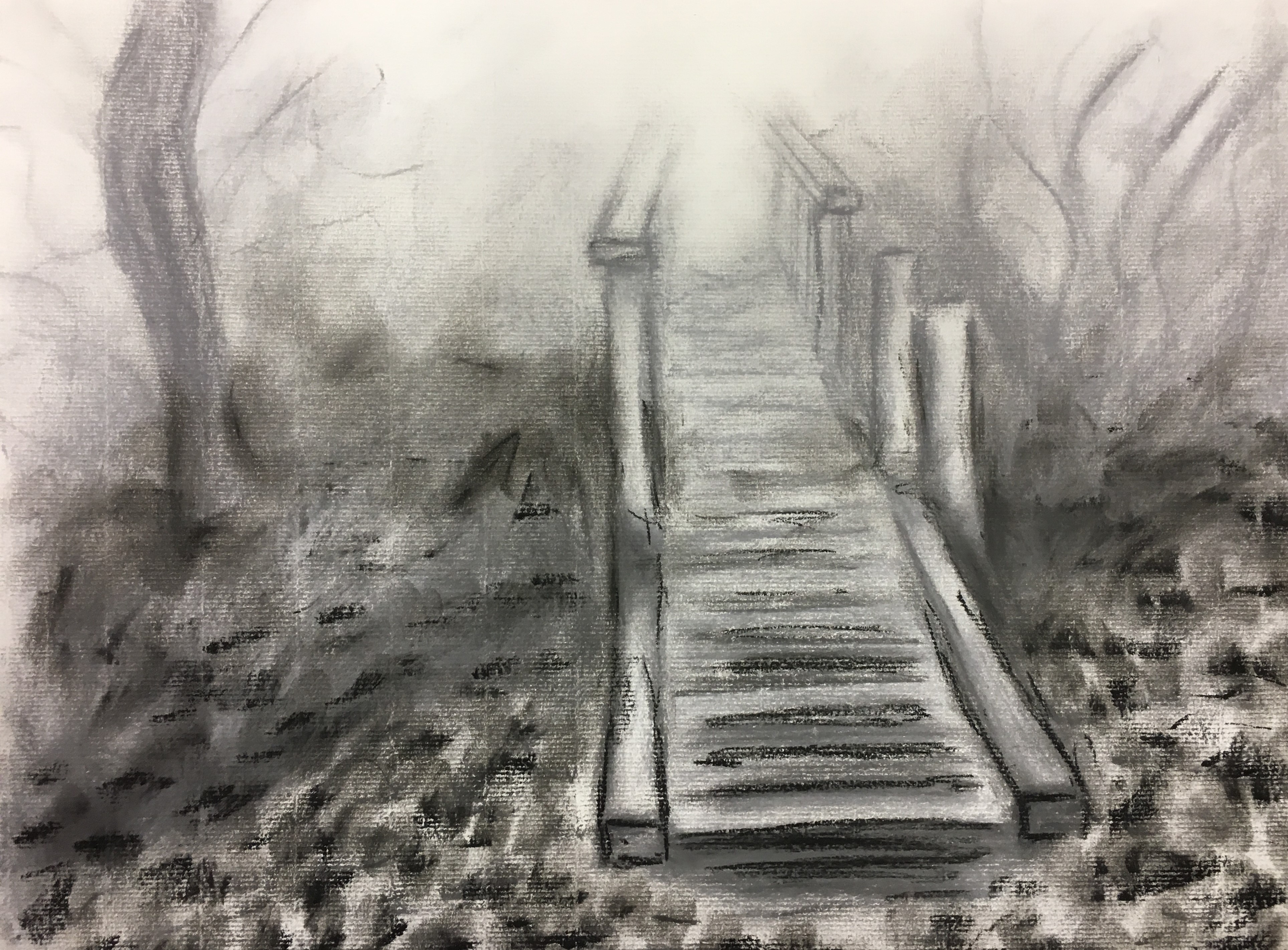
I went to a local park and chose this spot as I could visualise the bridge disappearing in the distance. I tried to imagine the grid lines and vanishing points in the distance and to see the parallel lines in my chosen setting.

I built the piece up with a set of white, grey and black soft pastels, working from the back, forwards. Whilst I created this piece in the summertime, from my earlier exercises with trees, I found I much prefer working with the ‘skeleton’ of the tree, as opposed to dealing with the excess of foliage. Instead, I tried to represent foliage through blended areas with a touch of dabbing in places to create the texture of the leaves, mud and moss throughout the three grounds, having minimal in the background.

I was rather pleased with the end result of this piece and the atmosphere created within it. I tried to really draw upon Atkinson-Grimshaw‘s works to create this piece and think I have been somewhat successful in doing so. Whilst it holds none of the precision of Atkinson-Grimshaw’s pieces, I think I have been rather successful in creating the depth within the piece, with the bridge leading the viewer’s eye backwards towards the background of the piece. I think I have been rather successful with the perspective of the bridge considering it was practically freehand! A vast improvement I think (I hope!). Once again though, I think by adding in the outline of the bridge, I have made it look somewhat like a cartoon. I just cannot seem to break away from needing that outline! Maybe that is just my style? I’m not too sure!

Research Point: Project 5: John Virtue

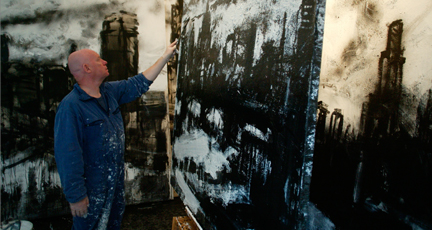
John Virtue is an English artist who focuses solely on creating black and white landscapes in a semi-abstract way. Whilst his work has great influence by such other English artists as Turner and Constable, he also allows for an influence from the American abstract expressionism and an enjoyment in oriental brush-painting. In his earlier years, Virtue’s pieces were largely recreations of the Oswaldtwistle, which was close to where he was raised, and were created in paint and later in pen and ink, white acrylic paint and shellac on canvas.

Later, Virtue gave up his career as a postman and relocated to Devon, creating pieces of the landscapes of the Exe estuary from his studio in Exeter.

Virtue was then offered the amazing opportunity to become the sixth Associate Artist at The National Gallery in 2003, where he created numerous paintings of London to compliment the works of the Old Masters held within the gallery and to become a piece of its history.

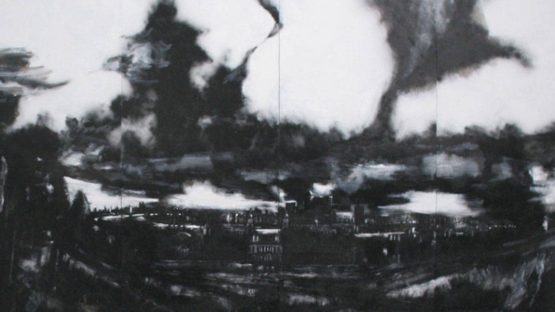
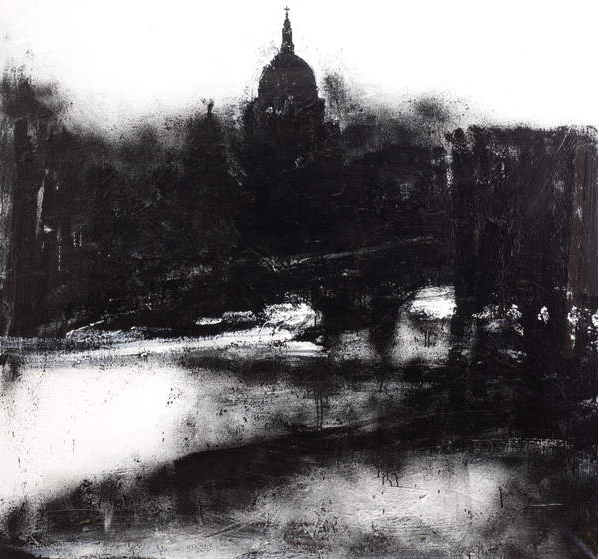
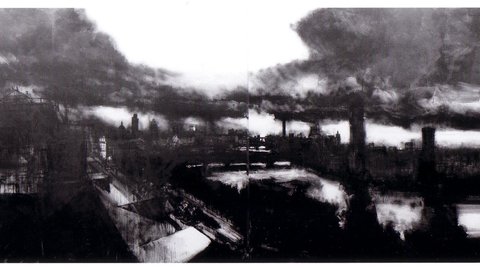
When looking at Virtue’s work, I cannot help but be drawn in by the strong tonal contrasts and the different intensities of the black / grey. Some parts of his pieces are very much abstract, whilst others are rather defined, for example, in Fig. 4., the clouds and detailing to the right appears rather blurred, whereas to the left, the piece appears rather defined. It is clear that Virtue defines those areas of the painting he wishes to be the focal points, whilst the rest is simply there to draw your eye around the piece from one focal point to the other.

The softness to the edges in the majority of the pieces gives a warmth to the atmosphere, whereas the stark black and white seems to give the piece a sense of cold and foreboding. It is also not immediately apparent what the pieces are or what they represent, which I think draws the viewer’s intrigue and a desire to know more. That moment of clarity when you look closer and see a landmark you are familiar with hidden amongst the mass of black and white is phenomenal to me!

I love the use of black and white and I can definitely see some of my own style of working within these pieces, so I think I will try to bear this in mind when creating my own work.

List of Illustrations

Fig.1. Virtue, J (Unknown) John Virtue at work in his studio [Photograph] At: https://www.nationalgallery.org.uk/learning/associate-artist-scheme/john-virtue (Accessed on: 24 June 2019)
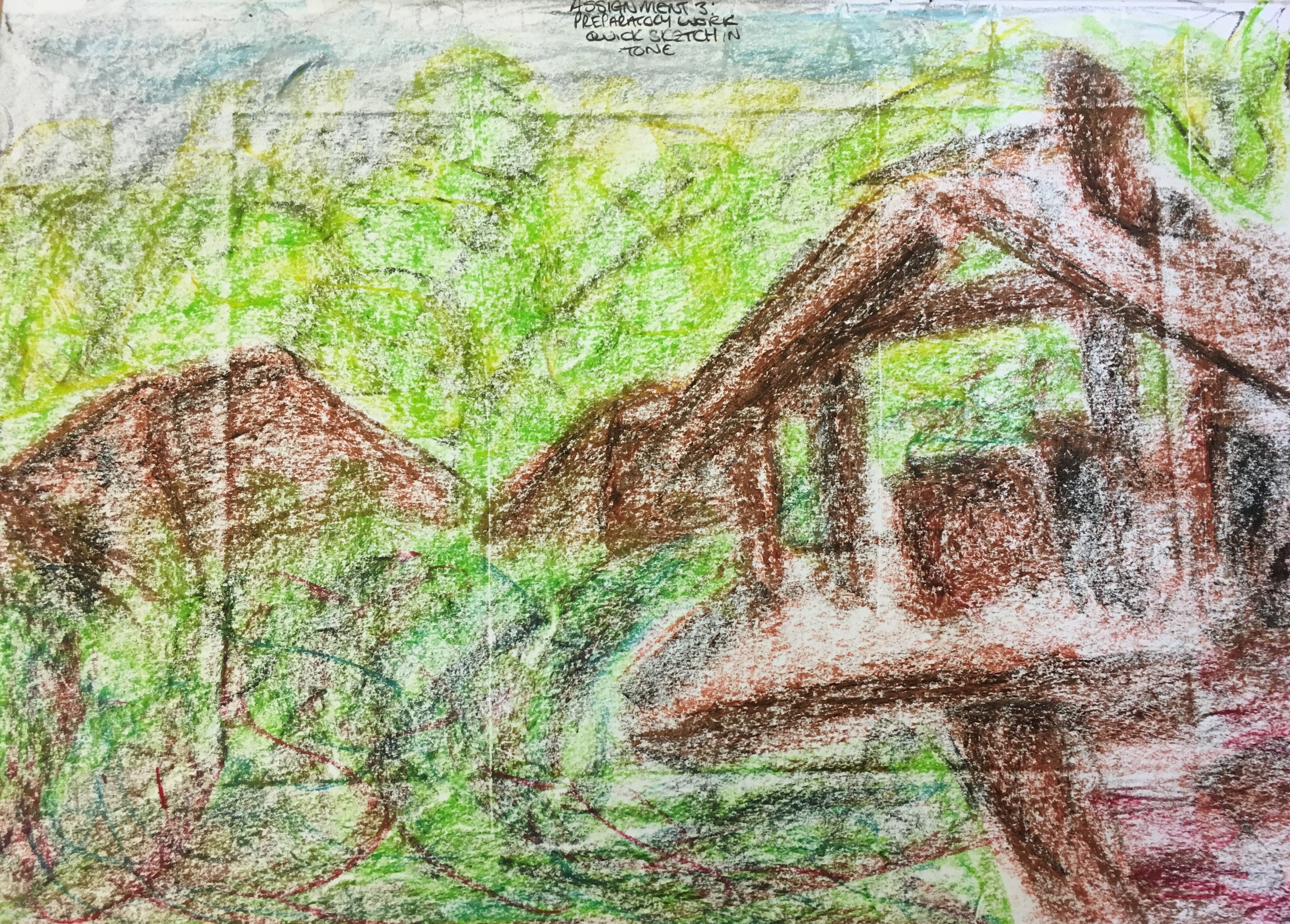
Fig.2. Virtue, J (Unknown) Monochrome Painting At: https://www.widewalls.ch/artist-search/?arist_name=virtue&nationality=&style=&gender=&age=10%2C100 (Accessed on: 24 June 2019)
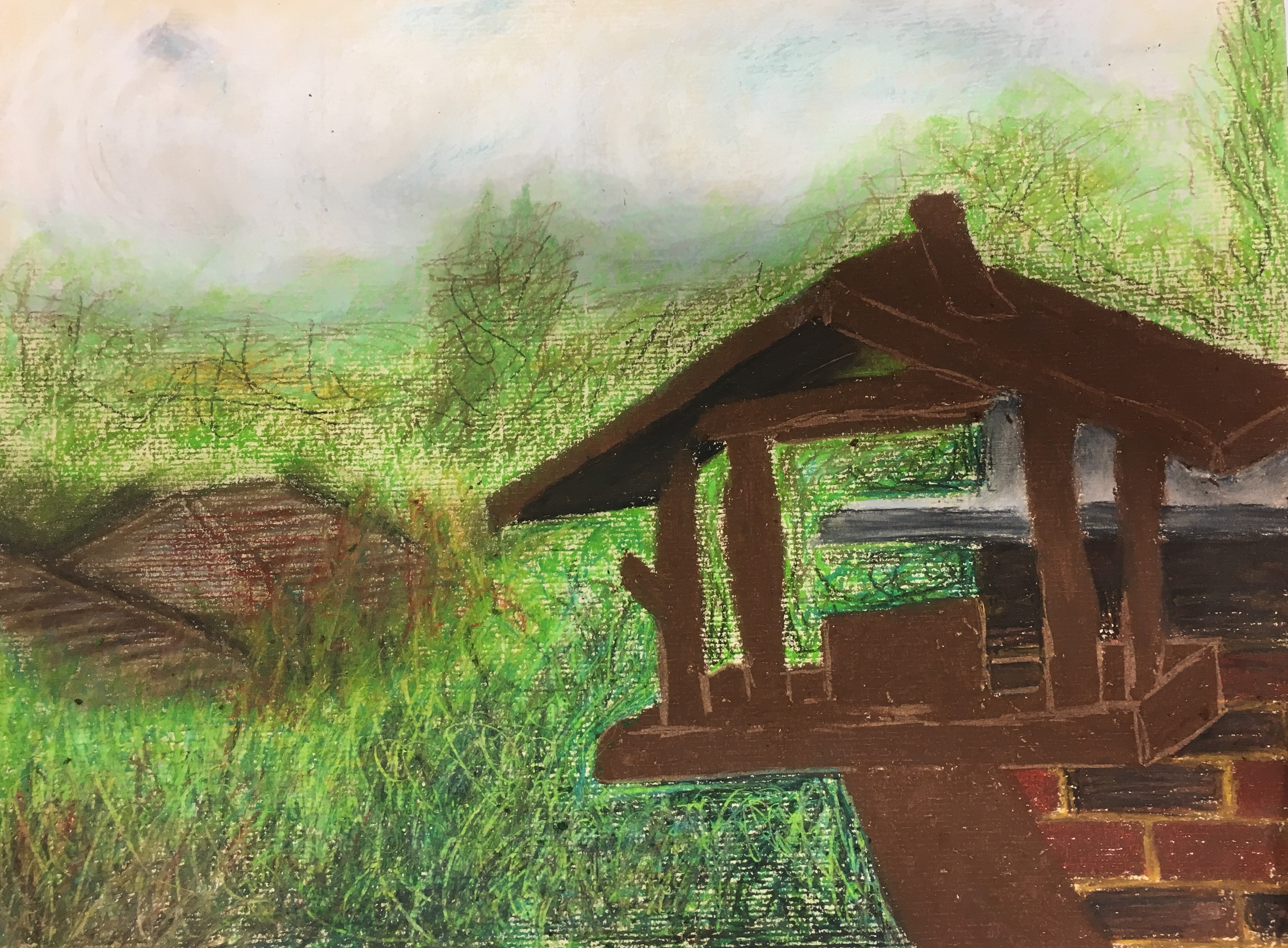
Fig.3. Virtue, J (2004) Landscape No.739 [acrylic & shellac on canvas] At: Bridgeman Education (Accessed on 24 June 2019)
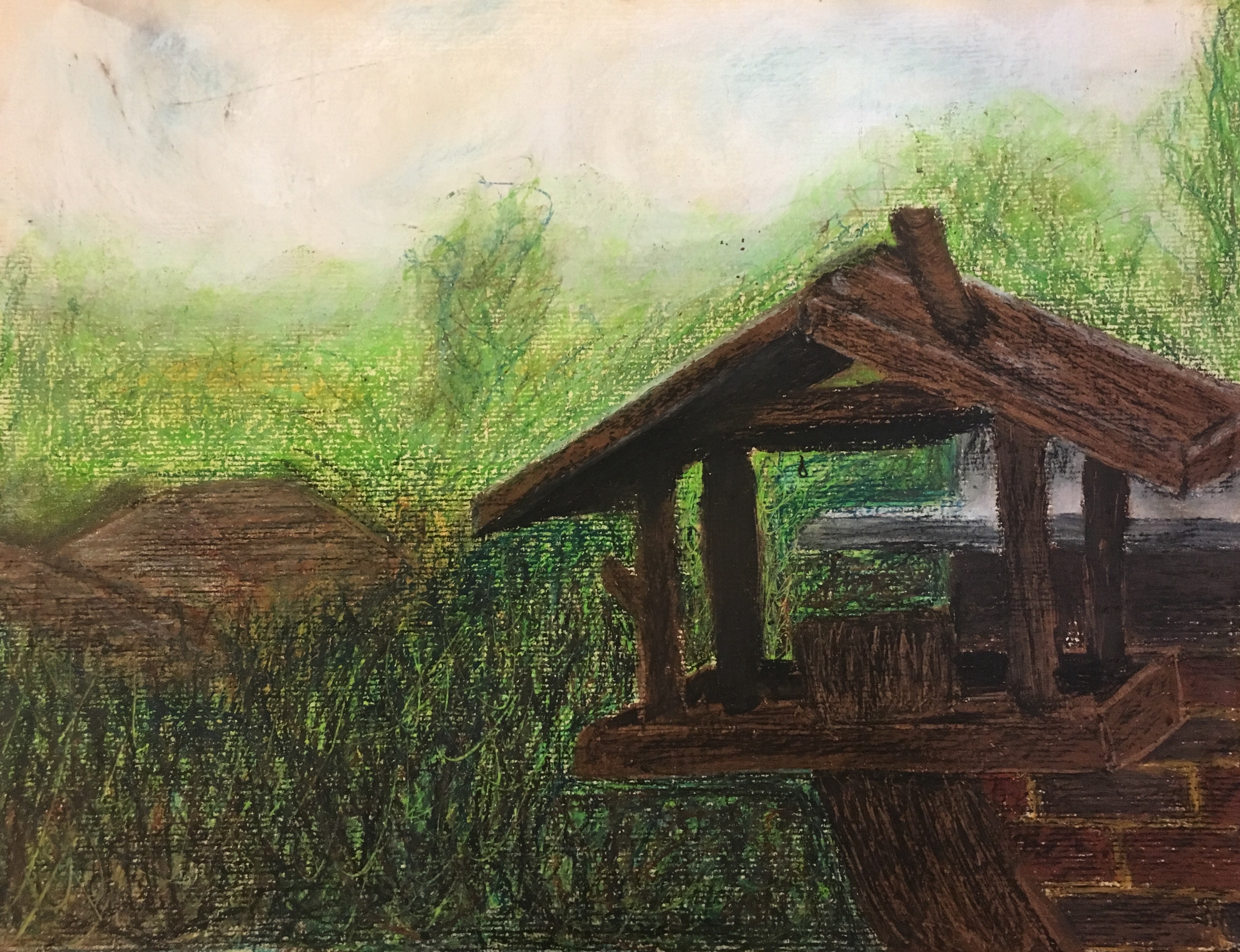
Fig.4. Virtue, J (2005) [Unknown] At: https://www.kanopy.com/product/john-virtue-london (Accessed on: 24 June 2019)
Bibliography

Artnet (Unknown) ‘John Virtue’ [Online] At: http://www.artnet.com/artists/john-virtue/ (Accessed on: 24 June 2019)
The National Gallery (Unknown) ‘John Virtue: Associate Artist 2003-5’ [Online] At: https://www.nationalgallery.org.uk/learning/associate-artist-scheme/john-virtue (Accessed on: 24 June 2019)

Yale University Press (2005) ‘John Virtue: London Paintings’ [Online] At: https://yalebooks.yale.edu/book/9781857093858/john-virtue-london-paintings (Accessed on: 24 June 2019)