Assignment Two

For this assignment, I decided I wanted to recap on some of the key points I took from the first Part of the course, as well as those from this Part of the course, so as to try and keep a steady flow throughout my progress and to keep my memory of these things rather fresh.

Key Points to Remember

Part One: Form & Gesture

  • Work on a larger scale – A2 or A1;
  • Practice the shapes of the objects;
  • Create a space with interesting shapes and angles;
  • Look at the spaces between the objects as well as the actual objects themselves;
  • Use a range of drawing tools, mediums and surfaces;
  • Consider such things as the height, depth, textures, tones and how these will translate into a visual form;
  • Practice skills in creating perspective and scaling of pieces;
  • Consider methods used by Redon, Morandi and Moore in their works;
  • Reflect on and review the work using the Assessment Criteria.

Part Two: Intimacy

  • Look closely and be selective;
  • Create atmospheric, expressive, interesting images;
  • Choose a medium which fits the subject, mixing mediums together to create interesting results;
  • Layer with darker marks or begin with the darkest and move to the lightest in layering;
  • Consider the positive and negative space of the piece;
  • Consider the choice of objects used, the composition of the piece, the background to the piece, the point of view, whether portrait or landscape and the lighting used;
  • Consider how to create the image in just line or how to create tone by using colour or by simply being monochrome;
  • Create several quick sketches to find the most interesting;
  • Reflect on and review the work using the Assessment Criteria.

Preliminary Experiments

I had decided earlier on that I would work with my fireplace to create my assignment piece and used my later exercises to create some of the preliminary work for the assessment.

From here, I decided to carry out several experiments within my sketchbook. I began by reflecting on my research of composition within pieces and created several quick sketches in Chinese brush pen, simplifying the objects as much as possible to their general shapes and divided two pages into four.

Landscape Composition Experiments

I used the first page to create some sketches in landscape of some mixed combinations of objects and their placements. I then draw some quick rough lines over each box to split the images into nine boxes to assess them for the ‘Rule of Thirds’. My favourite of these four sketches was actually the first of the images due to the amount of information within in. I was surprised to find this as I do quite like images with less visual information. My second favourite was number four as I think the central square definitely speaks of an absence of something important between the two vases, however, overall I think the image a bit sparse and bland.
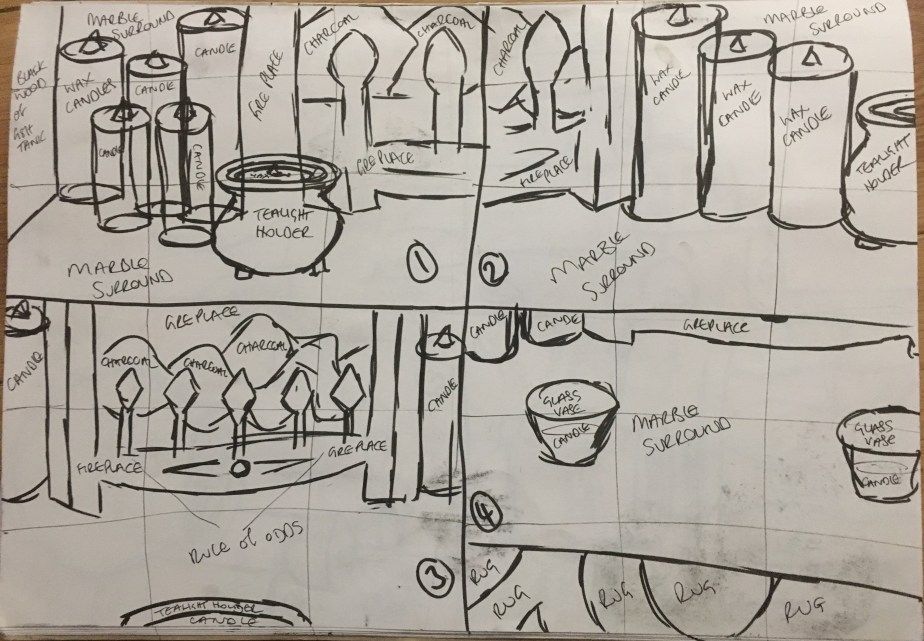
Quick sketches of different compositions in landscape format

Portrait Composition Experiments

On the next page, I created four images in portrait, again mixing the objects up and focussing on different sections. Again, I split each image roughly into nine squares. My favourite of these four sketches was number seven as it appears the candles are gathering around the tealight holder and feels rather cosy.
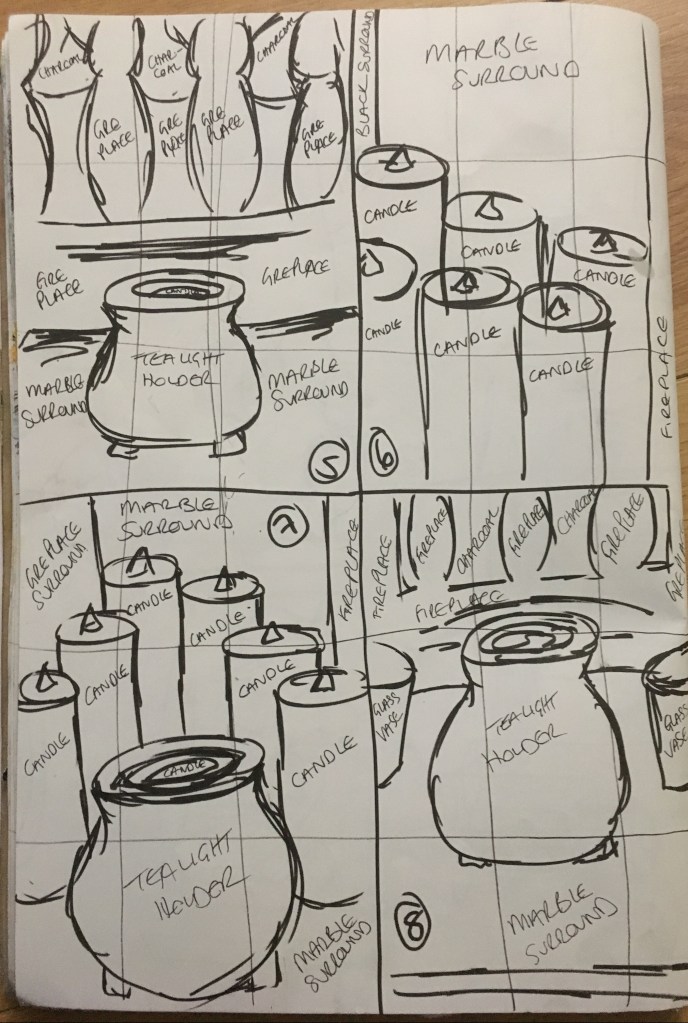

Quick sketches of different compositions in portrait format

Positive and Negative Space Experiment

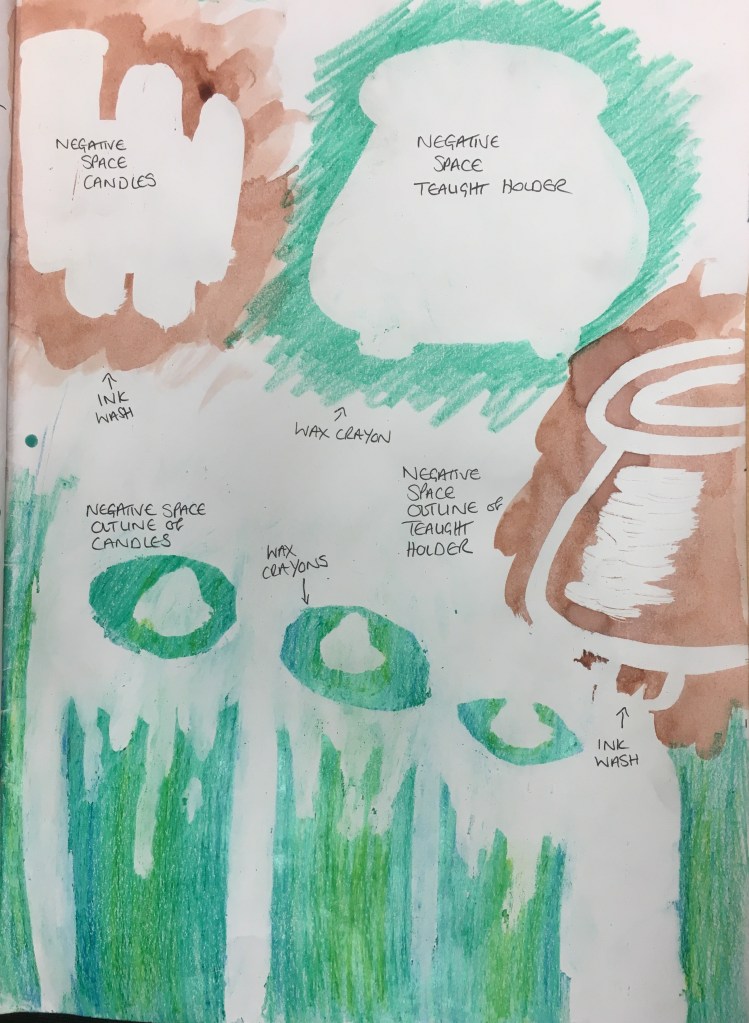
From here, I picked a couple of the objects to investigate further and to analyse the positive and negative space surrounding them, as researched in an earlier section of this Part of the course. I used masking fluid to ‘draw’ the candles in a group and then the tealight holder, filling the objects with the fluid. Then, I drew the outline of the candles and the dripping wax on them and then the outline of the tealight holder. I used an ink wash over the top of the silhouette of the candles and the outline of the tealight holder and then used a wax crayon over the silhouette of the tealight holder and the outline of the candles. I rather liked the outline of the candles after the masking fluid had been removed as the dripping wax looks rather realistic and the ability to mix the greens and blues before removing the masking fluid allows for a fair amount of expressive freedom without ruining the crisp contrasting lines when removed.
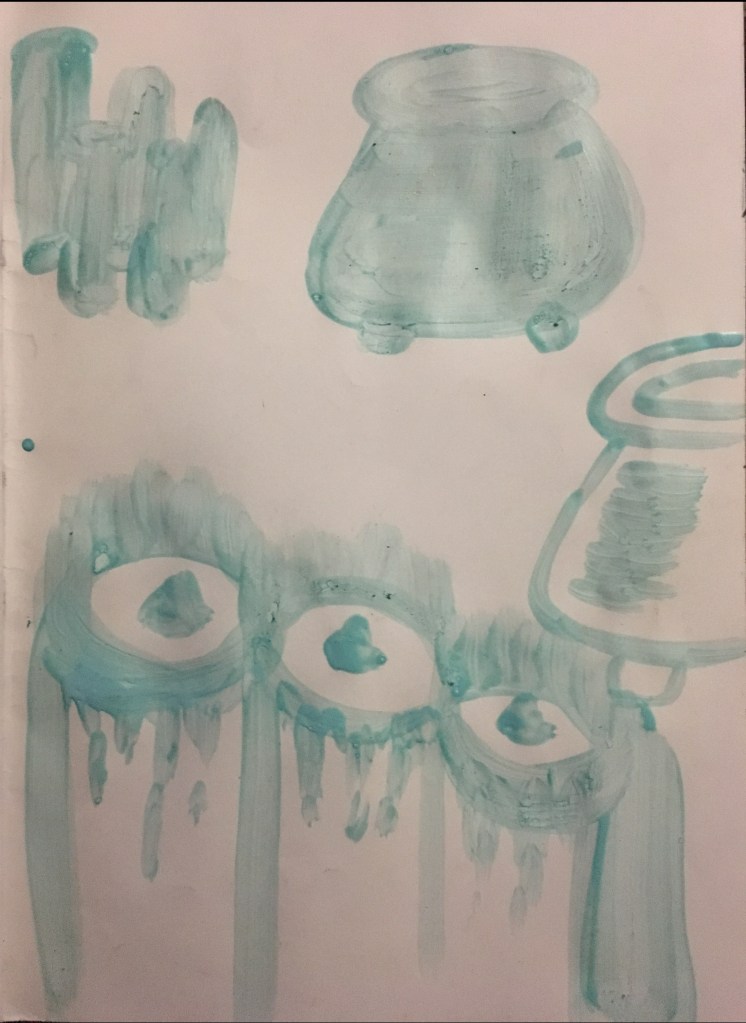
Experiment with Tone in Black and White

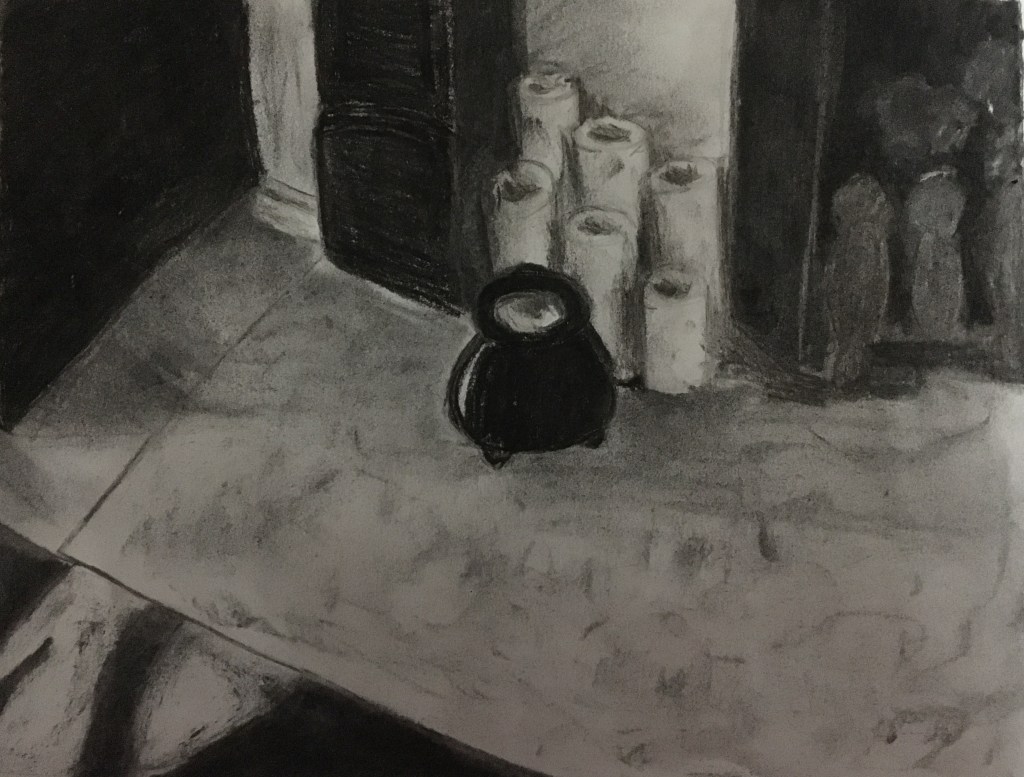
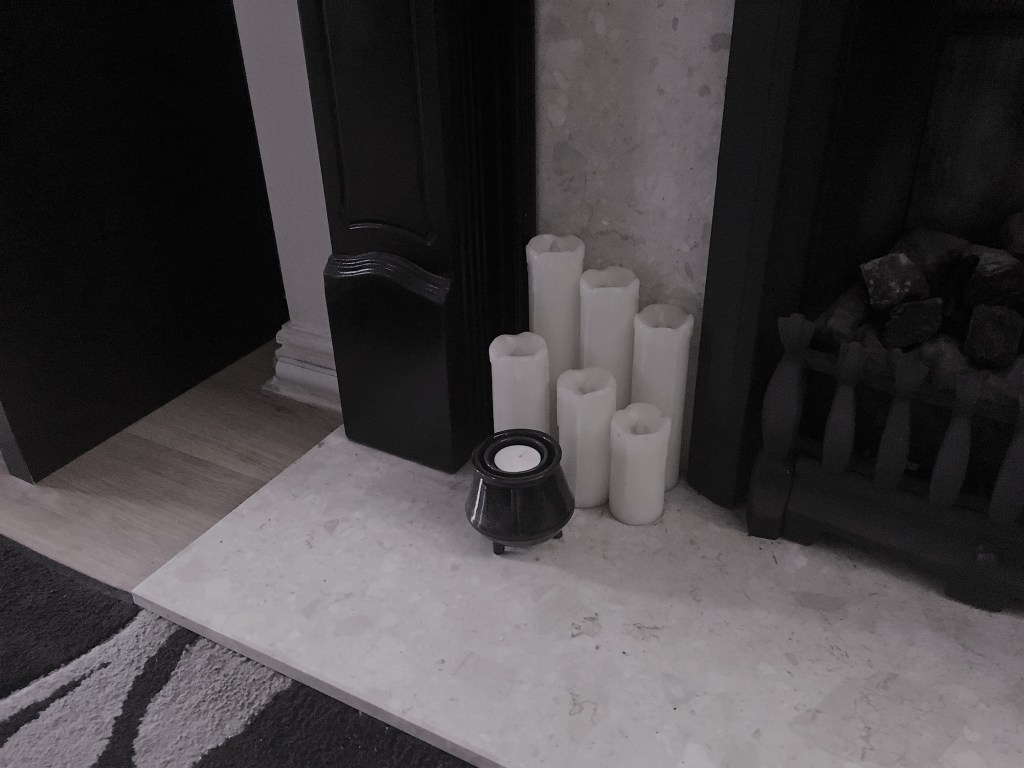
I had already settled on the composition I had created in my last exercise of the landscape tidy composition as this was the one I felt most comfortable with, but also which allowed me to explore most of the textures and surfaces. I had already created a larger scaled version of this for my final piece for the previous exercise, however, I decided to recreate it again quickly to refresh my memory of what was included and to also add some finer details which I had excluded from the previous piece due to being able to see more through the assistance of a black and white photograph of my chosen composition.
Experiment with Detail and Tone in Colour

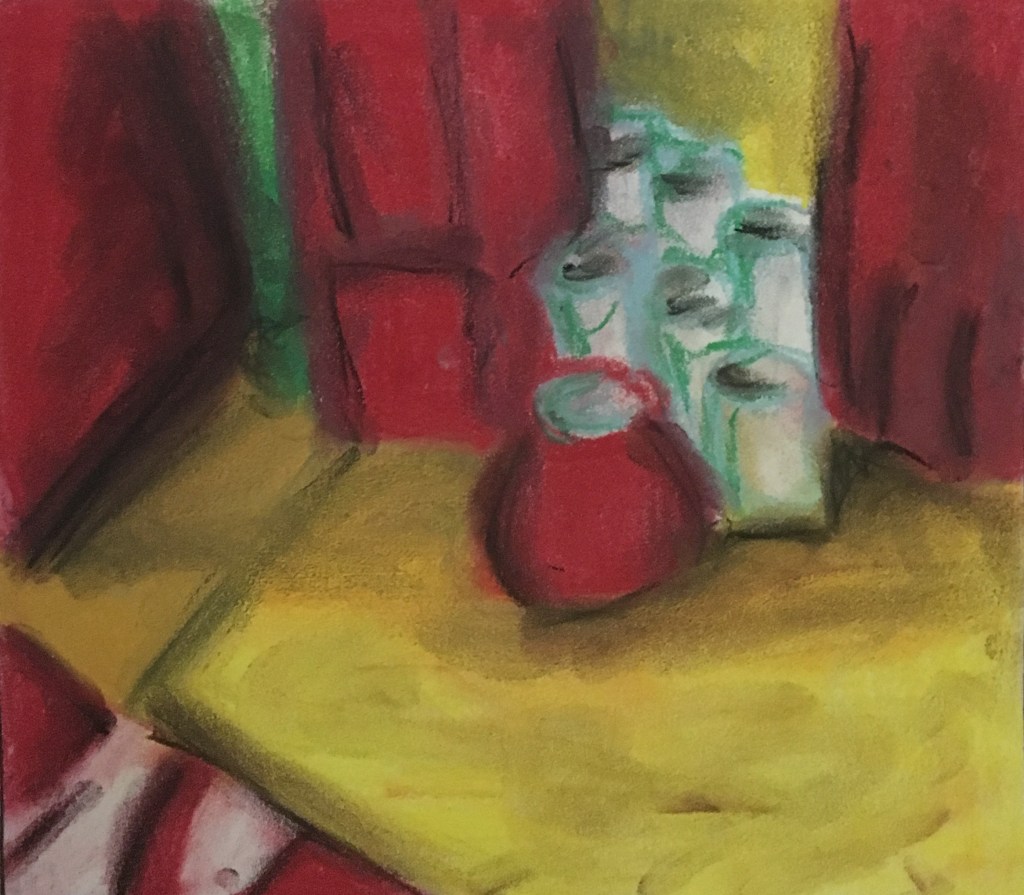
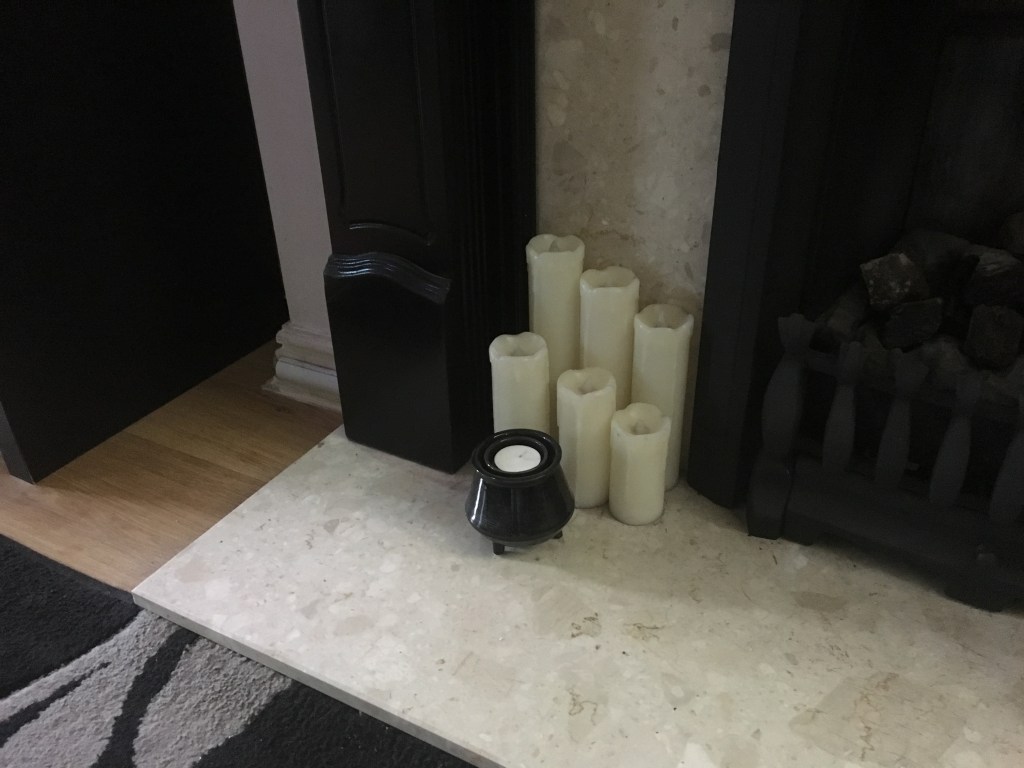
I then carried out an experiment similar to another previous exercise to add colour to the piece in a quick thumbnail sketch to experiment with the different shades of the image and to also attempt to create a piece in a similar way to Morandi’s work, except with bolder, more intense colours. I worked in soft pastels and tried to choose a different colour to represent the different tones in the composition. I chose red for the blackest tones, yellow for the lighter tones, with a touch of green for the white areas to show some shadow. To be completely honest, I did not really have a plan for this section as such, I just went with the flow and created a sample piece in whatever came to mind first. Considering there was no specific rhyme or reason to the experiment, I actually rather like the outcome as I think it just naturally seems to come together and work quite well. I chose the red and yellows to create a sense of warmth in the experiment as this is how I feel when I look at my fireplace. Again, I chose to keep detail to a minimum as I rather enjoy this method and the boldness of the colours created as a result but I think my composition doesn’t actually contain much in the way of finer details anyway.
Line Drawing Experiment

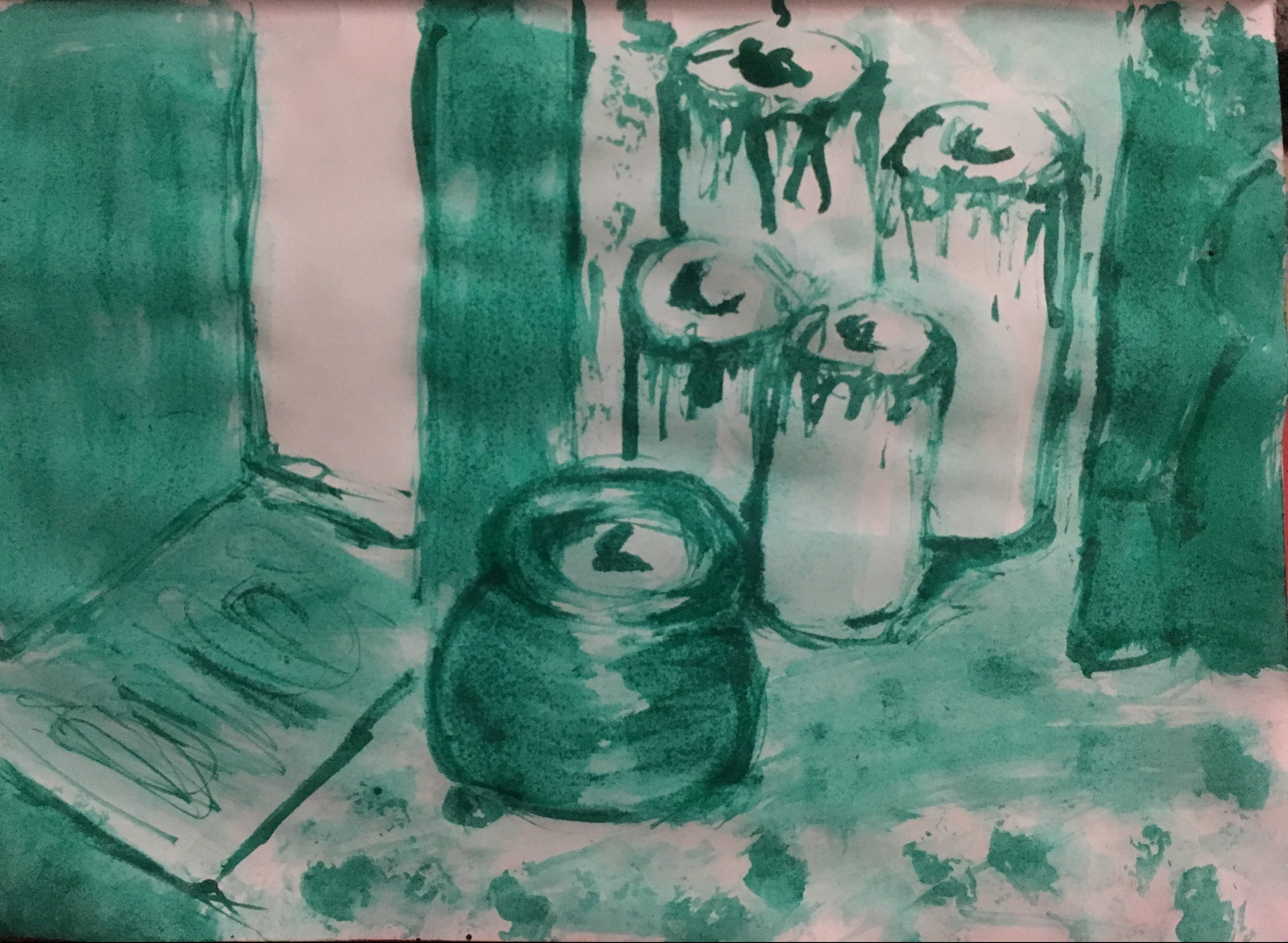
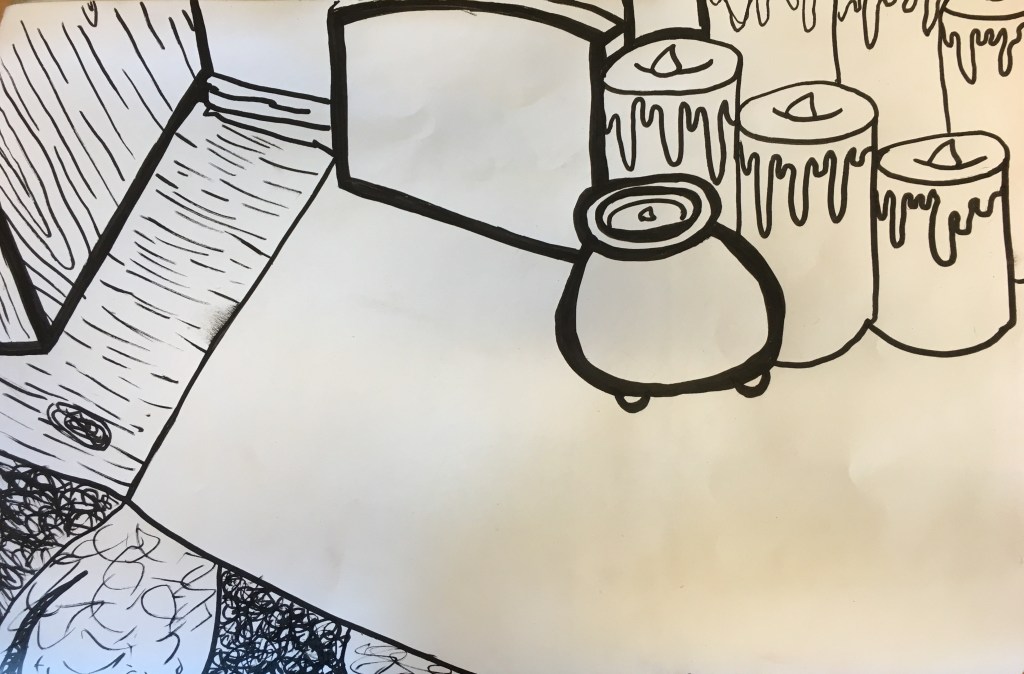
I then decided to carry out an experiment in line drawing, as done in an earlier exercise in this Part of the course. For this, I tried to envision the piece I came across during my research of domestic interior artists by Lichtenstein with its cartoon-like values and different use of line within the piece. I tried to show different directions of line for the wooden flooring to show the difference in the objects and their movement within the piece, as well as using thicker lines for the darkest areas within the piece. I figured that, this way, if I were only able to work from this piece for assisting to create my final piece, I would be able to distinguish the black areas, the direction in which they are moving, the texture of the rug, the delicateness of the candles (though I think I could have used finer lines for these). The only thing I felt unable to get across was the markings within the marble surround. However, I think the lack of any detail adds to the allowance of interpretation of the negative space to view this part as smooth and shiny of its own accord.
Experiment in line drawing

Monochrome Experiment

Final Piece

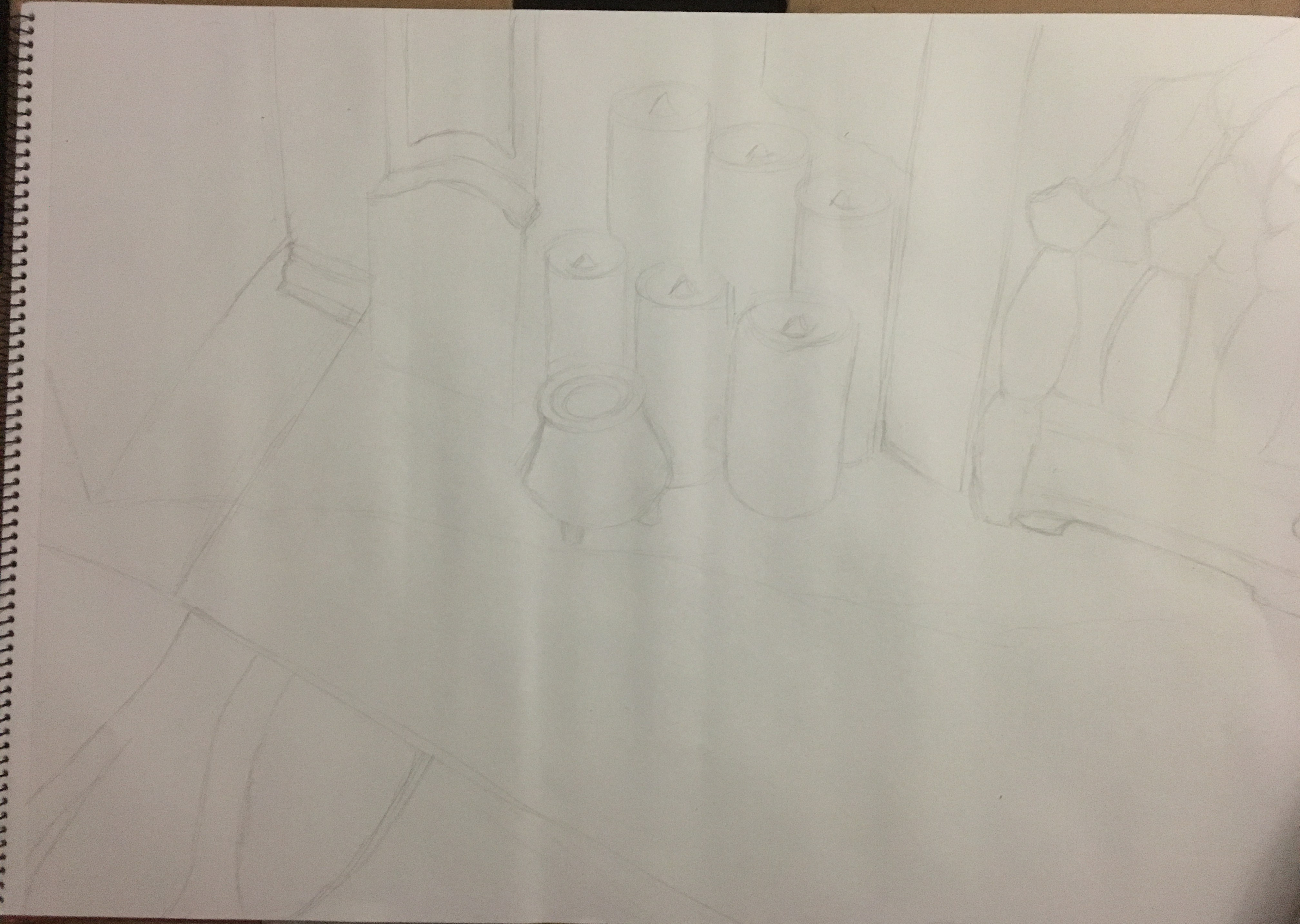
For my final piece, I tried to look at my preliminary work both for the assignment and the Part of the course as a whole and develop my piece from there. I took an A2 piece of paper and lightly sketched my image in. I was rather pleased with my result as it was on quite a large scale, however, I did not use a grid to create it, so I think my skills are improving somewhat!
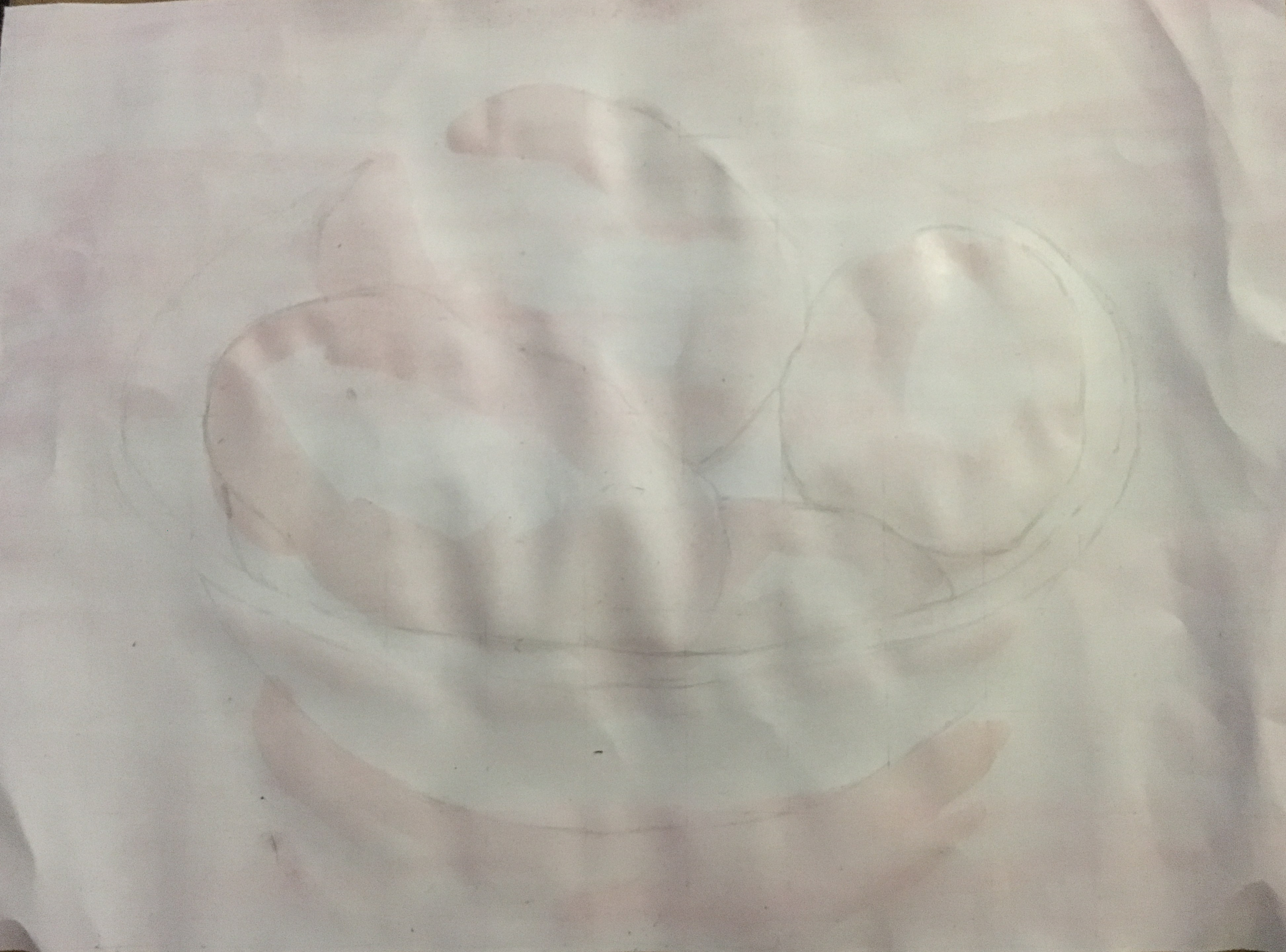
Preliminary sketch of final piece

After this, I used an acrylic marker to colour in the tealight holder, then used PVA glue to fill the candles with a waxy coating since they are generally white anyway, as well as a layer over the tealight holder to help create the sense of the shiny coated ceramic. Next, I added the tracing paper ready to apply the tea staining over the top. I was actually rather disappointed with this due to it gathering and spoiling the appearance of a smooth, marbled surface. I am going to try and think of a way to correct this, but won’t spend too long worrying about it and will put it down to a learning curve if all else fails!
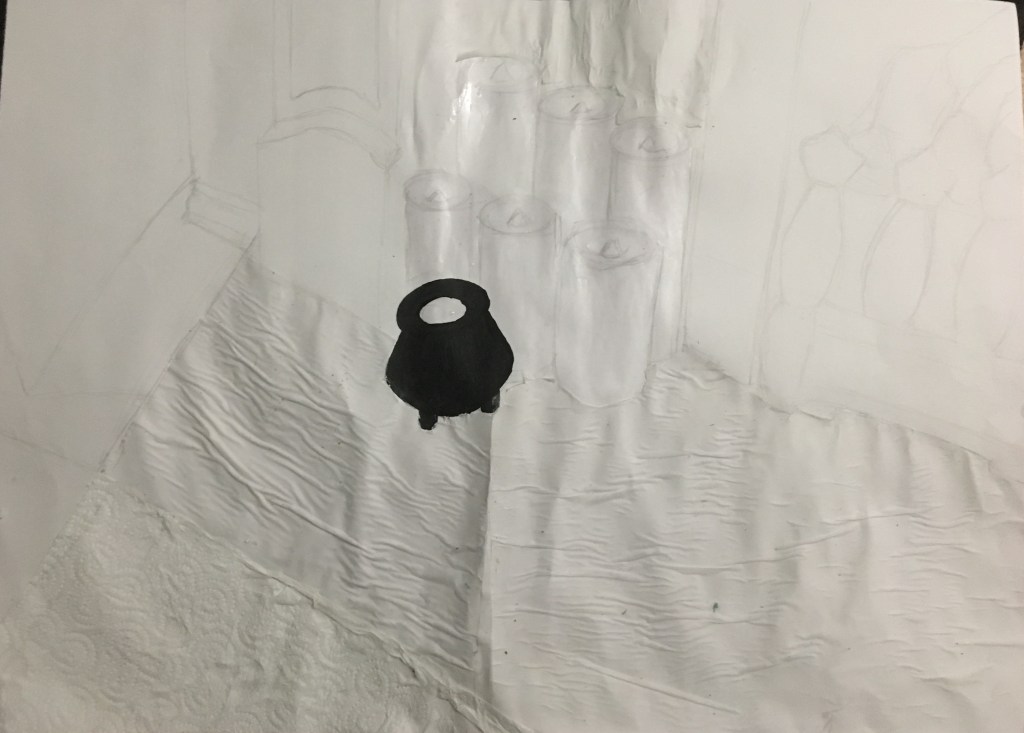
Application of acrylic marker, tracing paper, kitchen roll and PVA glue for the candles

I then applied some white chalk to the area which is the wall surrounding the fireplace. I added a bit of beige chalk and also some grey to create depth and tone. Once finished, I will add in any shading needed, but I am trying to keep it all as base layers where possible until the end. After this, I added the black soft pastel to the rug and was made up with the result! I think it really adds depth and texture to the piece and actually rather resembles the rug in question! I did notice, however, that I had lost the initial shape of the actual rug in my creation due to having stuck the kitchen roll down and not being able to see the preliminary sketch and taking the line for the white part of the rug to be the end of the rug. I put this down to artistic licence though and chose not to fret too much about it as now I would be able to show more of the wooden flooring texture as opposed to the small section I would have been showing if created picture-perfectly!
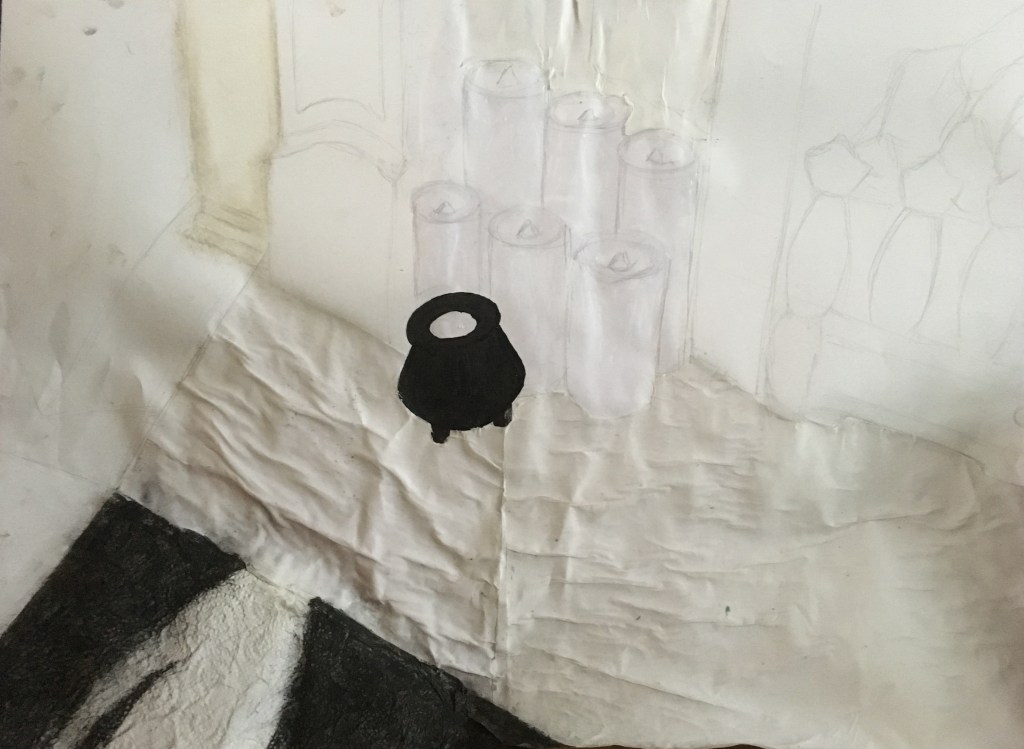
Application of black soft pastel on the rug and chalk on the wall

Next, I added the final ‘layer’ of main colours; I used brown and black conte sticks for the wooden flooring, using a wash over them to smooth the surface. I then used ink for the black cupboard to the far left of the piece, black acrylic marker for the fireplace surround, charcoal for the actual pieces of charcoal in the fire and a tea-staining wash over the tracing paper replicating the marble surround. I was happy with all aspects of the base layers besides the creasing of the tracing paper, which I was deeply disappointed in. I tried to think of a way to smooth this out and considered using PVA, but thought I had used this rather a lot already and should try something else. I just could not decide what that something else should be.
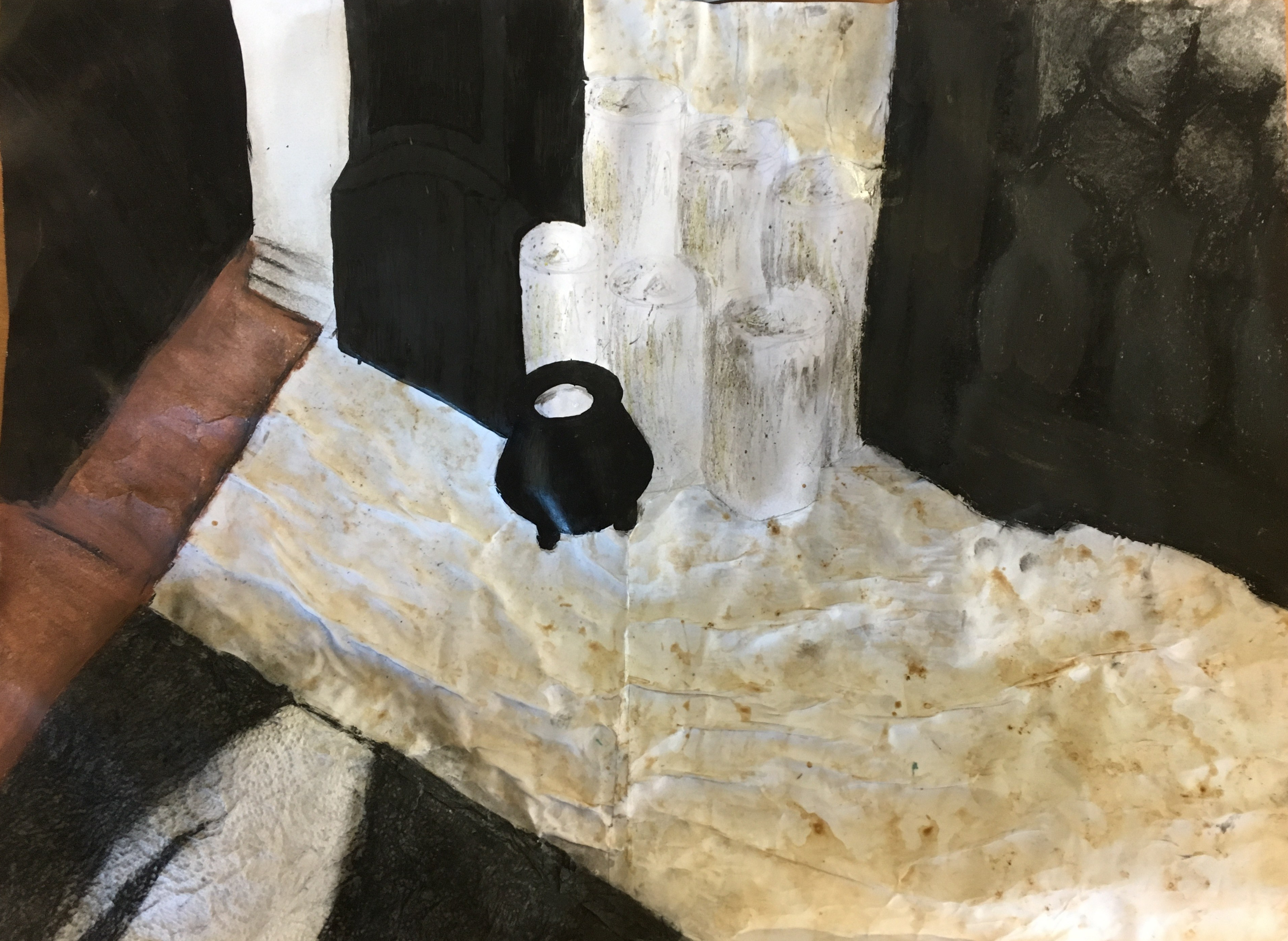
Application of ink, acrylic marker, brown conte stick and charcoal

My next and final task for this piece was to add in the shadows where seen in my original photograph (since some time had passed since then) and to try and create some depth in places by adding highlights where needed.
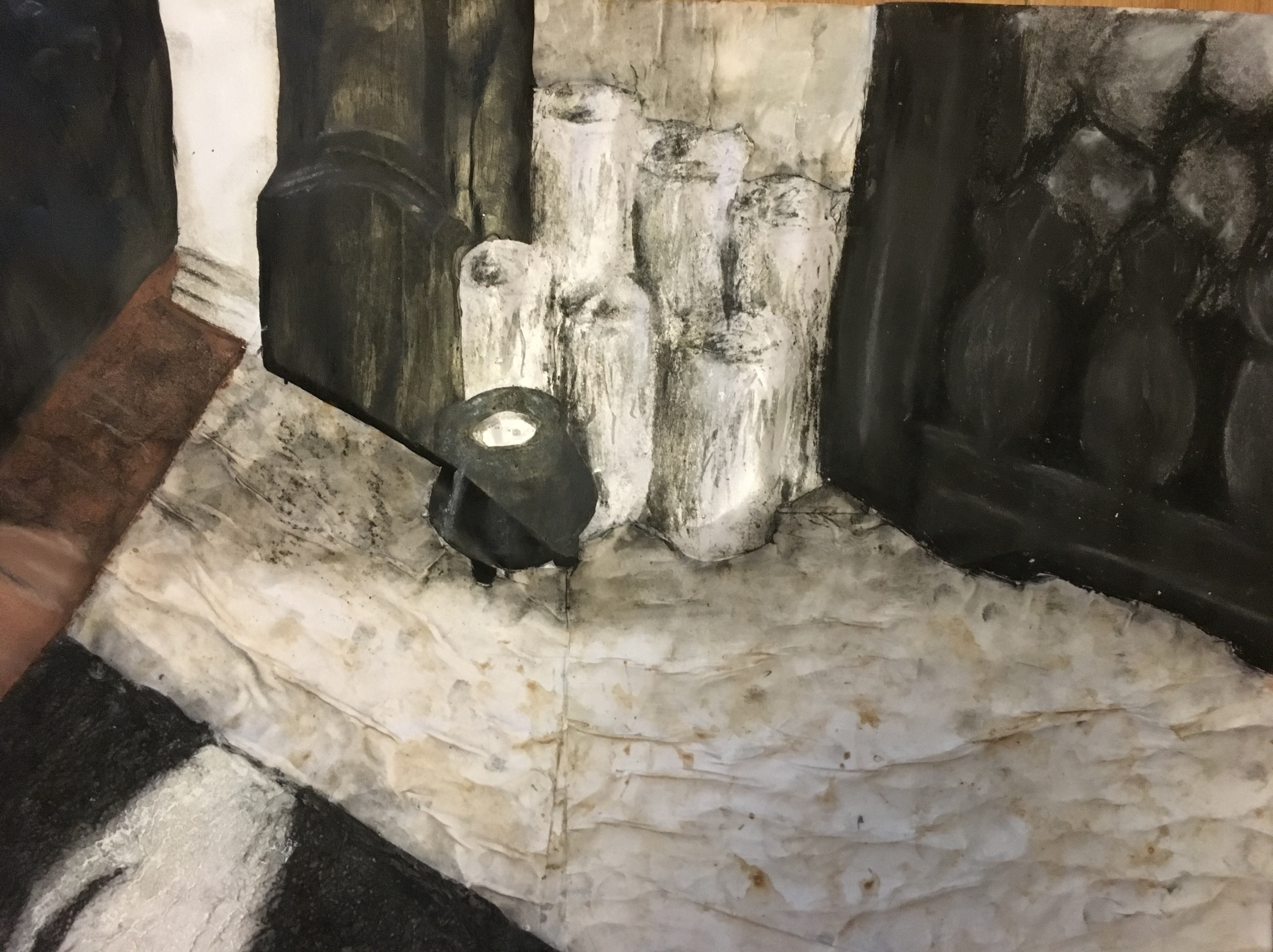
Finished piece – Assignment Two

Reflection

Overall, I am really happy with this piece.  I chose to create a warmer atmosphere in my piece and pulled out the brown hues of the marble to warm the cold, solid blacks in the composition.  I sat in front of my fireplace slightly to the right-hand side to create the view I did.  I took a photograph of this area in the day time as a reference for the darkest tonal areas of shadows and areas of lightest tone, but generally worked from real-life sitting to gain the overall shapes and loosest details of the composition, as well as for the textures.

Having learned some things in this part of the course regarding tone, I tried to stay away from trying to actually draw depth within the piece, but to create it naturally through shadows, highlights and the textures of each object, which I feel worked rather well, especially with regard to the rug and the wooden flooring to the left of it as I get a real feeling that the flooring is beneath the rug, as it should be.

Having already decided my chosen media for each object through the material differences exercise, I was able to apply them rather efficiently, however, I think I would think again before using the tracing paper for the marble effect if I were to redo this piece.  Whilst it has irked me since I completed this section, I decided to leave it be as I actually really like how the light hits it and fragments off from it.  The marble surface itself has small particles within it which seem to reflect the light in very fragmented ways so, whilst it initially bugged me, I finally understood the sentence in this part of the course “…remember that your subject matter might be quite different to your source material” as my source material is definitely different to my subject matter in this sense!

I think the objects I used and the background setting have a very obvious natural connection and the story / setting is rather clear.  I have tried to show the differences between the objects through their texture and, thinking back to my tutor’s comments regarding my first assignment, I tried to treat each object very separately and uniquely, concentrating just on that object at a time, whilst building the piece up layer by layer.

Going forward, I would really like to improve my method with regard to the marble surround to be able to create that smooth, but textured surface.  I also really enjoyed creating the wooden flooring and the rug, so I think I would like to perhaps do some more work with wood and its grains as it is so beautiful to behold.  I think the rug the most effective part of my piece as the texture of the kitchen roll just works so well to replicate the fluffiness and bobbles of the actual rug.

Overall, I have really enjoyed this part of the course and have learned some valuable lessons along the way.  Whilst I am sad to leave still life behind, I will definitely carry forward elements of what I have learned as I think a lot of it can be used through all aspects of art as a subject.

I feel I have developed my skills and understanding of the use of colour and line and when each works better in their own way, but also how to manipulate both to suit my purpose; using expressive or finer lines where needed and strengthening my pieces with contrasting colours and combinations.  I’ve definitely learned a lot in relation to the aspects and ‘rules’ of composition and how to set up a group of objects in an interesting and appealing way.  I think my ability to accurately depict scale has improved quite a fair bit.  I think this is due to the rough sketches I am carrying out alongside my course.  I still think I have a fair way to go and have enjoyed using grids, though I do find them time-consuming and also restrictive as I can only really use them if working from a photograph, so they are not very practical for real life situations.  I will, however, create a viewfinder to use as I progress through the course as the markings on this will allow me to create a rough grid for the basic idea of placement of some of the objects, such as trees etc. 
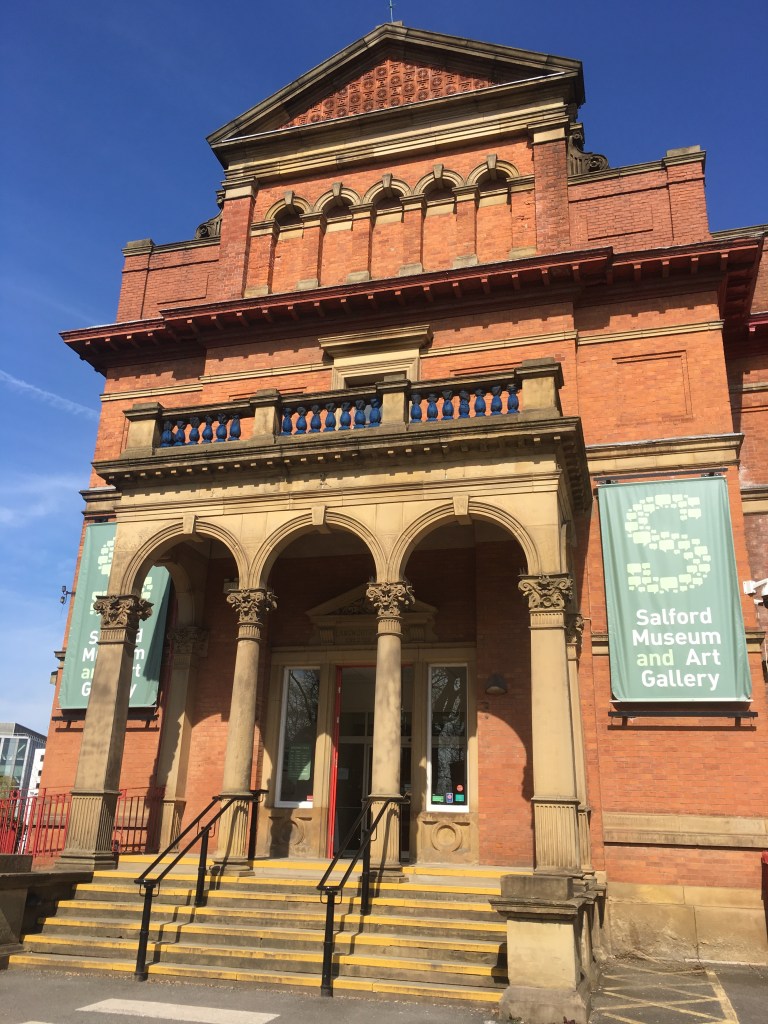
Salford Museum and Art Gallery Visit, 6 April 2019

Salford Museum and Art Gallery

I decided to go for a walk around Salford Museum and Art Gallery. I was mesmerised by some of the works I saw and took plenty of photographs as I walked around of any which caught my eye. I decided to separate them into different categories to be able to refer back to in future sections of the course.

Still Life

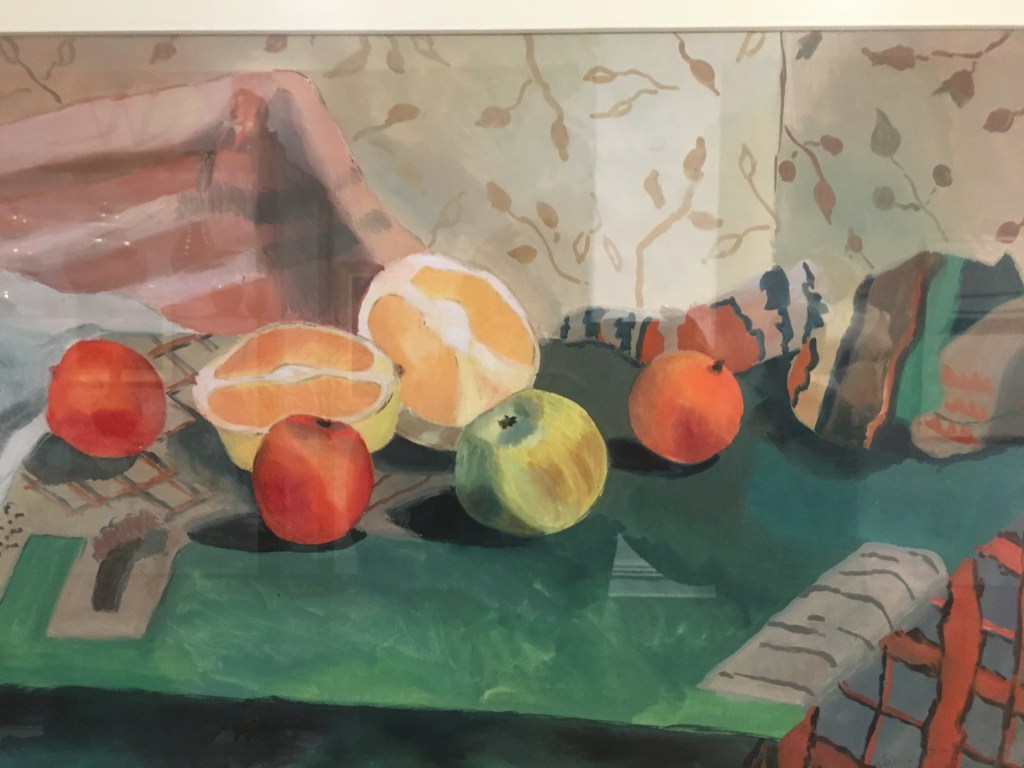
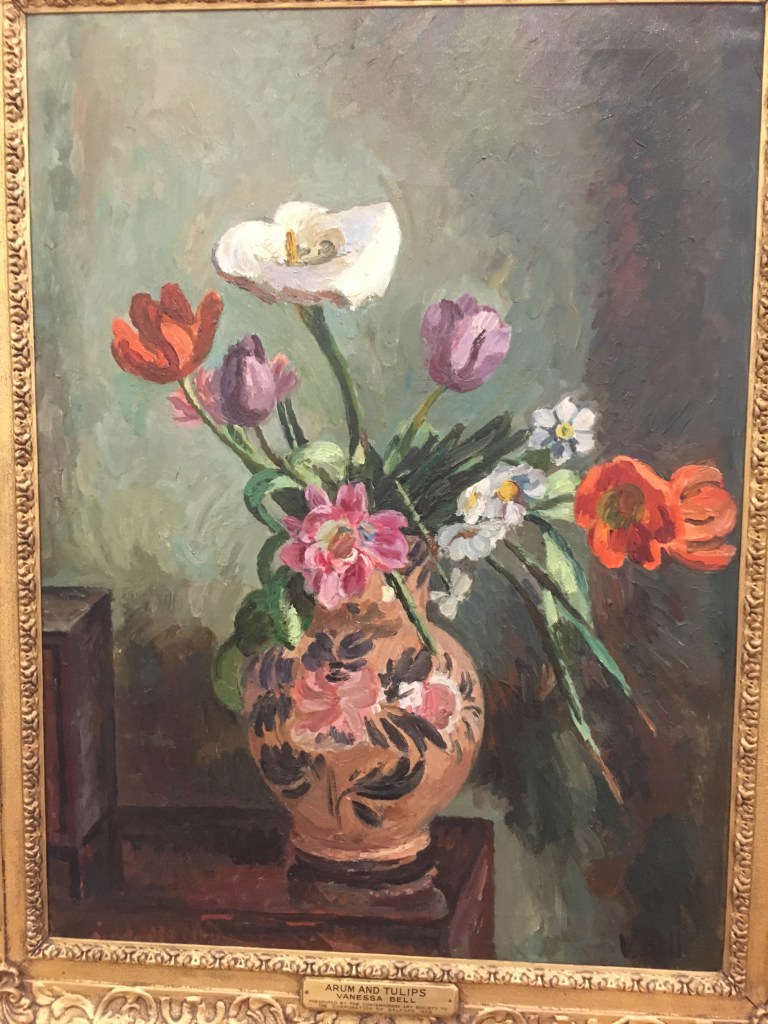
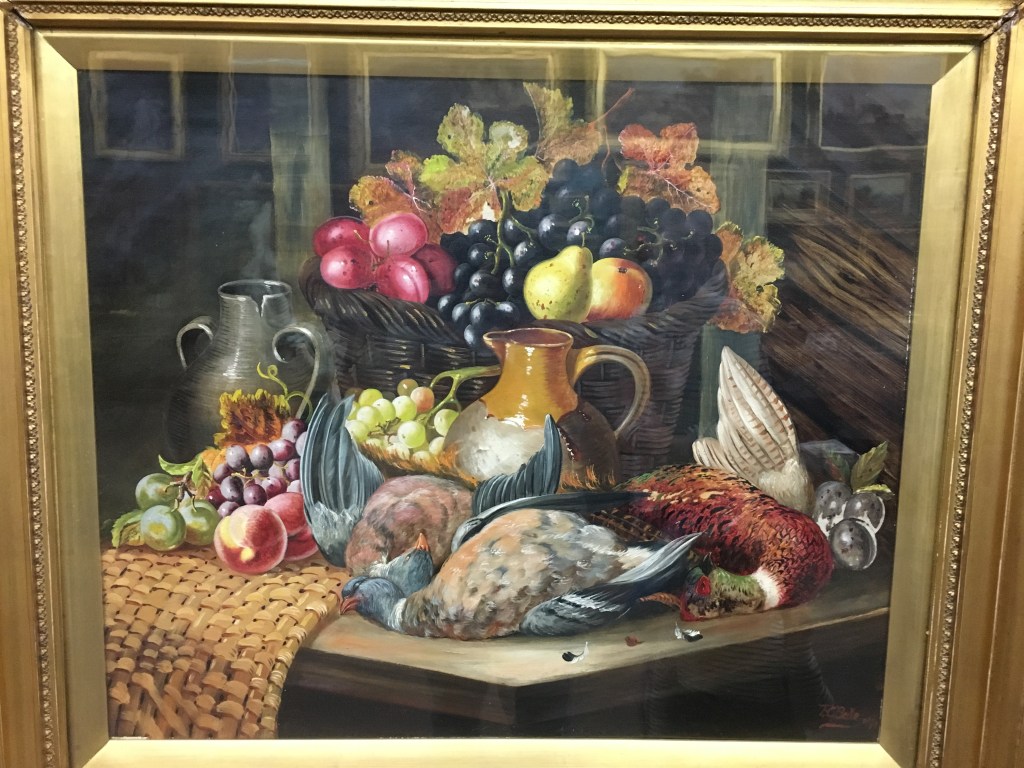
Below are just a small few examples of the still life pieces I saw which caught my eye. I find it bizarre that one of them would be Bell’s pieces, when I chose another of her pieces completely by chance! It was only when I came to type this that I realised that, clearly, I am rather drawn to this artist’s work! Whilst I really like the simplicity of Walne’s piece, I really like the bold and contrasting colours of Bale’s piece.

Landscapes

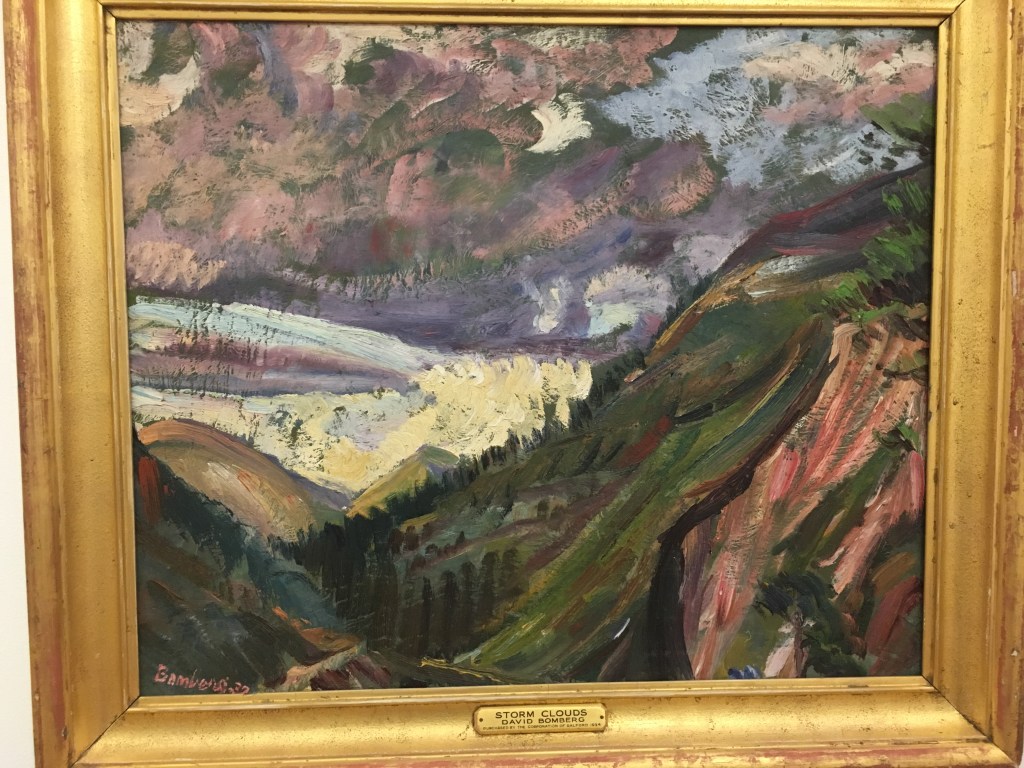
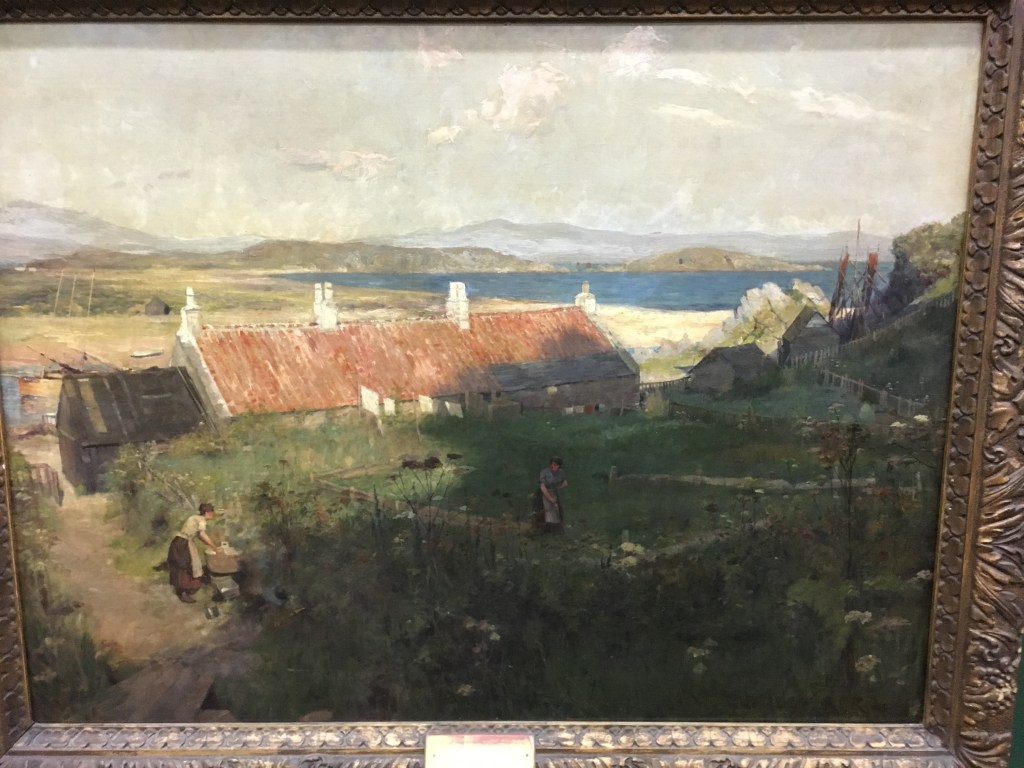
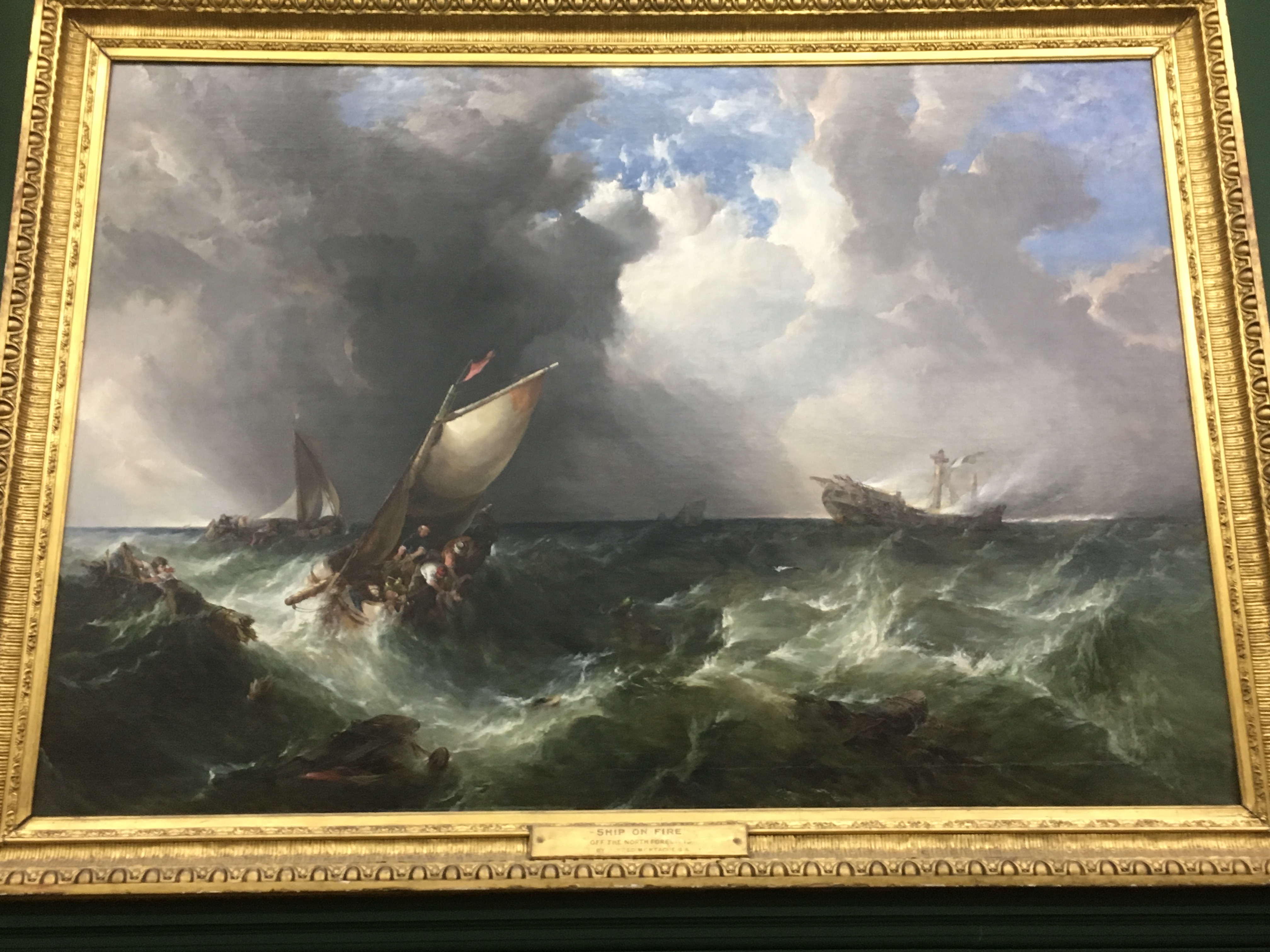
Whilst I have not studied this part of the course yet, I decided to take note of some which appealed to me to be able to perhaps refer to or revisit when I do come to this Part of the course. The pieces below all drew me in due to their intense atmospheres, differing skies and techniques used. I especially like the piece on the sea as the colours used are just beautiful to behold, however, I really like the delicate nature of Kerr’s piece and the expressive and almost unnatural colours used in the sky and landscape in Bomberg’s piece.

Townscapes

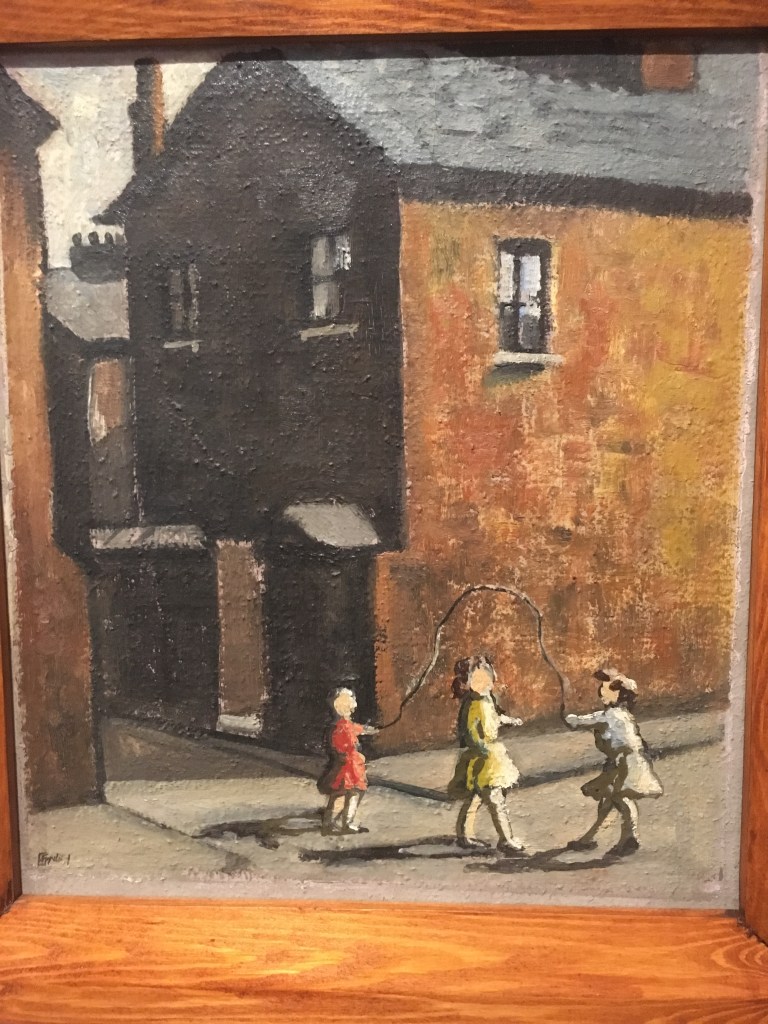
Next, I was drawn to the below pieces of townscapes due to their completely different techniques. Finley’s reminds me of my childhood and a typical ‘two up, two down’ Salford street, which I think is the aim of the piece, as well as the warm colours used to replicate the fondness of the memory and the beautiful summer’s day the children in the piece are enjoying.

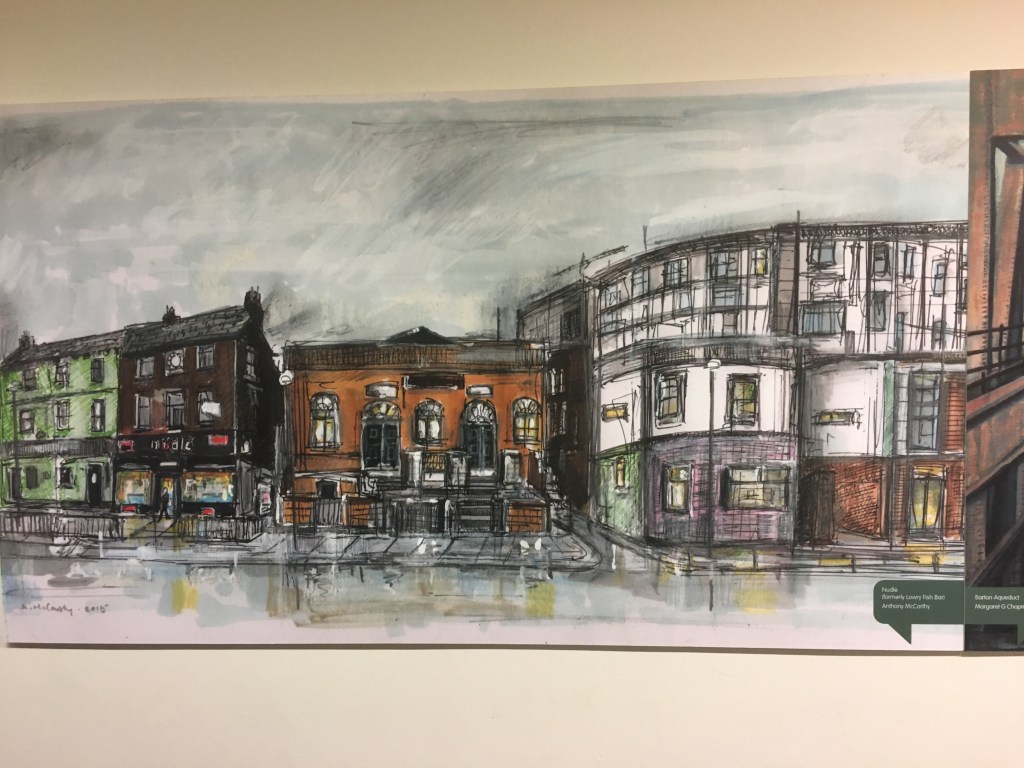
McCarthy’s piece seems very fast-paced (created, I think, by the expressive mark-making used to create the buildings) which I think works rather well for the city street’s hustle and bustle. The weather in this piece appears overcast and miserable.

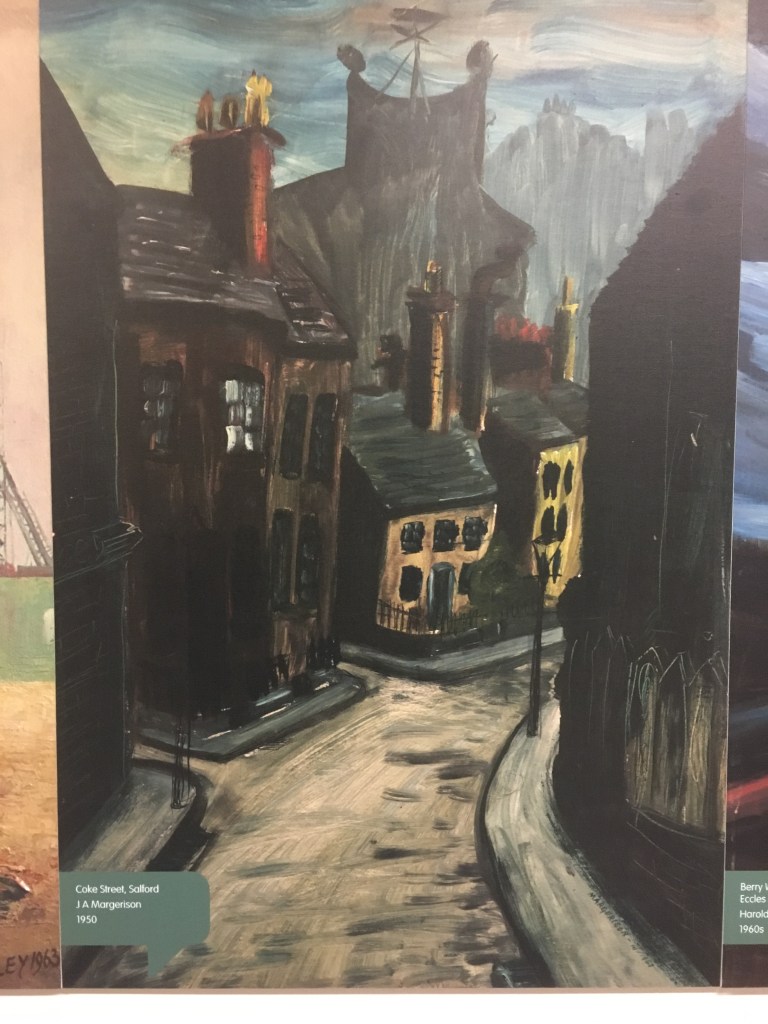
Margerison’s piece is rather quirky to me with its leaning buildings and reminds me of something in a Tim Burton movie. I like the dark mystery to the piece and the fact the road bends around and out of sight, as this makes me feel as though I am walking down the street myself.

Figure

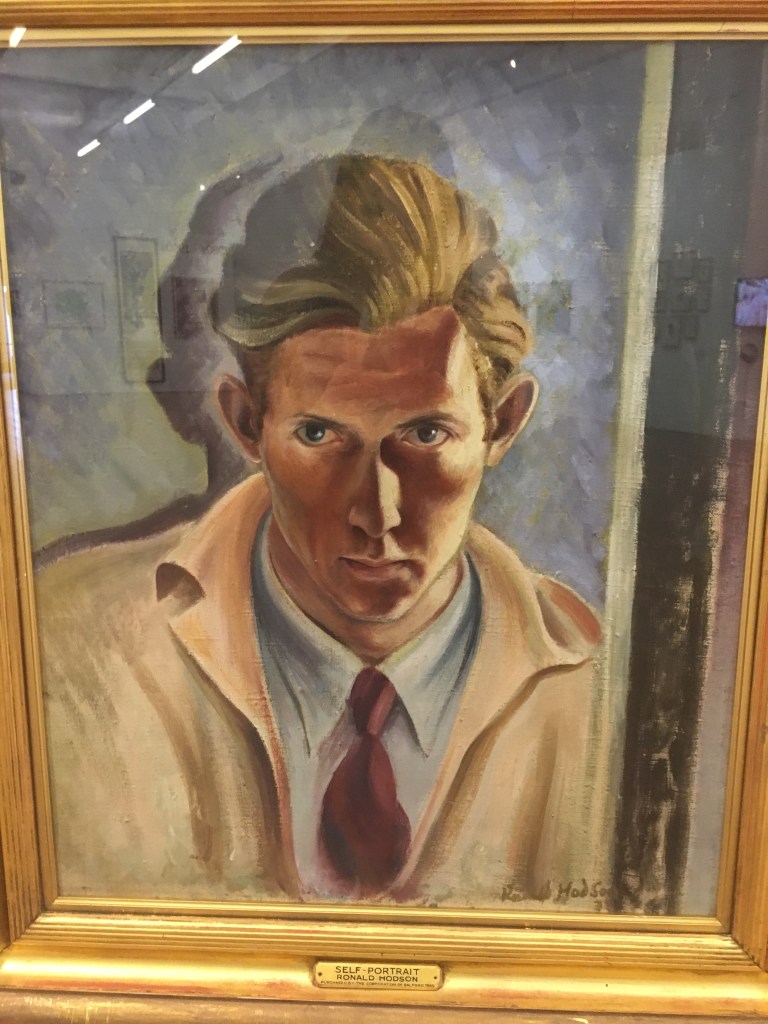
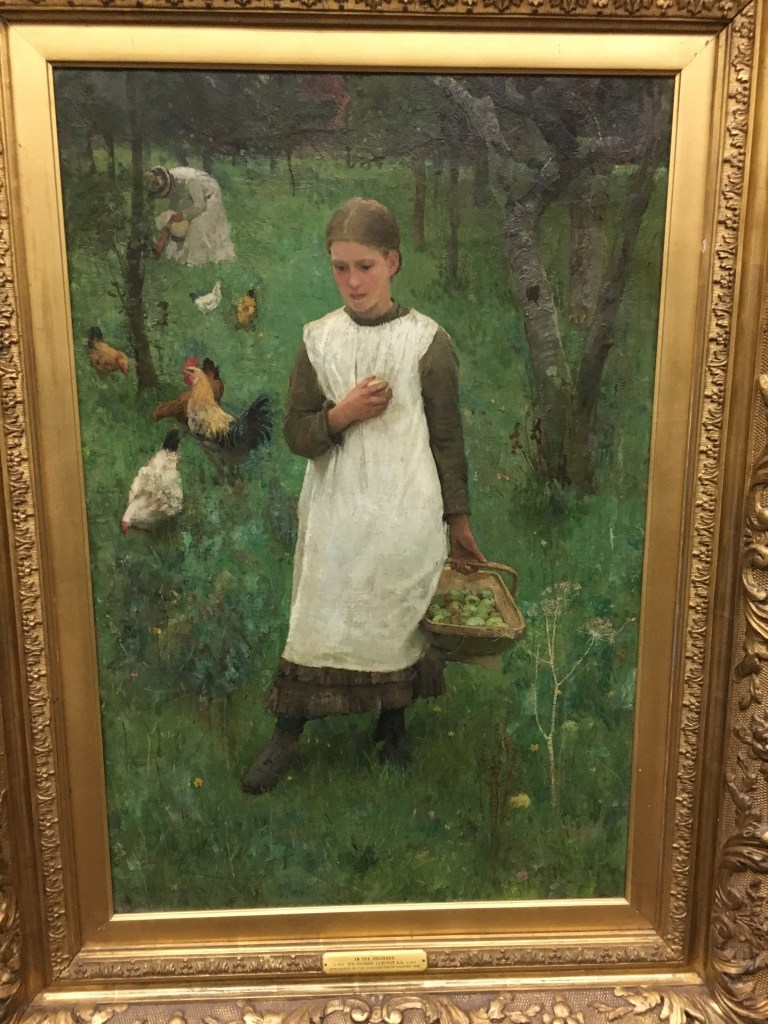
Finally, below are some pieces I was drawn to regarding the figure. I really like the expressive mark-marking used by Nicholl, the shadows and bright colours used by Hodson and the traditional methods used by Clausen. I really like the fact the girl is holding a hand near her chest in Clausen’s piece and looking down. I don’t actually know why, but I am pulled in by this action and the solid white of the dress against the rest of the green background, pulling into play the balance of positive and negative space.

I really cannot wait to go to see some more exhibitions and find other artists whose work I may never have seen otherwise as seeing methods used by others besides the well-known artists is very refreshing and inspiring, providing plenty of ideas to develop my own personal creative voice.

List of Illustrations

Fig. 1. Walne, K (unknown) Apples and Oranges [watercolour] Exhibited at A to Z of Salford’s Collections, Langworthy Gallery, Salford Museum & Art Gallery, Salford, 2019.

Fig. 2. Bell, V (unknown) Arum and Tulips [oil on canvas] Exhibited at Salford Museum & Art Gallery, Salford, 2019. 74cm x 55cm.

Fig. 3. Bale, C T (1891) Still Life with Fruit and Pheasants [oil on canvas] Exhibited at Salford Museum & Art Gallery, Salford, 2019. 61.5cm x 74cm.

Fig. 4. Bomberg, D (c.1932) Storm Clouds [oil on canvas]
Exhibited at Salford Museum & Art Gallery, Salford, 2019.
65cm x 75 cm

Fig. 5. Kerr, C (Unknown) Carradale [oil on canvas]
Exhibited at Salford Museum & Art Gallery, Salford, 2019. 76cm x 99cm.

Fig. 6. Motague, (1856) A Ship on Fire off the North Foreland [oil on canvas] Exhibited at Salford Museum & Art Gallery, Salford, 2019. 150cm x 212cm.

Fig. 7. Finley, E (unknown) Skipping Rope [oil on canvas] Exhibited at A to Z of Salford’s Collections, Langworthy Gallery, Salford Museum & Art Gallery, Salford, 2019. 35cm x 29cm.

Fig. 8. McCarthy, A (unknown) Nudle (Formerly Lowry Fish Bar) [painting] Exhibited at Salford Museum & Art Gallery, Salford, 2019.

Fig. 9. Margerison, J A (1950) Coke Street, Salford [oil on canvas] Exhibited at Salford Museum & Art Gallery, Salford, 2019. 53.5cm x 37cm.

Fig. 10. Nicholl, J (b.1965) Sailor II [oil on canvas] Exhibited at A to Z of Salford’s Collections, Langworthy Gallery, Salford Museum & Art Gallery, Salford, 2019.

Fig. 11. Hodson, R (1940) Self Portrait [oil on canvas] Exhibited at Salford Museum & Art Gallery, Salford, 2019. 56cm x 46cm.

Fig. 12. Clausen, G (1881) In the Orchard [oil on canvas] Exhibited at Salford Museum & Art Gallery, Salford, 2019.
75cm x 49.5cm.

Part Two: Intimacy – Assignment Criteria Reflection

Demonstration of Technical and Visual Skills (35%)

  • Materials: I think I have made good use of materials throughout this part of the course. I have experimented with a wide variety of surfaces and mediums throughout and tried to incorporate a variety as much as possible without over-complicating things. This is especially true for my final piece.
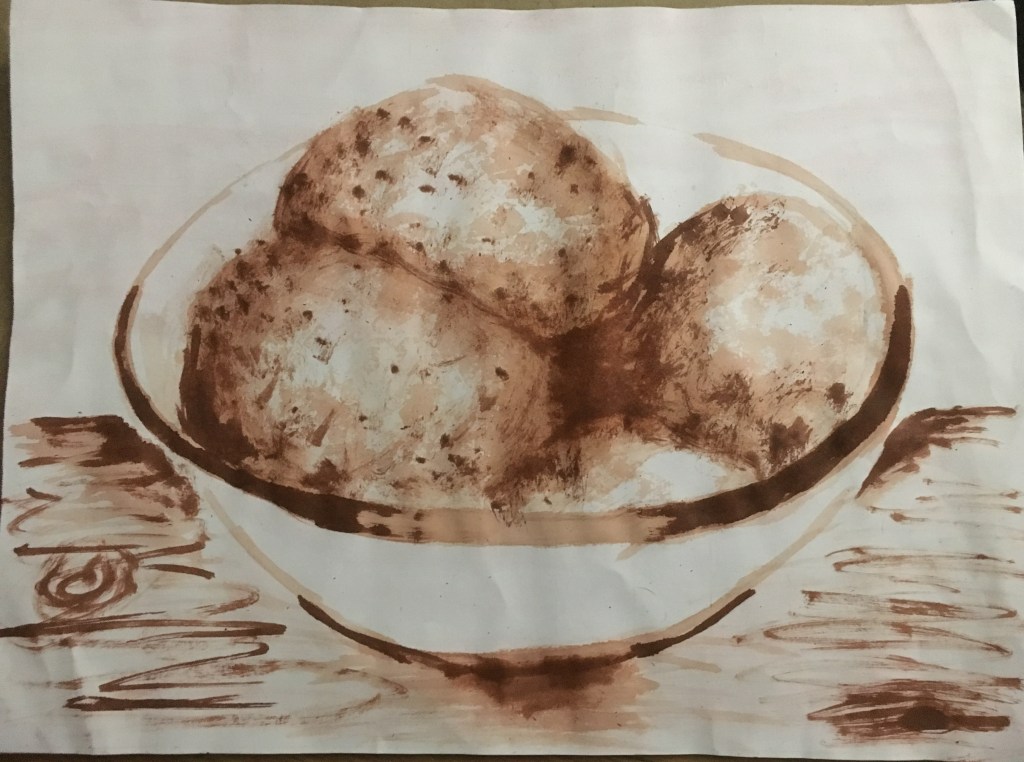
  • Techniques: I have tried to use differing techniques in this Part as opposed to treating objects the same, as my tutor noted upon in my first assignment. I have tried to take this on board and have tried to use different mediums and surfaces for different objects and really consider their qualities before committing to any one thing. I was especially pleased with the texture created by the ink in the potatoes and bowl image, though I think I still could have been slightly more experimental by using less traditional tools, such as twigs for drawing with or toothpaste and tomato ketchup for the colours and textures, for instance.
  • Observational Skills: I was especially pleased with my quick sketches around the house and think I definitely need to do more of this type of sketch before settling into my final piece. Doing this allows me to see things I may not have seen before, allows me to map things out more accurately and decide on my chosen viewpoint. I was rather disappointed, however, with the fact I forgot to rub out the grid in my pear and apple piece. I was so focussed and submerged on getting the colours to blend nicely, I did not take a step back and realise what was right in front of me! I also think that, whilst the grids are helpful, I should try and refrain from relying on them too much and instead work on improving my free-hand sketching.
  • Visual Awareness: Again, I am pleased I was able to see parts of my surroundings I would not normally see if not observing closely. I think I need to work on seeing the ‘artwork’ within my own surroundings as opposed to using photographs of ready made compositions where possible, however, I am pleased with my capabilities to be able to find the correct viewpoint generally.
  • Design: I think I have done well in my assignment piece and the beetroot pieces with the design of the pieces and the ideas portrayed within them. Again, I think I need to try and avoid photographs and try and find more real-life compositions where possible.
  • Compositional Skills: I am pleased with my preliminary work for my assignment piece, having considered several different compositions before settling on the most suitable one which contained many different angles, sharp and soft lines,many different textures and contrasting parts. Again, I think I should try and avoid using photographs where possible, however, sometimes it is the only option available. Whilst I do not regret using the photographs I have used, I will try not to use so many going forward. To improve in this area, I will try to push myself with regard to the creation of compositions and also try and find natural compositions, such as pots in a drainer next to the sink, for example.

Quality of Outcome (20%)

  • Content: Again, I am pleased with the information I have tried to get across in my pieces; creating texture within them to closely represent their original counterparts, as well as the natural connections between them all. However, I feel that some of the quick sketches around the house I have done are somewhat sparse and could be more interesting if I were to choose a slightly different angle or viewpoint. Going forward, I will try to find more compositions which tell a story. For example, going back to the pots in the drainer by the sink idea, I could have a plate with small amounts of food left on it to the other side of the sink, to infer the washing cycle.
  • Application of Knowledge:  I spent a fair bit of time in this Part of the course creating preliminary experiments and research which I then tried to build upon and refer back to for my assignment piece. I think I still need to develop somewhat in this area, but believe this will come naturally as I progress through the remainder of the course.
  • Presentation of Work in a Coherent Manner: I think my website is well maintained and rather accessible and user-friendly. I have also tried to keep my sketchbook as clear as possible, as well as the individual pages for the different exercises, having labelled them all up as best I could. This being the first time I have had to send any documentation to my tutor, I have decided that, going forward, I will create a checklist of contents and the order in which to view them for my tutor, but also to help me ensure I have sent everything and everything is accounted for and in its correct place.
  • Discernment: Following the first assignment, I read my tutor’s comments carefully and have tried to work through each part as best as I could throughout this Part of the course. Whilst I tried to cover all areas suggested, purely due to time, I have a few little bits still to go, such as the watching of documentaries. I did, in fact, watch many shows during this part of the course, however, I have just not had the time to document and reference them correctly, so will try to do this more so going forward. When I received my feedback, I was initially a little disheartened and could only see the negative aspects so I slept on it and came back to it with fresh eyes and viewed it neutrally, as though it was discussing someone else’s work and found I agreed with all of it, although there were a few little bits I was unsure of, so I used the student groups to discuss these with other students and then had a better understanding. I think I need to work on distancing myself from my work some more and practice seeing comments neutrally and not personally! I think this will get easier the more I go through the course (even though the comments may be even more critical the further I go!) as this was the first feedback I had received since college, so I need to get myself back into the swing of things!
  • Conceptualisation of Thoughts: I created a fair few experiments in my sketchbook which I then used as information to help me reach the conclusion of my final pieces, however, I think I could have done better here if I had used mind-maps (as I didn’t use any in this Part which I only realised at the end!). I also struggled with the monochrome exercise as I just could not find a muse which I felt fit the bill, so to speak. I spent far too much time dwelling on this and should have just created a mind-map much earlier to help get my thoughts down onto paper into an understandable format.
  • Communication of Ideas: I think my learning log is generally rather well stocked and is pretty much an open book – I try to be as honest as possible with my achievements and failures as possible, even though this can be difficult with failures sometimes! Again, I think I need to include more mind-maps to convey my ideas, as well as showing all parts of my processes as, looking back over my work, I think I sometimes can do something as an experiment and then not change direction somewhat but not explain this clearly enough.

Demonstration of Creativity (25%)

  • Imagination: I have enjoyed using different surfaces and media for my final assignment piece and think I have done so rather well. I think I could have a much wider variety of mediums and surfaces if I were to think more ‘out of the box’, so to speak, as I tend to stay rather traditional in my pieces. I may have used glue sticks, PVA glue and candle wax but, looking back, I think I could have been more imaginative and used such things as chocolate, handwash, lipstick etc. This is something I will try and work on going forward. Again, I think the use of mind-maps will also help get my imagination in full flow.
  • Experimentation:  I am very happy with the amount of experimentation I have done for this Part of the course. I really let myself go and loosened up, allowing one medium to mix with another here and there where I would think they would never work together! Again, I think I could have pushed my comfort zone somewhat by using less conventional media and surfaces, which I will bear in mind going forward.
  • Invention: I am pleased with the different mediums and surfaces I have used to represent different objects and textures, however, the sheets I had created to speed the write-up in my last Part did not play much of a role in this Part. Going forward, I will try to keep them on hand more and complete them as I go. I think the fact I was faced with a lot of research points in this Part, as well as some ill-health really threw me off course so I ended up playing a bit of catch-up towards the end and found the sheets a little tiring and time-consuming.
  • Development of a Personal Voice: I think I have shown again that I enjoy bolder, darker, moodier pieces, however, taking note of my tutor’s comment of not putting myself into one category, I attempted to work lightly in my apple and pear piece, which I think paid off rather well. I was slightly disappointed in myself for overworking the piece slightly and trying to pull a much darker shade than was needed as I ended up tearing the page somewhat. I think I need to work on learning when to leave a piece be and to accept the limitations of each media chosen and to not try to force more from them at the risk of ruining the piece overall.
  • Research: I really enjoy researching artists, but also techniques. The sheets I made to assist me with this really do help, however, I think I need to invest more in the feedback of my own interpretations of artists’ works.
  • Critical Thinking (Learning Logs): As stated above, I think my learning logs are very well laid out and was pleased that my tutor seemed to think so too after the first Part. I think I need to work more in series; including details of any decisions and diversions taken, as explained above. This is something I will try to consider more going forward.

Part Two: Project Three: Exercise Four: Monochrome

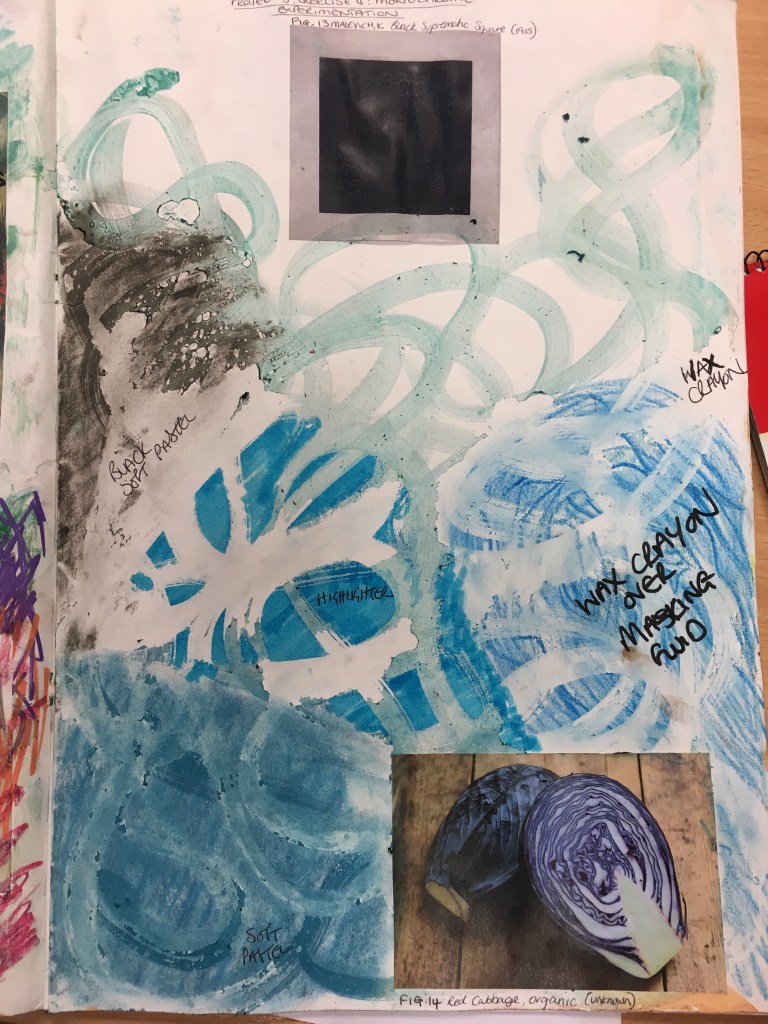
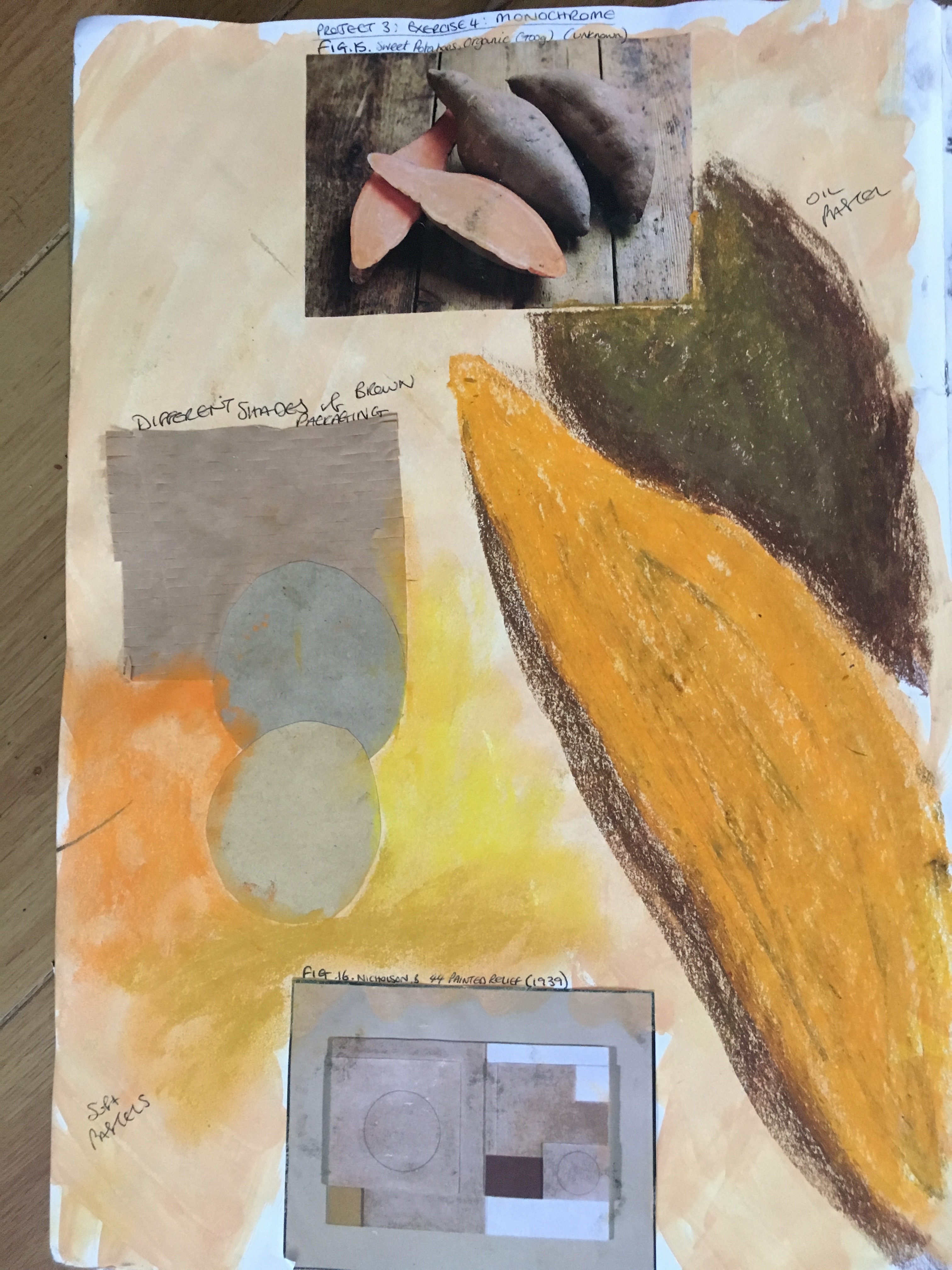
I began this exercise by carrying out some quick experiments in my sketchbook.  I settled on a picture of a red cabbage and some sweet potatoes I had found on the internet as I had struggled to find anything natural in my home which wasn’t alive – it just so happened that at the time I came to do this part of the course, and to prevent me from running out of time, the only option I had was to find an image online to work from. 

Red Cabbage Experiment

I really liked the red cabbage due to the positive and negative space it seemed to include in the veins of purples and whites, so I decided to experiment with the masking fluid again, using some wax crayons, a blue highlighter, black soft pastel and a blue soft pastel. Whilst the vegetable is actually purple in colour, I settled on blue due to the blue shade of the masking fluid. I then removed the masking fluid from several areas of the piece, but decided to leave a part of it without any additional colours, as this in itself represented the purple of the layers of cabbage. I actually really liked the wax crayons as the fluid was easier to remove with this media applied than with most others, however, the colours did blend somewhat, meaning the white was not as contrasting. I also really like the contrast between the highlighter and the white space created by the removal of the masking fluid. This, together with the ‘inverted’ masking fluid, are definitely the best results. I also really like the texture created by the masking fluid and soft pastel. This is definitely something I will consider using going forward.

Sweet Potatoes Experiment

I gave the page a bit of a wash with a skin-coloured ink, which I thought would fall into the ‘brown’ tonal range somewhat and carried out a brief experiment in oil pastels due to their boldness, texture yet ability for smoothness when blended, and also a bit of a collage in the style of the work of an artist I came across whilst carrying out some brief research on this topic (the details for whom can be found at the back of my sketchbook or by clicking here), showing the difference in tones of brown just in the different types of packaging around me. I added some soft pastels in a light yellow, a mustard colour and also in orange to the page to see if this worked at all. I was rather pleased to see it did, however, I do not think this page really meets the brief of ‘monochrome’ due to the variety of colours used.

Final Piece

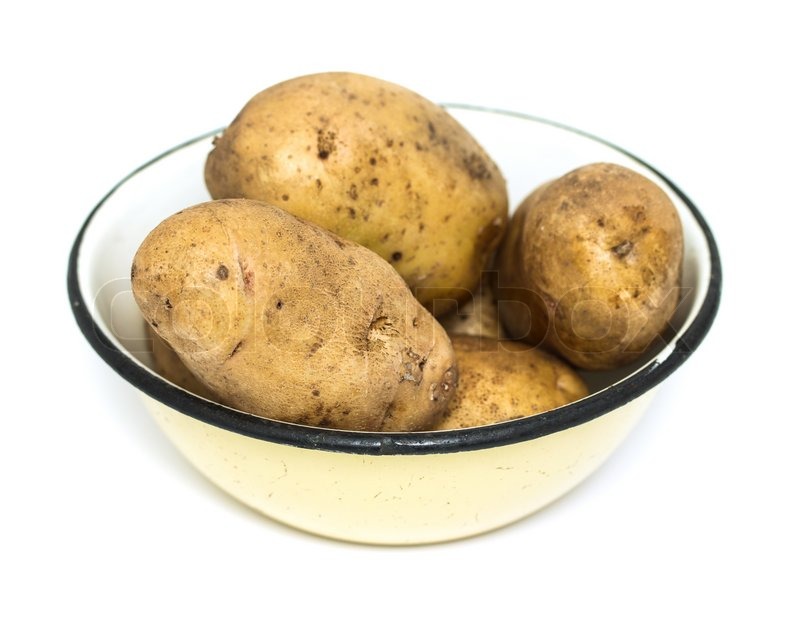
For my final piece, I settled on an image of some potatoes in a bowl.  I chose this image as I really liked the contrast in the textures of the objects, yet how they naturally seemed to link as you would generally eat food from a bowl.  I decided once again to use a grid to assist me with the scaling of the image.  I know this is a little on the ‘cheating’ side, but I have found it much easier to scale my images when working from an image as opposed to a real-life object.  I would have much preferred to work from real-life objects, however, I have just not had the chance to do so for this part.

Fig. 1. Vassilly, P
Raw Potato on the Plate (unknown)

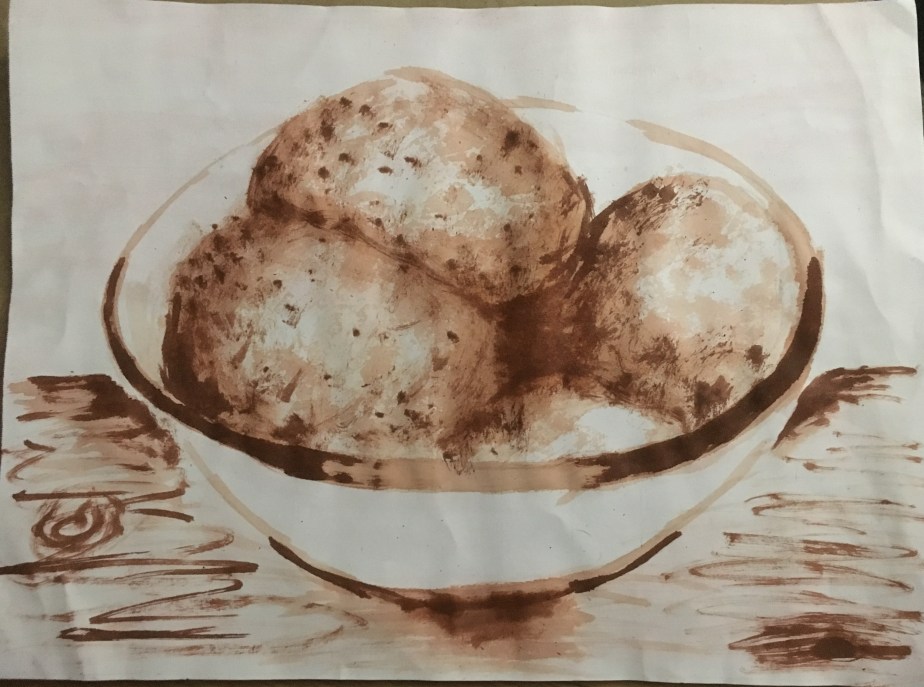
I decided to create this piece in a brown colour, trying to show the difference between the tone and textures using different dilutions of the media chosen, which I finally decided to do my initial base layers in ink and to adapt my method to suit each layer and each object accordingly. 

First couple of layers of ink for the potatoes, bowl and background

Firstly, I carried out an ink wash with only the lightest of ink added to the water.  Once this had dried, I then reduced the amount of water and added more ink to it, which I then applied to the darker areas of the piece to begin building up the layers, trying to leave the lightest parts with just a simple wash of colour.

Next, I reduced the amount of water some more and then added more ink to the mix to deepen the colour. I focussed this layer on the darker areas of the composition and tried to add some of the potatoes’ texture by using a dabbing technique. I also tried to add the smoothness of the bowl’s rim by using one fluid movement with the ink

Finally, I used undiluted ink and dabbed that in places to add the deepest of the darkest areas as well as to create the specs of earth and dirt found on potatoes. Whilst there is no background on the actual photograph of the potatoes, I decided to add one of a wooden surface as I thought the browns would work best with this surface. I looked at my wooden flooring for inspiration and used expressive mark-making to create the grain in the wood. I tried to add in a little shadow where I thought it would naturally fall and think I managed to pull this off successfully.

Final piece: Potatoes in a bowl

Reflection

Overall, I was rather overwhelmed by this exercise and spent a long time – maybe too long – trying to find subject matter I felt suited the brief best. I eventually came across the photograph of the potatoes from the internet and, whilst I would have preferred not to be working from photographs, I thought it was the best I could do in the limited time I had.

I was rather frustrated with myself during this section of the course and became somewhat subdued and disinterested. Once I had actually completed this part of the course, however, I was rather pleased with the result. I believed monochrome to be rather interesting beforehand, but when actually faced with it, found it rather challenging and overwhelming.

I think I have learned that I have to just work on these exercises quickly and without too much worry as to the end result, allowing the end result to form as I move through it.

Whilst my final piece does not 100% replicate the image used, I asked several family members if they could tell what it was meant to be and they all said potatoes in a bowl – even my three year old! Haha! So I thought this rather reassuring. I wasn’t so much bothered about the overall appearance as opposed to the application of the ink to get across the different textures and surface qualities of the piece which I think I managed rather well.

NB: Citation for images used in my sketchbook can be found by clicking here.

List of Illustrations

Fig. 1. Vassilly, P (unknown) Raw Potato on the Plate At:
https://www.colourbox.com/image/raw-potato-on-the-plate-image-8240568 (Accessed on 2 May 2019)

Part Two: Project Four: Research Point: Domestic Interiors

Contemporary Artists and their use of Viewpoints

Each room in a house offers a completely different story.  A lot of people will generally have different colour schemes for each room; blue or yellow in a living room for a cooler atmosphere or red in a bedroom to promote sensuality and romance perhaps.  Furniture also pays a large role in expressing a person’s personality, for instance a student earning a small income may prefer very space-saving furniture, made from lightweight flat-packed material which is easy to manoeuvre, whereas a wealthy middle-aged couple may have rather expensive, heavy and good quality wooden furniture and a leather suite for lounging.

Comparison of Artists

For this part of the course and having a starting point with Anthony Green and Phillip Pearlstein, I decided to do a general online search for other artists whose work has included that of a domestic interior. 

I tried to find artists from several different times in history with different ideas as to how one’s living room should look and below are my findings:

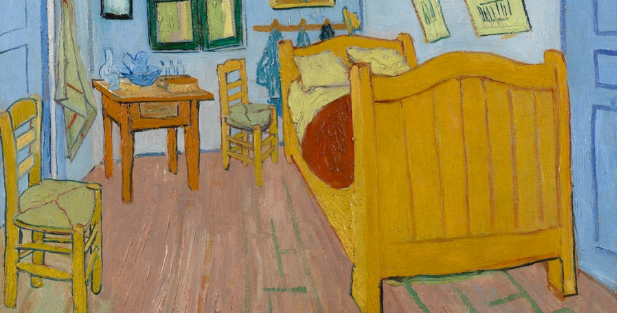
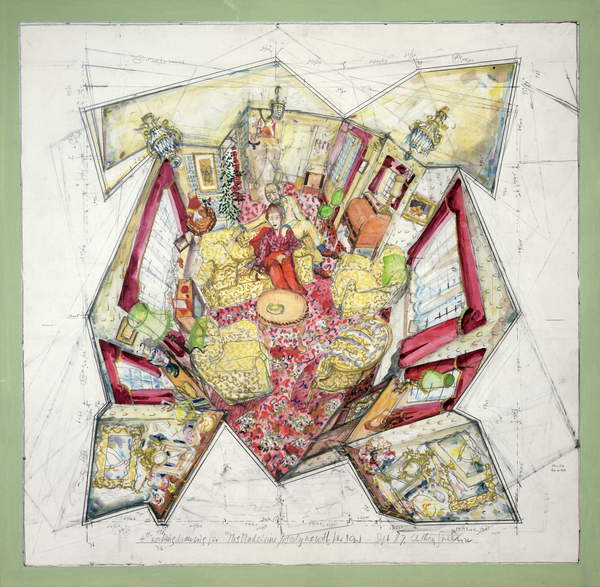
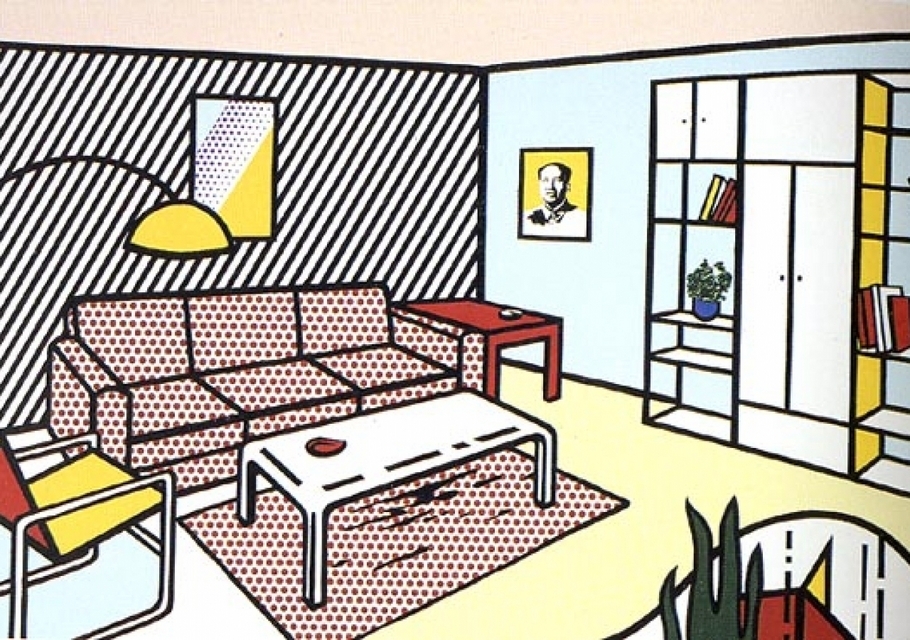
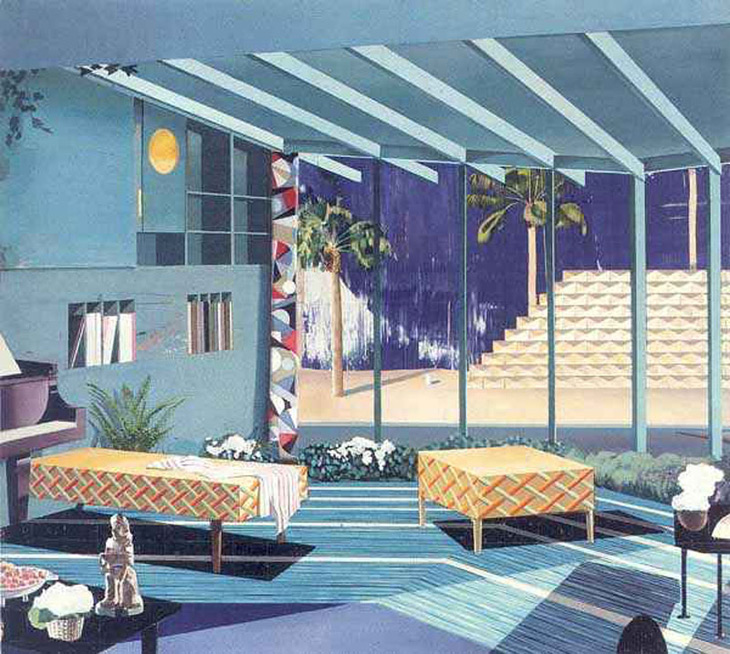
Fig. van Gogh, V The Bedroom (1888) Fig. Green, A Study for Mrs Madeleine Jocelyne with her Son (1987) Fig. Lichtenstein, R Modern Room (1990) Fig. Weischer, M Living Room (2003)
Van Gogh was a Dutch painter during the Post-Impressionism era. Before van Gogh began suffering the effects of his mental health problems, he spent a year in Arles in the south of France.  Van Gogh created this piece during his time in Arles in the Yellow House.  This piece was created by Anthony Green who is a British painter.  Green specialises in creating work focussing on the wealthier middle-class domestic interiors, choosing canvases of peculiar shapes to assist him with his irregular angles and perspectives. Roy Litchtenstein was an American painter during the Pop Art movement.  His work was rather precise in its composition and structure of the piece; however, he would often allow the piece to hold some humour, easing the formality somewhat. Matthias Weischer is a German painter whose work is very architectural and precise in nature, however, similar to Lichtenstein, Weischer inserts touches of the abstract into his pieces to blur the lines between real and imaginary.
This piece shows a bedroom in a relatively modest looking building.  Van Gogh removed the majority of the furniture from the room, repositioning that which he thought suitable for his composition, including pieces of his own work on the walls above the bed.  The view of this room appears to be at the eye level of a child – perhaps van Gogh had settled himself on the floor in the corner of the room to be able to create this piece and allowing the biggest view possible.  The light from the window and the shades of blue on the walls lead me to think the piece was created either in the early morning or early evening. This piece is an aerial view of Mrs Jocelyne’s living room and surrounding rooms.  The piece appears to have a fish eye view of the room, however, is very angular as opposed to round.  The perspective of this piece appears to be from that a fly on the ceiling.  I can only imagine Green used a pair of ladders to be able to achieve this angle.  Looking at the shades of the colours used and the whiteness of the windows, I believe the piece was created during the day time. The layout of the living room in this piece consists of a sofa, a couple of tables, a chair, a mat and a bookshelf.  Lichtenstein has used solid blocks of colours, line and dots to show different planes, directions and depth of the objects within the piece.  The perspective of this piece appears to be from that of an adult entering the room – perhaps after finishing work for the day?  It would appear to be daylight as the colours are very light and airy.  This piece shows a darker, cooler mood than the rest and allows a glimpse at the outside world as well.  The image consists of what appear to be a piano and a couple of tables just making it into the viewpoint of the piece, a stool and what would appear to be a bed, but considering the title of the piece, I can only assume it is a bench.  There appears to be a bit of a flowerbed inside the building, in front of the window and several plant pots.  In the background, there appears to be something resembling half of a pyramid and two palm trees.  There also appears to be a wave or tip of an iceberg.  This could also be an indication of rain or clouds.  Finally, there are some filled and also some empty bookshelves.  It is rather strange that the room shows a very cold interior and a hot exterior, yet the sun is inside.  I think this plays on the fact that the image appears to have been created in the late evening, when the sun would be on its path to setting.  The windows appear to continue around the end of the piece, so perhaps the sun on the cupboard door is actually the reflection of the sun in a mirror?
This piece also creates a sense of comfort and relaxation.  However, I also feel slightly unsteady and unbalanced due to the inward leaning of the objects.  It feels as though the room is slowly folding inwards on itself.  The atmosphere of this piece invites a feeling of warmth in the sofa, yet it is also slightly uncomfortable with the sharp edges to the piece. Due to the sparsity of details in this piece beyond lines and dots, as well as the straight lines throughout, this piece is very uncomfortable and clinical, almost as though the room was a waiting room in a dentist practice.  This room, due to the use of blue, feels very cold indeed.  It almost appears to represent ice, especially with the jagged downward slope to the floor.  Even the flowers look familiar to snow.  I find it surprising that there appears to be what looks like a sun on one of the cupboard doors. 
The colours in this piece are very mixed.  The furniture uses warm yellows and reds whereas the actual walls of the room are very cold.  Again, there is only a small touch of green in this piece and it is not the main point of emphasis.  Whilst at first glance this image appears rather accurate, when you look closer you can see there are flaws to the structure of the room and the objects, showing a rather well masked contortion of the angles in the piece.  There are only a few objects in this room and the detailing to the objects in the piece is greatly reduced. This piece uses many strange angles but is very obvious about this, where as the other pieces seem to mask them somewhat.  The colours in this piece are very warm, using red and yellows with only a hint of green or blue in places.  This piece has a lot of visual information both in the amount of objects, their details and the amounts of rooms. The colours used in the piece vary between muted on the walls and floor and bold in the stripes, spots, chair and side table.  The colours are also mostly primary, except for the plant in the bottom right of the image.  Again, the incorrect angles in this piece are well masked as the piece appears rather accurate upon first glance. Whilst this piece has a lot of objects in it, the details in are very limited. Similar to Green’s piece, this has quite a lot of visual information, however, the details to the objects are rather limited.  The angles in this piece all appear to be accurate, however, the objects and angles all appear to be placed cleverly to create the appearance of jagged angles.  The bulk of the piece appears to have been created in cold colours, with only hints of warmer colours in places, such as the sun, the stool and bench.
In this piece, the eye is initially drawn to the bold coloured bedding on the bed.  It then becomes apparent that the angles of the room all appear to be leaning inwards, as though the room were collapsing inwards.  It almost feels that this piece is a delusion; perhaps van Gogh created this piece to represent a mental prison he had created for himself which was slowly imploding or caving in on him or which he felt he was in prior to his mental breakdown.  It is this leaning which leads me to believe it is van Gogh’s way of being expressive in this piece. Initially, your eye is drawn to the person in red in this piece, who appears to be Mrs Jocelyne.  The person behind Mrs Jocelyne is less distinct initially due to the colours blending with the background.  From there, the eye is pulled downwards towards the curtains on both sides.  All of the angles and sections jutting out in every direction pulls your eye in every direction, but there is visual information to be found in each one.  This piece is the only one to contain any actual people who appear very close.  The lady is sat in the forefront, very prim and proper and bold in colouring.  The male is slouching across the back of the sofa almost as a child would and is very muted in colouring, showing he is not the main focus of the piece but merely a supporting role.  This piece is rather chaotic but is very expressive with the amount of detail it contains and the almost magical qualities of the hidden rooms attached. The first thing I noticed about this piece was the face in the picture which appears to be looking towards the left-hand wall which has diagonal lines leading downwards to the spots of the sofa, which both contrast each other greatly and help show the difference in depth to the objects.  This piece shows a photograph on the wall of an Asian male and reminds me of a dictator of some sort, which I feel is totally at odds with the character of the piece itself.  This piece appears very computer-generated and very cartoon-like, however, there is still some expression to the piece in the humour it seems to contain within the inclusion of the photograph and contrast between the lines and dots. This piece is very linear and angular throughout, so your eye is pulled in several directions purely from the objects themselves.  Even the curtains appear to have a zigzagging motion working through them.  The triangles in the semi-pyramid are placed cleverly to give the appearance of steps.  The crosshatching in the stool and bench are very clever in that they create depth to the objects and show which way they are moving.  This piece also has a few little additions which add a bit of expression to it; the sun and the almost real-looking statue on the table, again, adding a slight touch of humour to the piece.
The success of this piece is the scaling of the flooring and the realism to the floor boards.  I think the green to the floorboards is slightly off, but it does offer a good contrast.  Overall, I really like the use of the jagged angles within this piece and the quantity of visual information it holds.  I feel I can look at it again and again and still find things I didn’t see before, which keeps it really interesting.  However, I feel the amount of visual information is also a slight failure to the piece as it tires me to look at it for too long due to my eyes being pulled in every direction and causing confusion and frustration.  It also makes me feel somewhat erratic and stressed. Overall, I really like the spots and stripes to the piece and how the table looks very plastic, however, I do think the angles of the chair, sofa and table are all somewhat skewed. I really like how the artist has made the glass visible in some of the windows but there is a bit of a lack of this detail in the remaining panes.  I also think the lack of detail to the white flowers is slightly disappointing since there is detail, even if only simply, to everything else in the piece.
For this piece, I would use oil pastels due to their bold colours and expressive qualities. If I were to recreate this piece, I would use pencil crayons as I feel this would be the best to recreate the fine details. I think markers would be best to use to recreate this piece due to their solid and bold colouring.  I also think they would be the best medium to create a cartoon-like finish to the piece. For this piece I think either markers or ink would be best.  The markers would have the bold colours and control to the movements, but the ink would be able to flow better.

Own Interpretation of Artists’ Works

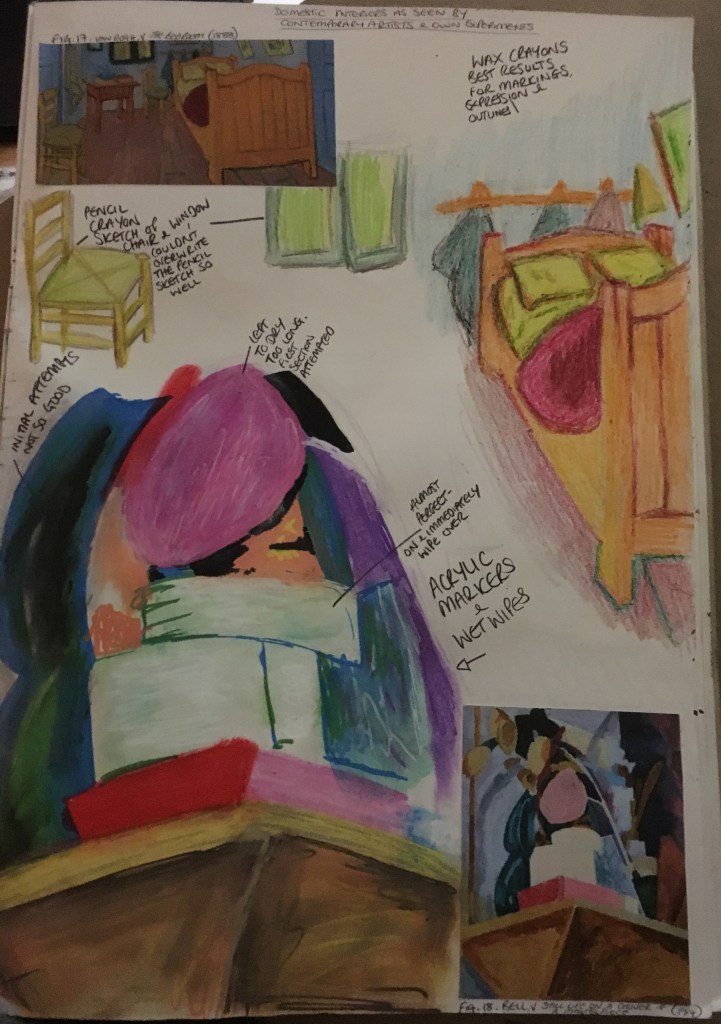
Firstly, I decided to take certain elements of van Gogh’s The Bedroom (1888) piece, using wax crayons and pencil crayons to assist me. I was rather surprised at the use of very contrasting colours used for outlines (around the base of the bed / wooden floor and the bed frame itself. More-so, I was somewhat excited to see the results and colours I could use to try and replicate the objects. It is funny as I have always just quickly glanced at the piece and seen an orange bed, a red duvet, a green and yellow chair etc, but can actually see now that van Gogh includes multiple colours in just the smallest of sections which build up to appear as a whole of one solid colour.

I then moved on to Bell’s Still Life on Corner of a Mantlepiece (1914) and tried to replicate this somewhat. I couldn’t make out what the objects were meant to be, but presumed they were separate objects all stacked on top of each other. I decided to experiment with the acrylic pens for this part and to thin the colours by using a wash over them. I started over to the left-hand side and was rather disappointed with the results, but altered my method and by the time I came to the objects I can only describe as two white cakes, I had mastered the technique as well as possible. I really like the simplicity of the objects in this piece as they remind me somewhat of Morandi’s work.

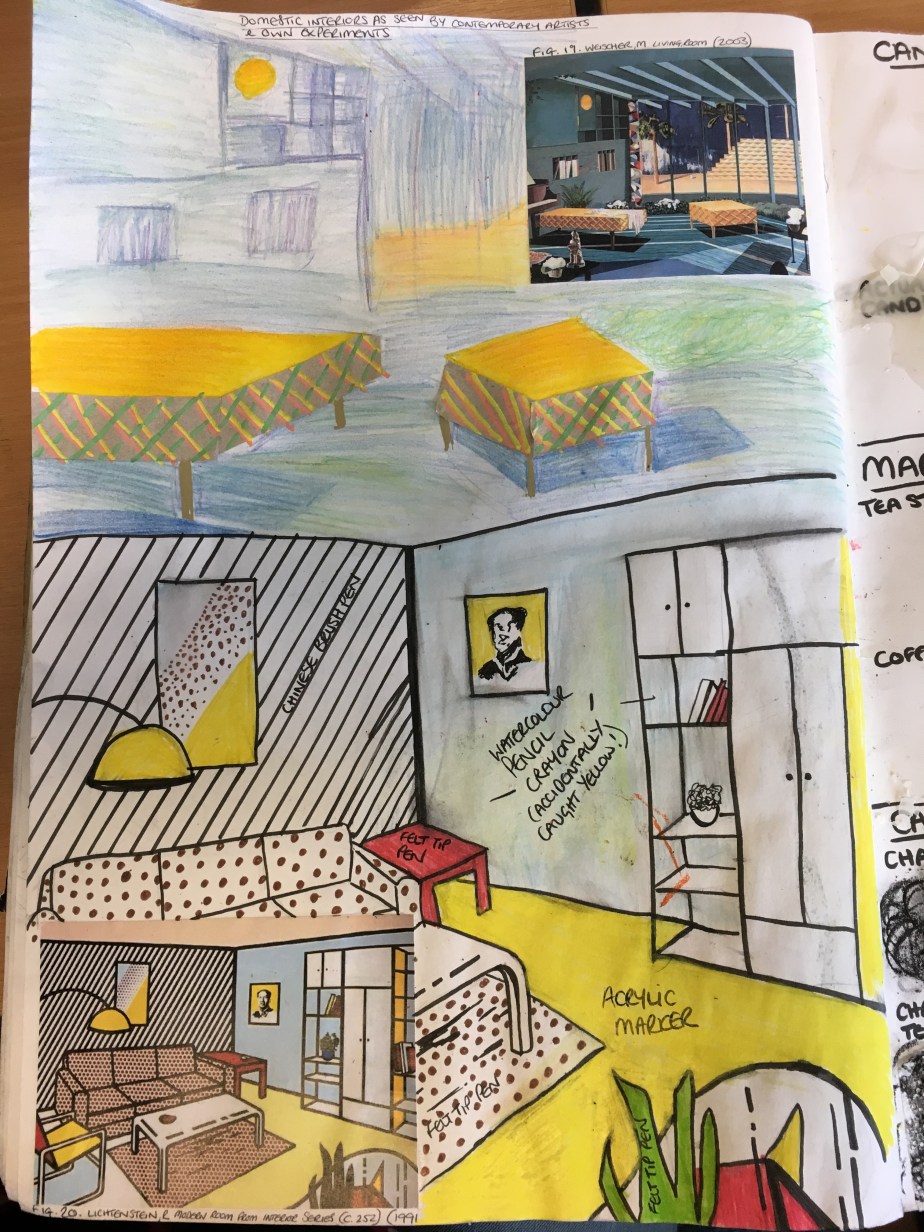
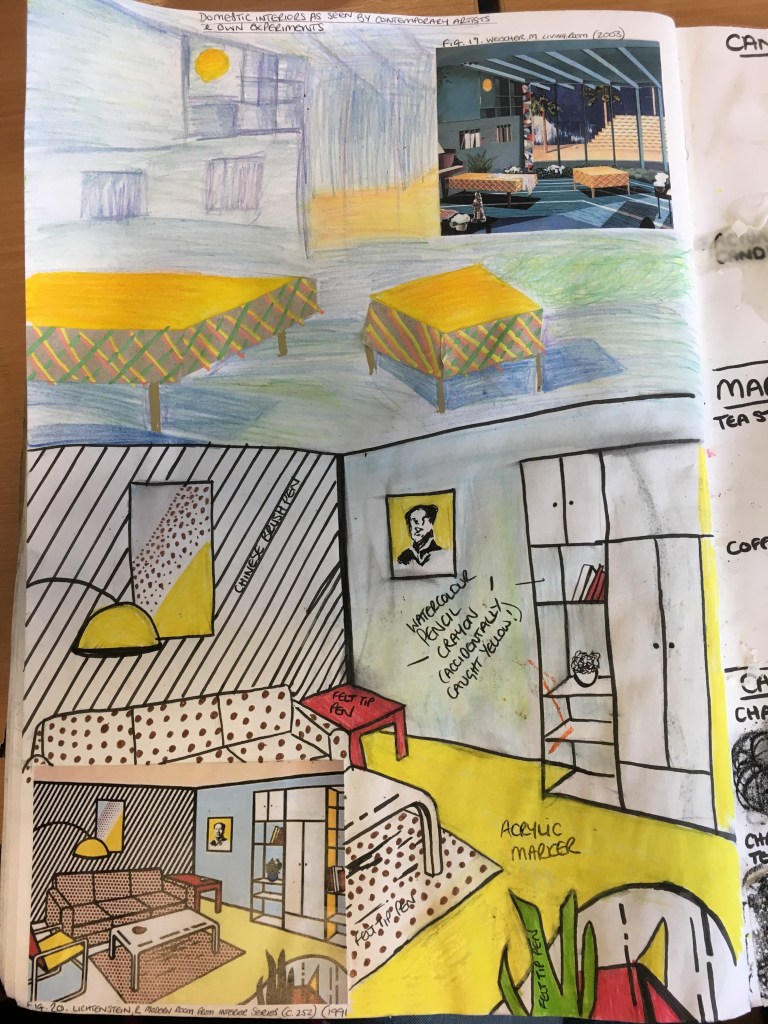
Next, I turned to Weischer’s Living Room (2003). To look at, I rather liked this piece with its jagged angles and cool colouring, but to try and recreate I was rather disappointed. I chose pencil crayons to create the walls and flooring, felt tip pens for the sun and table tops and, finally, a bit of brown packaging with some acrylic pens for the sides of the tables.

Finally, I chose to recreate Litchenstein’s Modern Room from Interior Series (1991). Whilst I initially didn’t like the piece all that much due to its cartoon-like appearance, I found this the most exciting to recreate, I worked in acrylic pens, felt tip pens, chinese brush pens and watercolour pencils. I was pleased with the result of this the most.

Reflection

Having looked at the several different artists’s styles and methods used to create their pieces, I think I have a much better understanding of what helps make a good piece as well as the abilities mixing several contrasting colours together can have when trying to create just the appearance of one solid colour.

NB: Citation for images used in my sketchbook can be found by clicking here.

List of Illustrations

Fig. 1. van Gogh, V (1888) The Bedroom [oil on canvas] At: https://www.vangoghmuseum.nl/en/collection/s0047V1962?v=1 (Accessed on 18 March 2019)

Fig. 2. Green, A (1987) Study for Mrs Madeleine Joscelyne with her son [watercolour, oil, pastel and pencil on paper] At: https://www.bridgemaneducation.com/en/asset/308025/summary?context=%7B%22route%22%3A%22assets_search%22%2C%22routeParameters%22%3A%7B%22_format%22%3A%22html%22%2C%22_locale%22%3A%22en%22%2C%22filter_text%22%3A%22anthony+green%22%7D%7D (Accessed on 18 March 2019)

Fig. 3. Lichtenstein, R (1990) Modern Room from Interior Series (C. 252) [Lithograph, woodcut and screenprint on museum board] At: https://www.artsy.net/artwork/roy-lichtenstein-modern-room-1 (Accessed on 18 March 2019)

Fig. 4. Weischer, M (2003) Living Room [Oil on canvas] At: https://www.saatchigallery.com/artists/artpages/weischer_living_room.htm (Accessed on 18 March 2019)

Bibliography

ArtUK (unknown) ‘Anthony Green’ in ArtUK.org [online] At:
https://artuk.org/discover/artists/green-anthony-b-1939 (Accessed on 11 April 2019)

Artic (unknown) ‘Van Gogh’s Bedrooms: About the Paintings’ In: Artic.edu [online] At: http://archive.artic.edu/van-gogh-bedrooms/about-paintings (Accessed on 18 March 2019)

Artsy.net (unknown) ‘Roy Lichtenstein’ In: Artsy.net  [online] At: https://www.artsy.net/artwork/roy-lichtenstein-modern-room-1 (Accessed on 18 March 2019)

Artsy.net (2013) ‘Modern Room, from Interior Series (C. 252)’ In: Artsy.net [online] At: https://www.artsy.net/artwork/roy-lichtenstein-modern-room-1 (Accessed on 18 March 2019)

Royal Academy (unknown) ‘Anthony Green RA’ In RoyalAcademy.org.uk [online] At:https://www.royalacademy.org.uk/art-artists/name/anthony-green-ra (Accessed on 10 April 2019)

Saatchi Gallery (unknown) ‘Matthias Weischer: Living Room’ In: Saatchi Gallery.com [online] At: https://www.saatchigallery.com/artists/artpages/weischer_living_room.htm (Accessed on 18 March 2019)

Van Gogh Museum (unknown) ‘The Bedroom’ In: van Gogh Museum [online] At: https://www.vangoghmuseum.nl/en/collection/s0047V1962?v=1 (Accessed on 18 March 2019)

Wikipedia (2019) ‘Matthias Weischer’ In Wikipedia.org [Online] At: https://en.wikipedia.org/wiki/Matthias_Weischer (Accessed on 10 April 2019)

Wikipedia (2019) ‘Roy Lichtenstein’ In Wikipedia.org [Online] At: https://en.wikipedia.org/wiki/Roy_Lichtenstein (Accessed on 10 April 2019)

Part Two: Project Four: Exercise Two: Composition – an Interior

For this piece, I decided to work solely in my sketchbook and use the exercise as the preliminary work to the next exercise / my assignment piece.

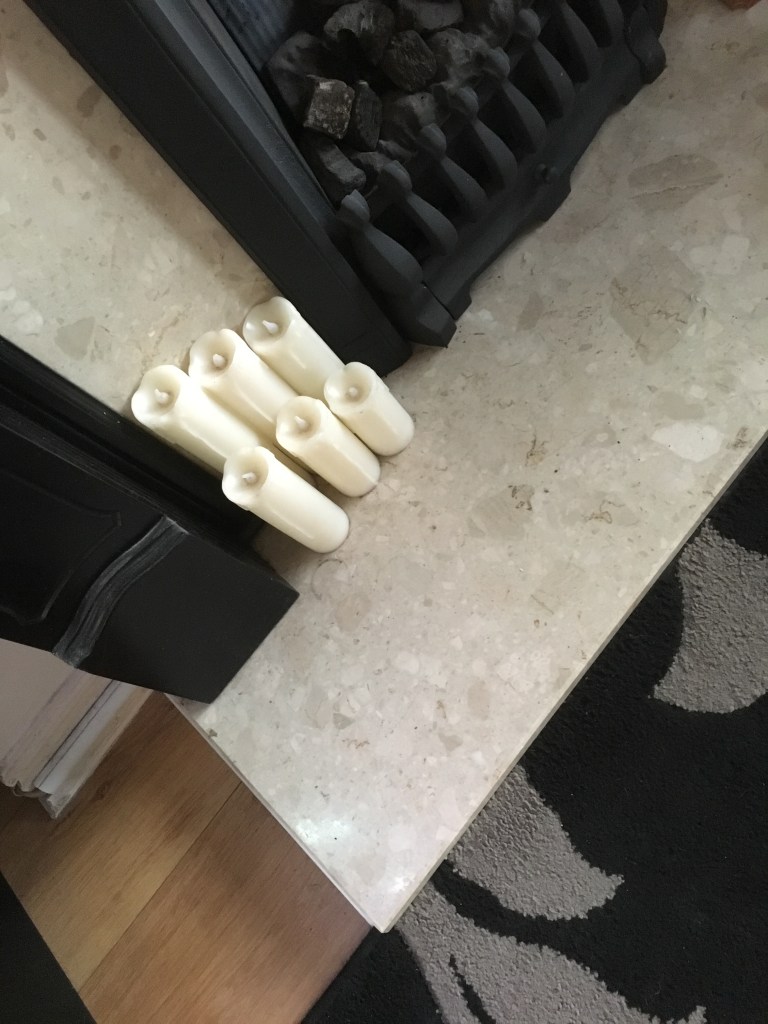
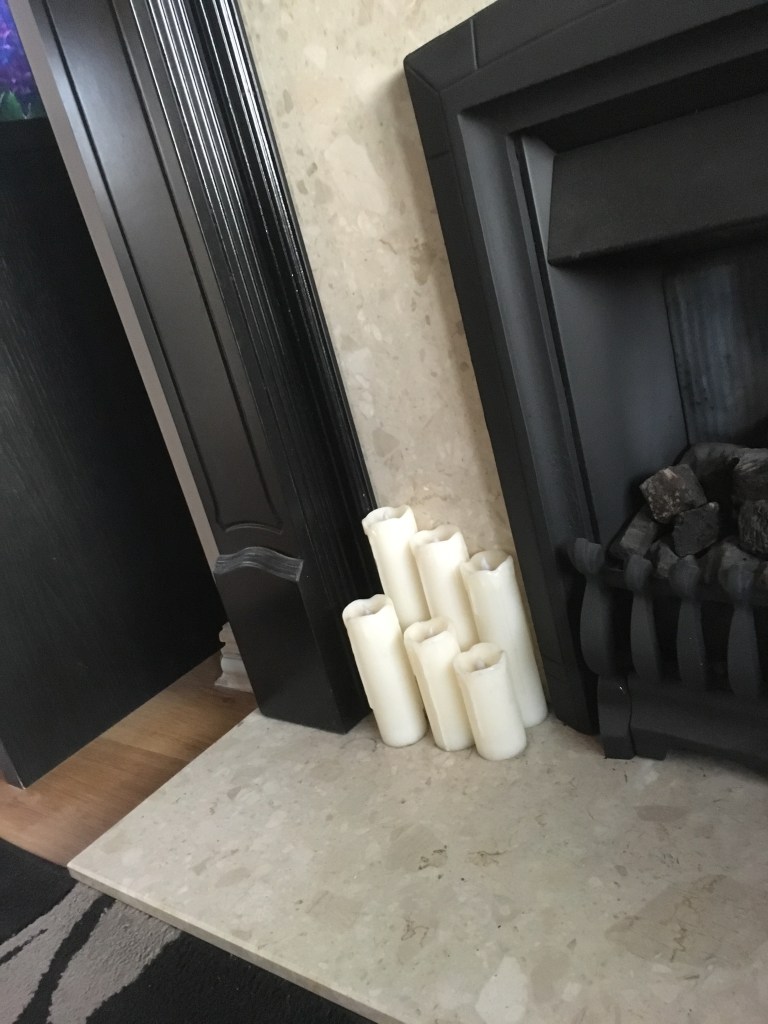
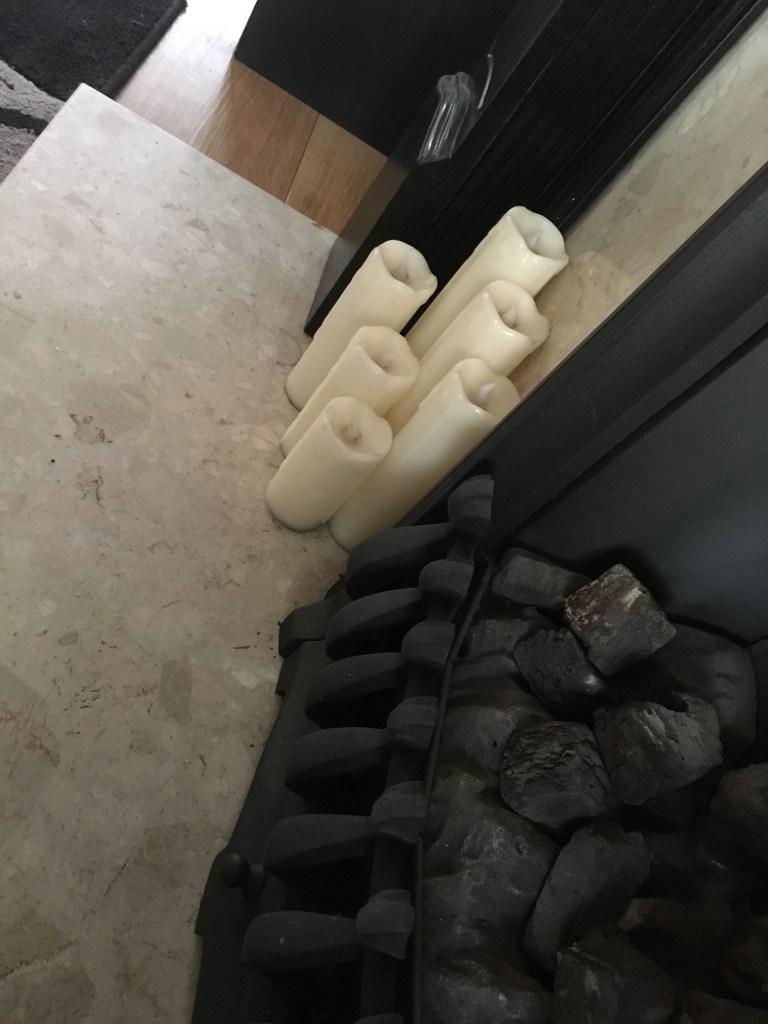
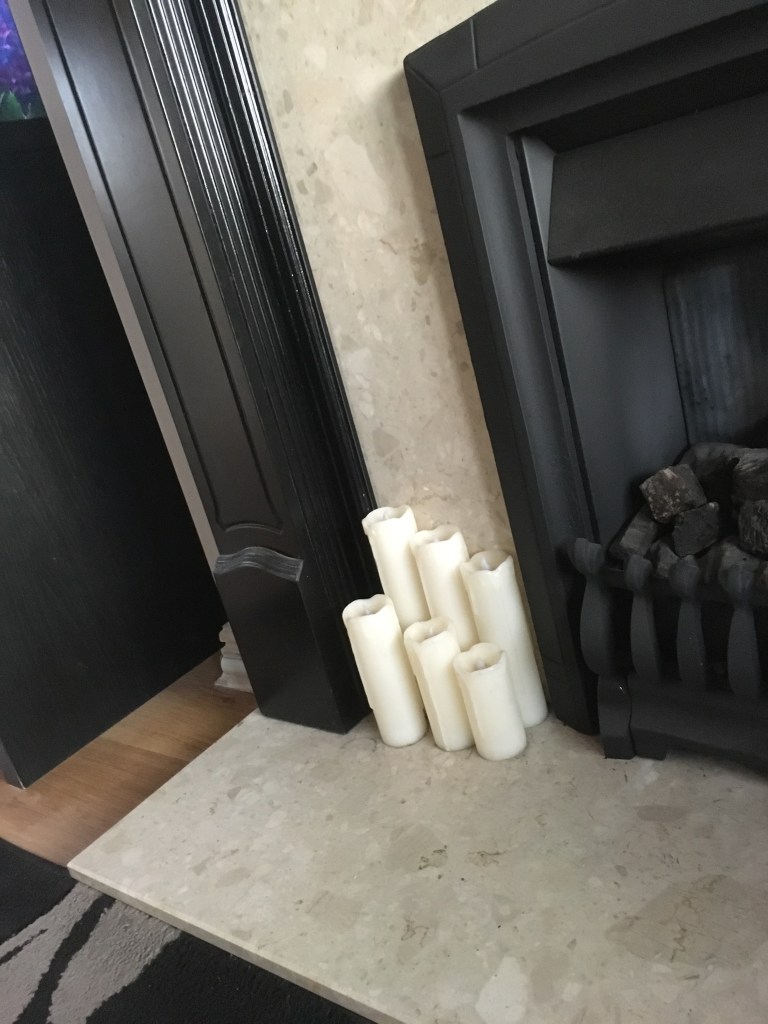
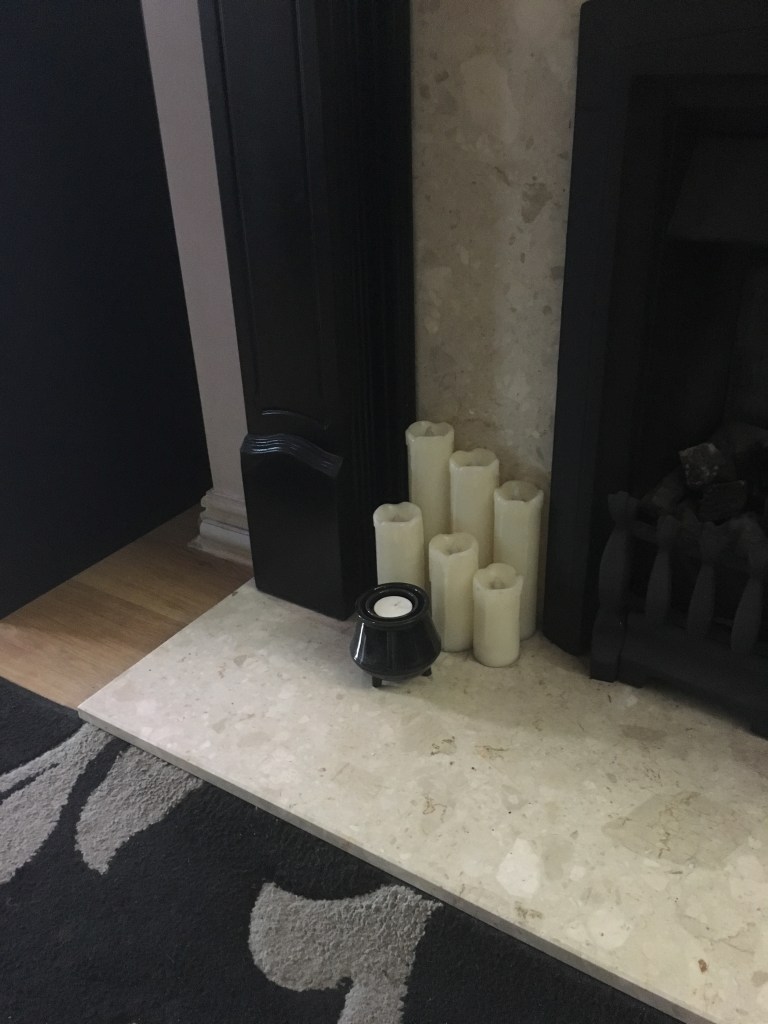
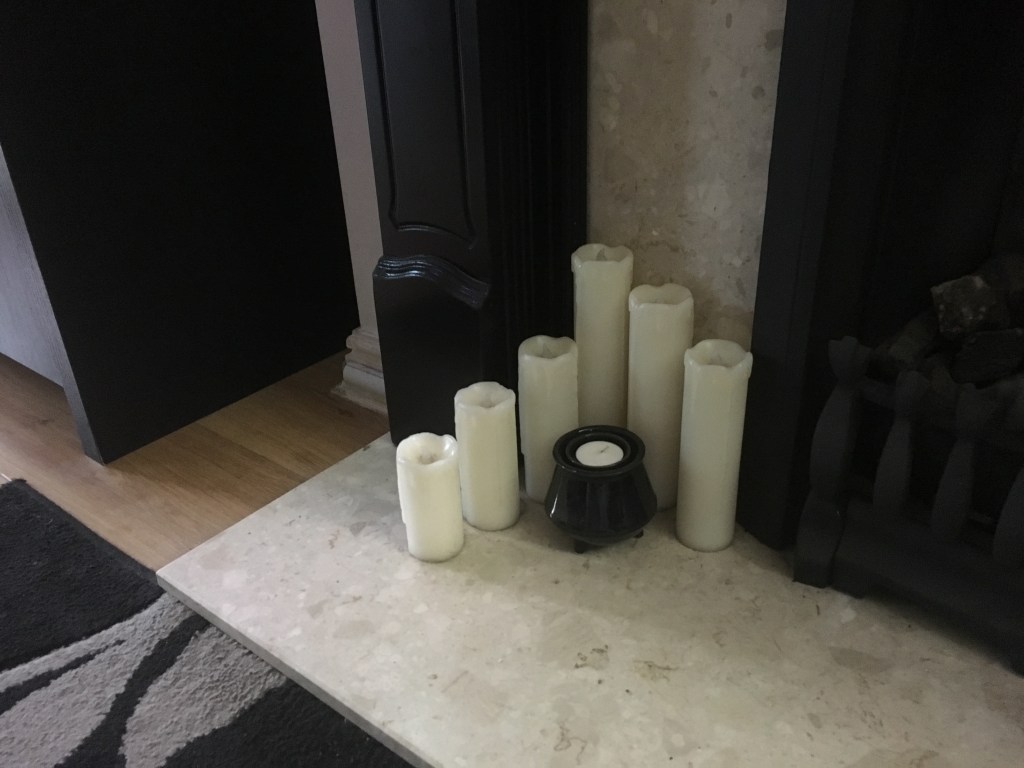
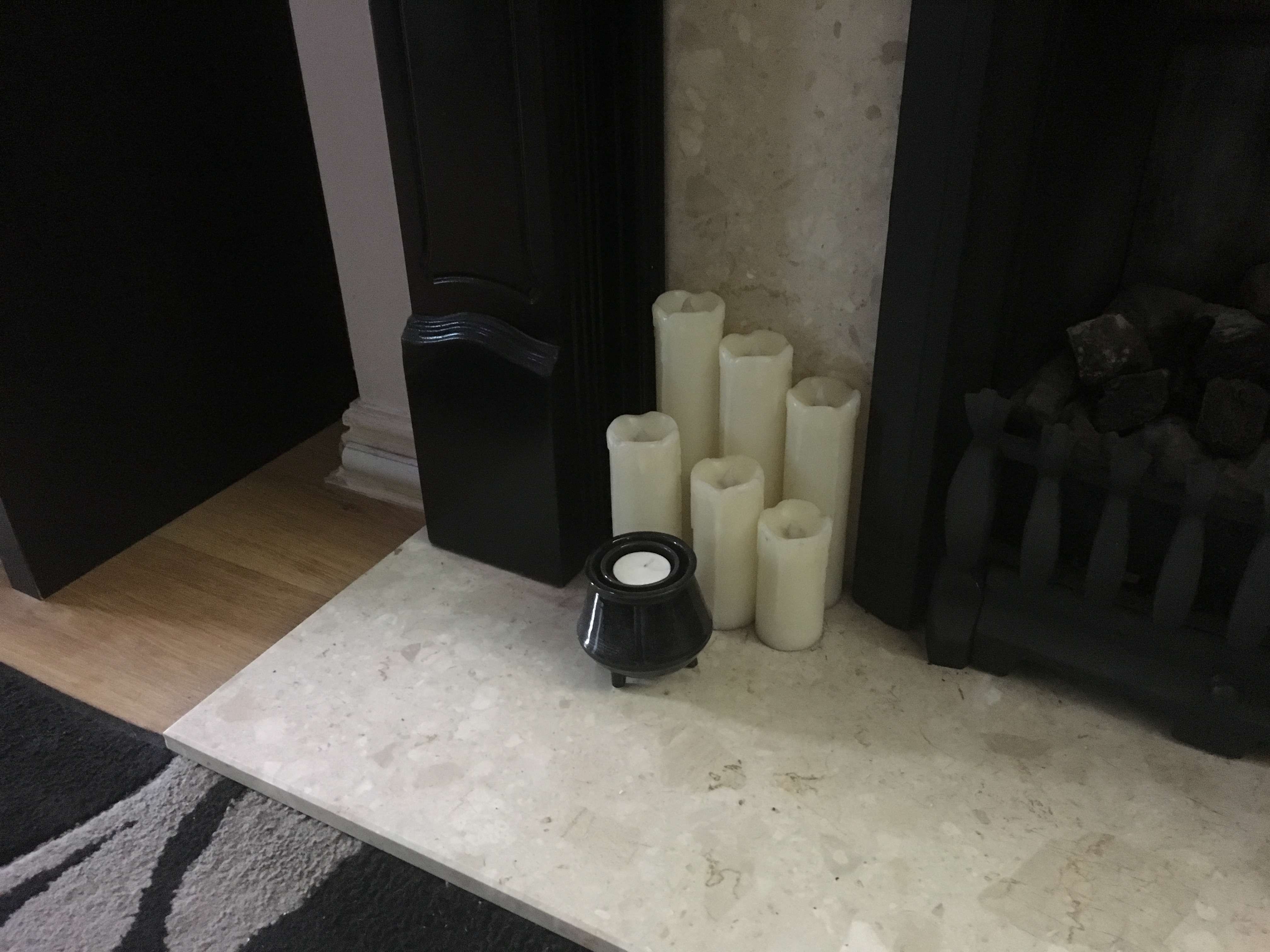
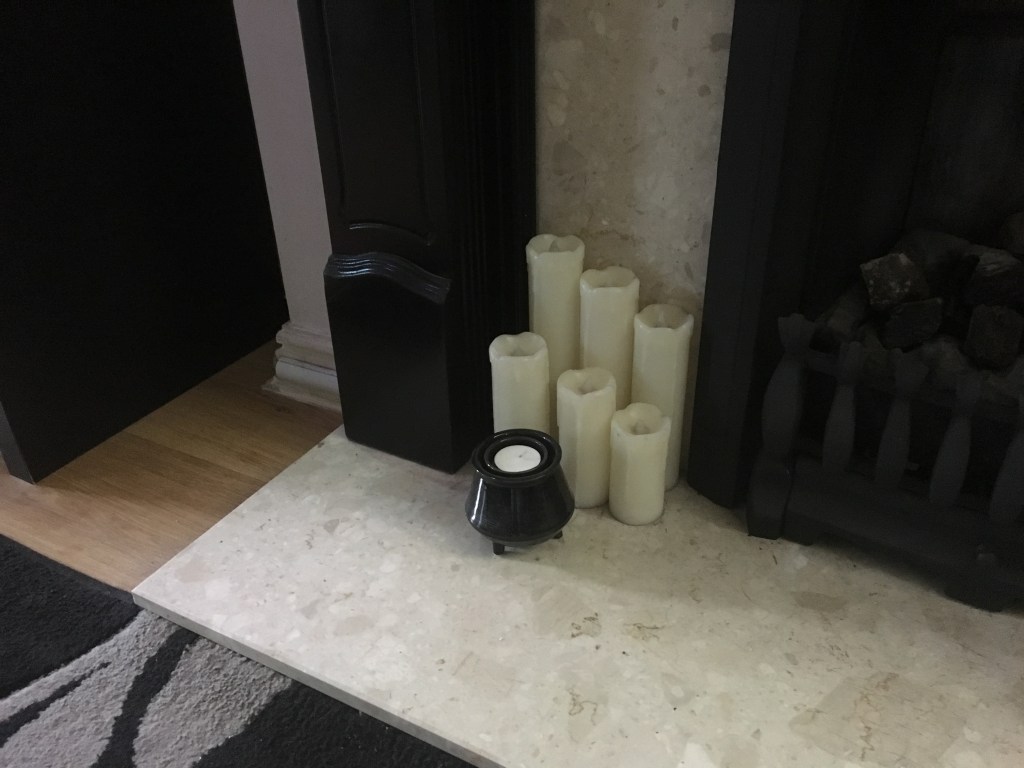
After the previous exercise, I had found a fair few areas of my home which were interesting but, wanting to incorporate both still life and the domestic interiors within my next piece, I decided to work on a section of my fireplace.  I chose this section to look at as it included an arrangement of candles, the metal fireplace, charcoal on the fireplace, a marble-effect surround, some of the black wood of my fish tank, the plaster on the walls, the laminate flooring and also my rug, so an abundance of textures, positive and negative spaces and contrasting colours (my whole house is black and white, so there is a real lack of any colour to be found!).

Angles, Viewpoints, Composition and Perspectives

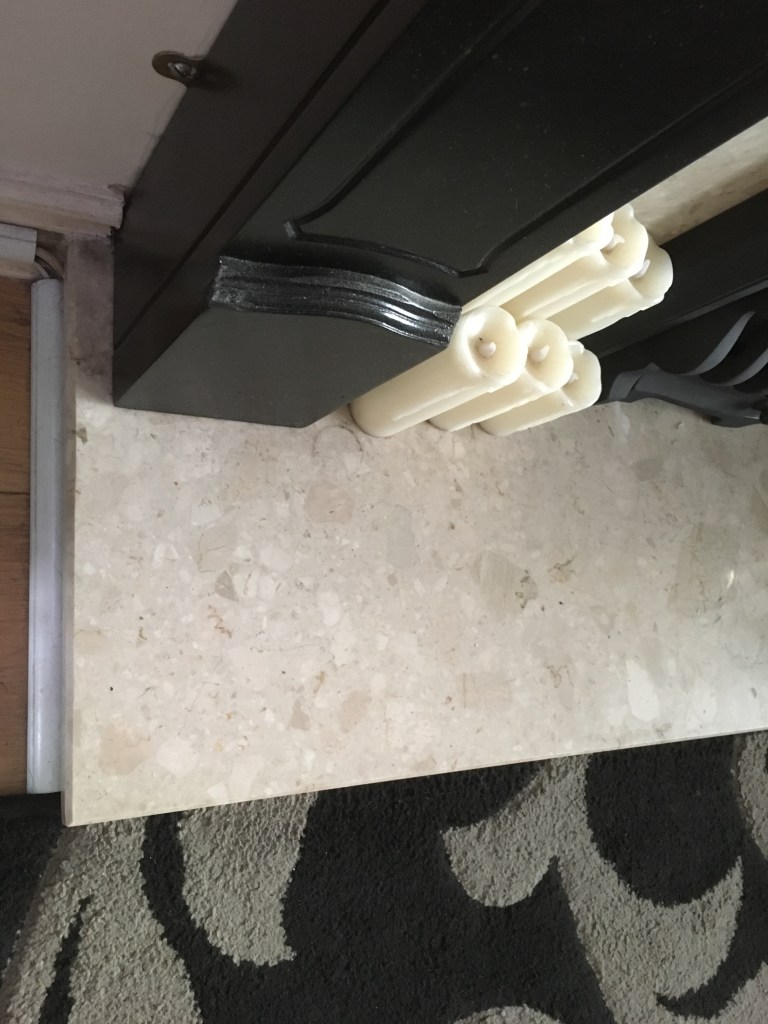
Before I started properly, I decided to take some pictures from different angles, viewpoints and perspectives, as well as messing about with the composition. I did this by moving around, but I also took photographs to be able to look back on and for others to see what I was seeing too.

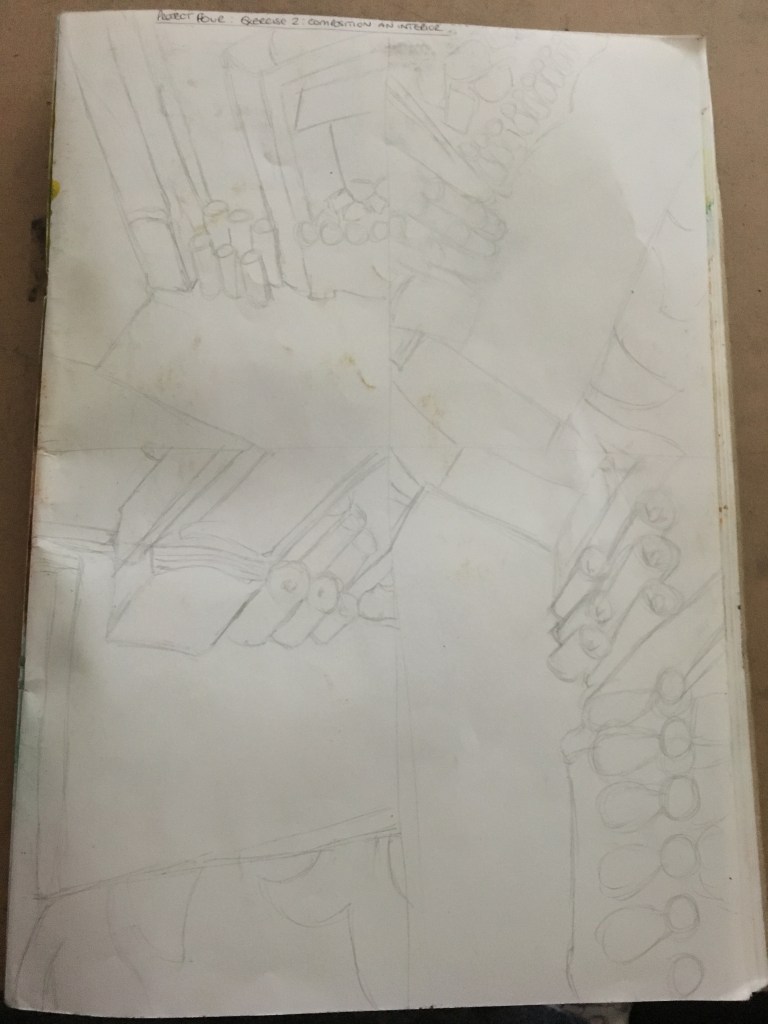
I began by doing four sketches from different angles on a page in my sketchbook.  I did two angles in portrait and two in landscape, trying to vary the angle by standing and sitting, being closer and viewing from a distance. 

Going back to the exercise where I worked solely in line, I stayed just with the Chinese brush pens and merely used a thicker nib to show the darkest areas of shade (excluding the actual black of the fish tank etc) for future reference.  I also took photographs of the area just in case I did not finish in time and the shading had changed any, but also for reference for my tutor etc. 

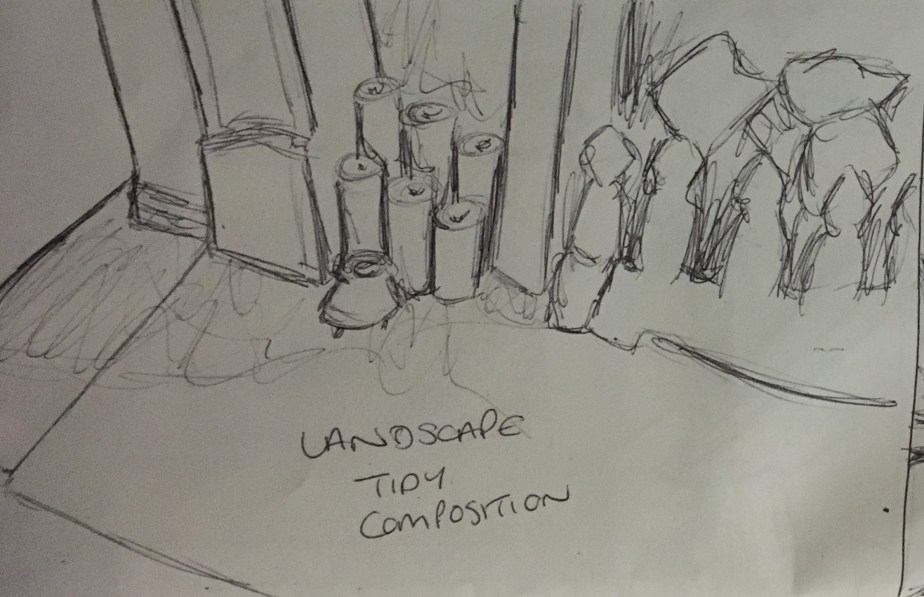
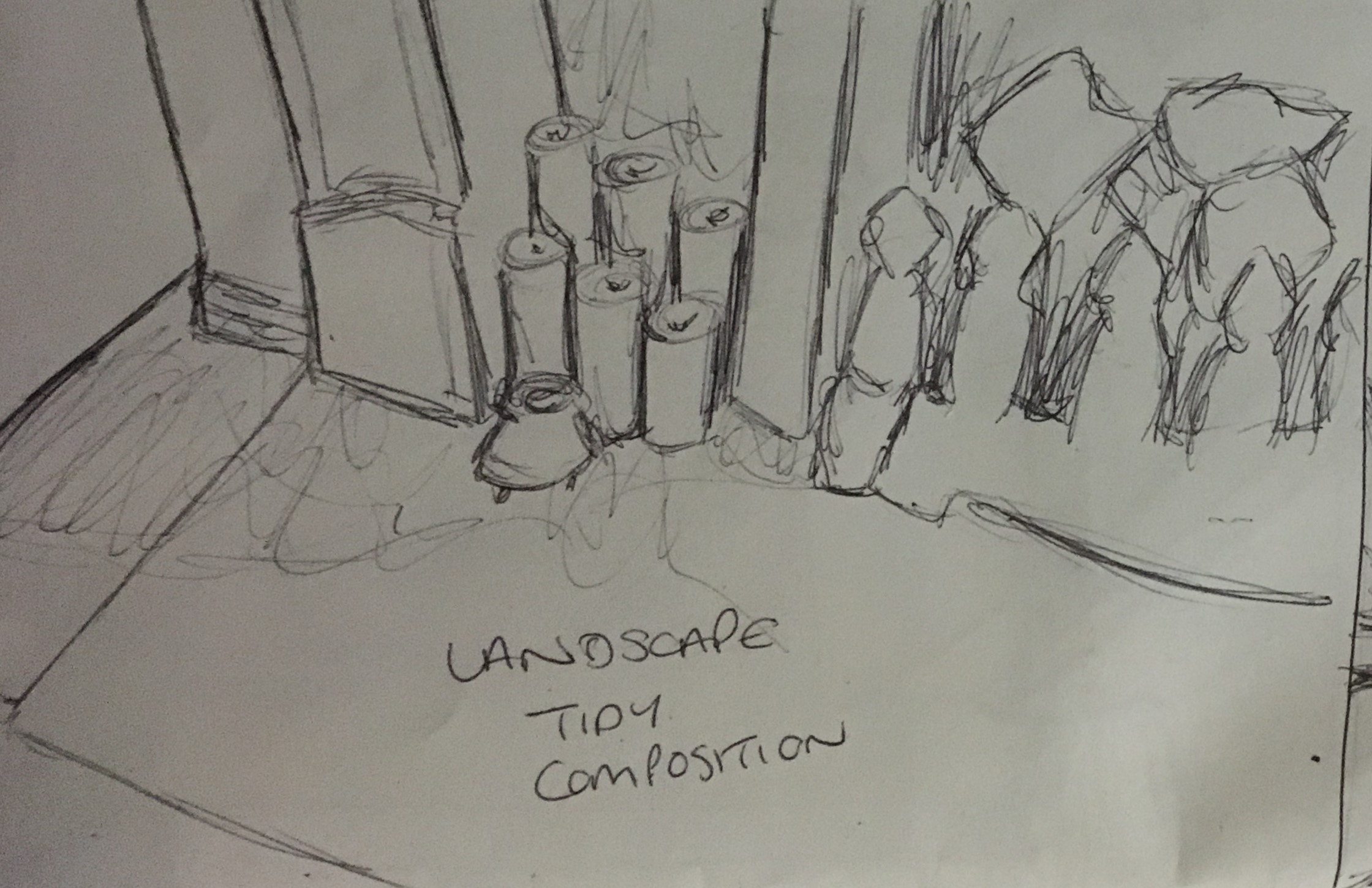
Next, I moved on to sketching in biro and mixing the composition up somewhat; I moved some of the candles into a different position and added a tealight holder.  Again, I created two sketches in portrait and two in landscape with both what I called ‘messy’ and ‘tidy’ compositions. For these sketches, I again stayed mostly in line, but indicated a little of the shadows’ directions and placements in some areas.

Choosing a View

I decided my favourite of the eight sketches I had done was the ‘tidy’ landscape composition created in biro.  I chose this as I felt it had the best level of intimacy – I confess, I did not actually understand this sentence in the course textbook until I came to this exercise but now I can see just how much better a landscape composition can be in certain situations; allowing a closer view of details within the piece, but also allowing for more of the surrounding areas to be included in the piece.

Reflection

Going back to my research of composition, I especially liked how the lines in the composition of this sketch lead off the page and lead the eye in a ‘c’ shape from the marble / rug and around the candles and fireplace and back off the page. I also like how the vertical lines lead the eye upwards, as do the candles and spokes on the fireplace.

Going back to the Rule of Thirds within my research, I think I have done well in this sketch with placing the majority of detail within the upper horizontal section of the composition also.

I was very surprised to find that, whilst my home and furnishings are all mostly squared or have sharp, straight lines which are placed rather parallel to each other, depending on the position in which I was standing, there was a great element of foreshortening within my pieces, which I was not quite expecting! I tried to work with them as best I could and think I have done quite a good job, but do think this is something I will continue to practice and improve on, as well as scaling my objects, their depths and their placements better.

I am looking forward to the next exercise and feel much better prepared for it now than when I had previously glanced over it briefly. 

Part Two: Project Four: Exercise One: Quick Sketches Around the House

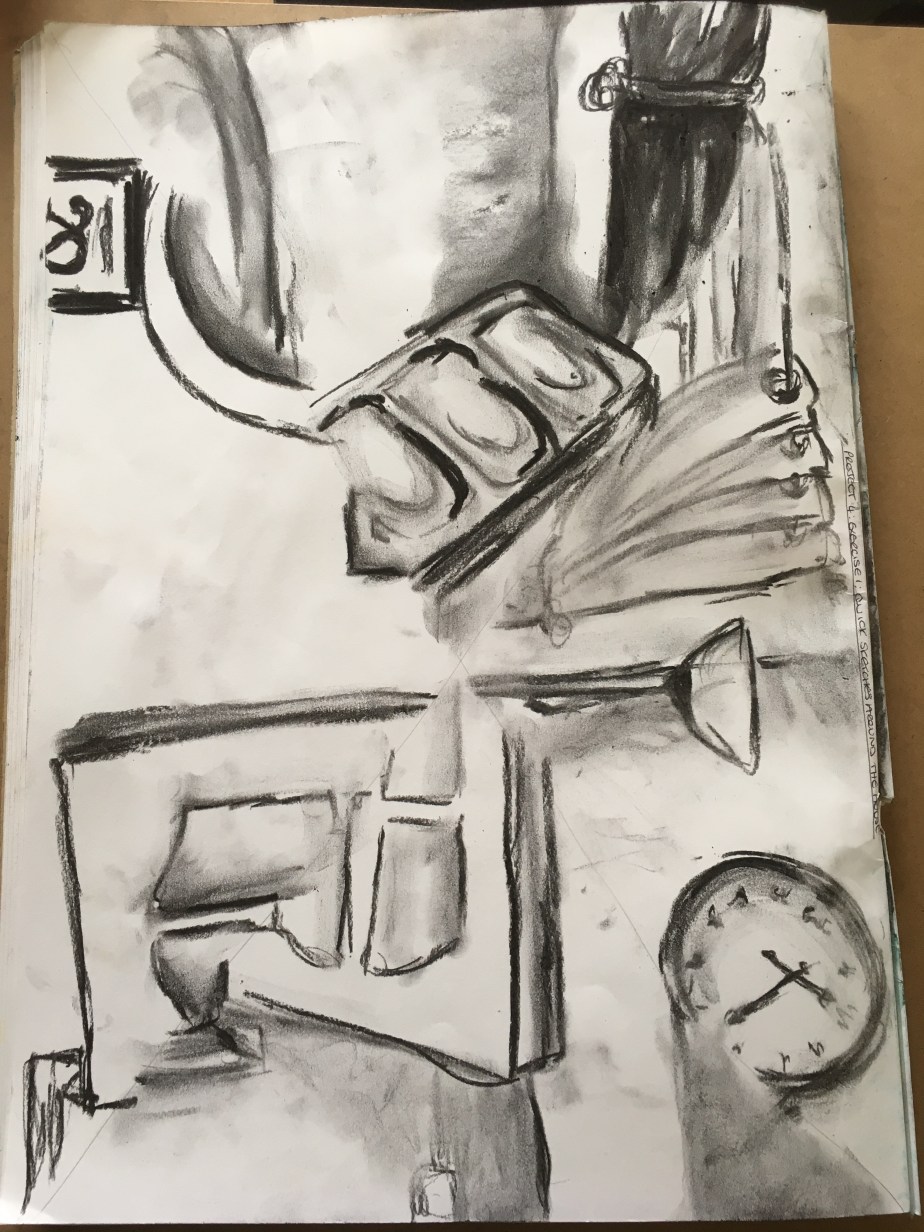
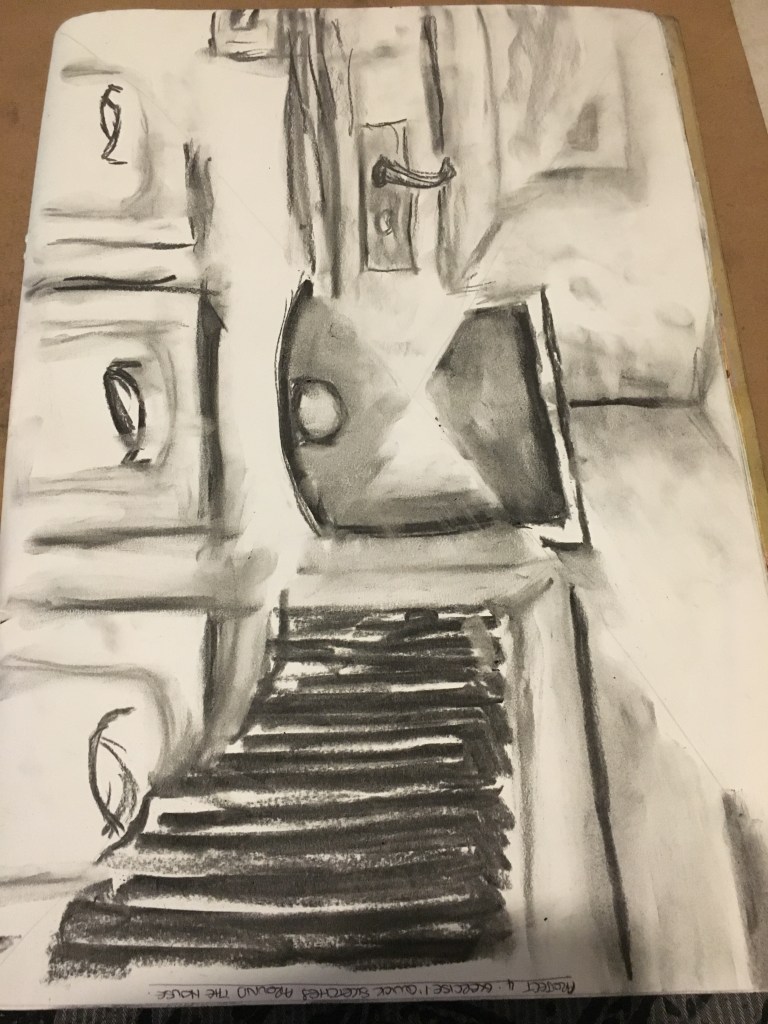
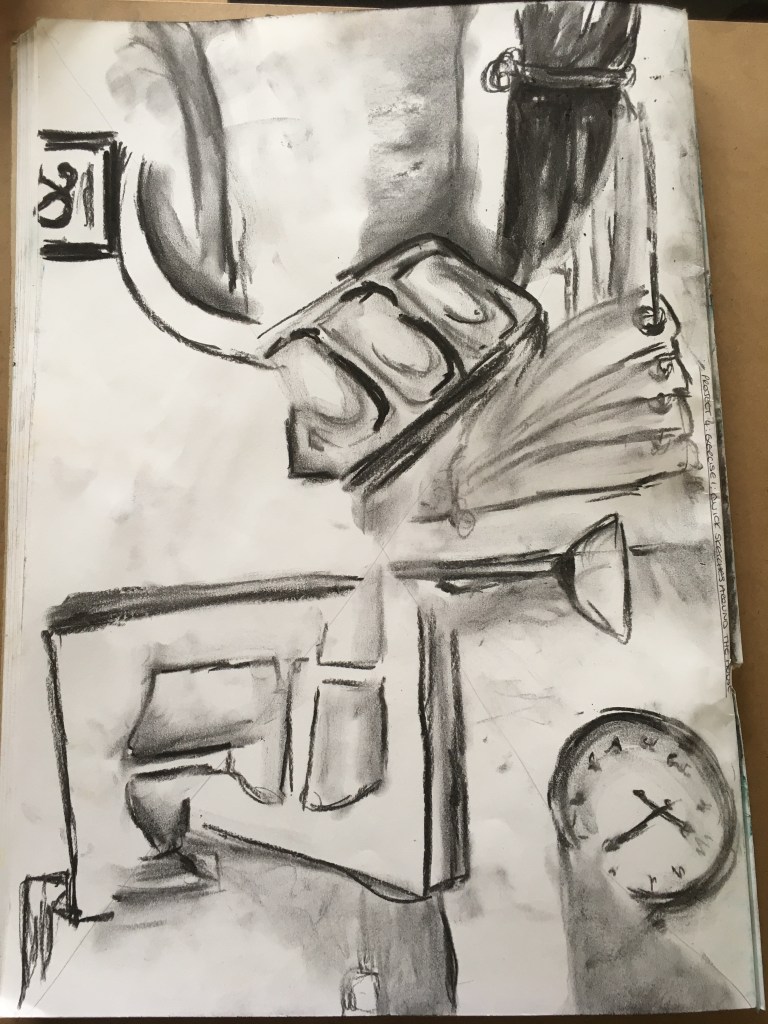
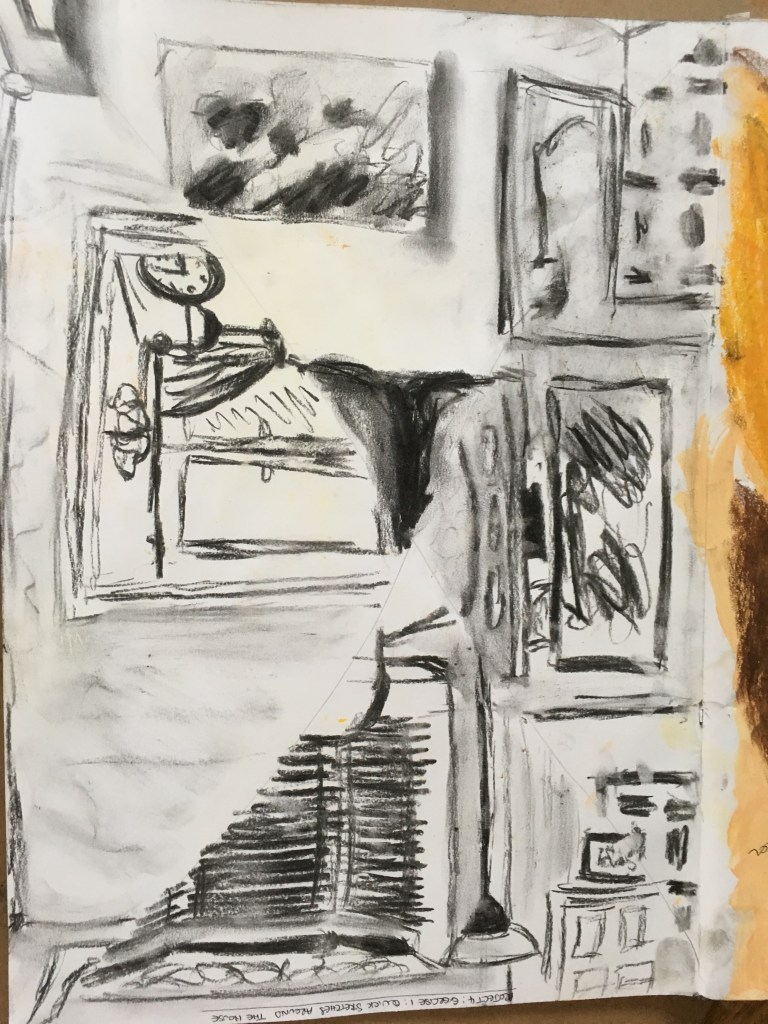
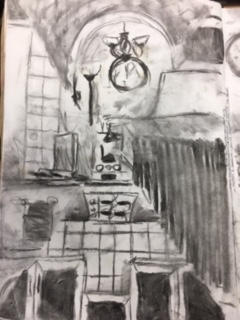
For this exercise, I looked at different areas of my home in several rooms; the living room, dining room, kitchen and my bedroom. My home is very minimalistic and so I do not have anything in the way of ornaments etc. As a result, I presumed my work would be rather boring and with little content.
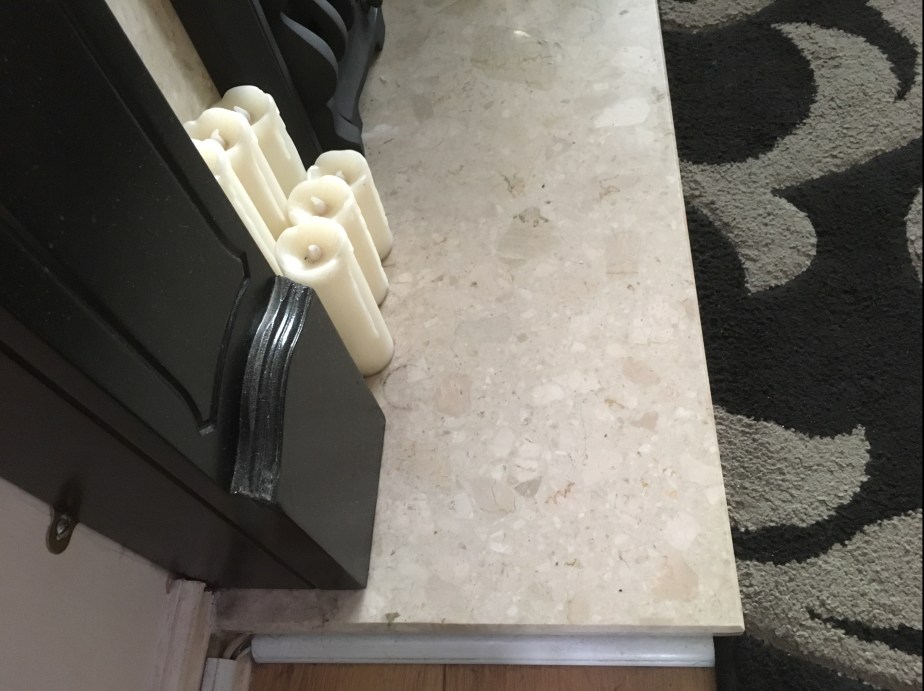
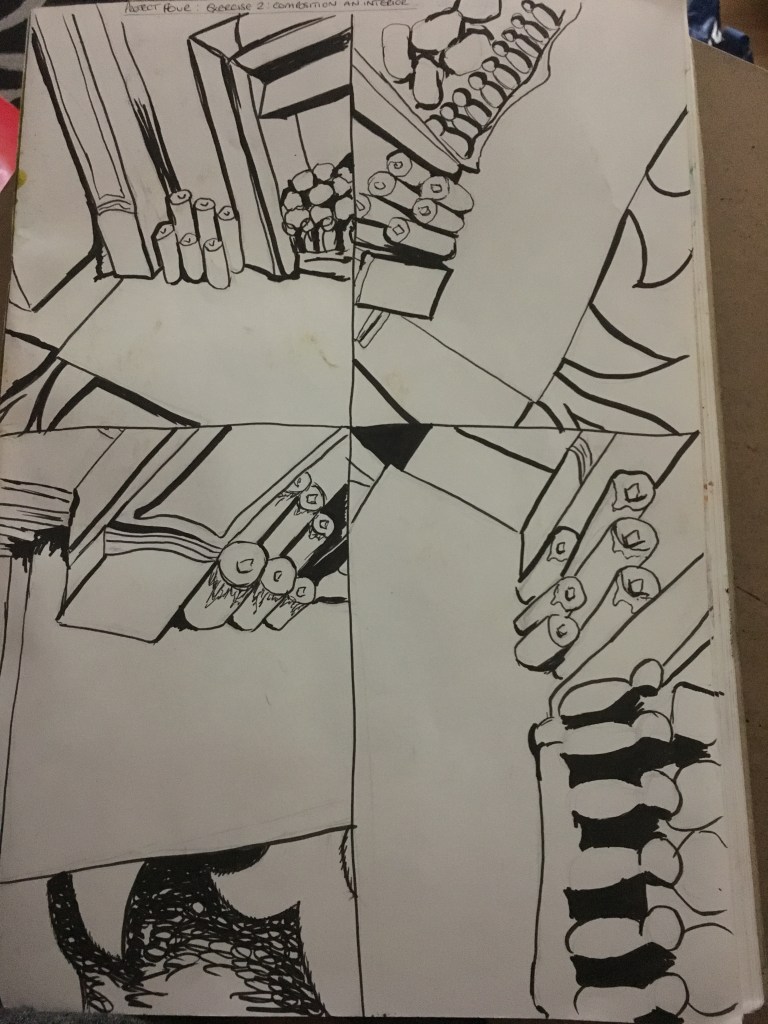
To begin with, I sat myself in the middle of my living room floor and looked up into the corners of my rooms, however, there was not much interesting detail in several of these, so I simply chose to pick out parts which interested me and work on a close-up scale, sometimes closer than others, depending on the subject matter chosen. I also tried to alternate between landscape and portrait. I had divided my sketchbook pages into four triangles for each room and filled each with the subject matter I found most appealing.

Because this was an exercise to work quickly and not to be too concerned with fine lines and details, I decided to use willow charcoal, which I was also able to blend somewhat to create depth and shadows briefly.

Reflection

I was rather pleased with the end results of this exercise and was surprised as to how much I actually enjoyed myself whilst doing it. However, I was rather disheartened by how easily the charcoal would smudge as I used it. Looking back, I think I may have done better having used a Chinese brush pen and ink to create these sketches, however, the blending did come in handy sometimes when I needed to quickly smudge out any errors. I think my favourite room sketchings has to be the kitchen as there is plenty to see and draw, yet without too much fine detail, which is something I tried to avoid when creating these quick sketches. I will definitely try to use this exercise going forward as it really did help me to see things I did not even imagine were visible and taught me some lessons about the home I thought I knew so well and now feel I have never really taken the time to look at fully.

Part Two: Project Three: Exercise Three: Experiment with Mixed Media

For this section, I was asked to use both traditional media (such as ink, pencil crayons and charcoal) together with non-traditional media (such as highlighters and wax crayons) to create a mixed media piece. 

Experimentation

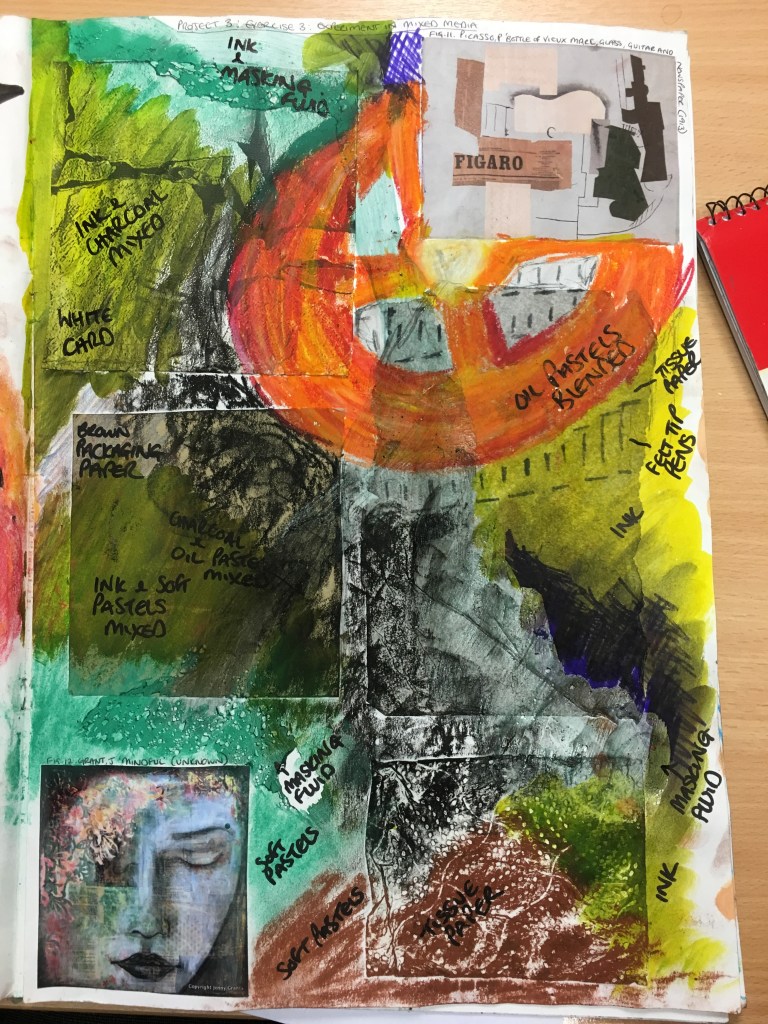
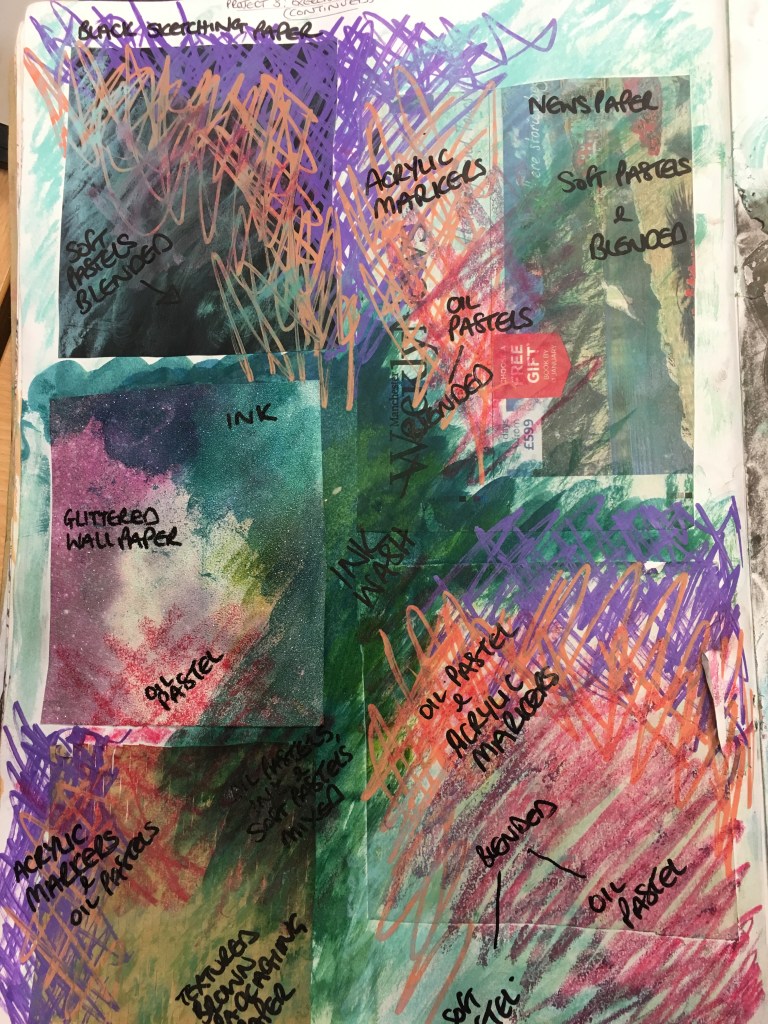
Firstly, I decided to get stuck right in and be messy and experimental with several different media and support. I used two pieces of work by two very different artists (the citation for which can be found by clicking here) as a guide. I decided to use different aspects from each piece to experiment with; the collaged supports from the top image, the wash over the support from the bottom image, but also from a ceiling I came across in a local cafe.

Mixed Media Experiment in Sketchbook Page One

I was really pleased with some of the results in this experiment; I really liked the way the colours intensified or weakened depending on the support.  I really liked the effect on the kitchen roll, especially the charcoal.  I was rather surprised to see how well the charcoal mixed with other media.  I also liked the way the masking fluid rubbed away somewhat on the white card when the ink was applied.


Mixed Media Experiment in Sketchbook Page Two

On the next page, I rather liked the result of the ink and soft pastels merging together and may use this going forward.  Also, the soft pastel and oil pastel merged rather nicely too.

Final Piece

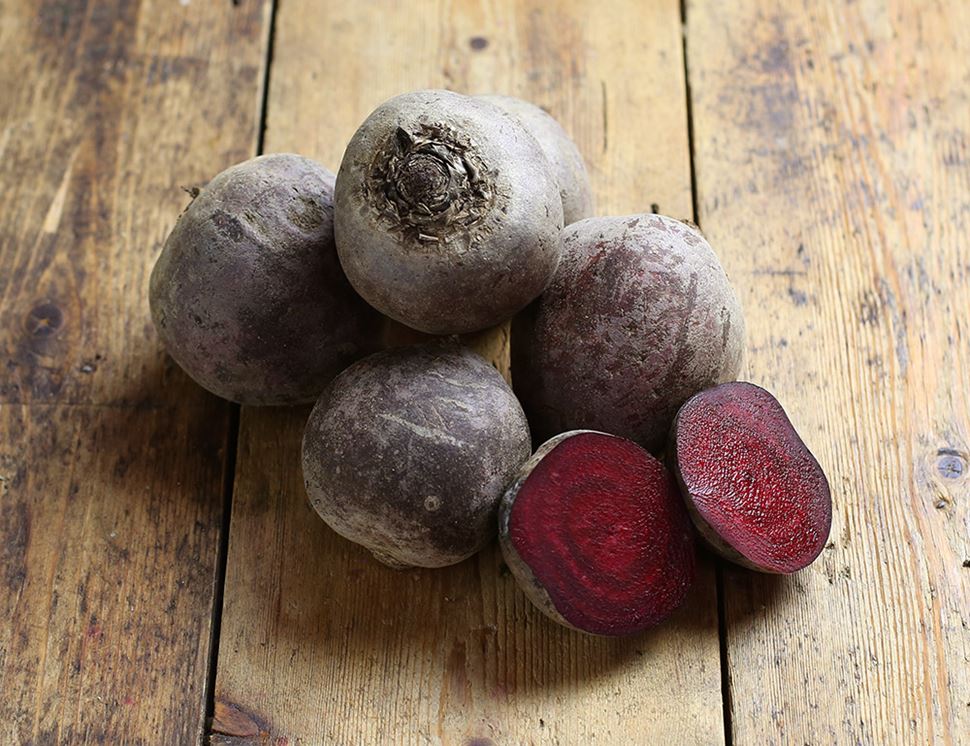
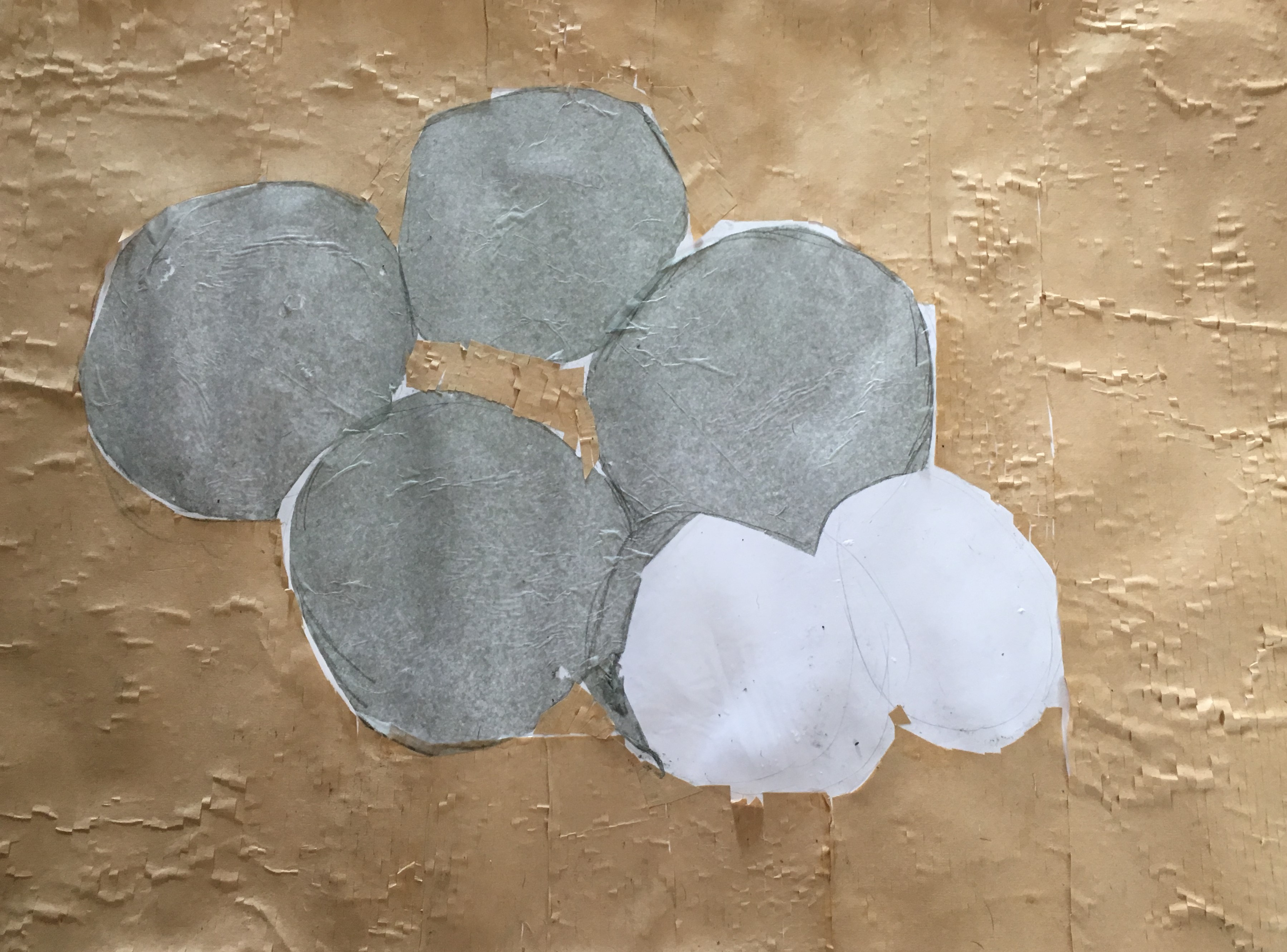
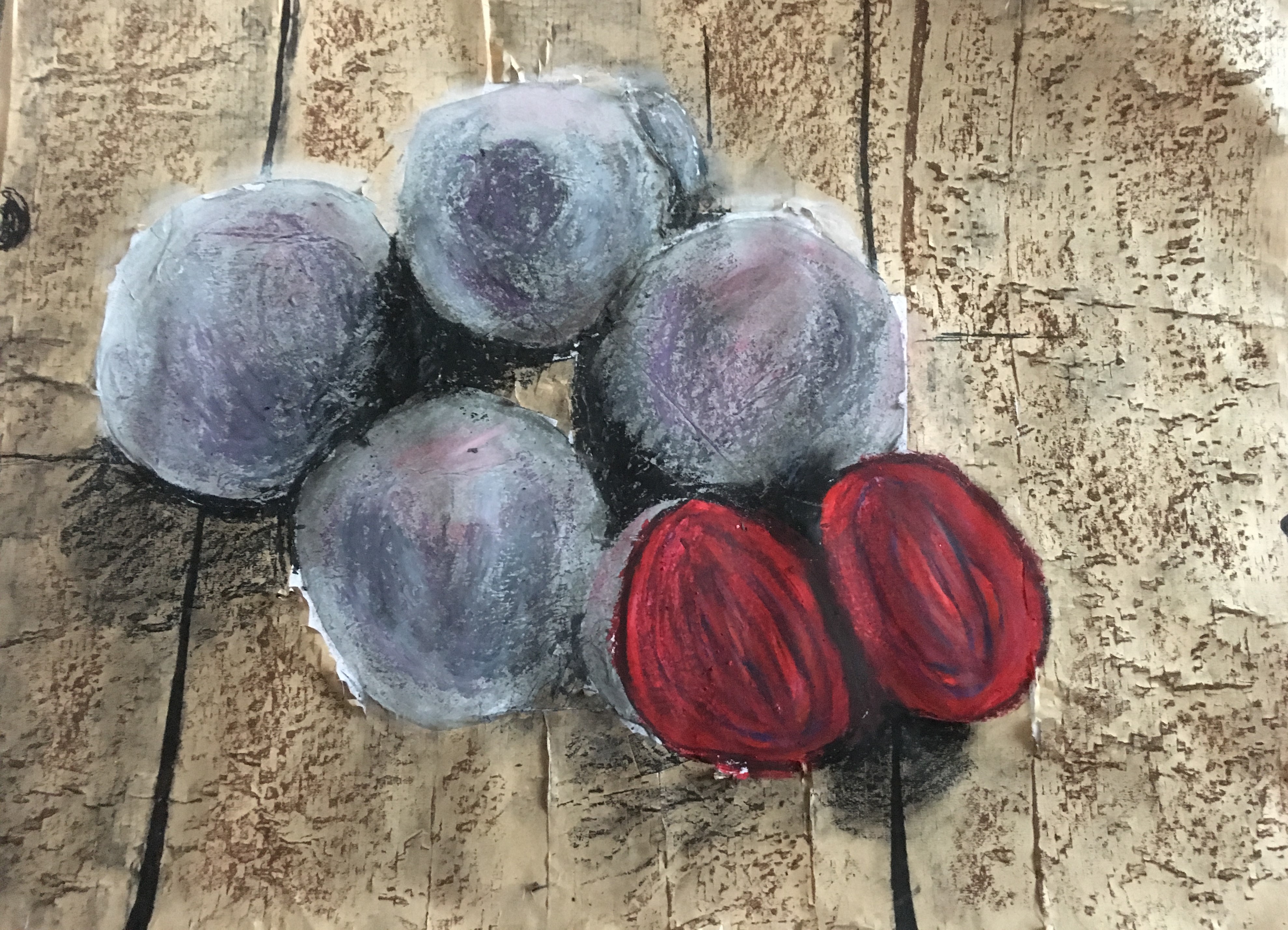
I struggled finding a muse for this part of the course, so decided to search the internet for the best fitting image.  I decided upon a bunch of beetroot on a wooden surface due to the multitude of colours, vibrancies, textures and surfaces.  I chose to work with a sheet of A2 sketchpad paper as a base for my piece.  I then used some textured brown packaging paper to represent the wooden parts of the image.  Next, I chose some grey tissue paper for the skin of the beetroot.  I left the base of the insides of the beetroot as the plain white surface of the paper, but applied a layer of PVA glue.

Once everything had dried, I began working in some of the detail of the objects; I tried to work in the darkest shadows in charcoal.  I then added some of the colours I could see in the beetroot skin with soft pastel, trying to recreate the purples, pinks and blues I could see as well as the grey.  I also tried to bring out the lightest parts of the skins by adding a very light grey and white soft pastel.  I used ink for the flesh of the beetroot, with a layer of wax crayons and oil pastels on top to add in the veins of the layers.  I finished the piece by using oil pastels to add in the deepest shadows again as these became somewhat lost with the layers of soft pastel etc.  I used black marker for the gaps in the wood and a brown conté stick on its side to add texture as if grains in the wood.
Final piece – Beetroot

Reflection

Overall, I am very pleased with this piece and think I have captured the different types of surfaces well. I think the shadow on the bottom middle beetroot could be slightly more prominent as it looks somewhat unreal compared to the others, or maybe I have simply overworked the others? I am not so sure. I also noticed a bit to the left-hand side of the bottom beetroot which is still white which works to spoil the illusion I am trying to recreate. I really enjoyed creating this piece and the methods used are definitely something I would like to consider incorporating for my final piece for this Part, but also in future parts too.

NB: Citation for images used in my sketchbook can be found by clicking here.

List of Illustrations

Fig. 1. Bunched Beetroot, Organic (500g) [photograph] At: https://www.abelandcole.co.uk/bunched-beetroot-organic (Accessed on 29 April 2019)

Part 3: Project 3: Exercise 2: Still Life in Tone Using Colour

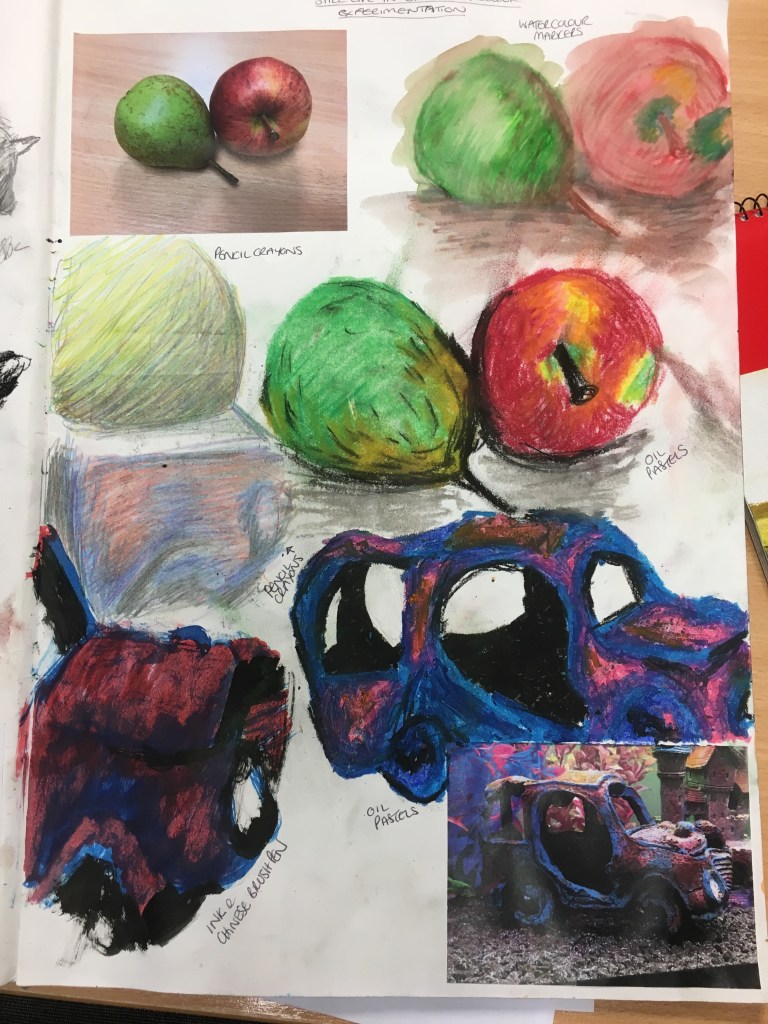
To begin this exercise, I decided to have a play in my sketchbook with two different objects (one natural and one man-made) using several different media before deciding on the ones I would use for my final piece for the exercise.

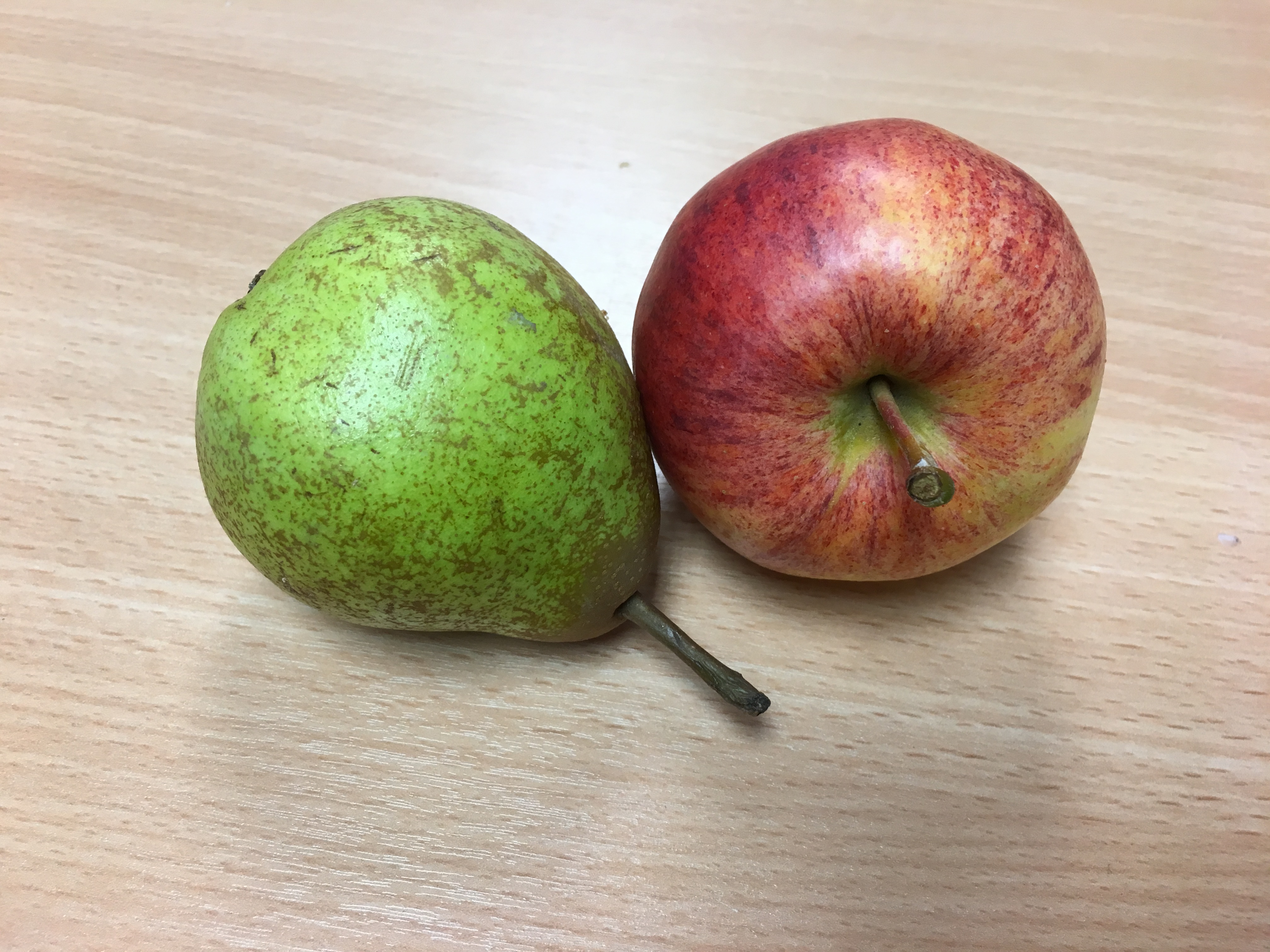
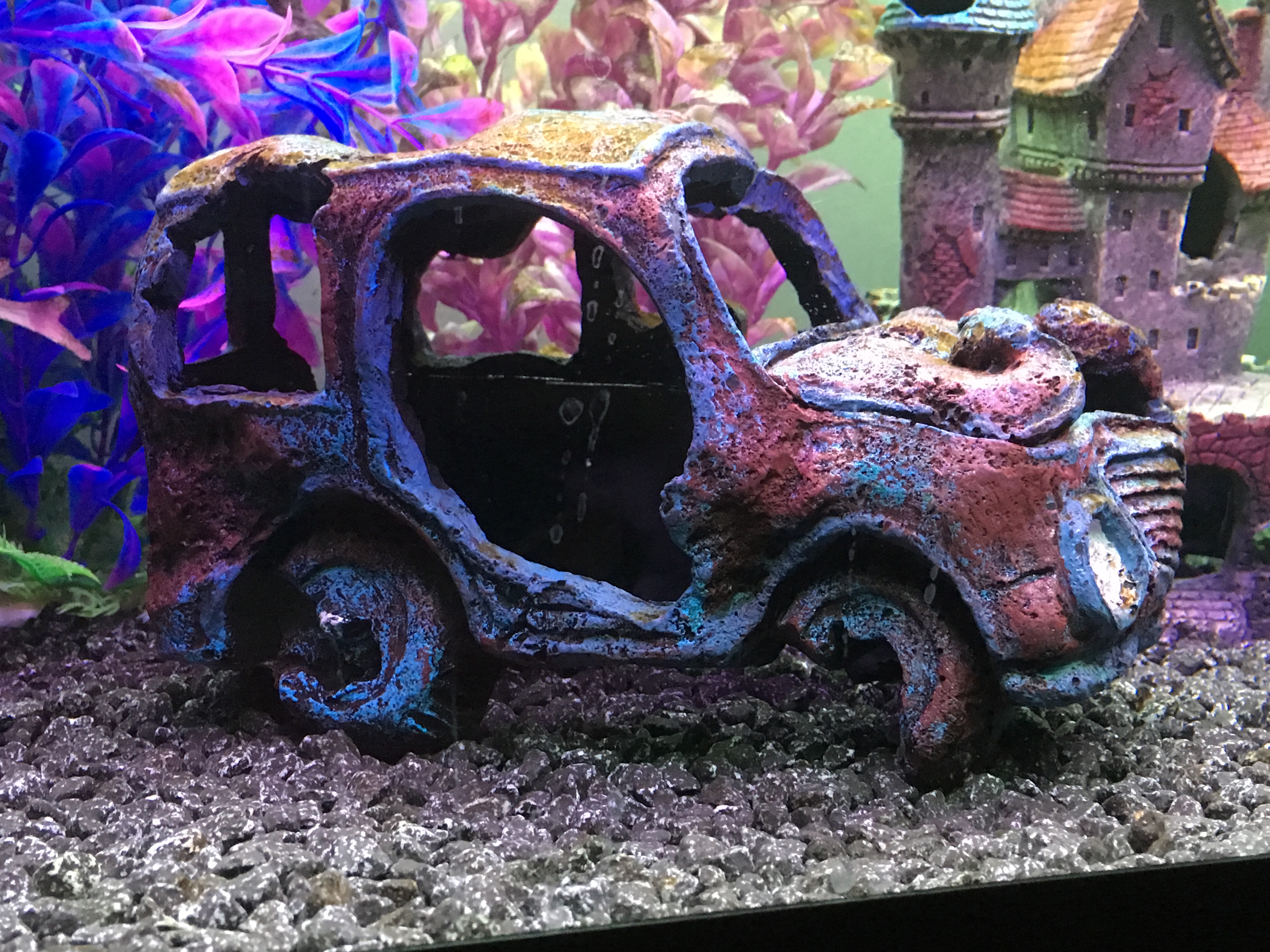
I settled on a picture of an apple and a pear together and also a sunken, ruined car which is in the bottom of our fish tank.  I chose these three objects because the colours were very bold and contrasting, but also allowed for a lot of mixing with my colours.  The colours in the fruit are both very natural (green, yellow, red, pink and a touch of white), whereas the colours to the car are completely different (blue, pink and purple).

Firstly, I quickly drew the pear and apple using watercolour markers and then used a wash of water over the top of them.  I actually really liked the outcome of this and the background created by the bleeding colours.

After this, I used pencil crayons to recreate the pear.  Whilst I liked the colours, I was able to create with this medium, I was a bit disappointed with how round it actually made it, instead of creating the natural misshapen bumps to the object. 

I then used soft pastels to create the pear and apple.  I loved the boldness of the colours in this and the ability to blend them but still retain the smooth but rough-looking texture to the objects.  I ran a little water over the shadow on the table and really liked the effect.

After working in several ways with the apple and pear, I moved on to the sunken car and recreated it quickly using pencil crayons, ink and oil pastels.  The pencils just did not pull through the vibrancy of this object, just as I had found when I used them in my preliminary work for this section.  The ink was fantastic in bringing through the colours, but the oil pastel was, once again, by far my favourite medium to use due to its ability for blending, messiness and vibrancy of colours.

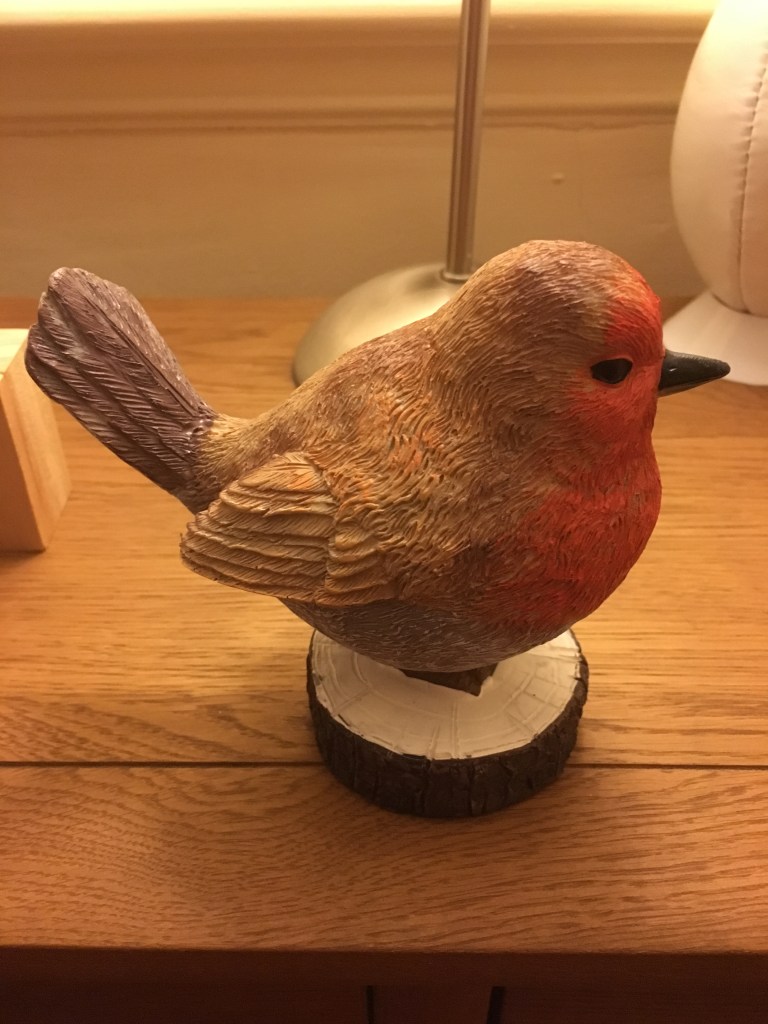
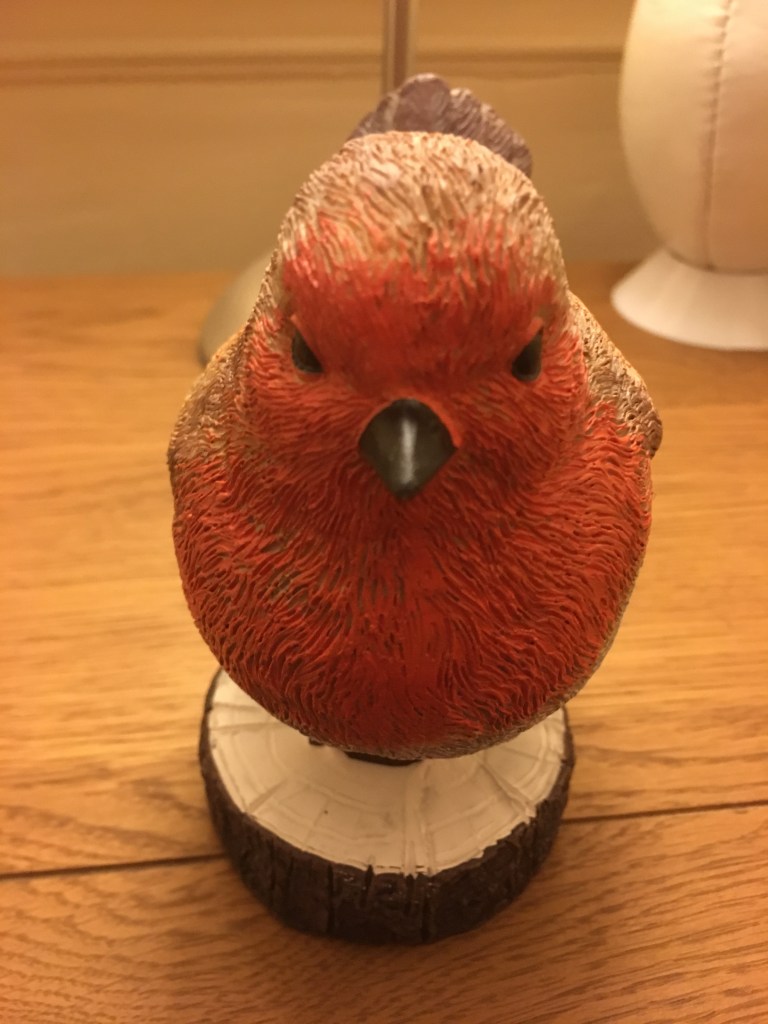
I then carried out one final experiment in my sketchbook, using a statue of a robin on a log, the same object I used as my final piece for Part 2: Project 2: Exercise 1: Still Life using Line.  I used marker, soft pastels and oil pastels.  The markers were great for their intense colours and the detail of the bird’s feathers.  The soft pastels were by far the easiest to blend, but the oil pastels did blend and did still show through some of the markings of the bird’s feathers. 

Final Piece

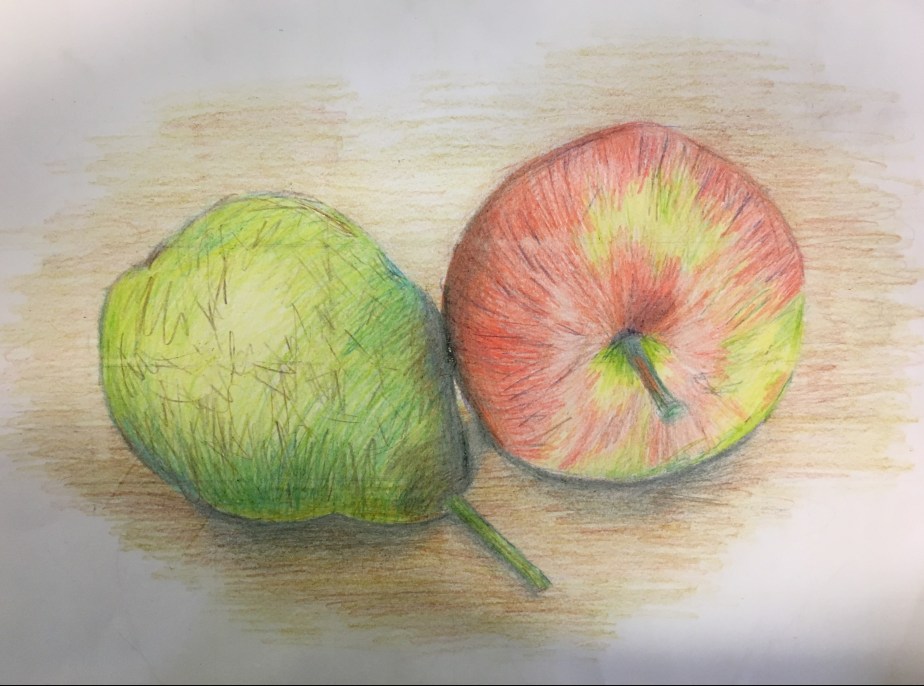
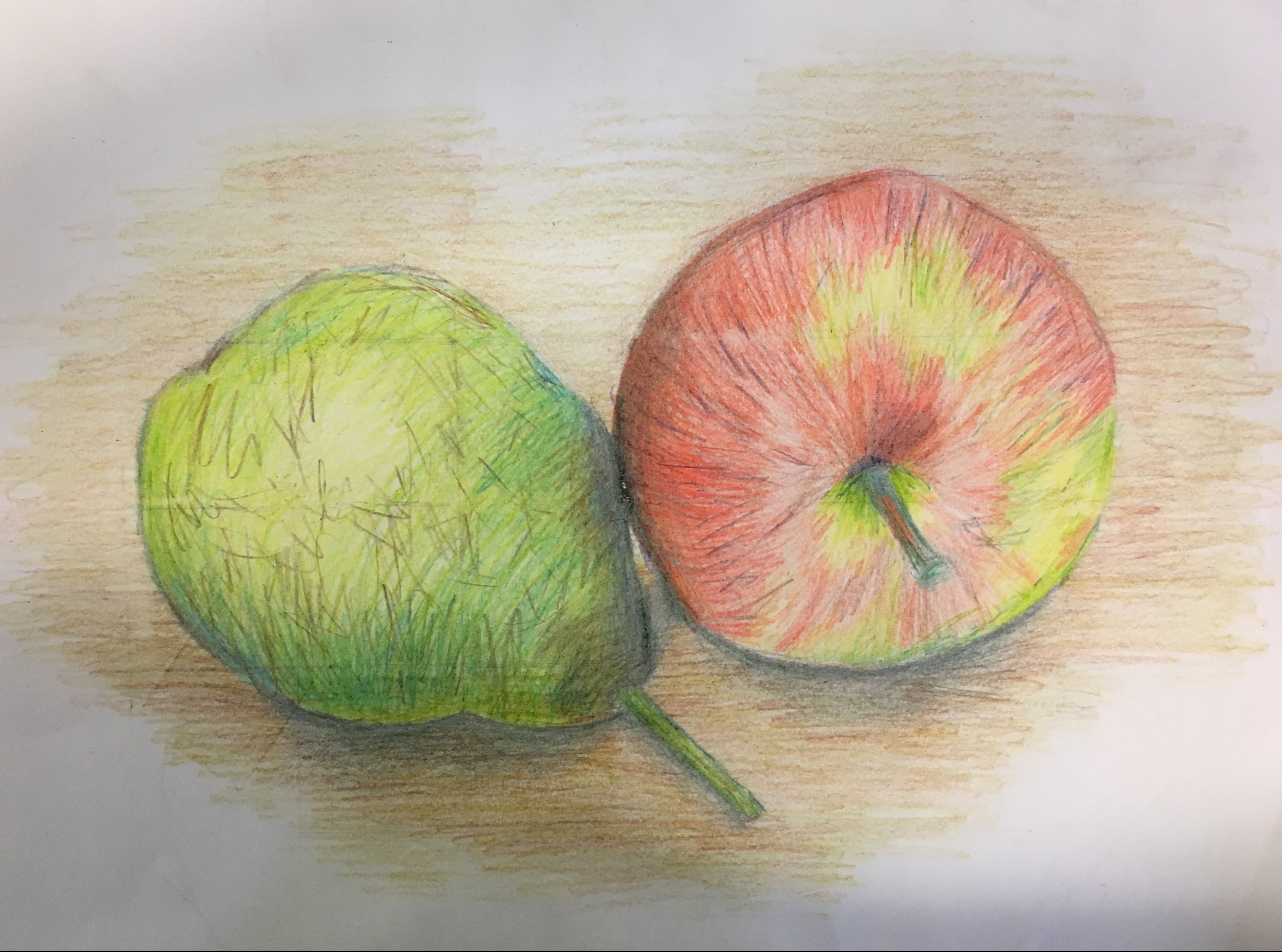
For my final piece I decided to recreate the apple and pear again, but using pencil crayons.  I chose this medium because I liked how they had worked in my preliminary work and, whilst the pear and apple are vibrant in their colours, I think they are also very natural objects, so my work should reflect the naturalness instead of using artificial intense colours. 

Final Piece – Pear and Apple

Taking note of my tutor’s feedback on my scaling issues, I decided to try using a grid to help me measure the items out better. I found this unbelievably helpful and feel the likeness and scale are really good compared to my earlier works. However, I made a rookie error and did not remember to rub out the grid before I began colouring! I tried to remove the grid afterwards and then recolour the patches. I decided not to colour the full background of the table the fruit was resting on which, again, is something new for me as I am trying not to create ‘pretty pictures’ so to speak.

Reflection

Whilst I really do like the end result and see it as somewhat of an achievement for myself as it is nowhere as bold as my usual pieces, I think I still managed to overwork the medium because there are sections of the page where I have pressed too hard trying to urge the boldness of the shadows through (where the apple and pear meet).  Also, I am somewhat disappointed in myself for not noticing something so simple as the grid still being in place before colouring.  I will put this down to trial and error and will try to learn from it going forward!  I also really like the shadow on the table because I put the black down first and then went over it with brown and a very dark red which gives the shadow depth and warmth and adds weight to the objects.  I was also rather surprised by the fact that yellows and blues on the green for the pear really worked, as did yellow, orange, pink and purple for the red of the apple.

Questions

Below are the questions in my course textbook, which I have decided to answer at the bottom of both exercises, as opposed to both together:

What aspects of each drawing were successful, and what did you have problems with?
The parts of this exercise I thought successful were the mixture of colours to create a solid three dimensional finished object. The problems I encountered in this piece was definitely my error in not removing the grid prior to colouring in the piece. This is something I will have to consider going forward – perhaps I can use water-soluble colours to draw the grid to make it easier to cover over and reduce the need to erase the lines.

Did you manage to get a sense of depth in your drawings?
What elements of the drawings and still life groupings helped to create that sense?

The depth in this piece was achieved by the mixing of the colours. I was able to include shadow in the correct places and use the contrast between the lighter and darker colours to show the natural ‘line’ found in real life as opposed to the cartoon-like outline of my previous piece. The movement of the colouring and the placement of the shadows helps to shape the objects into understandable information for the viewer to process.

What difficulties were created by being restricted to line or tone?

On reflection, I think I have not stuck to using block tone and have, again, focussed on it looking like a picture. I think if the image was purely blocks of different tone, there would be no real depth, direction of the object’s movement or clarity as to the object’s identity to be found in the piece due to the lack of line. I think I have inadvertently realised that the two generally must go hand in hand!

How did using colour affect your working method?

Using colour in this piece as opposed to just line, I found I was a lot freer with my movements and had the ability to lift or darken the colours in the piece to suit, assisting to create the sense of depth and direction of the shape’s movements to suit my will. I found it much easier to portray shadows with colour than with just line, however, I think I could use cross-hatched lines or – if considering the methods used on a map or in an illusion for instance – distance between the lines to assist in shadow and depth formation, for example I could put the lines closer together, they would appear darker than those which were spaced further apart, thus tricking the viewer’s mind into seeing something I wish them to see.